

 Written by

The true cost of deferred maintenance and stripped financial controls was on full display during the June 22 Marion City Council meeting. Forced to navigate the severe constraints inherited from years of institutional neglect, the Collins Administration and city council members moved with urgency. Operating in a state of legislative triage, the council unanimously suspended the standard three-reading rule across the board, fast-tracking every ordinance and resolution on the docket to pass on its first reading.
From making unpopular decisions on failing storm sirens and scrambling to secure outside grant money, to demanding transparency over deeply compromised IT systems, the night’s proceedings highlighted the stark reality of governing in the shadow of Marion’s “Silent Sabotage.”
This avoidable rot, introduced by the former Schertzer Administration has ultimately landed Marion in a “Fiscal Caution” status by the Ohio Auditor of State.
The Financial Reality of Failing Storm Sirens
The contentious debate over the city’s aging outdoor early-warning storm sirens highlights a series of difficult “growing pains” the Collins Administration is currently navigating. These unpopular, triage-style decisions are the direct fallout of what our multi-year investigation identifies as the “Silent Sabotage” of Marion. Decades of systemic neglect, technological hygene issues, and stripped legally required financial fail-safes have left current leadership scrambling to modernize critical municipal infrastructure with severely depleted resources.
Following recent public scrutiny regarding their operational status, the administration confirmed that the current siren system is largely obsolete. Replacement parts can no longer be sourced, and a full system upgrade for the five sirens carries an estimated price tag of $240,000.
While federal grant money through FEMA was available to offset this cost, the city ultimately chose not to apply. The administration explained that the grant required a 25% local match, meaning Marion would have had to provide $60,000 out of pocket. City officials stated that this matching fund requirement simply was not allocated in the 2026 budget.
Furthermore, with the city only able to provide about $5,000 in in-kind labor, and still awaiting the state auditor’s response regarding its ongoing financial recovery plan, the expenditure was deemed unfeasible.

Moving forward, the administration is heavily leaning on the Hyper-Reach system, an emergency weather notification service that sends alerts directly to cell phones and landlines. The Mayor emphasized that outdoor sirens were never designed to be heard indoors and argued that cellular alerts represent the necessary next generation of public safety technology.
However, this transition met immediate pushback. Several council members and residents argued that abandoning the sirens leaves vulnerable populations—particularly the elderly and those without smartphones—at severe risk during severe weather events. When a resident questioned whether funds from the recently passed fire department levy could be utilized to upgrade the sirens, the administration quickly shut the idea down. Chief Deem and the Law Director clarified that while boilerplate legal language on the ballot might technically allow for broader usage, the levy was explicitly sold to taxpayers as a dedicated fund for building new fire stations and replacing vehicles. Diverting those funds to emergency management infrastructure would violate the trust and established promises made to voters.
Ultimately, these abrupt programmatic pivots—from relying on legacy hardware to pushing digital alerts—represent the unavoidable growing pains of an administration attempting to course-correct after years of institutional neglect. The inability to seamlessly upgrade or even maintain these life-saving alert systems is a stark, real-world consequence of Marion’s compromised technological foundations and budgetary oversight. Because proper IT lifecycle management and financial controls were previously ignored, current officials are forced into making unpopular decisions just to keep basic communications functioning.
Withheld Records and the Compromised New World System
This systemic sabotage extends far beyond physical infrastructure; it is deeply embedded in the city’s digital and financial networks. This week, Marion Watch spoke with IT Oversight Committee Chairman and Marion City Councilman Ralph Smith regarding the continued failure of Marion IT and the City Auditor’s staff to fulfill long-standing public records requests. Since December 2025, city personnel have been either unable or unwilling to provide historical user access permission logs, documentation on unused or misconfigured New World software modules, and other essential system data which can be used by experts within the Marion Watch team and wider network to assist in exposing these catastrophic failures to the public, and assist the administration in drafting IT industry standard practices to ensure that it never happens again.

The glaring absence of a standard trouble-ticketing and change-control system within the city’s IT infrastructure unnecessarily complicates this process; a proper framework would allow historical user permissions to be retrieved almost instantaneously.
However, even without a formal change-control environment, there are well-established administrative methods to extract this data, making the ongoing delay inexcusable.
Councilman Smith, along with IT and financial advisors and many within the Collins administration, believes this is an “intentional delay” designed to suppress the information these logs would expose to the public. Marion Watch fully concurs with this assessment and is currently exploring legal mechanisms to force the release of this information—a move heavily encouraged by Smith and others.
The reluctance to release these records is particularly alarming given what is already known about the system’s historical security gaps. Marion Watch is aware of widespread, inappropriate access rights previously granted within the New World software. Multiple current and former city administrators and staff members have independently verified that former city council members and clerks—alongside other individuals with no legitimate business need—held active, and in some cases highly elevated, system permissions.
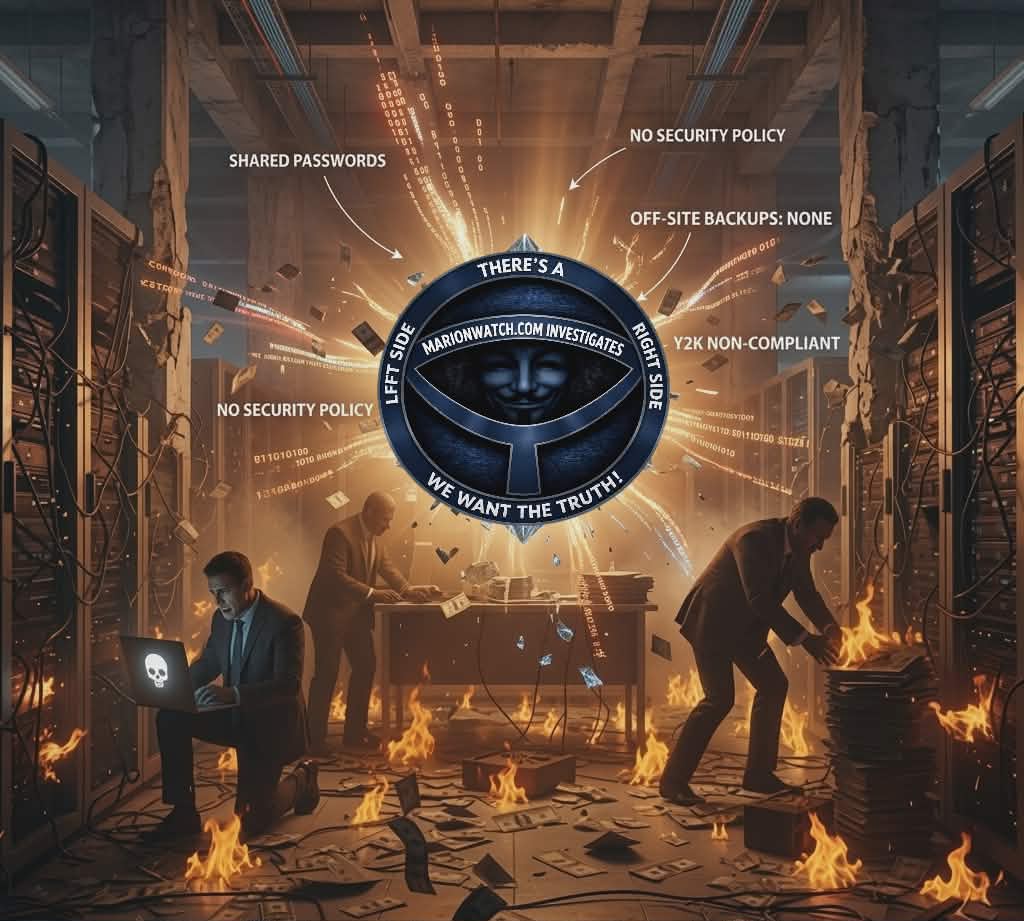
This sprawling access was only curtailed when Mayor Collins intervened to strip these specific privileges after observing concerning patterns. Traces of this inappropriate access can even be found documented within past City Council meeting summaries, which paint a picture of collusion and coordinated requests reportedly orchestrated by members of the former administration and their citizen operatives.
Smith has repeatedly stated on the record that this lack of transparency is highly concerning, arguing it is highly improbable that the Auditor’s office and IT personnel are genuinely unaware of which software modules were utilized. Marion Watch agrees: if city officials truly do not know which modules were absent, misconfigured, or improperly accessed by unauthorized users, it reinforces the reality that any data currently generated by the New World financial system remains fundamentally compromised. Given the catastrophic failures in both governance and IT controls, industry standards dictate that all data originating from this system must be considered compromised until a full forensic IT audit is completed.
This week Marion Watch asked Smith about the progress of ensuring accountability for these severe IT and financial issues Smith simply stated “I hope they do something soon, people are getting anxious”.
For verifiable documentation and deeper context regarding how these municipal controls were compromised, and the reason Smith, Marion Watch, many other administrators, and outside experts are demanding federal oversight and a full forensic IT audit read our full Silent Sabotage investigation.

The Flock Surveillance
Surveillance Infrastructure and the Flock Camera System
The council addressed questions surrounding the area’s surveillance infrastructure, specifically the ongoing use of automated Flock license plate reader cameras. Following recent reports that Marion County had been awarded $70,000 to continue the program, the administration clarified whether the city would face financial exposure for the remaining balance to fund the system for the full year.
Chief of Police Jay McDonald explicitly confirmed on the record that there are zero city dollars going to the Flock program. The Marion County Sheriff’s Office was able to negotiate a price difference independently, ensuring the grant covers the program without drawing from municipal funds. Furthermore, city council members have advised Marion Watch that not one cent of city taxpayer money will be spent on the Flock system.
LEVERAGING OUTSIDE GRANTS FOR CITY SERVICES
To navigate the city’s tight financial constraints, the council utilized first reading votes to secure several critical grant funding packages, ensuring local youth programs and public safety initiatives remain funded without heavily burdening the general fund.
The council passed Ordinance 2026 57 to accept a private grant donation from Poet Bioprocessing. This funding will be directed to the YMCA Rec Center to provide youth scholarships for the remainder of the fiscal year. The center has become a vital community hub, serving up to 200 children a month and providing over 486 free meals since late April. Councilman Rollins, who serves as the plant manager at Poet Bioprocessing, formally abstained from the vote.
Infrastructure at local parks is also slated for an upgrade. Through the unanimous emergency passage of Ordinance 2026 58, the Safety Service Director is now authorized to apply for an Ohio Department of Natural Resources Nature Works grant. If awarded, these specific funds are earmarked to replace the aging playground equipment at Rotary Park.
On the law enforcement front, the council authorized an application for a federal COPS hiring grant through the United States Department of Justice. Notably, the city is applying for a cost share waiver. If the Department of Justice approves the waiver based on Marion’s financial status, it would completely eliminate the standard 25 percent local matching requirement, allowing the city to bolster its police force without upfront municipal costs.
MUNICIPAL OVERSIGHT AND ELECTION PREPARATION
The council also took steps to finalize the November ballot and maintain strict oversight over controversial municipal departments. Following a clarification request from the Board of Elections, the council finalized the ballot language for the November 3, 2026, general election. Voters will soon decide whether to fundamentally change the structure of the city’s legislative body by shifting city council and council president terms from their current two year limits to four year staggered terms.
The Commercial Building Code Department also saw action, receiving an additional appropriation of over 10,000 dollars to sustain operations through the end of the year. However, the approval came with a stern reminder of the council’s oversight responsibilities. Multiple council members pointed out that the department remains under heavy scrutiny following intense debates over its efficacy last year. The department is scheduled to face a mandatory, comprehensive operational review this coming fall to prove it is functioning effectively and transparently for the citizens of Marion.
In a point of clarification regarding surveillance infrastructure, Chief of Police Jay McDonald addressed recent reports that the county had received 70,000 dollars to continue the Flock license plate reader program. Chief McDonald explicitly confirmed on the record that absolutely no city tax dollars are being used to fund the camera system, noting that the Sheriff’s Office successfully negotiated the financial terms independently.
In separate logistical news, the administration formally announced that the city’s current municipal recycling program will end on July 5, transitioning to a new drive through drop off service at the city garage starting July 6.