


 Written by
 The Quiet War: Inside the Escalating Espionage Crisis Between the United States and Israel
The alliance between the United States and Israel has long been defined in the public imagination as an unbreakable bond, forged in shared democratic values, mutual geopolitical interests in the Middle East, and deeply intertwined defense architectures. Politicians in Washington frequently speak of the relationship in absolute terms, emphasizing total cooperation and shared destinies. However, behind the public handshakes, the joint military declarations, and the unified diplomatic fronts lies a shadow war of espionage, surveillance, and counterintelligence that has recently reached a historic boiling point.
In the summer of 2026, the Pentagon’s Defense Intelligence Agency took the extraordinary and highly sensitive step of elevating Israel’s counterintelligence threat designation to “critical”—the highest possible level in its security system. This unprecedented internal designation, which leaked to the press in early June, shattered the long-held illusion of total, unvarnished trust between the two allied nations. The assessment concluded that Israel’s capacity and willingness to conduct human and technical espionage against the United States had crossed a dangerous threshold, driven largely by intense geopolitical disagreements over the handling of the ongoing war with Iran and the future of the Middle East.
This investigative report delves into the mechanics, the high-profile targets, and the profound geopolitical implications of Israel’s escalated espionage campaign against the Trump administration. By examining brazen physical security breaches, the targeted surveillance of top diplomatic envoys, the deployment of sophisticated cyber-surveillance tools like Pegasus, and the historical precedents of mutual distrust, this investigation uncovers a highly nuanced and troubling reality. The United States and Israel are simultaneously fighting side-by-side in a volatile region while aggressively treating each other as hostile intelligence targets in the dark.
The Pentagon Sounds the Alarm: A “Critical” Threat Designation
In the early weeks of June 2026, an internal seven-page document circulated within the Pentagon’s Defense Intelligence Agency, complete with detailed analytical charts and forensic evidence.
Its conclusion was stark and undeniable: the counterintelligence risk posed by Israeli intelligence agencies had reached a “critical” level.
Historically, United States intelligence agencies have carefully compartmentalized espionage concerns, treating them as a separate issue from broader diplomatic relationships. It is an open secret in the capital that allied nations routinely collect intelligence on one another. Friendly nations constantly probe for diplomatic advantages. However, the Defense Intelligence Agency assessment made it explicitly clear that recent Israeli operations had far exceeded the acceptable boundaries of what is considered “friendly” or routine espionage. One senior United States official, speaking on the condition of anonymity, characterized the aggressiveness of Israel’s intelligence gathering during President Donald Trump’s second term as entirely “unhinged”.
To fully grasp the gravity of this shift, one must understand the standard counterintelligence matrix utilized by the United States Department of Defense. The elevation of an ally from a “high” threat to a “critical” threat signifies a profound shift in risk calculus. It means the intelligence community believes a foreign entity not only possesses the advanced capability to penetrate highly sensitive American networks and physical spaces, but is actively, aggressively, and successfully doing so with alarming frequency.
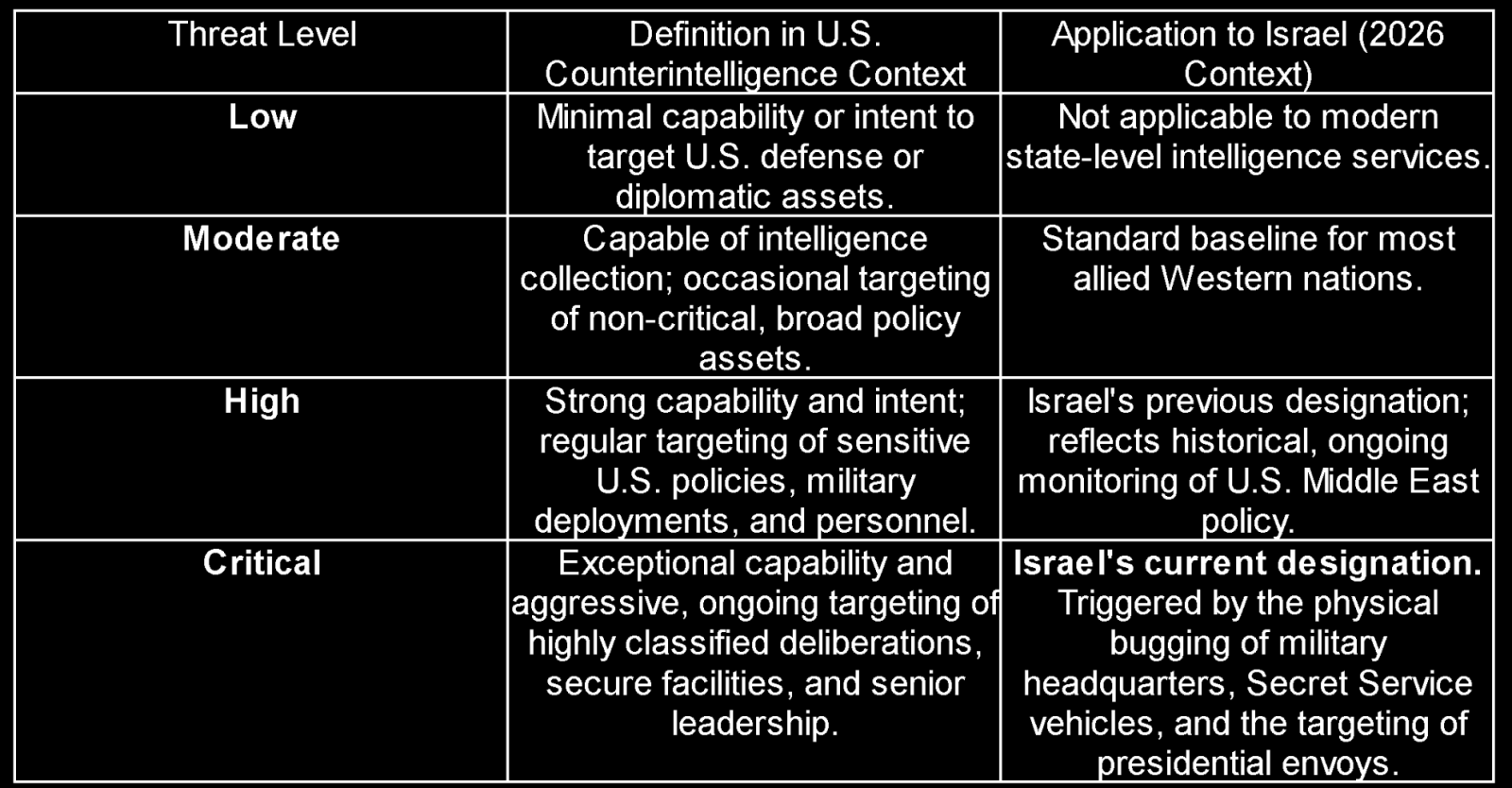
The timing of this leaked designation highlights a profound institutional contradiction within the United States government. At the exact moment the Pentagon was raising internal alarms about Israeli spies compromising American security, lawmakers on Capitol Hill were actively debating a legislative provision that would grant Israel unprecedented access to American military secrets. Section 224 of the Fiscal Year 2027 National Defense Authorization Act is designed to significantly deepen defense technology cooperation and industrial integration between the United States and Israel over the next decade, intertwining joint research, weapons co-production, and licensing agreements.
Pro-Israel lobbying groups, including AIPAC, released public statements heavily praising the House Armed Services Committee for including Section 224 in the defense bill. This juxtaposition generates a vital realization about how Washington operates: the national security apparatus is fundamentally fractured in its approach to Israel. The defense and intelligence communities view the Israeli state as a potent counterintelligence threat requiring severe operational security measures, while the political and legislative branches continue to treat Israel as an unimpeachable partner worthy of unfettered, deepening technological access.
Unsurprisingly, official diplomatic channels vehemently denied the rift. The Israeli Embassy in Washington released a public statement calling the espionage claims “completely false,” asserting that Israel’s intelligence collection efforts are aimed strictly at its enemies, not its allies, and suggesting the leaks were politically motivated. A White House official echoed this defensive posture, attempting to discredit the initial NBC News report that broke the story by claiming it was sourced to individuals lacking direct knowledge of current operations. However, the highly detailed, persistent leaks emanating from the Pentagon suggest a deliberate effort by the United States intelligence community to force the White House to acknowledge the severity of the security breaches.
The Geopolitical Powder Keg: The 2026 War with Iran
To understand why Israeli intelligence would risk its most vital strategic alliance by engaging in “unhinged” espionage against the United States, one must examine the deep geopolitical chasm that opened between the two nations regarding the Islamic Republic of Iran. The espionage is not occurring in a vacuum; it is a direct, desperate consequence of an existential policy dispute that threatens the stability of the entire Middle East.
On February 28, 2026, the United States and Israel launched joint military strikes against Iran, a culmination of rising regional tensions that effectively triggered open warfare. During this period of intense combat, the United States suffered significant military setbacks, including the crash of an Army Apache helicopter near the Strait of Hormuz—the first such loss in the conflict. The military engagement also took a severe toll on American logistics. A report by the Center for Strategic and International Studies warned that the ongoing conflict with Iran was severely draining critical United States missile stockpiles, noting that defense contractors would need a minimum of three years to rebuild these depleted inventories.
Faced with mounting costs, volatile oil prices surging toward ninety-five dollars a barrel due to retaliatory strikes, and a desire to avoid a permanent quagmire, the strategic priorities of Washington and Tel Aviv diverged sharply. The Trump administration’s objective was to use the military strikes purely as leverage. By weakening Iran’s military capabilities, the United States sought to force Tehran to the negotiating table to secure a favorable, economically beneficial diplomatic deal that would cap Iran’s nuclear program and ease regional hostilities. President Trump prioritized securing a diplomatic victory through negotiation, leading to a tentative ceasefire that took effect on April 7, 2026.
Conversely, the government of Israeli Prime Minister Benjamin Netanyahu viewed the war not as a pathway to a diplomatic deal, but as a historic, closing window of opportunity to fundamentally degrade Tehran’s military capabilities, destroy its nuclear infrastructure, and potentially collapse the Iranian leadership entirely. Netanyahu publicly and privately expressed extreme skepticism of the ceasefire, continuously urging the United States to abandon the talks and resume heavy military strikes.
This strategic divergence resulted in a total breakdown of allied communication. The Trump administration, fully aware that Israel would vehemently oppose any diplomatic concessions made to Iran, began to rigidly compartmentalize its negotiating strategy. Israeli security officials reported to the press in early June 2026 that they had been “completely” pushed aside by the Trump administration, to the point where they were barely involved in the ceasefire discussions. Lacking direct information from their closest ally, Israel felt existentially threatened by the prospect of a United States-Iran deal being brokered in the dark. They were forced to gather what information they could about the Washington-Tehran contacts through backchannels with regional leaders and diplomats.
The interpersonal relationship between the two leaders further fueled this paranoia. The alliance has been severely strained by personal friction, peaking when President Trump reportedly unleashed a profanity-laced tirade at Netanyahu over the phone. Trump called the Israeli premier “crazy” for threatening to bomb the Lebanese capital of Beirut, an action Trump feared would instantly derail his fragile talks with Tehran.
The rift deepened as Trump publicly cast doubt on Netanyahu’s political future, wondering aloud if “Bibi” even wanted to continue his career, prompting the Likud Party to release a defensive statement insisting he would run again.
Trump further escalated the pressure by attempting to force a regional realignment. He mandatorily asked countries involved in negotiations—including Saudi Arabia, the United Arab Emirates, Qatar, Pakistan, Turkey, Egypt, Jordan, and Bahrain—to expand the Abraham Accords and normalize ties with Israel if Iran signed a deal with the United States. While Pakistan firmly rebuffed the demand and others remained silent, Trump made his ultimate stance clear, stating that Netanyahu would have “no choice” but to accept whatever deal the United States reached with Iran.
This dynamic illuminates the core driver of the espionage crisis. The spying was a mechanism of state survival from the Israeli perspective. Denied access through the front door of diplomatic intelligence sharing, Israel broke through the windows. The objective was to ascertain the true intentions of the Trump administration—to find out exactly what concessions American envoys were preparing to offer Iran, and whether Trump intended to abandon the military option entirely.
Domestic Chaos and the Intelligence Vulnerability
The vulnerability of the United States intelligence apparatus was further compounded by a deeply chaotic domestic environment in the summer of 2026. Counterintelligence relies on institutional stability, but the Trump administration found itself fighting battles on multiple fronts, both abroad and at home.
In a highly controversial move, President Trump assigned housing chief Bill Pulte to serve as the acting director of national intelligence. This selection, made over the vocal objections of his own advisers, raised massive alarms among Senate Republicans and intelligence community critics. Pulte, viewed primarily as a political loyalist with absolutely no background in the complex world of national intelligence, was suddenly placed in charge of navigating the most severe allied espionage crisis in modern history.
Simultaneously, the administration faced severe legislative pushback. In a rare bipartisan rebuke of the president’s handling of the conflict, the House of Representatives voted 215-208 to pass an Iran War Powers resolution introduced by Representative Gregory Meeks. This measure aimed to halt United States military operations against Iran without explicit congressional authorization, legally restricting Trump’s ability to act. In the Senate, Secretary of State Marco Rubio faced harsh criticism from Democrats like Senator Chris Van Hollen, who condemned the strikes and argued the president had entered the war solely on Israel’s behalf. Meanwhile, hawkish Republicans attacked the administration’s emerging diplomatic terms, warning that easing pressure on Tehran and reopening the Strait of Hormuz was a repeat of the Obama-era nuclear deal and not “America First”.
The domestic security landscape was equally fractured. The nation was rocked by a chaotic shootout near a community festival in Toledo, Ohio, that left twelve people wounded, alongside a terrifying incident where the Secret Service fatally shot a gunman who opened fire at a White House checkpoint, forcing reporters to shelter in the press briefing room. Tensions over the Middle East spilled into the streets, with a horrific antisemitic subway attack in New York, massive protests by Jewish groups outside the New York Times headquarters and the residence of New York Mayor Zohran Mamdani, and disturbing pro-Palestinian rallies in Canada where effigies of Trump, Netanyahu, and Israeli minister Itamar Ben-Gvir were hung.
In this environment of extreme distraction, where military stockpiles were depleted, the intelligence community was led by an inexperienced loyalist, and the nation was consumed by domestic unrest, the environment was perfectly primed for a sophisticated foreign intelligence service to operate with near impunity.
Targets in the Crosshairs: Witkoff, Colby, and DiMino
Intelligence collection is inherently objective-driven. The Defense Intelligence Agency assessment, corroborated by extensive reporting from The New York Times, revealed that Israeli intelligence apparatuses—including the Mossad, the Shin Bet domestic security agency, and military intelligence known as Aman—had allegedly directed their focus toward a highly specific subset of American officials: those orchestrating the administration’s policy on Iran.
At the very center of this surveillance net was Steve Witkoff, President Trump’s special diplomatic envoy for the Middle East. Witkoff, a key member of Trump’s inner circle, has been deeply involved in high-stakes negotiations with Iranian officials, working alongside Jared Kushner to broker peace. Witkoff’s portfolio is immense. He led the United States negotiating teams in Geneva, meeting with Omani mediators and Iranian Foreign Minister Abbas Araghchi. During these talks, Witkoff sought to separate Iran’s nuclear file from its development of ballistic missiles and its funding of regional proxies, pushing for an economically beneficial deal.
Witkoff held the keys to the most sensitive data regarding the conflict. He was the official tracking Iran’s nuclear capabilities, publicly assessing that while much of the program was destroyed, Iran still possessed roughly ten thousand kilograms of fissionable material—including 460 kilograms enriched to sixty percent, and a thousand kilograms enriched to twenty percent. Israel desperately needed to know what Witkoff was willing to concede regarding this highly enriched uranium.
Alongside Witkoff, Israeli intelligence allegedly targeted top Pentagon officials, most notably Elbridge Colby, the United States Undersecretary of Defense for Policy, and his principal deputy, Michael P. DiMino IV. Colby is well known within the administration as a prominent advocate for a more restrained foreign policy. He generally favors a pivot of American military resources toward Asia to counter China, advocating for a reduction of permanent, costly military entanglements in the Middle East. DiMino directly oversees Pentagon policy in the region, making him a figure of intense, natural interest to Israeli intelligence.
The targeting of these three men was a highly strategic effort to penetrate the inner workings of American decision-making. Israel sought to uncover the true baseline of Washington’s negotiating positions. However, the success of this alleged espionage was significantly aided by the operational vulnerabilities of the targets themselves.
United States officials acknowledged that many senior figures within the Trump administration were exceptionally “easy targets for surveillance”. A persistent culture of lax security protocols permeated the administration’s upper echelons.
The targeted officials frequently traveled on private aircraft rather than secure military transport, conducted highly sensitive national security conversations on their personal, commercial cell phones, and occasionally declined the protective and communications support offered by United States Embassy teams while abroad.
This reveals a crucial reality about modern espionage: technological sophistication is often secondary to human error. By exploiting the convenience-driven habits of American envoys, Israeli intelligence did not necessarily need to break highly encrypted government communications systems; they simply needed to monitor the less secure, private channels that the officials voluntarily used.
The resulting vulnerability forced United States military personnel working in or with Israel to adopt draconian security protocols, including the mandatory use of disposable “burner” phones, the deployment of “clean” laptops devoid of sensitive historical data, and a strict prohibition against discussing classified matters in foreign hotel rooms.
The Anatomy of Infiltration: From Physical Bugs to Cyber Spying
While the surveillance of diplomats via unsecured cell phones represents one vector of attack, the Defense Intelligence Agency’s elevation of the threat to “critical” was primarily catalyzed by highly aggressive, physical breaches of United States government spaces. The audacity of these alleged operations points to a risk calculus within Israeli intelligence that heavily discounted the potential for American retaliation.
The history of Israeli technical espionage is well-documented, establishing a long precedent of sophisticated operational capability. In 1968, Shin Bet and Mossad operatives were heavily implicated in the NUMEC affair, where highly enriched uranium was allegedly diverted from a Pennsylvania plant to aid Israel’s nuclear program. In 1978, Israeli intelligence successfully planted a sophisticated, booby-trapped listening device on the main telephone cable between Damascus and Jordan, resulting in the deaths of Syrian secret service personnel when it was discovered.
Building on this legacy of technical infiltration, a review of specific incidents identified by the Pentagon illustrates a pattern of escalating intrusion against the United States in recent years:
The 2019 White House StingRay Incident
In 2019, the FBI and the Department of Homeland Security concluded, based on detailed forensic analysis, that Israel was highly likely responsible for planting miniature surveillance devices near the White House and other sensitive locations in Washington, D.C.. These devices, known colloquially as “StingRays” and formally as International Mobile Subscriber Identity catchers, mimic standard cell phone towers.
When a mobile device connects to a StingRay, it is tricked into believing it is communicating with a legitimate network. The interceptor can then capture the phone’s location, identity information, data usage, and the actual contents of unencrypted calls and text messages. Former senior United States officials stated that the devices were almost certainly intended to monitor President Trump—who was known at the time to use an insufficiently secured personal cell phone—as well as his closest aides.
The 2021 Defense Intelligence Agency Headquarters Infiltration
In a brazen breach of physical security, Israeli military intelligence officers from Aman were allegedly caught attempting to plant a physical listening device directly inside the headquarters of the Defense Intelligence Agency in 2021. The penetration of a core United States military intelligence facility by an allied nation represented a profound escalation in espionage tactics. It signaled that Israel was willing to move beyond intercepting signals in the air and actively target the physical infrastructure of the American intelligence community.
The 2025 Secret Service Vehicle Bugging
The espionage eventually extended to the protective details that guard the nation’s highest officials. In 2025, operatives from the Shin Bet were discovered attempting to plant a physical listening device inside a United States Secret Service vehicle. This incident is particularly notable because it targeted the mobile, supposedly secure environments used by leadership and protective personnel, highlighting a desperate effort to capture candid, in-transit conversations that might not occur over monitored phone lines.
The 2026 Military Personnel Phone Hacks
Coinciding with the diplomatic rifts of early 2026, United States military and defense personnel stationed in Israel discovered that sophisticated software, capable of intercepting communications and environmental audio, had been secretly installed on their personal mobile devices.
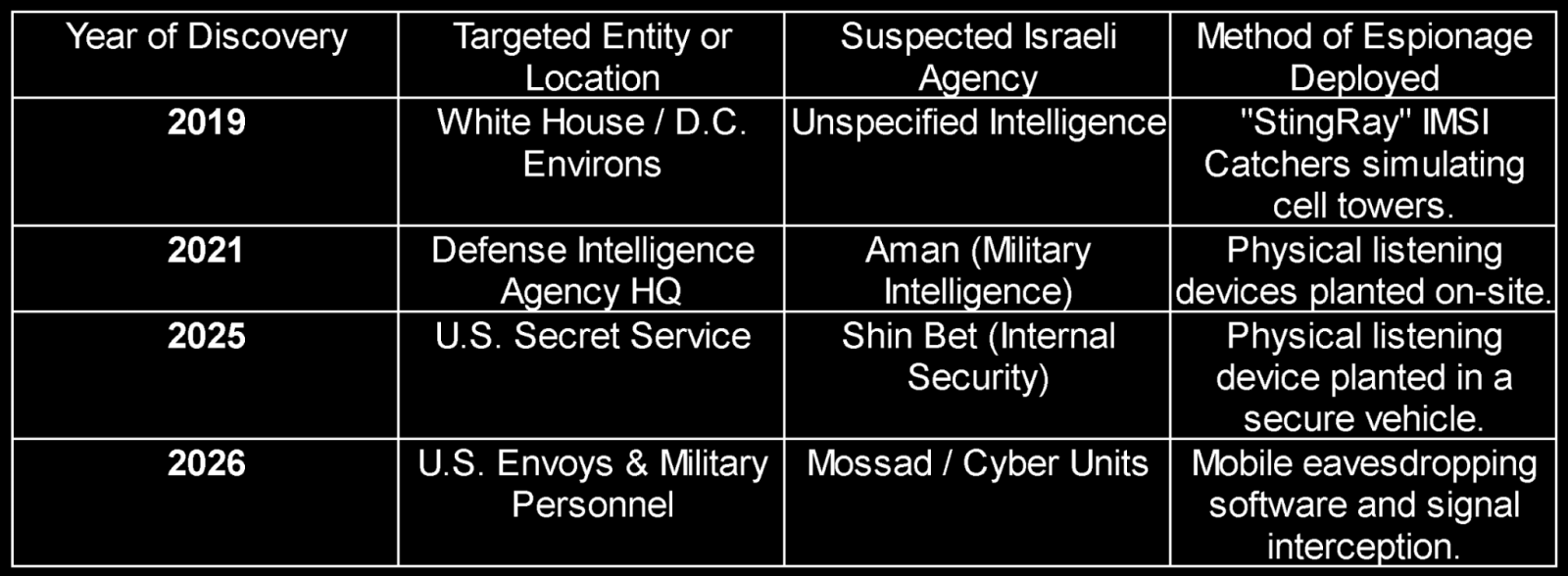
These incidents demonstrate a comprehensive, multi-domain approach to intelligence gathering. From the localized radio-frequency interception of StingRays in the nation’s capital, to the physical insertion of hardware bugs in secure facilities, to the remote deployment of malware on diplomats’ phones, the sheer variety of methods employed confirms the Pentagon’s assessment that Israel’s capabilities are operating at an entirely critical level.
The consequence of these physical breaches is a severe degradation of institutional trust. When an allied intelligence service is caught bugging the headquarters of a host nation’s defense intelligence agency, it necessitates a sweeping, incredibly costly overhaul of counterintelligence infrastructure. Millions of dollars must be diverted to sweep facilities, secure communications, and monitor the very diplomatic liaisons that are supposed to be collaborative partners in the fight against mutual adversaries.
The Cyber Proxy War: NSO Group and Pegasus
While traditional human intelligence and physical bugs have dominated the headlines, the most insidious, long-term threat to United States counterintelligence may come from the private sector. The role of commercial spyware—specifically the Pegasus software developed by the Israeli firm NSO Group—has become deeply intertwined with the United States-Israel espionage crisis.
NSO Group was founded in 2010 by veterans of Israel’s elite signals intelligence units, including founders Niv Karmi, Shalev Hulio, and Omri Lavie. They created Pegasus as a tool to defeat modern smartphone encryption. Once installed, Pegasus defeats nearly all the encryption on a device by transmitting a mirror of the phone’s contents, granting the operator full, undetected access to the microphone, camera, emails, encrypted messaging apps like Signal and WhatsApp, and real-time location data.
The technology is terrifyingly efficient. In a landmark legal case where WhatsApp won a $168 million settlement against NSO Group, the court records revealed how Pegasus was delivered. NSO had created an exploit that delivered the spyware to targets’ phones with a single missed call, which the software then deleted from the phone’s call history. Later, they shifted to “one-click” delivery systems, tricking targets into clicking seemingly innocuous links about bank deliveries or hospitalized loved ones.
While NSO claimed the software was meant to catch terrorists, WhatsApp and organizations like Citizen Lab proved the tool was routinely sold to authoritarian regimes in Saudi Arabia and Rwanda, where it was used to target journalists, dissidents, and Amnesty International staff.
For years, NSO Group operated with the tacit approval, and often the explicit regulatory authorization, of the Israeli Defense Ministry. However, following widespread international outrage, the United States government took decisive action. In 2021, the Commerce Department placed NSO Group on its Entity List—a strict commercial blacklist—effectively crippling its ability to do business with American tech companies, citing actions contrary to United States national security and foreign policy interests. Furthermore, President Joe Biden signed a 2023 executive order banning the government from using commercial spyware that poses national security risks.
In October 2025, a dramatic corporate shift occurred. A group of American investors led by Hollywood producer Robert Simonds purchased a controlling stake in the struggling NSO Group, injecting much-needed capital. The original founders stepped down, but the company remained headquartered in Ramat Hashron, Israel, operating under the full regulatory authority of the Israeli Defense Ministry.
The most significant development followed in November 2025, when NSO Group appointed David Friedman as its new executive chairman. Friedman is an American attorney who served as the United States Ambassador to Israel during Donald Trump’s first administration, maintaining deep, enduring ties to the President’s inner circle.
Friedman’s mandate is explicitly political: utilize his connections to lobby the Trump administration to remove NSO Group from the blacklist, rescind the executive order, and authorize the sale of Pegasus to United States law enforcement agencies, including local police departments.
In an address to NSO employees, Friedman praised them as the “most brilliant minds” in high-tech, dismissing the adverse attention as “unfair”.
He publicly stated that he expects the Trump administration to be “receptive to considering any opportunity that might keep Americans safer,” arguing that NSO has reformed its licensing practices to find “trustworthy clients”.
This aggressive lobbying effort—backed by $7.6 million spent by NSO in Washington between 2020 and 2024, including personal appeals to Jared Kushner and Netanyahu—has deeply alarmed members of Congress.
In May 2026, Representative Summer Lee, the Ranking Member of the House Subcommittee on Federal Law Enforcement, sent a letter to Commerce Secretary Howard Lutnick demanding answers about the Trump administration’s relationship with the sanctioned spyware firm.
Representative Lee explicitly warned of the catastrophic counterintelligence and national security risks posed by allowing a foreign-regulated spyware entity, with a long history of compromising officials globally, to integrate its surveillance architecture directly into the American domestic security apparatus.
The NSO Group saga highlights the privatization of espionage. By utilizing private cyber-intelligence firms, nation-states achieve plausible deniability. Even as the Pentagon flags the Israeli state as a “critical” threat, an Israeli-regulated proxy corporation is actively leveraging former American diplomats to embed its tools inside the United States. This blurs the line between allied defense cooperation and state-sponsored espionage, creating a legal and ethical gray zone that traditional counterintelligence frameworks simply cannot handle.
The Precedent of Impunity and the Transactional Alliance
To understand why Israeli intelligence felt emboldened to target the Secret Service, the Defense Intelligence Agency, and the President’s special envoys, one must look at the historical precedent of American responses to Israeli espionage. For decades, the standard response from Washington upon discovering Israeli spying has been a quiet, behind-closed-doors reprimand, followed swiftly by a return to the status quo.
The most glaring example of this impunity occurred following the 2019 StingRay incident. When federal agencies concluded that Israel had planted cellular interceptors near the White House, the administration’s response was unprecedented in its passivity.
Unlike previous occasions when foreign espionage was discovered on American soil—which typically resulted in diplomatic expulsions, severe economic sanctions, or harsh public rebukes—the Trump administration took absolutely no formal action. One former senior official noted that there were “no consequences” for Israel’s behavior, and the administration did not rebuke the Israeli government privately or publicly. President Trump even stated to the press that he found it hard to believe Israel was behind the devices, effectively providing top-cover for the operation.
When a global superpower declines to enforce boundaries against an ally, it establishes a new operational baseline. By failing to impose any tangible costs for the 2019 White House surveillance, the United States inadvertently signaled to the Mossad and Aman that aggressive intelligence collection on American soil was a low-risk, high-reward endeavor. The bugging of the military headquarters in 2021 and the Secret Service in 2025 are the direct, logical downstream effects of that 2019 impunity.
Furthermore, the foundation of the intelligence relationship has been repeatedly compromised by actions taken by the executive branch itself. The core concept of an intelligence alliance relies on the absolute, strict protection of sources and methods. This trust was severely damaged in May 2017, when President Trump, during a closed-door meeting in the Oval Office, disclosed highly classified intelligence to Russian Foreign Minister Sergei Lavrov and Ambassador Sergey Kislyak.
The intelligence, which pertained to a terror plot to use laptop computers as bombs on aircraft, had been provided by Israel under a highly sensitive intelligence-sharing arrangement. According to current and former officials, Trump’s unilateral decision to share this information with Russia—a close geopolitical ally of Israel’s primary adversary, Iran—without prior authorization directly endangered the life of an Israeli spy embedded deep within hostile territory in Syria.
Israeli officials were reportedly furious, “shouting at their American counterparts” over the catastrophic leak, and the incident forced Israel to fundamentally alter how it shared intelligence with the United States moving forward.
This incident breeds a deep, enduring institutional cynicism. If Israeli intelligence agencies believe that the American Commander-in-Chief is an unreliable, unpredictable custodian of classified information, they are logically incentivized to rely less on official, cooperative sharing channels and more on unilateral espionage to acquire the intelligence they require for their own survival.
This highly transactional, politicized approach to national security is further evidenced by the handling of the Jonathan Pollard case. Pollard, a former United States Navy analyst, spent thirty years in federal prison for passing massive quantities of classified American intelligence to Israel in the 1980s. In November 2020, during his final weeks in his first term, President Trump allowed Pollard’s parole restrictions to expire entirely, enabling the convicted spy to relocate to Israel to a hero’s welcome. Furthermore, at the explicit, direct request of the Israeli government, Trump issued a presidential pardon to Pollard’s original Israeli handler.
By officially pardoning the architect of one of the most devastating intelligence breaches in American history, and allowing Pollard to settle in Jerusalem—where he recently made headlines endorsing far-right Israeli minister Itamar Ben-Gvir and advocating for the mass transfer of Gaza’s Palestinians to Ireland—the administration signaled that espionage against the United States could ultimately be forgiven, or even rewarded, through sustained political lobbying.
The current crisis also directly mirrors the espionage breakdown of the Obama administration.
During the negotiation of the 2015 Joint Comprehensive Plan of Action, United States intelligence intercepted communications revealing that Israel had stolen American secrets regarding the Iran nuclear talks. In that instance, Israel allegedly fed the stolen information to American legislators in a deliberate attempt to sabotage the diplomacy. The 2026 espionage campaign against Steve Witkoff and Elbridge Colby appears to be a direct repetition of this exact playbook. Israel is gathering intelligence not just for passive situational awareness, but to actively weaponize that information politically within the United States to derail a peace deal it views as a threat to its national survival.
Broader Implications for National Security and Future Diplomacy
The escalation of Israeli espionage to a “critical” threat level carries profound implications that ripple far beyond the immediate security of a diplomat’s cell phone or the physical perimeter of a military building.
First, it fundamentally alters the bandwidth and efficacy of American diplomacy. When envoys like Steve Witkoff must operate under the assumption that their allied counterparts already know their fallback negotiating positions because their communications have been compromised, it destroys the utility of diplomatic ambiguity.
It forces negotiators to adopt a posture of extreme deception not just toward their adversaries in Tehran, but toward their supposed allies in Tel Aviv. This leads to a siloed, paranoid policymaking environment where critical data is withheld from the very regional partners required to execute the strategy.
For example, as Jared Kushner unveils specific, detailed plans to redevelop the Gaza Strip, and figures like Mike Huckabee declare that certain nations will have no role in the region’s future, these policies must be crafted in an environment completely devoid of operational security. The release of hostages, such as Rom Braslavski—who spent 738 days in captivity before meeting Trump at the White House—requires delicate, secure coordination that is nearly impossible when allied nations are hacking the phones of the coordinators. Furthermore, when the United States re-sanctions figures like UN Special Rapporteur Francesca Albanese for her criticism of Israel, it does so while its own defense establishment views Israel as a critical espionage threat, highlighting a deeply incoherent foreign policy.
Secondly, the espionage crisis threatens the broader architecture of United States defense integration. The ongoing push to merge the American and Israeli defense industrial bases under Section 224 of the NDAA presents a massive paradox. How can the Pentagon safely integrate its most advanced, classified aerospace, missile defense, and cyber technologies with a nation that its own intelligence agency has flagged as a critical counterintelligence threat?
If Israel is actively hacking the phones of defense personnel and bugging the Pentagon’s intelligence hubs, the sharing of proprietary defense technology becomes an unacceptable liability.
The technology risks not only being reverse-engineered by Israel to compete with American defense contractors, but potentially leaking to third-party nations through insecure, overlapping defense networks. To protect itself, the United States military may be forced to impose stringent new restrictions on intelligence and technology sharing, which would ironically degrade Israel’s qualitative military edge—the very advantage American policy seeks to maintain.
Finally, there is the devastating risk to global alliance cohesion. European intelligence agencies watched in horror during the 2017 Oval Office leak, with senior officials warning that sharing intelligence with the United States could put their own sources at catastrophic risk.
Burkhard Lischka, a member of the German Bundestag’s intelligence oversight committee, warned that passing information at will makes the administration a security risk for the entire western world. If the United States cannot secure its own capital, its own Defense Intelligence Agency headquarters, its own Secret Service vehicles, and its own diplomatic envoys from an allied intelligence service, it projects a profound image of operational weakness to near-peer adversaries like Russia and China.
The Future of an Alliance in the Shadows
The 2026 espionage crisis represents a dark, irreversible evolution in the relationship between the United States and Israel. The elevation of Israel to a “critical” counterintelligence threat by the Defense Intelligence Agency is not merely a bureaucratic reclassification to be filed away in a vault; it is a klaxon warning that the traditional boundaries of allied intelligence gathering have completely eroded.
Driven by an existential panic over secret negotiations to end the war with Iran, Israel has deployed a sprawling, aggressive intelligence apparatus against its primary benefactor. By targeting senior envoys, physically bugging highly secure facilities, and utilizing former American officials to lobby for the domestic integration of blacklisted spyware, Israel has demonstrated a cold willingness to prioritize tactical information over strategic trust.
Yet, this crisis is equally a product of American making.
A persistent, decades-long failure to enforce consequences for past transgressions, combined with a lax culture of operational security among senior leaders, the appointment of inexperienced loyalists to lead the intelligence community during a crisis, and a highly politicized approach to intelligence sharing, created the perfectly permissive environment in which this espionage flourished.
As Washington attempts to negotiate a delicate, incredibly complex peace in the Middle East amidst a backdrop of depleted missile stockpiles and domestic unrest, it must simultaneously navigate an invisible battlefield in its own corridors of power. The United States is learning a difficult, costly lesson in statecraft: an ally that fears abandonment can quickly become as dangerous in the shadows as a sworn adversary. Until the government resolves the internal contradiction of treating Israel simultaneously as a critical security threat and an unimpeachable defense partner, the quiet war of espionage will only continue to escalate, threatening the foundations of American national security.
Works Cited (Click Here)
“At Israel’s Request, Trump Pardons Israeli Handler of Spy Jonathan Pollard.” The Times of Israel, 2026, www.timesofisrael.com/at-israels-request-trump-pardons-israeli-handler-of-spy-jonathan-pollard/.
“Burner Phones, Spy Fears: Pentagon Flags Israel’s Counterintelligence as ‘Critical’ Threat.” The Times of India, 2026, timesofindia.indiatimes.com/world/us/burner-phones-spy-fears-pentagon-flags-israels-counterintelligence-as-critical-threat/articleshow/131544928.cms.
“Donald Trump’s Disclosures of Classified Information.” Wikipedia, Wikimedia Foundation, 2026, en.wikipedia.org/wiki/Donald_Trump%27s_disclosures_of_classified_information.
“The FBI Reportedly Thinks Israel Spied on Trump’s Phone.” Futurism, 2026, futurism.com/the-byte/fbi-israel-spied-trumps-phone.
“Is Israel Spying on US? Iran Talks Come Under Spotlight as Espionage Concerns Grow.” The Times of India, 2026, timesofindia.indiatimes.com/world/middle-east/is-israel-spying-on-us-iran-talks-come-under-spotlight-as-espionage-concerns-grow/articleshow/131561162.cms.
“Israel Accused of Planting Mysterious Spy Devices Near the White House.” HSToday, 2026, www.hstoday.us/subject-matter-areas/intelligence/israel-accused-of-planting-mysterious-spy-devices-near-the-white-house/.
“Israel Accused of Spying on US Officials? Inside Explosive Intelligence Claims.” YouTube, uploaded by various sources, 2026, www.youtube.com/watch?v=_laebmDbCL4.
“Israel Alters Intelligence Sharing with US.” Voice of America, 2026, www.voanews.com/a/israel-us-intelligence-sharing/3868845.html.
“Israeli Espionage in the United States.” Wikipedia, Wikimedia Foundation, 2026, en.wikipedia.org/wiki/Israeli_espionage_in_the_United_States .
“Jonathan Pollard.” Wikipedia, Wikimedia Foundation, 2026, en.wikipedia.org/wiki/Jonathan_Pollard.
“Links: Israel Accused of Planting Mysterious Spy Devices Near the White House.” Iroon.com, 2026, iroon.com/irtn/link/43966/israel-accused-of-planting-mysterious-spy-devices-near-the-white-house/.
“Mossad.” Wikipedia, Wikimedia Foundation, 2026, en.wikipedia.org/wiki/Mossad.
“NSO Group.” Wikipedia, Wikimedia Foundation, 2026, en.wikipedia.org/wiki/NSO_Group.
“NYT: Israel Allegedly Targeted Witkoff, Senior Pentagon Officials In Stepped-Up Spying Effort.” i24NEWS, 2026, www.i24news.tv/en/news/international/americas/artc-nyt-israel-allegedly-targeted-witkoff-senior-pentagon-officials-in-stepped-up-spying-effort.
“Pentagon Fears Israel Spying on US Officials Amid Trump–Netanyahu Rift.” YouTube, 2026, www.youtube.com/watch?v=FbyOKGZFu44.
“Pentagon Raises Israeli Espionage Threat to ‘Critical’.” Washington Policy Weekly, Arab Center Washington DC, 2026, arabcenterdc.org/resource/washington-policy-weekly-pentagon-raises-israeli-espionage-threat-to-critical/.
“Pentagon Raises Israeli Spy Threat as NDAA Seeks Deeper Defense Ties.” Military.com, 2026, www.military.com/pentagon-raises-israeli-spy-threat-as-ndaa-seeks-deeper-defense-ties.
“Pentagon Raises Threat Assessment of Israeli Spying on US to ‘Critical’.” The Times of Israel, 2026, www.timesofisrael.com/pentagon-raised-threat-assessment-of-israeli-spying-on-us-to-critical-level-report/.
“Pentagon Raises Threat of Israeli Spying to ‘Critical’ – US Media.” Global Nation Inquirer, 2026, globalnation.inquirer.net/326470/pentagon-raises-threat-of-israeli-spying-to-critical-us-media.
“Pentagon Sees Growing Espionage Threat From Israel.” GV Wire, 2026, gvwire.com/2026/06/08/pentagon-sees-growing-espionage-threat-from-israel/.
Rep. Summer Lee. “Rep. Summer Lee Demands Answers from Dept. of Commerce on Trump Admin Ties to Sanctioned Spyware Firm.” Summerlee.house.gov, 2026, summerlee.house.gov/newsroom/press-releases/rep-summer-lee-demands-answers-from-dept-of-commerce-on-trump-admin-ties-to-sanctioned-spyware-firm.
“Seeking to Get Off US Blacklist, Spyware Firm NSO Taps Ex-Envoy Friedman as Chairman.” The Times of Israel, 2026, www.timesofisrael.com/seeking-to-get-off-us-blacklist-spyware-firm-nso-taps-ex-envoy-friedman-as-chairman/.
“Spy Stories, This Time in Politico.” CAMERA.org, 2026, www.camera.org/article/spy-stories-this-time-in-politico/.
“Spy vs. Spy: Pentagon Calls Israel’s Espionage A ‘Critical’ Threat.” Tasnim News, 2026, www.tasnimnews.ir/en/news/2026/06/07/3610342/spy-vs-spy-pentagon-calls-israel-s-espionage-a-critical-threat.
“The NUMEC Affair: Did Highly Enriched Uranium from the U.S. Aid Israel’s Nuclear Weapons Program?” National Security Archive, 2016, nsarchive.gwu.edu/briefing-book/nuclear-vault/2016-11-02/numec-affair-did-highly-enriched-uranium-us-aid-israels-nuclear-weapons-program.
“The Senior US Officials Israel Allegedly Spied On, and the Shin Bet Operatives Caught Red-Handed.” Ynetnews, 2026, www.ynetnews.com/article/s15qojmbgl.
“Trump Shared Secrets with Russia. Here’s Why It Matters.” Atlantic Council, 2026, www.atlanticcouncil.org/blogs/new-atlanticist/trump-shared-secrets-with-russia-here-s-why-it-matters/.
“US Denies Pentagon Leak on Israeli Espionage, Blames Anti-Iran War Sources.” The Jerusalem Post, 2026, www.jpost.com/middle-east/iran-news/article-898647.
“US Intelligence Concerned over ‘Growing Espionage Threat’ from Israel: Report.” Anadolu Agency, 2026, www.aa.com.tr/en/middle-east/us-intelligence-concerned-over-growing-espionage-threat-from-israel-report/3958776 .
“US Worried Israel Increasing Efforts to Spy on Witkoff, Other Senior Officials — Report.” The Times of Israel, 2026, www.timesofisrael.com/liveblog_entry/us-worried-israel-increasing-efforts-to-spy-on-witkoff-other-senior-officials-report/.
Wajeeh Lion. “Intelligence Assessment: The Growing Israeli Espionage Threat.” Substack, 2026, substack.com/@wajeehlion/note/c-271802206.
“WhatsApp Accuses NSO of Fresh Pegasus Targeting.” Financial Times, 2026, www.ft.com/content/3eb6f792-e8a2-47a6-b997-030e2af02efd?syn-25a6b1a6=1.