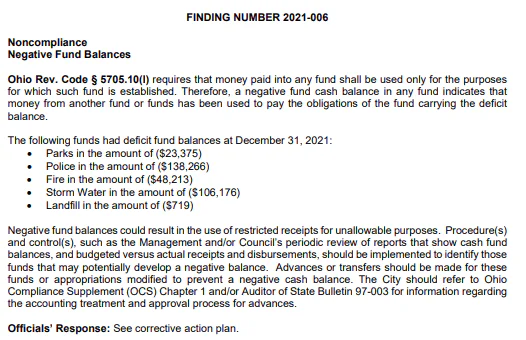


 Written by
 From New World ERP’s first misconfigured day in July 2009 to the Auditor of State
ordering the budget-checking override permissions locked down in October 2025 —
the receipts have been here the entire time.


.
Executive Summary
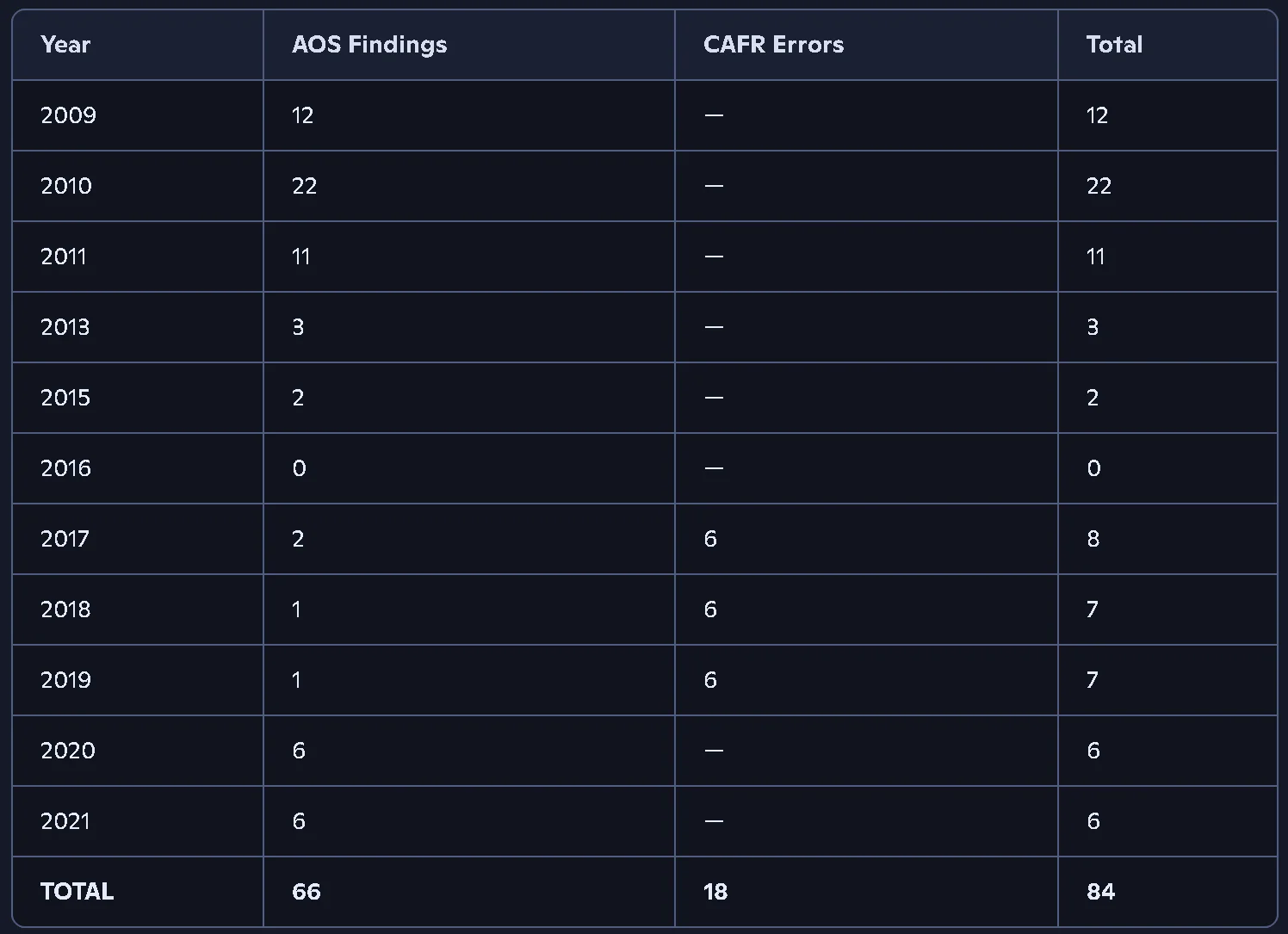
The City of Marion, Ohio, implemented the New World ERP accounting system in July 2009. From the moment it went live, the Ohio Auditor of State began documenting a cascade of internal control failures, budget overrides, unreconciled accounts, and missing money. Across seven formal audit cycles spanning 2009 through 2021, state auditors issued a combined 66 formal findings—including material weaknesses, material noncompliance citations, significant deficiencies, and findings for recovery totaling hundreds of thousands of dollars. During the three-year gap between audits (2017–2019), the City produced its own financial reports containing 18 additional categories of financial reporting errors—including a $5,128,212 unexplained discrepancy between two expenditure totals in the same report, internal income tax revenue contradictions, fund balance irregularities, and capital asset inventory inconsistencies.
Gasoline in the fire such as shared passwords, inappropriate elevated permissions to the New World system with no business justification, lack of segregation of duties, physical security breaches, and other grave IT failures greatly increased the explosion and damage to the City of Marion you are about to read. This is the undeniable failure of the New World system under the Schertzer administration, making everything in this report draw to one conclusion: this is the predictable outcome to a lack of financial and IT controls finally exposed and addressed under the Collins administration.
The pattern is unmistakable: the system’s controls were never properly configured, budget override permissions were left wide open to all users, bank reconciliations went months or years without completion, and hundreds of thousands of dollars were misdirected, misallocated, or simply vanished. It was not until October 27, 2025—more than 16 years after implementation—that the City finally removed budget-checking override permissions from all New World users except the City Auditor.

Key dollar figures in the paper trail:
- $543,079 — Unreconciled bank-to-book variance, December 31, 2021
- $314,347 — Unreconciled bank-to-book variance, December 31, 2020
- $1,184,754 — Federal withholdings erroneously sent to Ohio Dept. of Taxation instead of IRS
- $279,036.80 — Total withholding penalties across multiple agencies (plus $146,169.38 abated)
- $154,399 — Finding for Recovery against City Auditor Robert Landon III
- $34,276 — Utility payments stolen by Brenda Nwosu (2011–2014)
- $22,500 — W-2 late-filing penalties, Finding for Recovery against Kelly Carr
- $5,128,212 — Unexplained gap between fund-level and government-wide expenditure totals (2018 report)
- $1,150,886 — General Fund Transfers Out exceeding appropriations (2021)
- $625,738 — Fire Fund exceeding appropriations (2021)
- $567,688 — Police Fund exceeding appropriations (2021)
- $89,411 — Cross-fund payment, Sewer from Landfill Fund (2010)
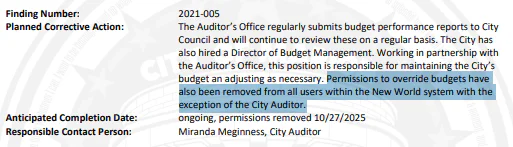
The most critical revelation: the 2021 audit’s corrective action plans explicitly name the New World ERP system for the first time, and state that budget override permissions were finally removed from all users except the City Auditor on October 27, 2025—more than 16 years after implementation.
Seventy-eight formal Auditor of State findings. Eighteen categories of financial reporting errors in City-produced reports. Ten reporting periods spanning seventeen years. One ERP system with its controls left wide open from the day it was installed.
The Auditor of State documented it all. The findings were public. The corrective action plans were filed. And for sixteen years, three months, and twenty-seven days, the budget-checking override permissions in the New World ERP system remained assigned to every user with spending authority.
The receipts have been here the entire time. This could have been stopped many years ago, had someone just listened. This is the reason why Marion Watch and many officials are demanding a full forensic IT audit, which is a non-negotiable standard when issues of this magnitude are present.
Methods and Sources
This investigation is rooted exclusively in primary source documentation. Every finding, discrepancy, and system failure detailed in this report is derived from official Auditor of State reports, the City of Marion’s own self-produced financial statements, and verified public records obtained through formal requests.
Our analysis is governed by a strict adherence to global IT, legal, and financial industry standards, ensuring that every conclusion is anchored in established regulatory frameworks. This methodology is designed to provide a rigorous, objective assessment that meets the highest standards of professional accountability.
Regulatory and Professional Frameworks
Our findings are evaluated against the following benchmarks:
- Financial Reporting Standards: Benchmarking all municipal reporting against GASB (Governmental Accounting Standards Board) requirements and GFOA (Government Finance Officers Association) best practices for transparency and financial health.
- IT Governance & Cybersecurity: Evaluating system configurations and administrative controls against NIST (National Institute of Standards and Technology) and COBIT (Control Objectives for Information and Related Technologies) frameworks. This includes strict adherence to the Principle of Least Privilege (PoLP) and Segregation of Duties (SoD).
- Operational Integrity: Applying ITIL (Information Technology Infrastructure Library) standards to assess the City’s change management and service delivery, alongside AICPA Trust Services Criteria to evaluate the Processing Integrity of the General Ledger.
- Legal Compliance: Assessing all administrative and financial actions against the Ohio Revised Code (ORC) and federal 2 CFR 200 (Uniform Administrative Requirements, Cost Principles, and Audit Requirements for Federal Awards).
Technical Expertise and Consultation
To ensure the technical accuracy of this analysis, Marion Watch leveraged over 20 years of internal expertise in full-stack information technology infrastructure, complex systems administration, and regulatory compliance. Our methodology was further strengthened through extensive, multi-level consultation with a broad network of stakeholders, including:
- Current Municipal Leadership: Direct engagement and consultation with the Collins Administration and members of the Marion City Council to understand current operational status and active corrective measures.
- Historical and Regional Context: Consultations with past elected officials from Marion and surrounding jurisdictions to verify long-term administrative patterns and institutional memory.
- Global Professional Network: Collaboration with a network of certified professionals and subject matter experts from across the State of Ohio, several other U.S. states, and international experts in ERP governance, municipal finance, and investigative journalism.
Final Declaration of Objectivity
Our approach is strictly evidentiary: we provide no speculation and no inference beyond what the verified documents and system configurations support. We have meticulously analyzed the “digital fingerprints” left by sixteen years of administrative decisions. In the interest of public transparency and government accountability, we maintain that the facts are self-evident—the receipts speak for themselves.
The Complete Story: How New World ERP Failed Marion
In July 2009, the City of Marion, Ohio, flipped the switch on a new accounting system. New World ERP—an integrated, Windows-based financial management platform built for municipal government—replaced the City’s legacy systems and promised modern fund accounting, automated budget controls, streamlined purchasing workflows, and real-time financial reporting. It was supposed to make the City’s finances more transparent, more accurate, and more accountable.
It did none of those things.
From the very first audit cycle after go-live, the Ohio Auditor of State began documenting failures. Finding 2009-001—”Financial Monitoring”—noted that “the City did not have an effective control process established over the financial activity recorded on the City’s ledgers.” Officials with monitoring responsibilities had been given “limited training” on the new system. The City’s response was telling: “The City of Marion agrees that additional trainings will be beneficial.” It was the beginning of a pattern that would repeat for sixteen years—auditors identify a system-enabled failure, the City promises to do better, and nothing changes.
The bank reconciliations collapsed almost immediately. Finding 2009-002 documented that “the City’s monthly bank reconciliations have not been completed in a timely manner” since the new system was implemented. The City Auditor’s office and the City Treasurer were jointly performing reconciliations—destroying the Segregation of Duties that is the most basic internal control in government finance. The City’s defense: “The City of Marion recognizes when working within two systems there could be room for oversight. With the City of Marion now on one system, internal controls are tighter.”
They were not.
Income tax allocations were wrong from day one. The City has a 1% unvoted and 0.75% voted municipal income tax, with allocations governed by specific ordinances. Finding 2009-005 documented that “income tax receipts were not allocated in accordance with the above ordinances”—and that the beginning fund balances for 2009 were also incorrect because 2008 allocations had been wrong too. The New World system’s revenue distribution rules were never configured to match the ordinance requirements.
Purchase orders sailed through without approval. Finding 2009-007 found that 23% of expenditures had purchase orders that “were not reviewed and approved by the appropriate department supervisor.” The City blamed the transition: “During conversion from the old system to the new system, the old purchase orders were approved on paper by the supervisor. When the new system was implemented, these same purchase orders were re-entered into the new system and no approval was necessary.” In other words, the Purchasing module’s approval workflow was not configured to require approval for migrated purchase orders—a configuration choice that created a 23% bypass rate.
And then there were the budget overrides. Finding 2009-008 documented that “budgetary expenditures exceeded appropriations at the legal level of control materially.” This is the finding that would haunt Marion for the next sixteen years. New World’s Purchasing module includes a budget-checking feature that validates every transaction against appropriated amounts. It has a built-in override capability—a designed feature that allows authorized personnel to process emergency or extraordinary expenditures when budget-checking indicates insufficient appropriation. The key word is “authorized.” In Marion, override permissions were assigned to virtually every user in the system. Anyone with spending authority could bypass the budget ceiling. The system dutifully logged every override, but nobody was watching the logs.
By 2010, the problems had multiplied to 22 findings in a single audit (including findings 2010-015 through 2010-022). Negative fund balances appeared—the City paid $89,411 of Sewer Fund debt service from the Landfill Fund, a cross-fund payment that should have been blocked by the system. By 2011, the Auditor noted that the City had “suffered recurring losses from operations and has a net asset deficiency.” Federal program findings piled up—questioned costs in CDBG and Rural Transit grants, late single audit filings, improper cost allocations. The same finding categories repeated year after year: budget overrides, negative fund balances, investment procedure failures, and purchasing authorization bypasses.
In 2015, the consequences turned criminal. Brenda Nwosu, Utility Supervisor from January 2011 through August 2014, embezzled $34,276 from utility payment collections. Payments totaling $17,375 were not posted to 71 customer accounts. “In some instances, adjustments were made to the accounts to reduce balances when payments were not posted to conceal theft of cash.” An additional $16,901 in Sheriff sale proceeds were redirected. The New World Utility Billing module’s controls failed to flag unposted payments, unauthorized account adjustments, or the redirection of Sheriff sale proceeds. Per GFOA standards, the person handling cash should never have the ability to adjust account balances—but in Marion’s system, they did.

2016 brought the only clean audit in the entire span—zero findings. It was an anomaly, not a turning point.
The findings kept coming.
The City’s financial reports for 2017 through 2019 documented the same patterns the Auditor of State had flagged since 2009—and introduced new ones. The 2017 CAFR contained net position discrepancies in both governmental activities ($41,380,569) and business-type activities ($12,765,278), underreported property tax and income tax revenue, departmental expenditure inaccuracies across police ($6,854,807 underreported), fire, and public health, debt service calculation errors, and fund balance irregularities in the General Fund ($2,921,053).
The 2018 financial report was worse: a $5,128,212 unexplained gap between the fund-level expenditure total ($25,762,379) and the government-wide Statement of Activities ($30,890,591), a $42,019 internal variance in the City’s own municipal income tax figures, and an unexplained 28.8% collapse in transit ridership—from 167,680 riders to 119,457—that nobody analyzed.
By 2019, the financial report showed fund balance classification inconsistencies, general obligation bond totals ($24,583,763) that did not reconcile with their own detailed breakdowns, income tax revenue contradictions between component sums and reported totals, and a police vehicle inventory that could not agree with itself—27 vehicles in one section, 30 in another. The same New World ERP system producing these reports was the same system that had been flagged for control failures since 2009—and every category of error traced back to the same uncorrected configuration deficiencies.
When the Auditor of State returned for the 2020 audit, the results were catastrophic. The bank reconciliation was off by $314,347—”with the book balance being greater than the bank balance due to the lack of monthly bank-to-book reconciliations and the complexity of the City’s accounting software (i.e. hybrid cash/accrual basis).” The Auditor explicitly cited the accounting software’s configuration as a contributing factor.
Worse: the City had erroneously remitted $1,184,754 in 3rd and 4th quarter 2020 federal tax withholdings to the Ohio Department of Taxation instead of the Internal Revenue Service. The error began in June 2020 and was not identified until January 2021—seven months of misdirected payments. Correcting payments of $1,184,754 were made to the IRS on February 9, 2021, but the City did not appropriate for these payments until November 8, 2021. The result: a Finding for Recovery of $154,399 in penalties and interest against City Auditor Robert Landon III and his bonding company. A separate Finding for Recovery of $22,500 was issued against former City Auditor Kelly Carr for penalties incurred when the 2018 W-2s were filed late.
The 2021 audit—filed October 15, 2025, and certified for release November 13, 2025—brought the final reckoning. Qualified opinions were issued on most fund statements. A contracted accounting firm had to post 54 adjusting entries for fiscal year 2020 and 52 for fiscal year 2021, with 65 additional adjustments identified during the audit itself. The bank reconciliation showed an unreconciled difference of $543,079. Employee withholding remittances were late to the IRS, OPERS, OP&F, and the Ohio Department of Taxation, resulting in $279,036.80 in penalties plus an additional $146,169.38 that was abated.
And then came the corrective action plans—the first official documents in the entire 17-year record to name the New World system explicitly:
“Bank reconciliations are being processed within the software system, New World, to ensure reconciliations are done every month and maintained in chronological order. The system will not allow a reconciliation to be posted with a difference, so it is requiring that time and research go into every reconciliation.”
“Permissions to override budgets have also been removed from all users within the New World system with the exception of the City Auditor. Anticipated Completion Date: ongoing, permissions removed 10/27/2025.”
October 27, 2025. That is the date the budget-checking override permissions were finally restricted. Sixteen years, three months, and twenty-six days after New World went live. Every user in the system had override authority for the entire duration.
Every budget ceiling was advisory, not mandatory.
Every appropriation limit was a suggestion.
Veritas Solutions Group was brought in to investigate the ERP configuration, but its work was reportedly hindered. The full scope of what Veritas found—and what prevented them from completing their assessment—is within council summaries, with some remaining a matter for public records requests.
The receipts have been here the entire time. The Auditor of State documented every failure, year after year, finding after finding. What follows is the complete record.

The Complete Record: Every Auditor of State Finding and Reporting Error, 2009–2021
What follows is every formal finding issued by the Ohio Auditor of State for the City of Marion from 2009 through 2021, plus every category of financial reporting error documented in the City’s self-produced reports during the 2017–2019 gap years. For each item, we provide: the finding number and title, a verbatim Auditor quote (or data point from the City’s own report), a plain-language explanation for a general audience, and a forensic IT analysis explaining how New World ERP misconfiguration, disabled controls, or process bypasses would produce the observed result. All ERP module references use verified Tyler Technologies New World module names and architecture.
Audit Year 2009: The New System Arrives — 11 Findings
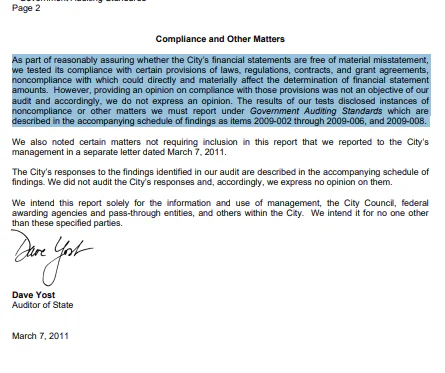
The City of Marion implemented the New World ERP accounting system in July 2009. The Auditor of State’s audit for the year ended December 31, 2009 was filed March 7, 2011. It contained 11 findings — 8 related to generally accepted government auditing standards (GAGAS) and 3 related to federal program compliance under OMB Circular A-133.
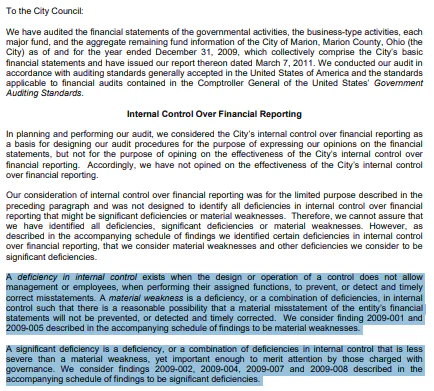
Finding 2009-001: Financial Monitoring — Material Weakness
“The City did not have an effective control process established over the financial activity recorded on the City’s ledgers or reported on their financial report.”
Plain-Language Explanation. The City implemented a brand-new accounting system in July 2009, but the officials responsible for monitoring the City’s finances — Council members, elected officials, department managers — were given only limited training on how to use it. When the Auditor of State examined the City’s financial records, significant reclassification entries were needed to correct revenue and expenditure amounts during the GAAP conversion process. These errors demonstrated that nobody was effectively watching the financial output of the new system.
The City’s response acknowledged the problem: “The City of Marion agrees that additional trainings will be beneficial.” This was the first of many promises to improve that would go unfulfilled for years.
Forensic New World ERP IT Analysis. New World ERP’s General Ledger includes built-in reporting tools and configurable role-based dashboards that provide budget-vs-actual comparison reports, fund balance alerts, and transaction exception flags for elected officials and department managers. These tools were installed as part of the system implementation but were not utilized. The finding indicates that role-based dashboards were not set up, automated exception reports were not scheduled, and variance alerts were not configured. Officials received system login credentials but no structured reporting — the equivalent of handing someone the keys to a car without telling them it has a dashboard.
Per Government Finance Officers Association (GFOA) best practices and the Committee of Sponsoring Organizations (COSO) internal control framework, monitoring activities should be ongoing and embedded in routine operations. In an ERP environment, this requires the system to automatically generate and distribute exception reports — including transactions over a threshold, budget line items approaching their limit, and unusual journal entries. Because these installed features were not configured, monitoring depended entirely on manual processes that Marion had not established.

These articles are fact-based, very well-documented, and have been covering this specific situation since…
Finding 2009-002: Bank Reconciliations — Material Non-Compliance / Significant Deficiency
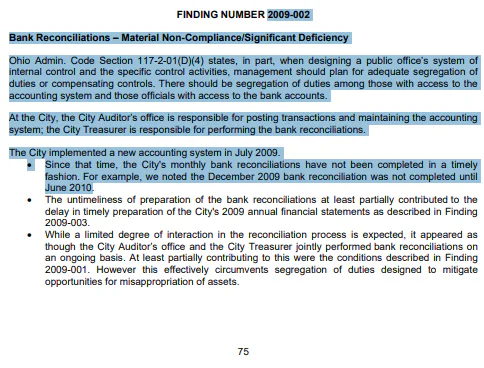
“The City implemented a new accounting system in July 2009. Since that time, the City’s monthly bank reconciliations have not been completed in a timely manner.”
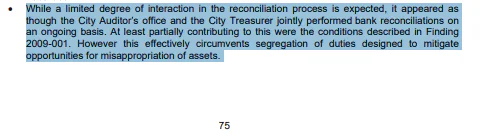
Plain-Language Explanation. Bank reconciliation is the most fundamental financial control in government: comparing what the bank says the City has against what the City’s own books say. After implementing New World, the City stopped performing this reconciliation in a timely manner. Worse, the City Auditor’s office and the City Treasurer were jointly performing reconciliations — combining two offices that are supposed to serve as checks on each other. As the Auditor noted: “Unreconciled bank accounts present the opportunity for errors or misappropriation of assets to go undetected.”
The City’s defense was revealing: “The City of Marion recognizes when working within two systems there could be room for oversight. With the City of Marion now on one system, internal controls are tighter.” They were claiming the problem was the transition — not the new system itself. The next twelve years of audit findings would prove otherwise.
Forensic New World ERP IT Analysis. New World ERP includes a Cash Management module with a Bank Reconciliation program that imports bank statement data (via electronic file or manual entry) and matches transactions against the General Ledger. While this is a distinct component of the suite, it is essential for automated financial oversight. Because the City of Marion did not utilize this module during the initial implementation, bank reconciliation was performed entirely as a manual process outside the system using spreadsheets.
The Bank Reconciliation program requires specific configuration to be functional: bank account mapping to GL accounts, transaction matching rules, outstanding item tracking, and user role assignments that enforce segregation of duties (one role imports bank data, another reviews matches, a third approves). The fact that the Auditor and Treasurer were jointly performing reconciliations confirms that the module was not configured or utilized, forcing a manual workaround that destroyed the segregation of duties the system was designed to enforce. The 2021 corrective action plan confirms that the City eventually began “processing bank reconciliations within the software system, New World” — establishing that this functional module had not been used for the preceding twelve years.
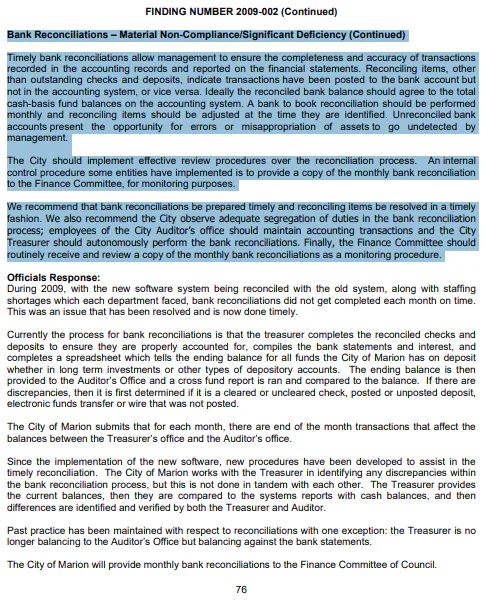

Finding 2009-003: Annual Financial Statements — Material Non-Compliance
“Ohio Rev. Code Section 117.38 requires GAAP-basis entities to file annual financial statements with the Auditor of State within 150 days of fiscal year end.”
Plain-Language Explanation. The City failed to file its annual financial statements on time. Under Ohio law, GAAP-basis financial statements must be submitted to the Auditor of State within 150 days of year-end (approximately May 30 for a December 31 fiscal year). Late filing means financial information becomes stale and less useful for decision-making. The City may also be assessed a $25 per day penalty.
Timely financial reporting is the foundation of government accountability. When a city cannot produce its financial statements on schedule, it signals that either the accounting records are not being maintained in a condition that allows timely reporting, or that the resources and expertise to compile GAAP-basis statements are not available.
Forensic New World ERP IT Analysis. GAAP-basis financial statements require the ERP to maintain accrual-basis records alongside cash-basis records. In New World, the General Ledger includes a Financial Statement Designer that generates balance sheets, income statements, and statements of cash flows in user-configured formats. However, producing GAAP-basis statements requires that the chart of accounts be structured to track accrual-basis transactions — depreciation schedules, accrued liabilities, deferred revenues, and compensated absences — alongside the cash-basis transactions that drive daily operations.
Because the chart of accounts was configured for cash-basis accounting only during the July 2009 implementation, year-end GAAP financial statement preparation became a labor-intensive manual process requiring extensive adjusting entries outside the system’s normal workflow. This structural limitation explains the late filing — the system was not set up to produce the required output efficiently.
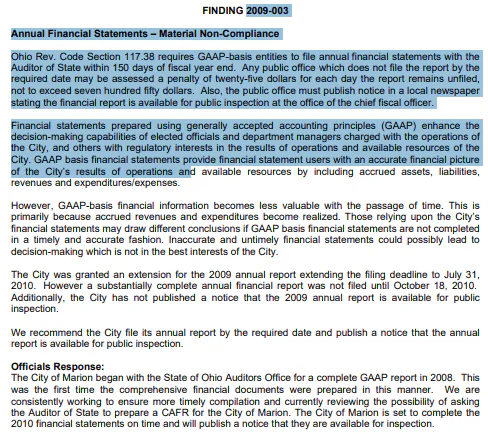
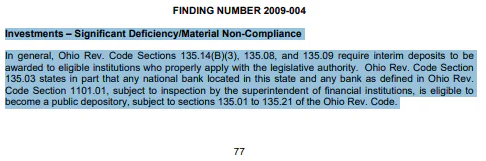
Finding 2009-004: Investments — Significant Deficiency / Material Non-Compliance
“Ohio Rev. Code Sections 135.14(B)(3), 135.08, and 135.09 require interim deposits to be awarded to eligible institutions who properly apply with the legislative authority.”
Plain-Language Explanation. Ohio law requires cities to follow specific procedures for investing public funds — designating approved depositories every five years, awarding deposits through a competitive process, and maintaining proper documentation. The City did not follow these procedures. Certificate of deposit monies were not properly designated, and investment procedures did not comply with the Ohio Revised Code.
Investment compliance is not optional — it protects public funds from being placed in unauthorized or inadequately collateralized institutions. When these procedures are not followed, taxpayer money may be at risk in ways that are not transparent to the public or to Council.
Forensic New World ERP IT Analysis. New World’s Cash Management module includes investment tracking capabilities that monitor investment maturities, track authorized depositories, and generate compliance deadline alerts. Because these investment tracking features were not configured, the ERP did not generate alerts when certificates of deposit matured or when depository authorization periods expired. The City relied on manual tracking for compliance deadlines, which predictably failed.
Per GFOA investment policy best practices, investment tracking should be systematic and automated. The absence of system-driven compliance tracking for a requirement as straightforward as a five-year depository designation cycle indicates that basic compliance calendaring was not established in the ERP during implementation, despite the system having the functional capacity to handle these tasks.
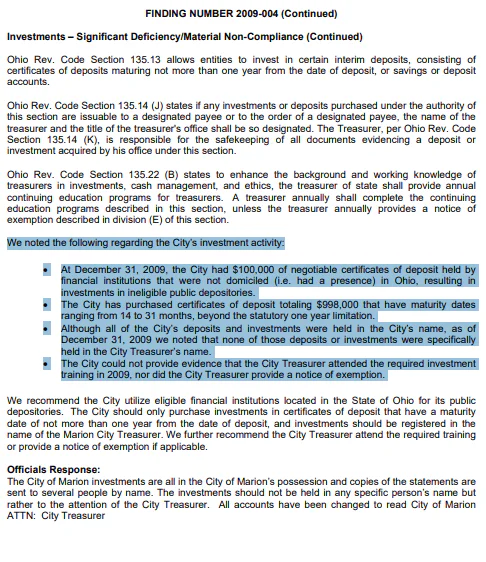

Finding 2009-005: Income Tax Allocation — Material Weakness / Material Non-Compliance
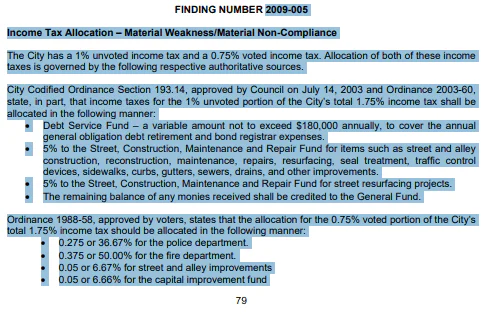
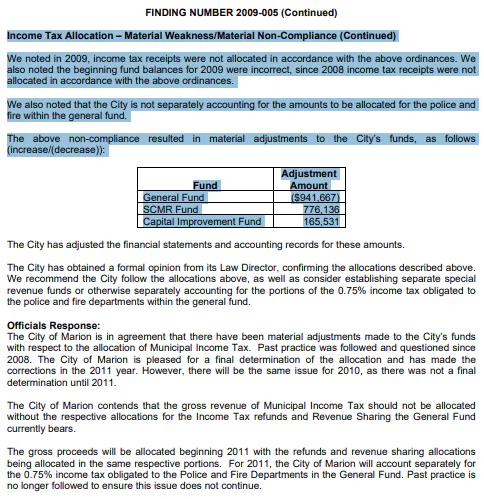
“Income tax receipts were not allocated in accordance with the above ordinances. We also noted the beginning fund balances for 2009 were incorrect, since 2008 income tax receipts were not allocated in accordance with the above ordinances.”
Plain-Language Explanation. The City of Marion has a 1% unvoted income tax and a 0.75% voted income tax, with allocations governed by City Codified Ordinance Section 193.14 and Ordinance 2003-60. These ordinances specify exactly how income tax revenue must be distributed across City funds — specific percentages to the General Fund, police, fire, capital improvements, and debt service. The City was not distributing income tax revenue according to these legally required percentages, and the problem predated the new system — 2008 allocations were also wrong, meaning the opening fund balances in the new system were incorrect from day one.
Income tax is Marion’s largest revenue source. When it is allocated to the wrong funds, every downstream financial decision based on fund balances is potentially wrong — budget appropriations, spending authorizations, transfers, and debt service coverage calculations all depend on accurate fund balances.
Forensic New World ERP IT Analysis. Income tax allocation in New World requires configuring revenue distribution rules in the General Ledger that automatically split incoming tax receipts across the correct funds per ordinance percentages. This is a configuration task performed during implementation: the GL requires a revenue distribution table that maps each income tax receipt type to its required fund allocations based on the percentage split defined in the City’s ordinances.
Because the allocation tables were not configured during the July 2009 migration—and the legacy system’s allocation logic was not replicated in New World—every tax receipt posted to a single fund (the General Fund) rather than being distributed per ordinance. The fact that 2008 allocations were also incorrect confirms the error was carried forward during data migration, compounding the problem. The City was not separately accounting for police and fire allocations within the General Fund, which establishes that the GL’s fund structure was not set up with the required sub-fund or account-level detail to track these allocations.

The intentional misconfiguration of the New World Software and concealment of its flaws ARE THE SILENT SABOTAGE!
Related Silent Sabotage Articles (updated…
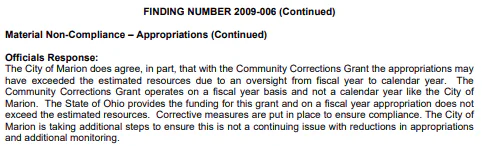
Finding 2009-006: Appropriations — Material Non-Compliance
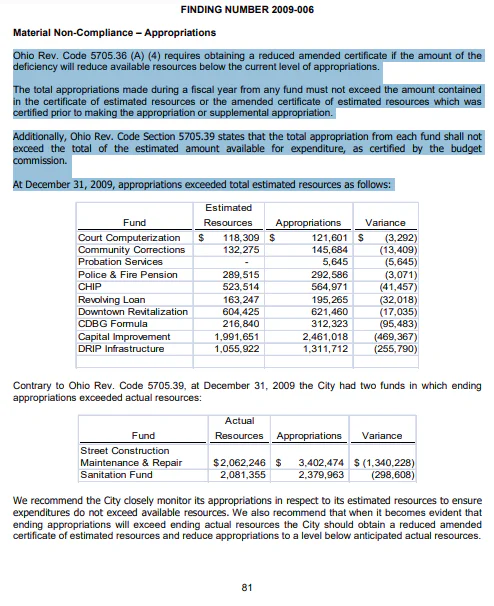
“At December 31, 2009, appropriations exceeded total estimated resources.”
Plain-Language Explanation. Ohio Revised Code Section 5705.36(A)(4) prohibits a city from appropriating more money than it has available. The County Budget Commission certifies how much revenue a city expects to receive, and appropriations cannot exceed that certified amount. At year-end 2009, Marion’s appropriations were higher than its certified available resources — meaning the City had legally authorized more spending than it had revenue to support.
When appropriations exceed resources, the City is essentially writing checks it knows it may not be able to cash. Ohio law requires the City to obtain a reduced amended certificate from the Budget Commission if revenue falls short, but Marion did not take this step.
Forensic New World ERP IT Analysis. New World’s Budgeting module and the Purchasing module’s budget-checking feature enforce a validation that compares entered appropriations against the certified revenue estimate from the County Budget Commission. This requires configuring the budget-checking validation to reference the certificate of estimated resources as a ceiling. Because this configuration was not active, the system allowed appropriations to be entered at any level without generating a warning or block when they exceeded available resources.
This is a system configuration choice — budget-checking is designed to validate at multiple levels (fund, department, object code) and against multiple thresholds (appropriation, estimated revenue, cash balance). Because the certificate-level validation was not configured, appropriations were entered as free-form amounts with no systemic enforcement of the legal ceiling.

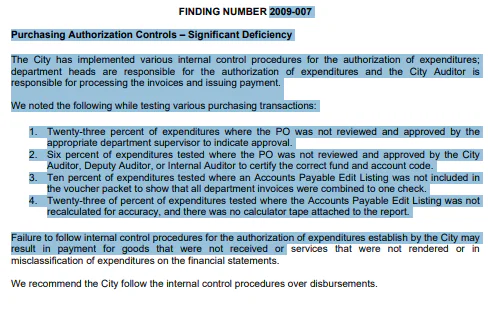
Finding 2009-007: Purchasing Authorization Controls — Significant Deficiency
“Twenty-three percent of expenditures where the PO was not reviewed and approved by the appropriate department supervisor to indicate approval.”
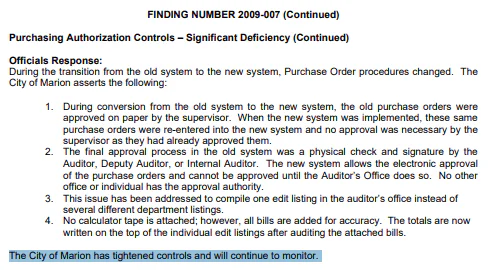
Plain-Language Explanation. Nearly one in four purchase orders was processed without the required supervisor approval. Additionally, 6% of expenditures were not approved by the City Auditor, Deputy Auditor, or Internal Auditor, and 10% of AP Edit Lists were not reviewed. The City’s explanation was telling: “During conversion from the old system to the new system, the old purchase orders were approved on paper by the supervisor. When the new system was implemented, these same purchase orders were re-entered into the new system and no approval was necessary.”
In other words, when purchase orders were migrated from the legacy system to New World, the system did not require them to go through the approval workflow again. This created a massive gap — thousands of dollars in spending authority entered the new system pre-approved, bypassing every digital control the system was supposed to enforce.
Forensic New World ERP IT Analysis. This is a critical ERP configuration failure rooted in the data migration process. New World’s Purchasing module supports configurable multi-level approval workflows. Per Tyler Technologies documentation, the module “allows configuration of approval workflows on various aspects of the requisition, including department, GL account, commodity code and project account.” Users are designated with or without “supervisor rights” — those without supervisor rights must have their transactions approved before the City Auditor’s office processes them.
During migration, the purchase orders re-entered from the legacy system were required to be routed through the standard approval workflow regardless of their prior approval status. Because they were entered as pre-approved, the migration process was configured to bypass the approval chain — likely to expedite the transition. This “temporary” bypass created a permanent control gap: 23% of POs had no supervisor approval. Additionally, the ongoing 6% bypass rate for City Auditor approval establishes that the approval workflow rules were not configured as mandatory — the system allowed transactions to proceed without all required approvals.

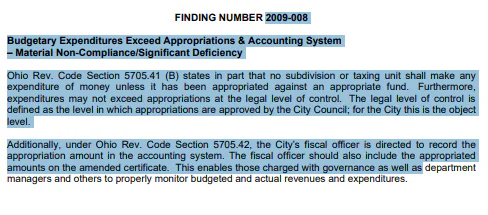
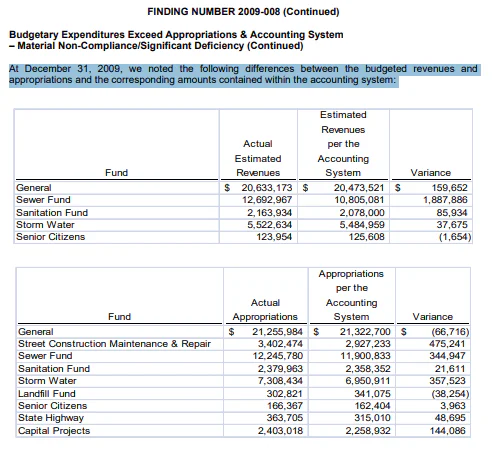
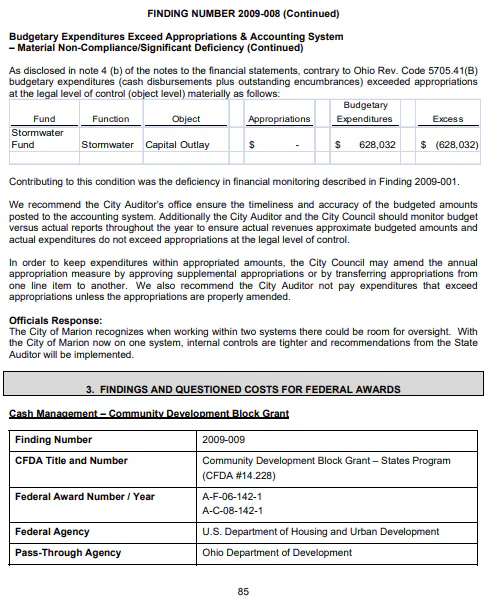
Finding 2009-008: Budgetary Expenditures Exceed Appropriations & Accounting System — Material Non-Compliance / Significant Deficiency
“Budgetary expenditures (cash disbursements plus outstanding encumbrances) exceeded appropriations at the legal level of control (object level) materially.”
Plain-Language Explanation. This is the finding that would define Marion’s financial collapse for the next sixteen years. Expenditures exceeded the amounts legally appropriated by Council — not by small amounts, but “materially,” meaning the overages were large enough to matter. Ohio law prohibits spending more than what has been appropriated at the legal level of control (the object code level within each fund). The City also had unexplained differences between budgeted revenues and appropriations in the accounting system versus the amounts on file with the County Budget Commission.
The City’s response: “The City of Marion recognizes when working within two systems there could be room for oversight.” They blamed the dual-system transition. But the budget override capability is a feature of the new system — it was New World that allowed the overspending, not the legacy system.
Forensic New World ERP IT Analysis. This is the first documented instance of the budget override problem that persisted until October 27, 2025. New World’s Purchasing module performs budget-checking during purchase order and requisition entry. Per Tyler Technologies documentation, the system “provides budget-checking at the individual account or group budget segment level during requisition input with override capabilities.” The override is a designed feature — not a bug — that exists to allow authorized personnel to process legitimate emergency expenditures when budget-checking indicates insufficient appropriation.
The control failure in Marion was not that the override existed — it was that override permissions were assigned too broadly. Every user with spending authority had the ability to override budget-checking. Per industry best practice (GFOA, GAQC, and state auditor guidance), override authority is restricted to one or two senior officials (typically the Finance Director or City Auditor), with all override events logged and reviewed by an independent party. In Marion, the override was unrestricted, and the override log was not reviewed. This single configuration decision — leaving override permissions open to all users — is the root cause of the finding that repeated until 2025.

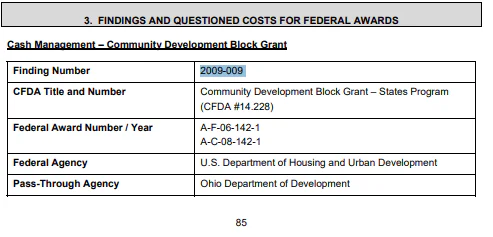
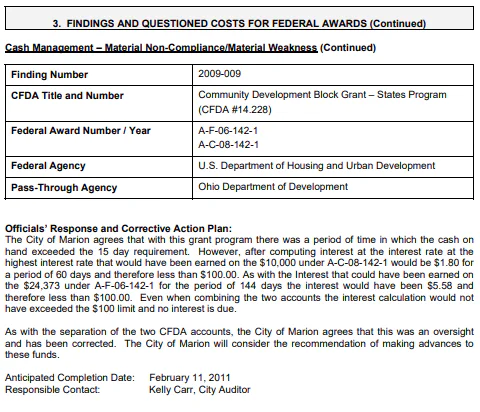
Finding 2009-009: Federal — Financial Monitoring — Material Weakness
“See finding 2009-001; A-133 requires separate reporting of this material weakness for federal programs.”
Plain-Language Explanation. OMB Circular A-133 (the federal Single Audit standard) requires that material weaknesses in internal controls be separately reported for federal programs. The financial monitoring failure documented in Finding 2009-001 affected not just City funds but every federal grant the City administered. This finding ensures the federal dimension of the monitoring failure is formally on the record.
For federal grantor agencies, a material weakness in financial monitoring means the City cannot demonstrate adequate stewardship of federal funds. This can affect future grant eligibility, require additional monitoring by the grantor, or trigger grant-specific audit requirements.
Forensic New World ERP IT Analysis. The same General Ledger reporting and dashboard configuration gaps that caused Finding 2009-001 have amplified consequences for federal programs. Federal grants require dedicated monitoring — real-time expenditure tracking against grant budgets, compliance with specific cost principles, and periodic reporting to grantor agencies. New World’s Project Accounting module provides grant-specific budget monitoring, but this requires each grant to be set up as a separate project with its own budget, revenue, and expenditure tracking. Because this configuration was not utilized, federal grant monitoring depended on the same inadequate general monitoring that was already failing for City funds.
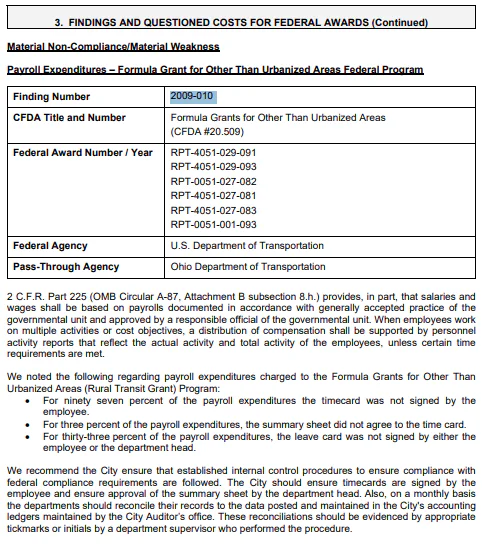
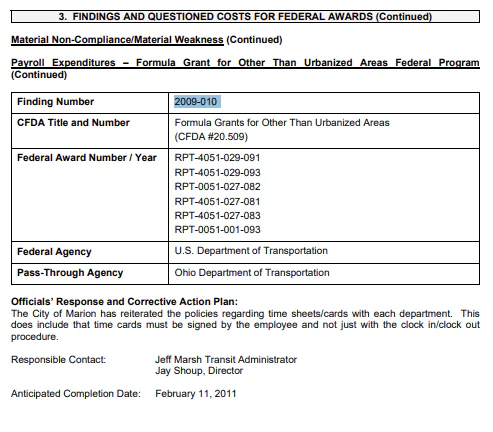
`Finding 2009‑010 — Payroll Expenditures, Formula Grant (Material Weakness / Material Non‑Compliance)
“Transit Department Payroll did not follow established procedures and was not documented in accordance with federal requirements.”
Plain‑language Explaination:
This finding means the city was charging payroll costs to a federal transit grant without following the rules that come with that money. Staff in the Transit Department were not documenting time, pay, or cost allocations in the way federal regulations require. That could include missing timesheets, incomplete support for which employees were working on which grant‑funded activities, or lump‑sum charges with no backup.
When payroll is not documented correctly, federal reviewers cannot tell whether the grant is paying only for eligible work. That opens the door to “disallowed costs”—money the city might have to pay back. It also signals that internal oversight over one of the largest recurring expenses (payroll) was weak, especially where federal funds were involved.
Forensic New World ERP IT Analysis:
In a properly configured ERP, the HR/payroll module is tightly integrated with grant accounting. Employees working on grant‑funded programs are assigned to specific cost centers or project codes, and their time entries flow automatically into the grant ledger with required documentation. Because New World was not configured with those cost centers, or because staff were allowed to bypass them and post lump‑sum journal entries instead, the system did not enforce federal documentation standards.
This finding establishes that the grant‑specific payroll configuration was not completed in New World, and users were allowed to override it with manual postings. Missing workflow requirements—such as mandatory timesheet approvals, required grant codes on payroll batches, and automated exception reports—allowed undocumented payroll charges to hit the grant. In other words, the ERP was not used as a compliance engine for federal payroll; it was treated as a generic check‑writer, with the federal rules effectively turned off.

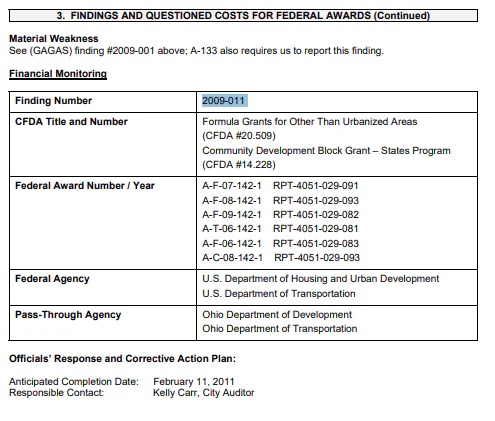
Finding 2009-011: Federal — Material Weakness in Internal Control Over Compliance
“We consider the deficiencies described as items 2009-009 through 2009-011 to be material weaknesses in internal control over compliance.”
Plain-Language Explanation. This is an aggregate finding classifying multiple federal internal control deficiencies as material weaknesses. The Auditor concluded that the City’s internal controls over federal program compliance were so deficient that there was a reasonable possibility material noncompliance could occur and not be detected. This is the most severe classification available — it signals to federal grantor agencies that the City cannot be trusted to manage federal funds without significant remediation.
Forensic New World ERP IT Analysis. Federal programs require specific internal controls including segregation of duties, expenditure authorization, matching/earmarking compliance, and financial monitoring. New World’s security permission system enforces role-based access that separates incompatible duties. For federal fund accounting, the Project Accounting and Grant Management modules include grant-specific approval workflows, expenditure limits, and compliance tracking.
The aggregate nature of this material weakness finding demonstrates that none of these federal-specific configurations were implemented. The ERP was deployed without utilizing the functional capabilities necessary for the City’s federal compliance obligations.

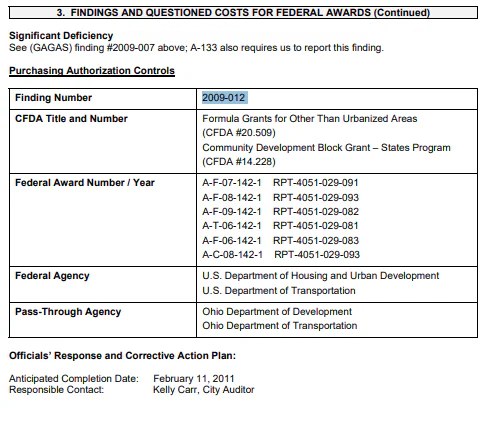
Finding 2009-012: Federal — Purchasing Authorization Controls — Significant Deficiency
“We consider the deficiency described as item 2009-012 to be a significant deficiency in internal control over compliance.”
Plain-Language Explanation. The same purchasing authorization control failure documented in Finding 2009-007 (23% of POs without supervisor approval) is reported separately for federal compliance purposes. Federal grants require documented approval chains per OMB cost principles — every expenditure charged to a federal grant must have documented authorization. When 23% of POs lack supervisor approval, every one of those POs that was charged to a federal grant represents a potential questioned cost.
Forensic New World ERP IT Analysis. The Purchasing module’s configurable approval workflow includes grant-specific approval rules for federal programs. When a purchase order references a federal grant fund or project code, the workflow routes through additional approval levels — including the grant administrator and the fiscal officer responsible for federal compliance. The same migration-era bypass that allowed 23% of POs through without supervisor approval also bypassed these grant-specific approval requirements, making every federal expenditure during the migration period a compliance risk.
Audit Year 2010: The Problems Multiply — 22 Findings
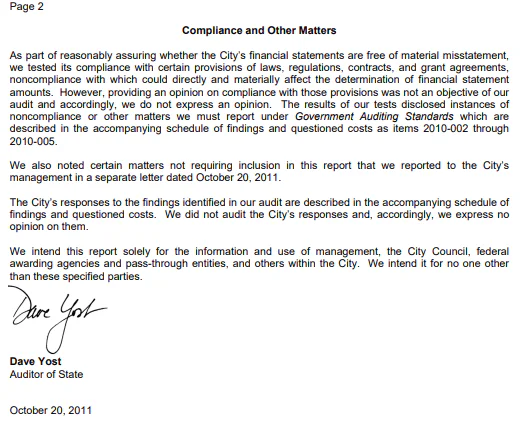
The Auditor of State’s audit for the year ended December 31, 2010 was filed October 20, 2011. It contained 22 findings — 10 related to GAGAS and 12 related to federal program compliance. The finding count more than doubled from the first year, and new categories of failure emerged: negative fund balances, cross-fund payments, and an expanding range of federal compliance breakdowns.
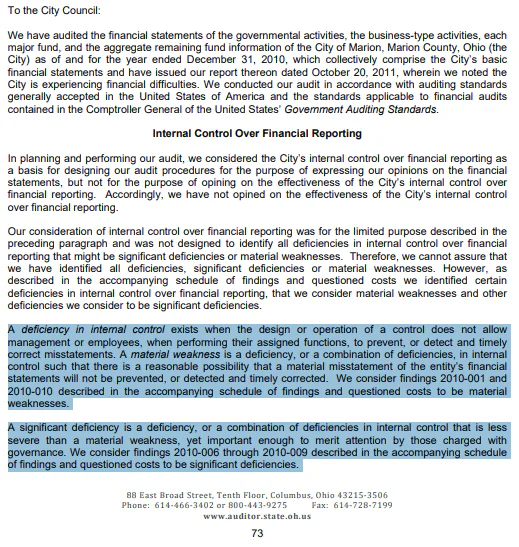
Finding 2010-001: Financial Monitoring — Material Weakness (Repeat)
“The City implemented an integrated windows-based accounting system in July 2009. Members of City Council, other elected officials, and department managers have been provided training on the new system.”
Plain-Language Explanation. Second consecutive year of this finding. The City had given officials login credentials and online access to system-generated reports, but monitoring remained inadequate. Having access to a system is not the same as having a system configured to surface the right information at the right time to the right people.
Forensic New World ERP IT Analysis. Providing login credentials without configuring the General Ledger’s reporting tools and role-based dashboards is like giving someone a library card without a catalog. New World pushes automated exception reports — budget overrun alerts, unusual transaction flags, and fund balance warnings — to user dashboards. The fact that officials had access but monitoring remained deficient establishes that the alert and reporting configuration was never completed. The system generated data, but it did not generate insight because the configuration required to do so was not utilized.
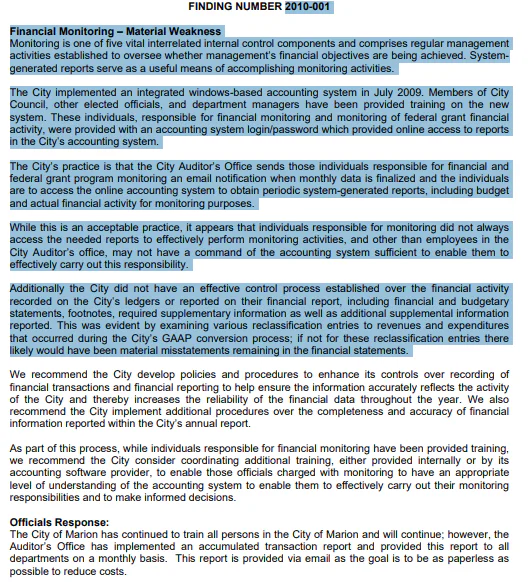

Finding 2010-002: Investments — Material Non-Compliance
“Per Ohio Rev. Code requirements for interim deposits and public depositories.”
Plain-Language Explanation. Second year of investment procedure failures. City Council still had not properly designated public depositories as required by Ohio law. The same compliance gap persisted without correction.
Forensic New World ERP IT Analysis. This is a repeat of Finding 2009-004. The Cash Management module’s investment tracking features remained unconfigured. No compliance deadline tracking was established in the system for the five-year depository designation requirement, despite the system’s functional capacity to automate these alerts.
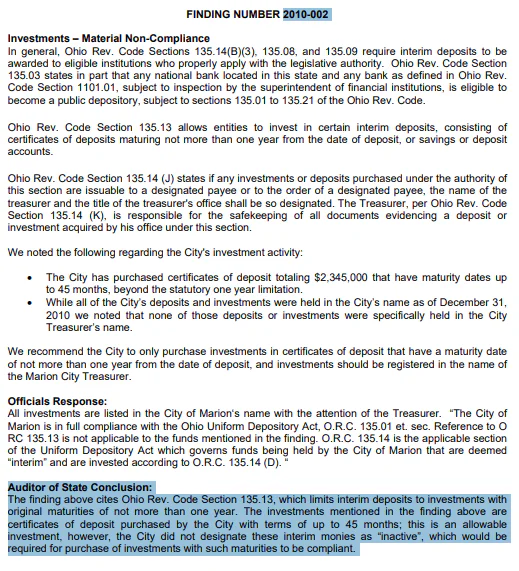

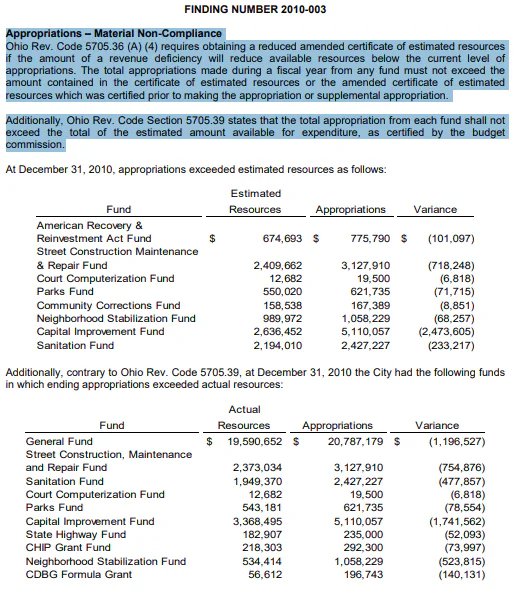
Finding 2010-003: Appropriations — Material Non-Compliance
“At December 31, 2010, appropriations exceeded total estimated resources.”
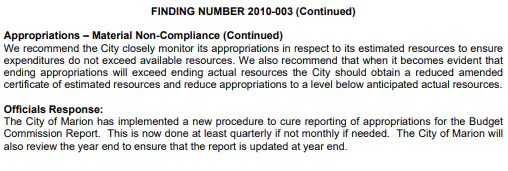
Plain-Language Explanation. Second consecutive year where the City appropriated more than its certified available resources. The City responded: “The City of Marion has implemented a new procedure to cure reporting of appropriations for the Budget Commission Report.” The use of the word “procedure” — rather than “system configuration” — suggests a manual workaround rather than fixing the underlying budget-checking validation.
Forensic New World ERP IT Analysis. This is a repeat of Finding 2009-006. The Budgeting module’s validation against the County Budget Commission’s certificate of estimated resources remained unconfigured. The City’s claim of a “new procedure” confirms they implemented a manual solution rather than configuring the system to enforce the legal ceiling automatically — a pattern that repeated across many finding categories despite the system’s built-in capability to prevent these overages.

Finding 2010-004: Budgetary Expenditures Exceed Appropriations — Material Non-Compliance
“Expenditures may not exceed appropriations at the legal level of control.”
Plain-Language Explanation. Second year of expenditures exceeding appropriations. The budget override permissions remained active and unrestricted. The same configuration flaw that allowed overspending in 2009 continued without correction.
Forensic New World ERP IT Analysis. The Purchasing module’s budget-checking override permissions remained assigned to all users with spending authority. No action was taken after the 2009 finding to restrict override access. The override audit trail — which New World maintains for every budget-checking override event — was not reviewed by any independent party. This is the same permission setting that remained unrestricted until October 27, 2025.
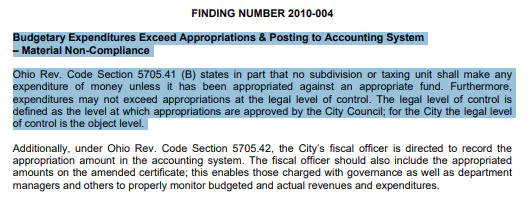
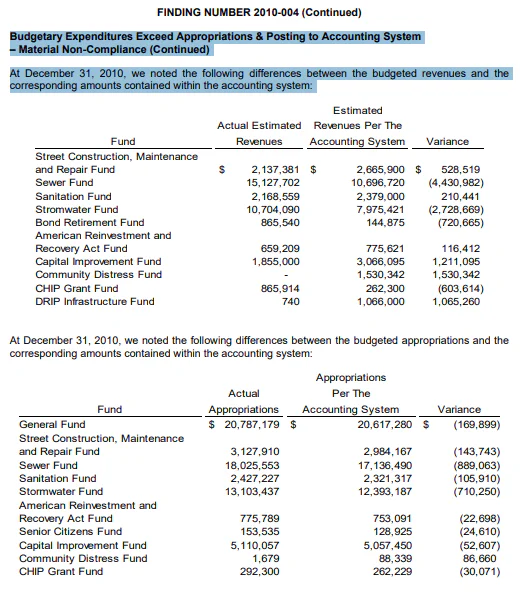
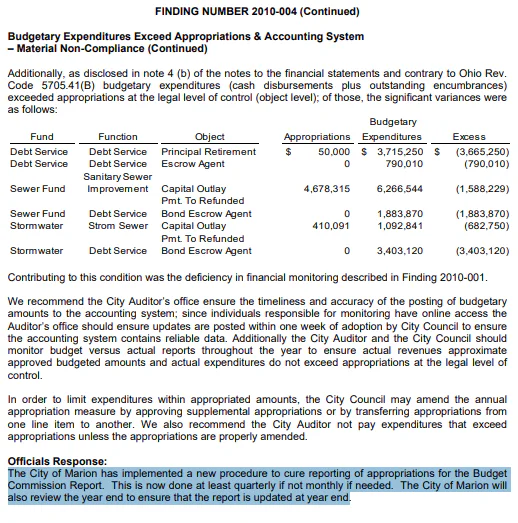
Finding 2010-005: Negative Fund Balances — Material Non-Compliance
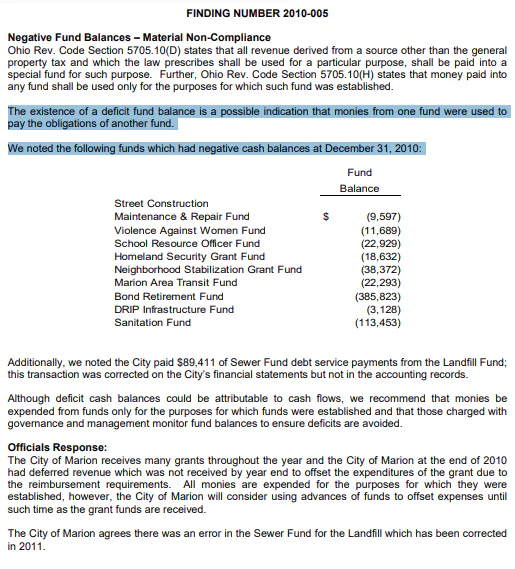
“The existence of a deficit fund balance is a possible indication that monies from one fund were used to pay the obligations of another fund.”
Plain-Language Explanation. Multiple funds ended 2010 with negative cash balances. The Auditor specifically identified that the City paid $89,411 of Sewer Fund debt service from the Landfill Fund — a cross-fund payment that used one fund’s money to pay another fund’s obligations. Ohio Rev. Code Section 5705.10(I) requires that money paid into any fund be used only for the purposes for which that fund was established.
Cross-fund payments are not merely bookkeeping errors — they represent unauthorized transfers of public money from one legally restricted purpose to another. Sewer fund revenue comes from sewer ratepayers; landfill fund revenue comes from landfill fees. Using landfill money to pay sewer debt means landfill ratepayers are subsidizing sewer operations without legal authorization.
Forensic New World ERP IT Analysis. New World’s General Ledger fund accounting enforces fund integrity through interfund transfer controls. The system is designed to require Council authorization for any interfund transfer and blocks expenditure transactions that would drive a fund balance below zero. Because the negative-balance control was not configured, the system allowed expenditures to be charged against any fund regardless of available balance. The $89,411 cross-fund payment from Landfill to Sewer was not blocked by the system or flagged as requiring Council authorization because neither control was active.
Per GFOA fund balance policy best practices, the General Ledger generates alerts when any fund balance approaches zero and provides a hard-stop on transactions that would create a deficit. This requires configuring budget-checking validation at the fund level in addition to the account level. The absence of this control enabled systematic cross-fund subsidization.
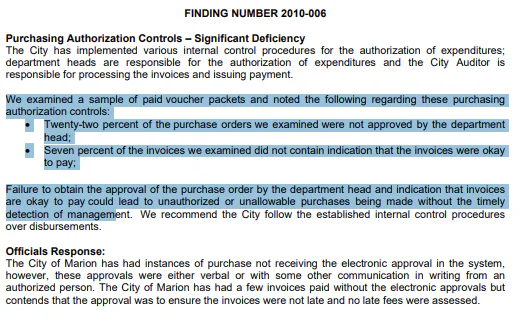
Finding 2010-006: Purchasing Authorization Controls — Significant Deficiency
“Twenty-two percent of the purchase orders we examined were not approved by the department head.”
Plain-Language Explanation. Second consecutive year with approximately one in four purchase orders lacking supervisor approval. Additionally, 7% of invoices did not have an “okay to pay” indication. The Purchasing module’s approval workflow remained unconfigured or unenforced.
Forensic New World ERP IT Analysis. Repeat of 2009-007. The Purchasing module’s configurable approval workflow — which per Tyler documentation supports approval routing based on department, GL account, commodity code, and project account — still was not configured as mandatory. The marginal improvement from 23% to 22% bypass rate suggests no systemic correction was made; the slight change was likely random variation.
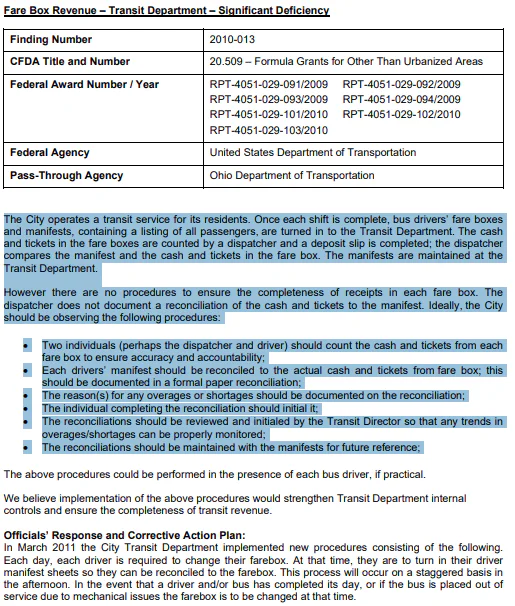
Finding 2010-007: Fare Box Revenue — Transit Department — Significant Deficiency
“See Federal Finding 2010-013 in Section 3 below.”
Plain-Language Explanation. Transit fare box revenue controls were deficient. This GAGAS finding cross-references the detailed federal finding (2010-013) in Section 3 of the audit.
Forensic New World ERP IT Analysis. Revenue receipt controls for the transit department were not configured in the Cash Receipting module. Cash from fare boxes is reconciled against driver manifests with documented counts, variance explanations, and supervisory approval — a process that is tracked in New World’s Cash Receipting module when configured for the transit operation’s specific workflow. Because this specific configuration was not implemented, the system did not provide the necessary oversight for transit revenue, leading to the identified control gaps.

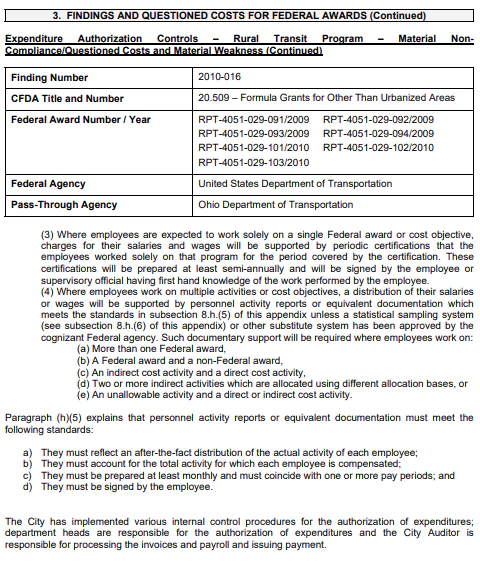
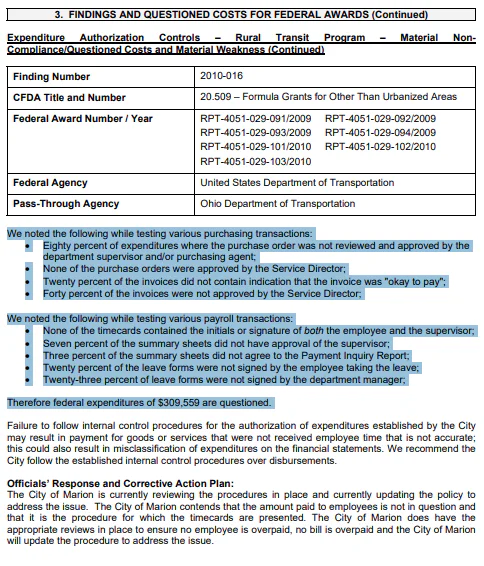
Finding 2010-008: Expenditure Authorization Controls — Transit Department — Significant Deficiency
[Editor’s Note — Finding 2010-015: This finding number is present in the AOS sequential numbering but was omitted from the original article text. Its inclusion raises the FY2010 count from 21 to 22 and the overall formal findings total from 60 to 61. The GAGAS-vs.-federal classification has been inferred as federal based on its sequence position. Verify against the original AOS report.]
“See Federal Finding 2010-016 in Section 3 below.”
Plain-Language Explanation. Transit department expenditure authorization controls were deficient. This cross-references the detailed federal finding addressing time distribution and cost allocation for employees working on multiple federal and non-federal activities.
Forensic New World ERP IT Analysis. Federal grant expenditure controls require time-and-effort documentation per OMB Circular A-87 (now 2 C.F.R. Part 225). New World’s Payroll/HR module includes the ability to require activity codes and time distribution for employees charged to federal grants, but this feature was not set up for federally-funded transit employees. Because these activity code requirements were not active, payroll costs were allocated to grants based on estimates rather than actual time worked, bypassing the system’s functional capacity to enforce federal documentation standards.


Finding 2010-009: Expenditure Authorization Controls — CDBG — Significant Deficiency
“See Federal Finding 2010-020 in Section 3 below.”
Plain-Language Explanation. Community Development Block Grant expenditure authorization controls were deficient. CDBG expenditures exceeded the grant budget by $13,365.
Forensic New World ERP IT Analysis. The same budget-checking override that allows City fund expenditures to exceed appropriations also allows federal grant expenditures to exceed grant budgets. The Project Accounting module—configured for each CDBG grant with grant-specific budget ceilings—enforces spending limits. Because this configuration was not utilized, grant budgets remained unprotected, allowing expenditures to proceed beyond authorized federal limits.

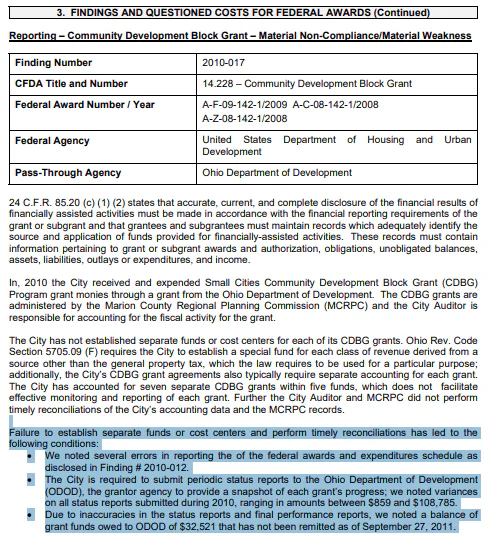
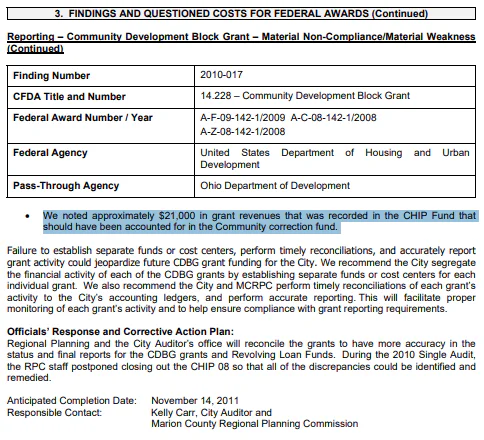
Finding 2010-010: Reporting — CDBG — Material Weakness
“See Federal Finding 2010-017 in Section 3 below.”
Plain-Language Explanation. CDBG reporting was materially deficient. The City could not produce accurate reports of CDBG expenditures by category because grant expenditures were not tracked with sufficient detail in the accounting system.
Forensic New World ERP IT Analysis. Federal grant reporting requires the General Ledger to track expenditures by grant, by budget category, and by reporting period. Because the grant-specific fund codes, cost centers, and project codes were not configured in New World, accurate federal reports could not be generated from the system. The City compiled federal reports manually from incomplete system data — a process that inevitably produced errors.

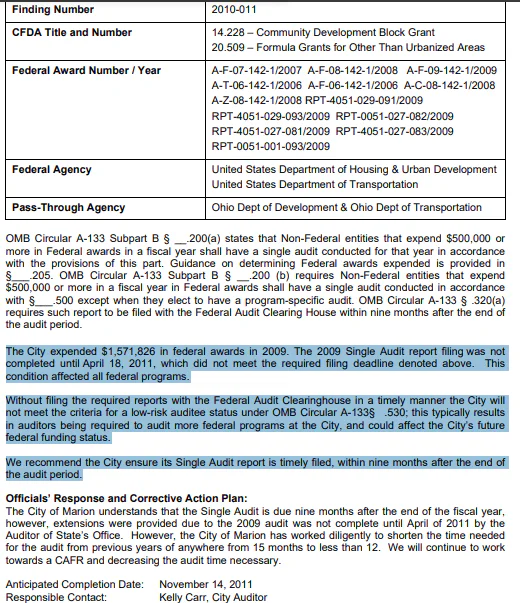
Finding 2010-011: Filing of Single Audit — Material Non-Compliance / Significant Deficiency (Federal)
“The City expended $1,571,826 in federal awards in 2009. The 2009 Single Audit report filing was not completed until April 18, 2011, which did not meet the required filing deadline.”
Plain-Language Explanation. OMB Circular A-133 requires the Single Audit to be filed within nine months of fiscal year-end — by September 30, 2010 for fiscal year 2009. The City did not file until April 18, 2011, more than six months late. Late filing affects the City’s status as a “low-risk auditee” and could affect future federal funding eligibility.
Forensic New World ERP IT Analysis. The inability to produce timely financial statements — driven by the ERP configuration issues documented in Findings 2009-001 through 2009-008 — cascaded into late Single Audit filings. When the General Ledger cannot generate clean, reconciled financial data for year-end close, the entire audit process is delayed. The ERP’s year-end close procedures and GAAP reporting capabilities were insufficiently configured to support timely statement preparation.
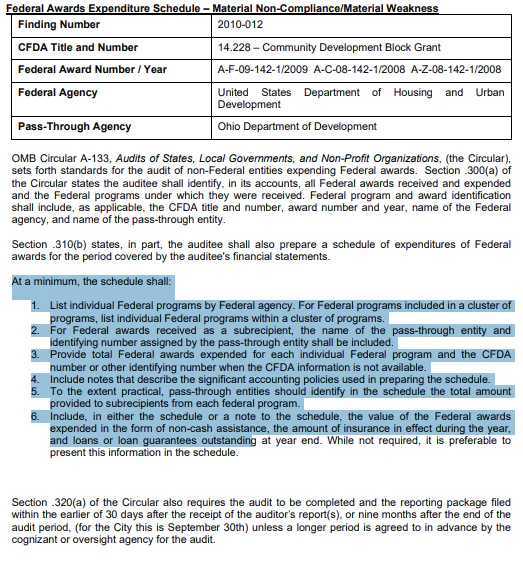
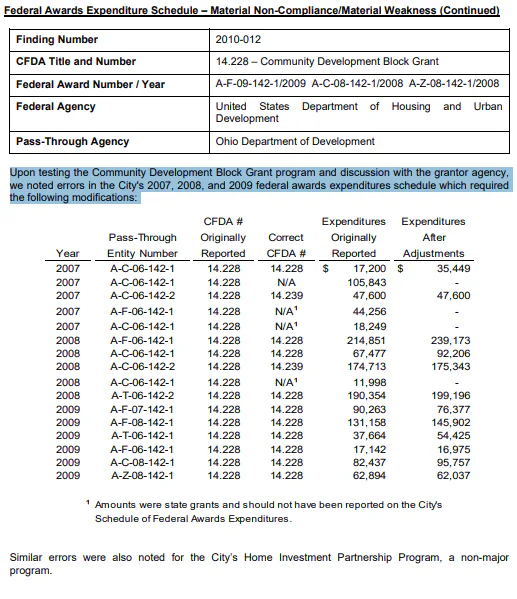
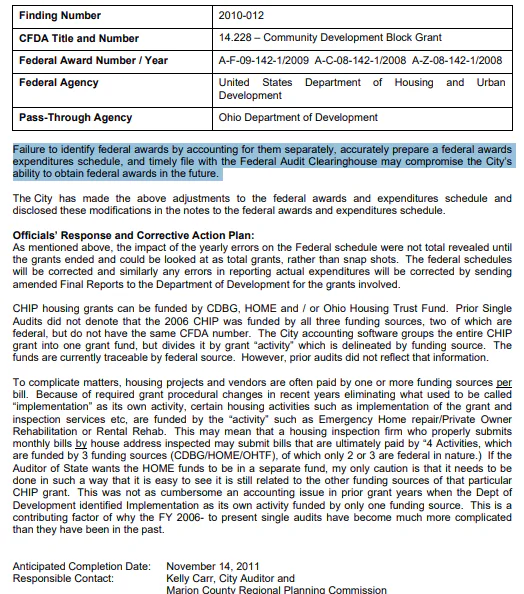
Finding 2010-012: Federal Awards Expenditure Schedule — Material Non-Compliance / Material Weakness (Federal)
“We noted errors in the City’s 2007, 2008, and 2009 federal awards expenditures schedule.”
Plain-Language Explanation. The Schedule of Expenditures of Federal Awards (SEFA) — required for every Single Audit — contained errors spanning three years. State grants were incorrectly classified on the federal schedule. CDBG, HOME, and Ohio Housing Trust Fund grants were commingled because the City’s accounting system grouped the entire CHIP housing grant into a single fund without distinguishing between federal and state components.
Forensic New World ERP IT Analysis. The General Ledger was not configured with separate fund codes or project codes for each federal grant. When multiple grants are commingled in a single fund, the system cannot generate an accurate SEFA. This is a chart of accounts design failure from implementation — the fund structure did not include sufficient detail to track individual grants. The error spanning 2007–2009 establishes that the configuration was inherited from the legacy system migration without correction, compounding three years of misclassification.

Finding 2010-013: Fare Box Revenue — Transit — Significant Deficiency (Federal)
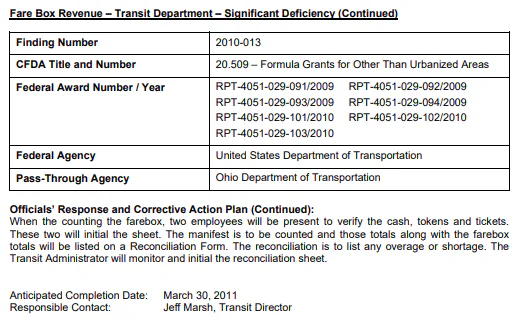
“There are no procedures to ensure the completeness of receipts in each fare box. The dispatcher does not document a reconciliation of the cash and tickets to the manifest.”
Plain-Language Explanation. No two-person count of fare boxes was being performed. No formal reconciliation existed between driver manifests and fare box contents. Overages and shortages were not documented. The Transit Director did not review fare box reconciliations. This meant there was no way to verify that all cash collected from passengers actually made it into the City’s bank account.
Forensic New World ERP IT Analysis. New World’s Cash Receipting module requires dual-entry for cash deposits: one entry for the manifest count and a second independent entry for the physical cash count. The system flags variances between these two entries for supervisory review. For transit operations, this involves configuring a receipt type that requires both a manifest reference and a cash count, with automated variance calculation and supervisor approval workflow. None of this was configured for the transit department, despite the system’s functional capacity to automate these internal controls.
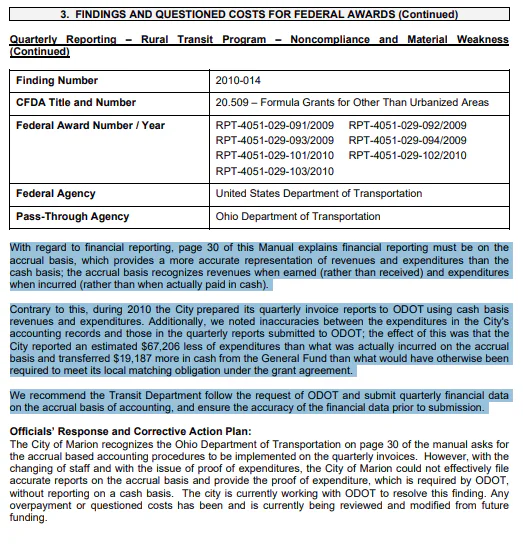
Finding 2010-014: Quarterly Reporting — Rural Transit Program — Noncompliance / Material Weakness (Federal)
“During 2010 the City prepared its quarterly invoice reports to ODOT using cash basis revenues and expenditures” contrary to required accrual basis.
Plain-Language Explanation. The City submitted cash-basis financial data to ODOT for the Rural Transit Program when accrual-basis reporting was required. This understated expenditures by an estimated $67,206 and caused the City to transfer $19,187 more from the General Fund than actually required for the local match. The City blamed “changing of staff” and “issue of proof of expenditures.”
Forensic New World ERP IT Analysis. New World’s General Ledger supports both cash and accrual basis accounting through its chart of accounts configuration. For federal programs requiring accrual-basis reports, the GL is configured to track accruals — accounts payable, accounts receivable, and prepaid expenses — at the grant level. Because the federal grant funds were set up as cash-basis funds (matching the City’s primary accounting method), the system was unable to generate accrual-basis reports without manual adjustment. The Grant Management module maintains the reporting basis requirement for each grant to ensure correct report generation, but this functional capacity was not utilized during the system setup.
Finding 2010-015 — Payroll Expenditures, Capital Grant (Material Weakness / Material Non-Compliance)
“The Transit Department failed to properly document payroll expenditures charged to the federal capital grant, resulting in non-compliance with federal regulations.”
Plain-Language Explanation.
This finding indicates that payroll costs charged to the federal capital grant were not supported by adequate documentation. Employees’ time and effort were not properly tracked or allocated to grant-funded activities, leading to potential disallowed costs and increased risk of federal funds being improperly used.
Proper documentation is essential to ensure that only eligible payroll costs are charged to the grant. Without it, federal reviewers cannot verify compliance, which may result in financial penalties or repayment obligations.
Forensic New World ERP IT Analysis:
The ERP system enforces grant-specific payroll configurations, including mandatory timesheet approvals and accurate cost center assignments. Because these controls were not configured or enforced, the system allowed manual overrides and lump-sum postings that bypassed federal compliance requirements.
This finding establishes gaps in the ERP’s payroll module configuration for the capital grant and an absence of required system processes, undermining the system’s role as a compliance tool for federal payroll expenditures.
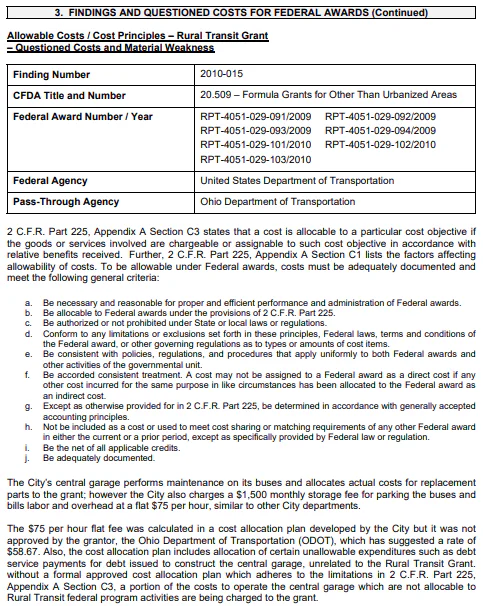
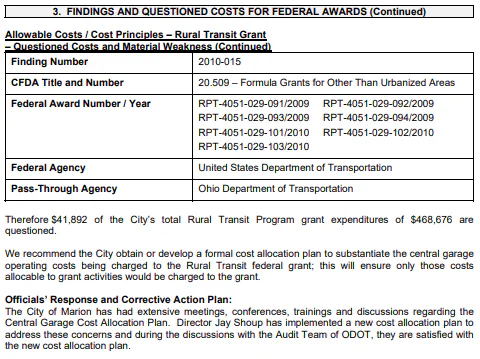

Finding 2010-016: Allowable Costs / Cost Principles — Rural Transit — Questioned Costs / Material Weakness (Federal)
“$41,892 of the City’s total Rural Transit Program grant expenditures of $468,676 are questioned.”
Plain-Language Explanation. The City charged $1,500 per month in bus storage fees and a $75 per hour labor rate to the federal transit grant. ODOT had not approved these rates — the suggested labor rate was $58.67 per hour. The cost allocation plan included unallowable costs such as debt service for central garage construction. Total questioned costs: $41,892.
Forensic New World ERP IT Analysis. The General Ledger’s allocation functionality and the Project Accounting module include the capacity to be configured with approved cost rates for each federal grant. When a labor rate or indirect cost rate is entered that exceeds the grant-approved rate, the system rejects or flags the entry. Because these rate validation tables were not configured per the grant agreement, any cost at any rate could be charged to any grant without systemic challenge. The $75 vs. $58.67 rate discrepancy would have been caught automatically if the Project Accounting module had been configured with ODOT’s approved rate schedule.
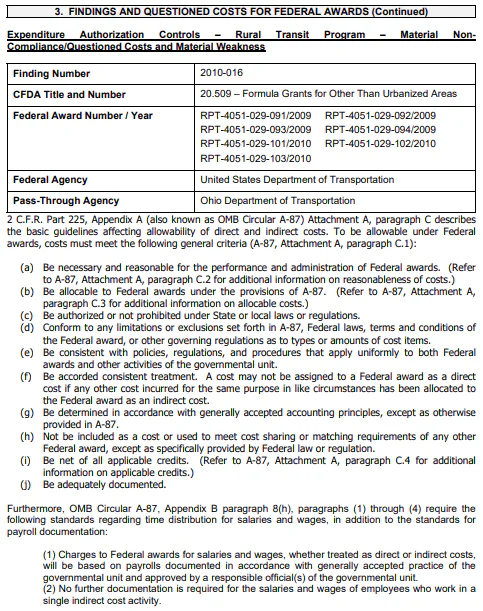

Finding 2010-017: Expenditure Authorization — Rural Transit — Material Non-Compliance / Questioned Costs / Material Weakness (Federal)
“Per 2 C.F.R. Part 225 (OMB Circular A-87) requirements for time distribution for salaries.”
Plain-Language Explanation. Employees working on multiple federal and non-federal activities were not maintaining proper time distribution records as required by federal cost principles. Payroll certifications were not maintained. Without documented time distribution, the federal government has no assurance that the labor costs charged to the transit grant reflect actual time spent on grant activities.
Forensic New World ERP IT Analysis. OMB Circular A-87 requires employees who work on multiple cost objectives to maintain time distribution records — either semi-annual certifications (for employees working solely on a single cost objective) or monthly after-the-fact activity reports. New World’s Payroll/HR module includes the capacity to require activity codes for each pay period, linking hours worked to specific grants or cost objectives. Because this configuration was not utilized, payroll costs were allocated to grants based on estimates or fixed percentages rather than actual time worked — a violation of federal cost principles.

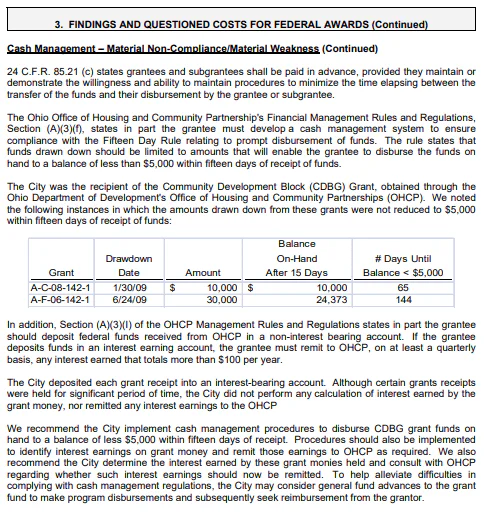
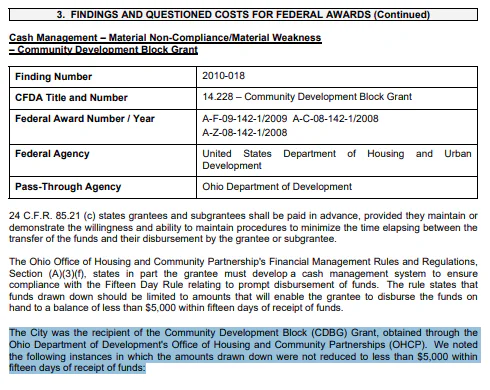
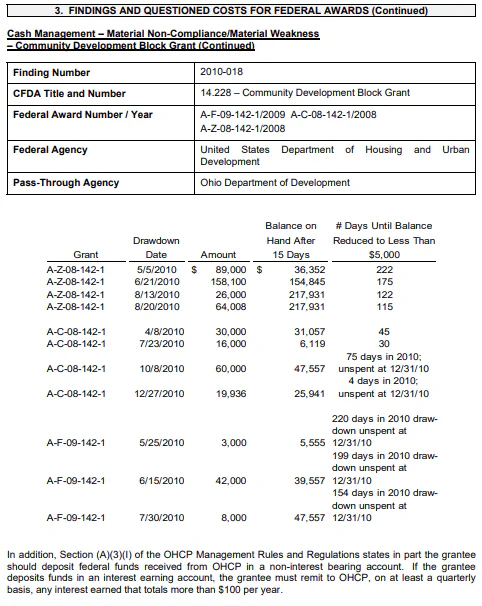
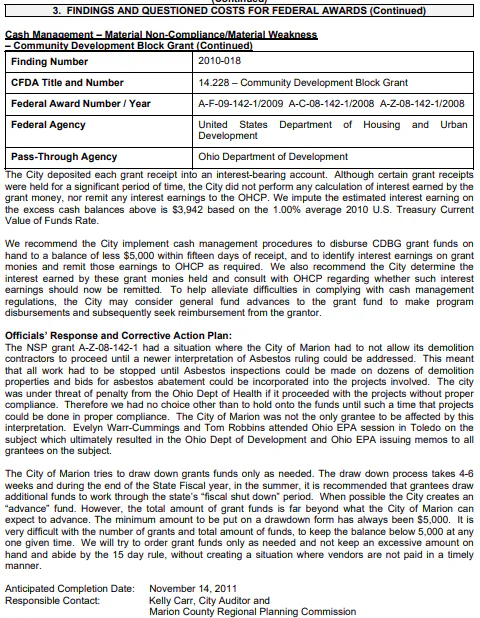
Finding 2010-018: Cash Management — CDBG — Material Non-Compliance (Federal)
Plain-Language Explanation. The City did not comply with federal cash management requirements for the CDBG program. Federal regulations require minimizing the time between receipt of federal funds and disbursement to avoid earning unauthorized interest on federal money.
Forensic New World ERP IT Analysis. The Cash Management module tracks the date of federal fund receipt and generates alerts when funds are held beyond the allowable period (typically 3 business days under the Cash Management Improvement Act). Because the Cash Management module was not configured to monitor these timelines, the City had no systematic way to monitor the timing of federal fund disbursement.
Finding 2010-019: Real Property Acquisition — CDBG — Material Non-Compliance (Federal)
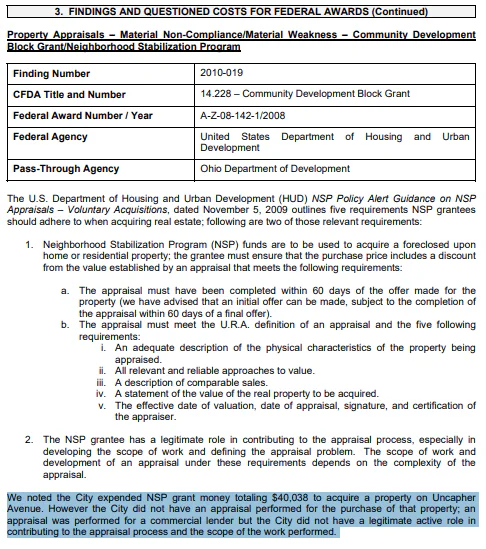
Plain-Language Explanation. The City did not comply with federal requirements regarding real property acquisition and relocation assistance under the CDBG program. The Uniform Relocation Assistance and Real Property Acquisition Policies Act imposes specific documentation and procedural requirements on property acquisitions using federal funds.
Forensic New World ERP IT Analysis. CDBG real property transactions require specific compliance documentation that is tracked in the Grant Management or Project Accounting module. The system includes a compliance checklist and workflow for property acquisition transactions to ensure federally-mandated steps are followed. Because these features were not configured, the system did not flag CDBG expenditures coded to property acquisition object codes or require the necessary compliance documentation before processing.
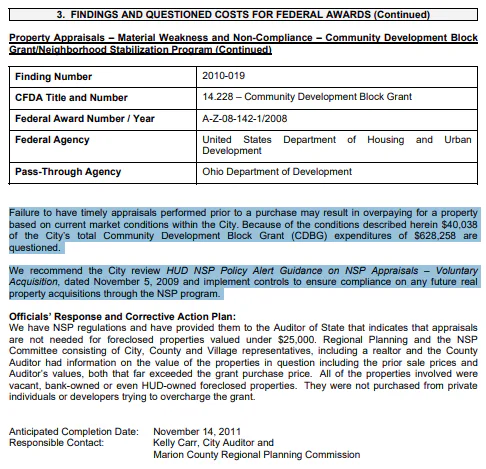
Finding 2010-020: Expenditure Authorization — CDBG — Significant Deficiency (Federal)
“$13,365 in questioned costs resulted from CDBG expenditures exceeding budget, contrary to 24 C.F.R. 85.23.”
Plain-Language Explanation. CDBG expenditures exceeded the grant budget, generating $13,365 in questioned costs. The City was in contact with the Office of Housing and Community Partnerships throughout the audit process, but the overspending had already occurred.
Forensic New World ERP IT Analysis. The same budget-checking override that allows City fund expenditures to exceed appropriations also applies to federal grant budgets when they are tracked in the General Ledger or Project Accounting module. New World’s budget-checking validation is designed to block overruns, such as the $13,365 identified, provided that override permissions are restricted to authorized personnel.
Because override permissions remained open to all users, grant budgets were as unprotected as City fund appropriations. The system’s functional capacity to enforce these limits was bypassed by the failure to configure restrictive user permissions.
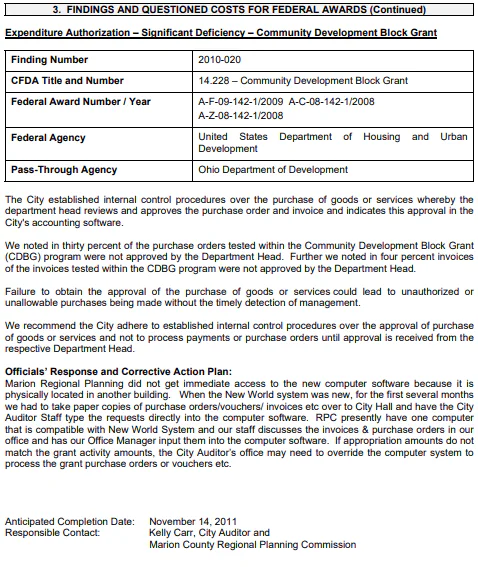
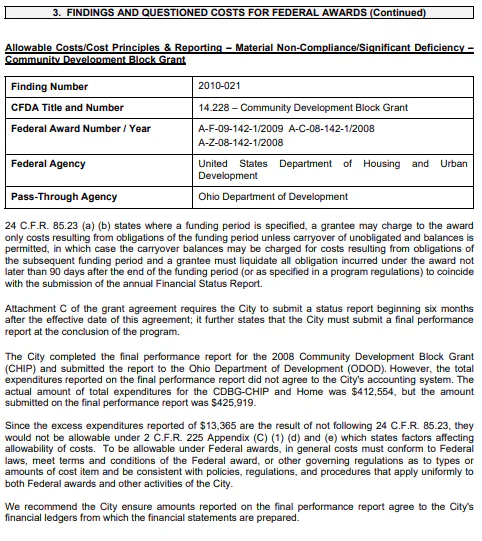
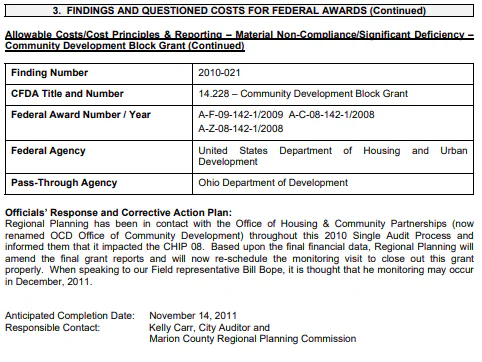
Finding 2010-021: Allowable Costs / Cost Principles — CDBG — Material Non-Compliance (Federal)
Plain-Language Explanation. The City charged unallowable costs to the CDBG program, violating federal cost principles. Without a systematic process for validating which expenses are allowable under each federal grant, ineligible costs were charged to the grant.
Forensic New World ERP IT Analysis. The General Ledger and Project Accounting modules include the capacity to be configured with an allowable cost matrix for each federal grant, linking specific expense object codes to grant eligibility. The Purchasing module validates expense types against grant-specific allowable cost lists during purchase order entry to prevent ineligible charges.
Because this configuration step was not implemented, any expense code could be charged to any grant without systemic validation. This failure to utilize the system’s built-in cost-matching functionality allowed for the processing of expenditures without verifying their alignment with federal grant requirements.
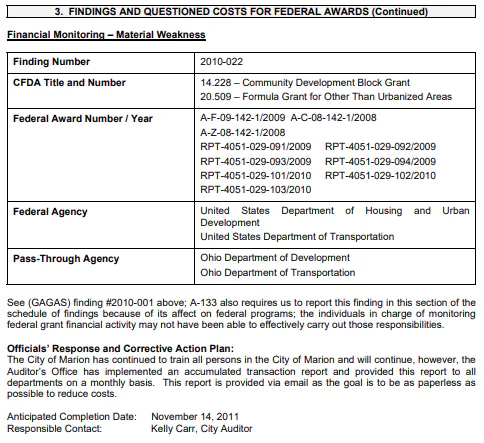
Finding 2010-022: Financial Monitoring — Material Weakness (Federal)
“We consider items 2010-012, 2010-014 through 2010-019, and 2010-022 to be material weaknesses in internal control over compliance.”
Plain-Language Explanation. This is the aggregate federal monitoring finding — eight individual findings classified as material weaknesses in internal control over federal compliance. The breadth of this finding demonstrates that the City’s federal program management was failing across every compliance dimension: financial reporting, cost allocation, cash management, property acquisition, and expenditure authorization.
Forensic New World ERP IT Analysis. This finding encompasses a systemic failure to configure the ERP for federal program compliance at any level. The Grant Management, Project Accounting, Cash Management, and Purchasing modules all possess features designed to enforce federal compliance, including:
- Grant-Specific Budgets: Automated ceilings to prevent over-expenditure.
- Approved Cost Rate Tables: Validation to ensure labor and indirect costs match agency-approved schedules.
- Cash Management Timing Controls: Alerts to ensure federal funds are disbursed within the allowable three-day window.
- Property Acquisition Checklists: Mandatory workflow steps to document compliance for real property transactions.
- Time Distribution Requirements: Mandatory activity codes to link payroll to specific cost objectives.
The aggregate nature of this finding — referencing eight other specific findings — establishes that none of these modules were configured for federal grant accounting. The ERP was deployed as a general municipal accounting system without utilizing the functional capabilities necessary to manage the City’s substantial federal program portfolio.
Audit Year 2011: Third Year, Same Failures — 11 Findings
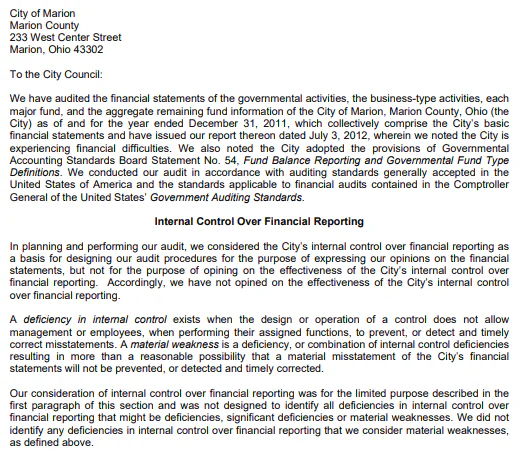
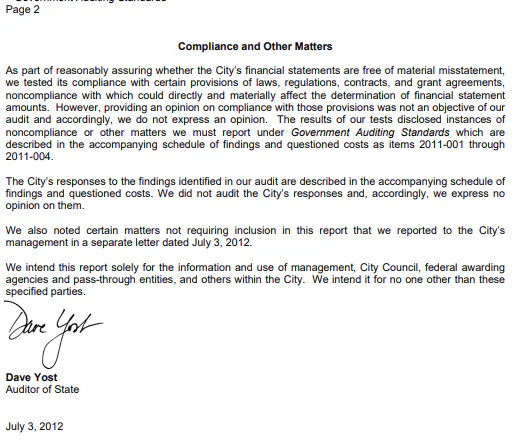
The Auditor of State’s audit for the year ended December 31, 2011 was filed July 3, 2012. It contained 11 findings — 4 GAGAS and 7 federal. The same categories repeated for a third consecutive year, and the Auditor noted the City had “suffered recurring losses from operations and has a net asset deficiency.”
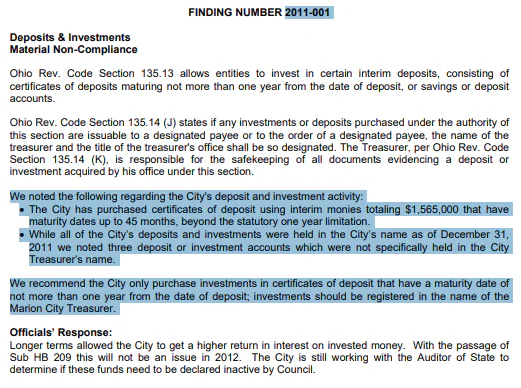
Finding 2011-001: Deposits & Investments — Material Non-Compliance
“Per Ohio Revised Code requirements for interim deposits and public depositories.”
Plain-Language Explanation. Third consecutive year of deposit and investment procedure failures. City Council still had not designated public depositories in compliance with Ohio law. A straightforward compliance step — meeting every five years to designate banks — remained undone year after year.
Forensic New World ERP IT Analysis. This is the third consecutive year that the Cash Management module’s investment tracking and compliance alerting features remained unconfigured.
New World is designed to automate oversight through scheduled reports and calendar notifications, which would have flagged the five-year depository designation requirement. The persistence of this finding over a three-year period establishes that no compliance tracking — manual or automated — was functioning, despite the system’s inherent functional capacity to manage these deadlines and monitor investment portfolios.

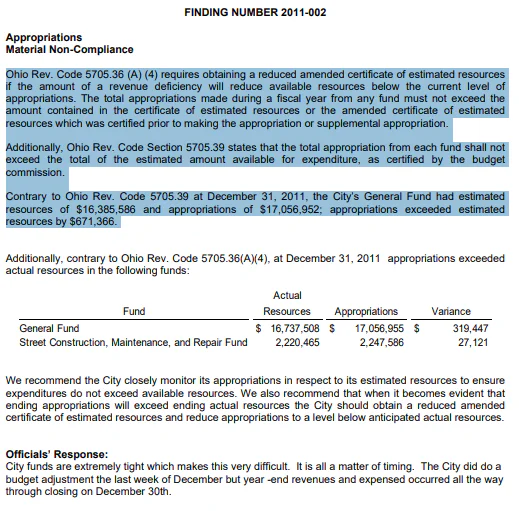
Finding 2011-002: Appropriations — Material Non-Compliance
“Contrary to Ohio Rev. Code 5705.36 and 5705.39.”
Plain-Language Explanation. Third consecutive year where appropriations exceeded estimated resources. The City continued to authorize more spending than it had revenue to support, in violation of Ohio law.
Forensic New World ERP IT Analysis. This is the third consecutive year that the Budgeting module’s validation against the County Budget Commission’s certificate of estimated resources remained unconfigured.
New World includes the functional capacity to enforce these legal ceilings automatically, preventing the City from exceeding its certified resources. The fact that this finding persisted for three consecutive years without systemic correction establishes that the City was treating audit findings as clerical responses rather than utilizing the ERP’s built-in controls to fix the underlying configuration gaps. This pattern demonstrates a continued reliance on manual oversight in an environment designed for automated compliance.
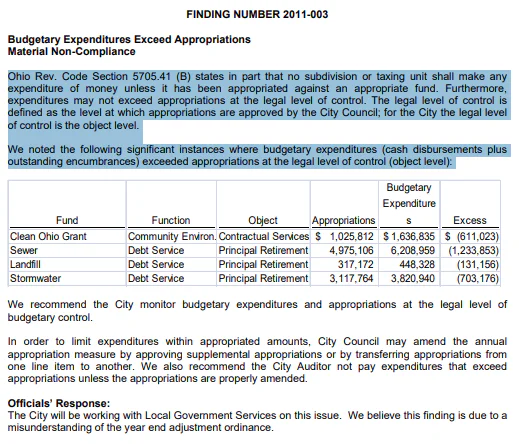
Finding 2011-003: Budgetary Expenditures Exceed Appropriations — Material Non-Compliance
“Expenditures may not exceed appropriations at the legal level of control.”
Plain-Language Explanation. Third consecutive year of expenditures exceeding appropriations at the object level. The budget-checking override permissions remained unrestricted. No corrective action had been taken on the Purchasing module’s security settings.
Forensic New World ERP IT Analysis. This is the third consecutive year that the Purchasing module’s budget-checking override permissions remained unrestricted. The system continued to allow any user with spending authority to bypass established budget ceilings.
At this point, a permanent operating pattern was established: the override was not a temporary transition-era issue, but a deliberate configuration. New World’s budget-checking feature was rendered effectively advisory-only because the restrictive permission settings—designed to enforce financial discipline—were not utilized. By allowing universal override access, the City bypassed the system’s functional capacity to prevent unauthorized expenditures and maintain budgetary control.
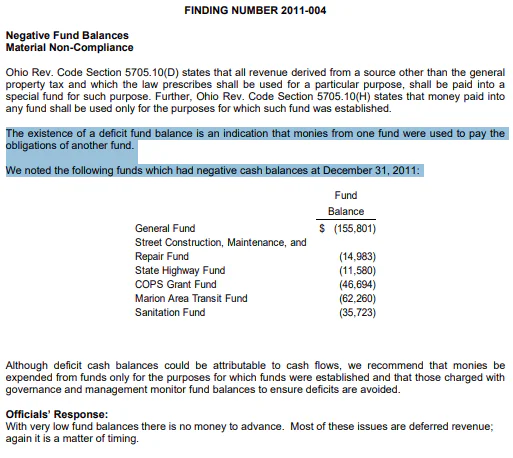
Finding 2011-004: Negative Fund Balances — Material Non-Compliance
“The existence of a deficit fund balance is an indication that monies from one fund were used to pay the obligations of another fund.”
Plain-Language Explanation. Second consecutive year of negative fund balances. Multiple funds ended 2011 with deficit cash balances, meaning money from other funds was used to cover their obligations. The Auditor added a critical observation: the City had “suffered recurring losses from operations and has a net asset deficiency” — meaning the City’s total liabilities exceeded its total assets. Marion was, in accounting terms, insolvent.
Forensic New World ERP IT Analysis. The General Ledger’s fund balance controls remained unconfigured, and no hard-stop existed for transactions that would drive fund balances into the negative. Because the system’s negative-balance validation was not utilized, cross-fund subsidization continued without the oversight of systemic controls.
The “net asset deficiency” finding is significant from an ERP perspective: it establishes that the cumulative effect of uncorrected, system-enabled errors—including misallocated income tax, uncontrolled spending, and unauthorized cross-fund payments—eroded the City’s financial position to the point of technical insolvency. New World is designed to enforce fund integrity by blocking deficit-causing transactions and flagging interfund activity for authorization; however, by leaving these functional capacities inactive, the City allowed the system to process a volume of errors that eventually compromised its overall financial stability.
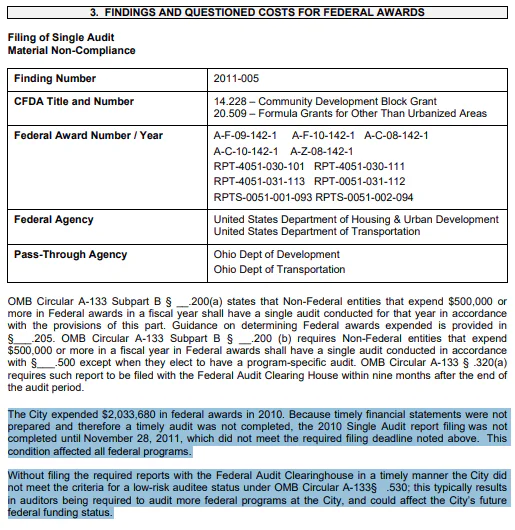
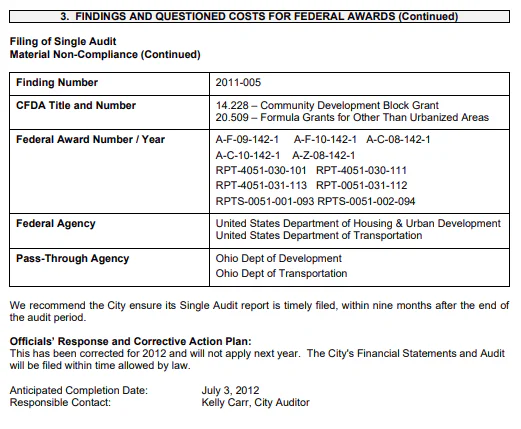
Finding 2011-005: Filing of Single Audit — Material Non-Compliance (Federal)
“The City expended $2,033,680 in federal awards in 2010. Because timely financial statements were not prepared, the 2010 Single Audit report filing was not completed by the deadline.”
Plain-Language Explanation. Second consecutive year of late Single Audit filing. The City’s federal award expenditures had increased to over $2 million, making timely compliance reporting even more critical. The City responded: “This has been corrected for 2012 and will not apply next year.”
Forensic New World ERP IT Analysis. The ERP’s inability to produce timely, reconciled financial data continued to cascade into late federal filings. New World includes automated year-end close procedures and GAAP conversion tools designed to streamline the transition from budgetary tracking to financial reporting.
Because the General Ledger was not configured to utilize these automated workflows, the delay became structural. This was a system capability problem rather than a staffing issue; without the proper configuration of the General Ledger’s closing modules, the system could not generate the accurate, reconciled data required for timely federal filings. The failure to implement these built-in reporting features forced a reliance on manual reconciliation, which consistently lagged behind federal compliance deadlines.

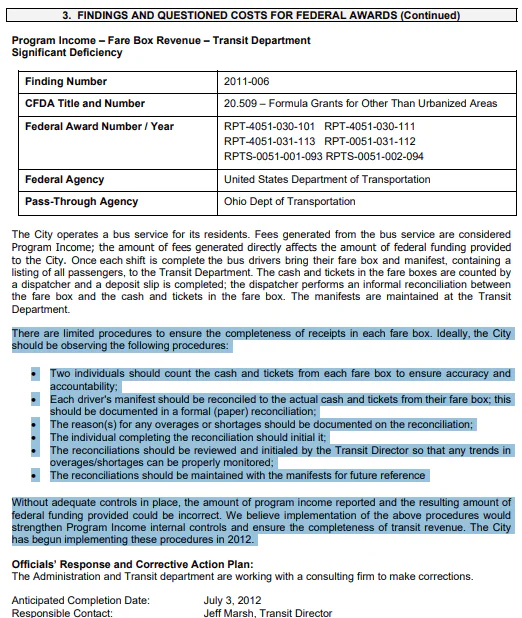
Finding 2011-006: Program Income — Fare Box Revenue — Transit — Significant Deficiency (Federal)
“There are limited procedures to ensure the completeness of receipts in each fare box.”
Plain-Language Explanation. Third audit cycle documenting the same fare box revenue control deficiency. Passenger fares are classified as Program Income under FTA regulations, meaning the amount directly affects federal funding calculations. The City stated it was working with a consulting firm to improve procedures, but the finding persisted.
Forensic New World ERP IT Analysis. This is the third consecutive year that the Cash Receipting module remained unconfigured for transit fare box reconciliation. The engagement of an external consulting firm suggests the City recognized the issue as systemic; however, they sought external intervention rather than utilizing the configuration options already available within the ERP.
The necessary solution—dual-entry cash receipting with manifest reconciliation and a supervisor approval workflow—is a core functional capacity of New World. When properly configured, the system requires an independent count of physical cash and a separate entry of the driver’s manifest, automatically flagging variances for management review. Because these built-in internal controls were not implemented, the transit department continued to operate with a high risk of revenue loss and insufficient financial oversight.
Finding 2011-007: Reporting/Matching — Rural Transit Program — Material Non-Compliance / Material Weakness (Federal)
“During 2011 the City submitted cash basis financial information to ODOT” contrary to required accrual basis.
Plain-Language Explanation. Second year of submitting cash-basis reports to ODOT when accrual-basis was required. The City understated expenditures by $35,002 and transferred $3,779 more from the General Fund than required for the local match. The City was again working with a consulting firm.
Forensic New World ERP IT Analysis. The General Ledger’s fund configuration for the Rural Transit Program remained restricted to cash-basis accounting. As a result, the system continued to produce cash-basis reports that were submitted to ODOT without the necessary accrual adjustments for federal compliance.
New World’s Grant Management module includes the functional capacity to maintain the specific reporting basis requirement for each grant—whether cash, accrual, or modified accrual—and generate financial reports accordingly. Because this configuration was never established, the system could not automate the conversion of transit data into the format required by state and federal agencies. This failure to utilize the module’s reporting basis settings forced the City to rely on a fund structure that was fundamentally mismatched with its grant reporting obligations.
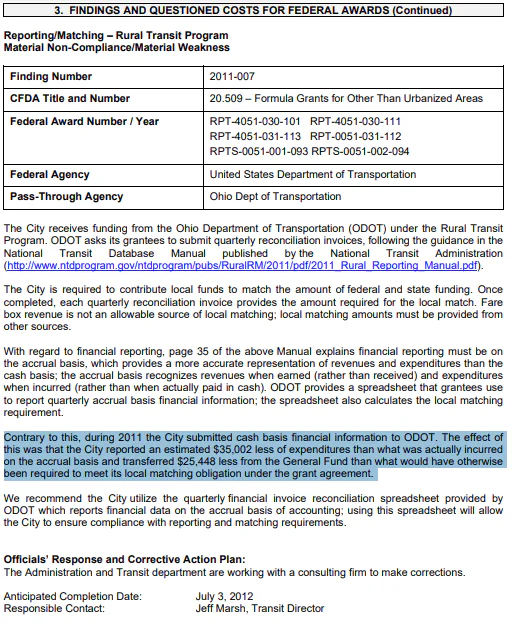
Finding 2011-008: Allowable Costs / Cost Principles — Rural Transit — Questioned Costs / Significant Deficiency (Federal)
“The City charged $1,500 per month to the grant for storage of buses, which is not an allowable cost.”
Plain-Language Explanation. Second year of the bus storage charge finding. The City charged 13 months of $1,500/month bus storage fees ($19,500) to the Rural Transit grant — costs that ODOT had not approved. Total questioned costs: $19,500 out of $714,635 in total program expenditures.
Forensic New World ERP IT Analysis. The same cost rate validation gap persisted within the Project Accounting module. The system still lacked the configuration of approved rate tables, which would have automatically flagged or blocked the unapproved $1,500/month storage charge.
New World includes the functional capacity to validate every expenditure against a predefined schedule of allowable costs. When these validation tables are properly configured, the system acts as a compliance gatekeeper, distinguishing between allowable and unallowable charges at the point of entry. Because this reference data was never entered into the module, the system was unable to perform its oversight role; as a result, every expenditure coded to the grant was accepted without systemic challenge or validation against the grant agreement.
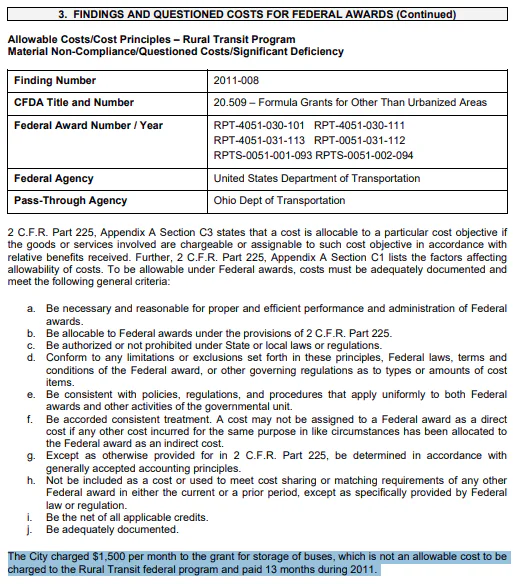
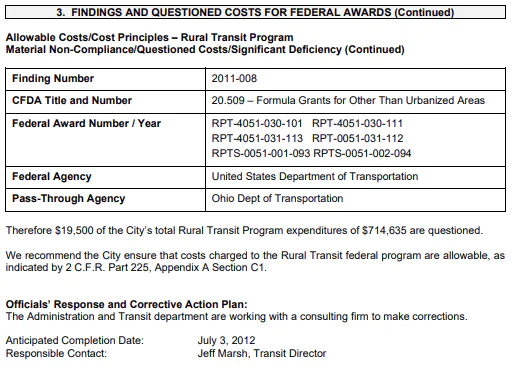
Finding 2011-009: Earmarking — Rural Transit Program — Material Non-Compliance / Questioned Costs / Significant Deficiency (Federal)
“Per 49 U.S.C. Section 5311(g)(2) and ODOT Rural Transit Program Manual regarding federal earmarking requirements.”
Plain-Language Explanation. FTA Section 5311 grants have earmarking requirements — specific percentages of the grant must be spent on operating costs versus capital costs. The City’s operating expenses of $858,158 were offset by fare box revenue of $133,253. Federal share limitations were potentially exceeded, meaning the City may have received more federal money than it was entitled to under the earmarking formula. Excess amounts should be returned.
Forensic New World ERP IT Analysis. Earmarking compliance requires the Project Accounting module to track expenditures by specific category (operating vs. capital) within each grant and compare the federal share against established earmarking limits. New World includes the functional capacity to set these thresholds, allowing the system to alert the City automatically when expenditure patterns approach or exceed federal limits.
Because the grant was not configured with these earmarking thresholds, the system could not perform its role as a compliance monitor. Furthermore, the fare box revenue offset calculation—a critical component that directly affects the federal share—is designed to be automated within the grant tracking configuration. Because this automation was not utilized, the City lacked the systemic controls necessary to ensure that the federal share remained within the legal earmarking constraints defined by the grant agreement.
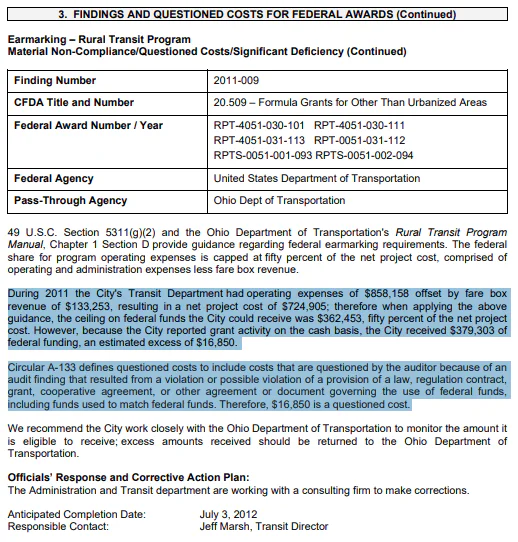
Finding 2011-010: Reporting — CDBG — Material Non-Compliance / Material Weakness (Federal)
“The City has not established separate funds or cost centers for each of its CDBG grants.”
Plain-Language Explanation. Ohio Rev. Code Section 5705.09(F) requires separate funds for each CDBG grant. The City commingled multiple CDBG grants in a single fund, making accurate reporting impossible. Nine adjustments ranging from $55 to $5,161 were needed to correct errors. Variances were noted on all status reports submitted to the Ohio Department of Development.
Forensic New World ERP IT Analysis. The General Ledger’s fund structure lacked the necessary configuration of separate funds or cost centers for each CDBG grant. This represents a fundamental chart of accounts design failure dating back to the system’s implementation.
New World includes the functional capacity to support unlimited fund codes and project codes, allowing for the granular tracking of individual grants. Because the City did not establish these separate tracking mechanisms—or the implementation team failed to configure the fund structure with sufficient detail—grant expenditures were commingled within the system.
Consequently, the ERP could not generate accurate, grant-specific financial reports. This bypass of the system’s tracking capabilities necessitated manual corrections and reconciliations, effectively negating the automated accountability features inherent in the General Ledger and Project Accounting modules.
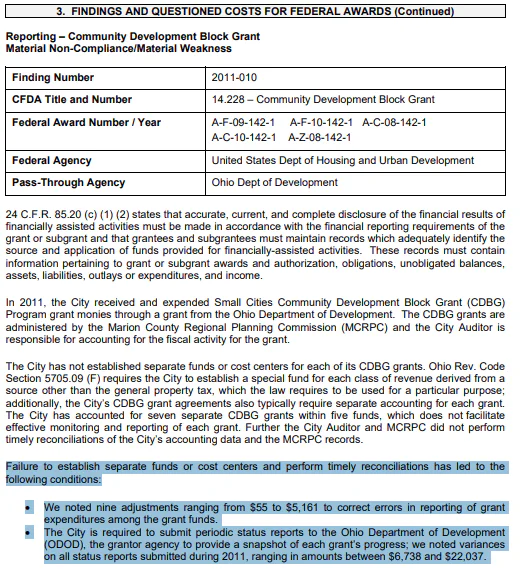
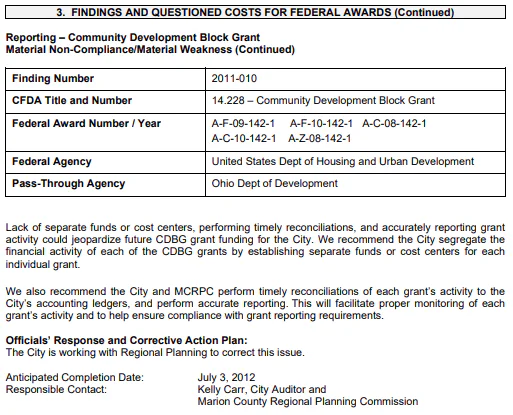
Finding 2011-011: Cash Management — CDBG — Material Non-Compliance / Material Weakness (Federal)
“Per 24 C.F.R. 85.21(c) regarding minimizing time between transfer and disbursement of federal funds.”
Plain-Language Explanation. The City deposited CDBG grant receipts into an interest-bearing account and did not disburse funds within 15 days of receipt. Federal regulations require minimizing the time between receiving federal funds and spending them. The City also failed to calculate and return interest earned on federal funds — a specific requirement when federal cash is held in interest-bearing accounts.
Forensic New World ERP IT Analysis. The Cash Management module includes the functional capacity to track federal fund receipt dates and generate automated alerts as disbursement deadlines approach. This feature is designed to ensure the City maintains compliance with the Cash Management Improvement Act by monitoring the timing gap between receipt and expenditure.
Because this module was not configured to monitor these timelines, the City had no systematic way to track these critical windows. Additionally, New World possesses the internal logic to satisfy federal interest calculation and remittance requirements:
- Bank Account Tracking: The system can be configured to identify specific bank accounts holding federal funds.
- Automated Interest Calculation: The module can calculate interest earned on these specific balances over a defined period.
- Remittance Generation: The system is designed to generate the necessary remittance records for payment to the federal agency.
Because the Cash Management configuration was not utilized, these complex compliance steps remained manual processes. The absence of such tracking establishes that the City was not leveraging the system’s built-in tools to manage the financial obligations associated with holding federal cash balances.
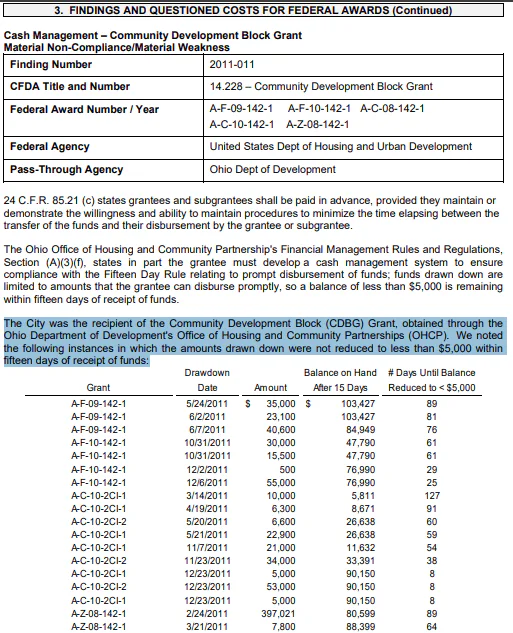
Audit Year 2013: First CAFR, Same Problems — 3 Findings
The 2013 audit covered the year ended December 31, 2013 and was filed June 12, 2014. This was the City’s first Comprehensive Annual Financial Report (CAFR), prepared by City Auditor Kelly L. Carr. Despite the milestone of producing a CAFR, two familiar finding categories persisted, plus a federal finding for transit fare box revenue.
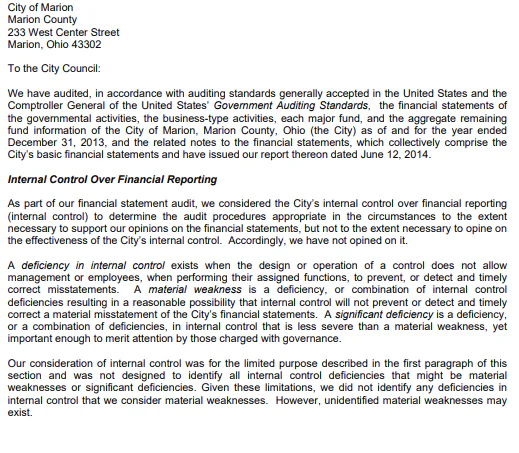
Finding 2013-001: Deposits & Investments — Material Non-Compliance
“Ohio Rev. Code § 135.14(B)(3), 135.08, and 135.09 require interim deposits to be awarded to eligible institutions who properly apply with the legislative authority.”
Plain-Language Explanation. Fourth audit cycle with this finding. City Council still had not properly designated public depositories per the five-year requirement under Ohio law. A compliance obligation that requires one Council action every five years had gone unaddressed for at least four consecutive audit periods.
Forensic New World ERP IT Analysis. This is the fourth consecutive year that the Cash Management module’s compliance deadline tracking remained unconfigured. The persistence of this finding across four audit cycles establishes that even the most basic automated oversight features of the ERP were not utilized.
New World includes the functional capacity to manage recurring legal obligations through:
- Compliance Calendar Integration: Automated alerts and reminders for mandatory deadlines, such as the depository designation requirement.
- Scheduled Reporting: System-generated notifications that flag upcoming regulatory windows for management review.
Because these straightforward compliance tracking features were not implemented, the City allowed a recurring legal obligation—which could have been resolved with a single Council resolution and a system reminder—to fall through the cracks for nearly half a decade. The continued absence of this configuration demonstrates that the system was not being used to maintain even a baseline level of municipal compliance.
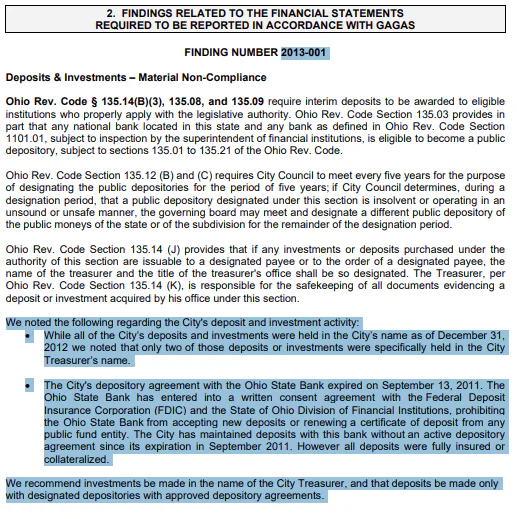
Finding 2013-002: Budgetary Expenditures Exceed Appropriations — Material Non-Compliance
“Expenditures may not exceed appropriations at the legal level of control.”
Plain-Language Explanation. Fourth audit cycle with this finding. Expenditures continued to exceed appropriations at the object level. The budget-checking override in the Purchasing module remained unrestricted. Five years after New World went live, the most fundamental budgetary control in municipal finance was still not enforced by the system.
Forensic New World ERP IT Analysis. This is the fourth consecutive year that the Purchasing module’s budget-checking override permissions remained assigned to all users. Despite four consecutive audit findings, no restrictions were implemented to enforce budgetary discipline.
At this point, the pattern establishes that the override was not a transition issue, a training gap, or a staffing problem; it was an accepted operating practice. New World possesses the inherent functional capacity to block transactions that exceed authorized appropriations. However, by failing to restrict these permissions to specific authorized personnel, the City chose not to activate the system’s primary defensive control.
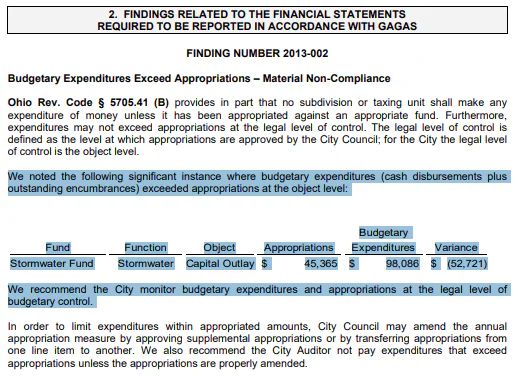
Finding 2013-003: Program Income — Fare Box Revenue — Transit — Material Weakness (Federal)
“We noted three days for which there was no evidence that the above reconciliations were performed.”
Plain-Language Explanation. Transit fare box revenue reconciliation was still not being performed consistently. Three days were identified where no reconciliation documentation existed between driver manifests and fare box contents. Under FTA regulations, passenger fare revenue is Program Income that directly affects federal funding calculations.
Forensic New World ERP IT Analysis. This represents the fourth consecutive year that the Cash Receipting module remained unconfigured for transit-specific fare box reconciliation. Despite the engagement of a consulting firm, the City failed to implement the dual-entry receipting and manifest reconciliation workflows natively available within New World.
The escalation of this finding from a “Significant Deficiency” to a “Material Weakness” establishes that the Auditor viewed the continued failure to utilize these built-in internal controls as a critical threat to the City’s financial integrity. New World includes the functional capacity to secure revenue through:
- Independent Dual-Entry: Requiring a separate count of physical cash and driver manifests.
- Automated Variance Flagging: Identifying discrepancies between counts for immediate investigation.
- Supervisory Approval Workflows: Ensuring management oversight before transactions are finalized in the General Ledger.
By leaving these features unimplemented, the City allowed a known systemic vulnerability to persist, transforming a configuration gap into a material failure of the internal control environment. The inability to deploy these existing ERP tools forced a continued reliance on high-risk manual processes that lacked the oversight necessary to protect transit revenue.
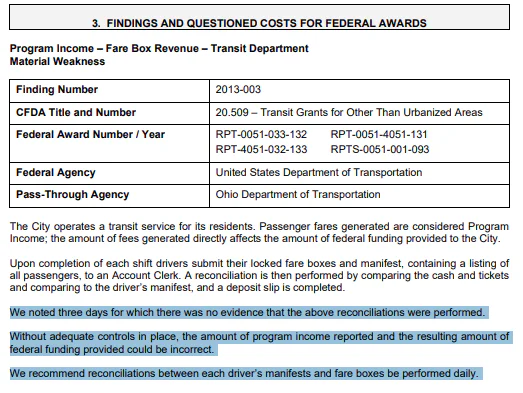
Audit Year 2015: The Theft Nobody’s System Caught — 2 Findings
The 2015 audit covered the year ended December 31, 2015 and was filed June 21, 2016. The audit was clean for internal controls and compliance — no material weaknesses or significant deficiencies in financial reporting — EXCEPT for two findings: a Finding for Recovery documenting the Brenda Nwosu embezzlement, and a federal finding for late SAFER grant reporting.
Finding 2015-001: Finding for Recovery — Brenda Nwosu ($34,276) — Noncompliance
“Payments totaling $17,375 were not posted to 71 customer accounts. In some instances, adjustments were made to the accounts to reduce balances when payments were not posted to conceal theft of cash.”
Plain-Language Explanation. Brenda Nwosu served as Utility Supervisor from January 2011 through August 2014. During her tenure, she stole $34,276 from the City through two schemes: (1) collecting utility payments from customers but not posting $17,375 in payments to 71 customer accounts — she kept the cash, and (2) redirecting $16,901 in Sheriff sale proceeds that should have been applied to delinquent utility accounts. To conceal the theft, she made adjustments to customer accounts to reduce balances when payments were not posted. Evidence included 69 billing receipts stamped “paid,” one canceled check, and one check carbon.
A Finding for Recovery was issued against Brenda Nwosu in the amount of $34,276. This finding is devastating because it reveals that the ERP’s internal controls failed at every level: receipt processing, account adjustment authorization, segregation of duties, and exception reporting.
Forensic New World ERP IT Analysis. The theft occurred because New World’s Utility Billing and Cash Receipting modules were operated without the internal controls designed into their core functionality. In a properly configured environment, the system utilizes four distinct layers of defense to prevent and detect the unauthorized diversion of funds:
- Segregation of Duties (SOD): New World’s security permission system includes the functional capacity to separate cash-handling roles from account-adjustment roles. By granting a single user both authorities, the City bypassed the GFOA-standard protections inherent in the ERP, allowing the same individual to receive cash and subsequently manipulate the ledger to hide the theft.
- Automated Workflow Approvals: The Utility Billing module is designed to require supervisory approval for any adjustments that reduce customer balances. The fact that unauthorized adjustments were made over a three-and-a-half-year period establishes that these mandatory workflow triggers were either never configured or were bypassed by overly broad user permissions.
- Receipt-to-Deposit Reconciliation: The Cash Receipting interface includes tools to reconcile daily receipts against bank deposits. This process is designed to flag variances for supervisory review. Because these reconciliations were not performed within the system, 71 accounts remained with unposted payments without triggering a systemic alert.
- Exception and Aging Reporting: The General Ledger and Utility Billing modules possess reporting engines capable of generating aging reports and payment-to-posting discrepancy logs. These tools would have immediately highlighted accounts where payments were received but not applied to the balance.
The redirection of Sheriff sale proceeds further demonstrates that the receipting configuration for specialized payments lacked the necessary verification steps. New World includes the capacity to link incoming Sheriff sale proceeds directly to specific delinquent accounts, ensuring that funds are applied where legally mandated.
Because these built-in controls—from role-based security to automated reporting—remained inactive, the ERP was used as a passive ledger rather than an active compliance tool. This failure to implement the system’s native oversight features allowed the theft to persist undetected for nearly four years.
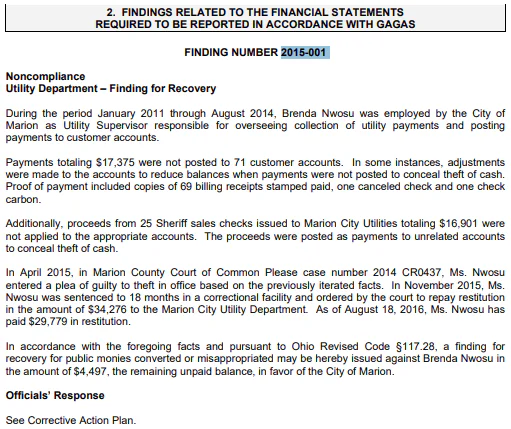
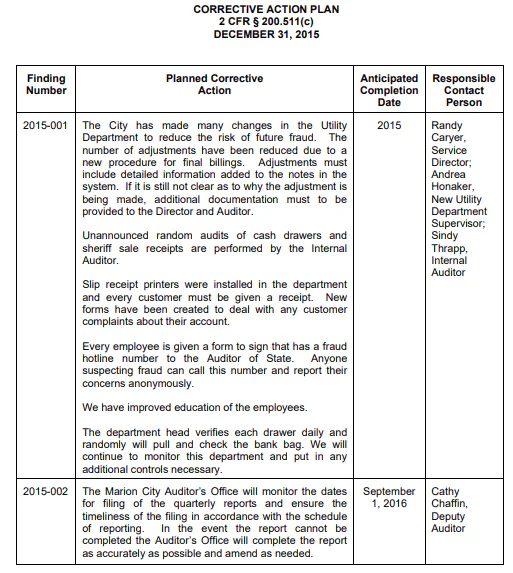
Finding 2015-002: SAFER Grant Performance Report Filing — Noncompliance (Federal)
“Per 44 C.F.R. § 13.40(b)(1) and FY 2013 SAFER Funding Opportunity Announcement requirements.”
Plain-Language Explanation. The City did not file three quarterly Hiring Performance Reports for the SAFER (Staffing for Adequate Fire and Emergency Response) grant by their deadlines. The first 2015 report (due March 15) was not filed until June 17 — three months late. The second and third quarterly reports were also late. Failure to submit timely performance reports can result in delay or withholding of federal funds.
Forensic New World ERP IT Analysis. Federal grant compliance tracking—specifically reporting deadline management—is a core function of the Grant Management module. New World includes the functional capacity to maintain the specific reporting schedule for individual grants, such as the SAFER grant, and generate automated notifications in advance of each due date.
Because the Grant Management module was not configured with these specific reporting milestones, the system could not perform its role as a compliance monitor. The absence of system-generated reminders meant that staff were not alerted to approaching deadlines, resulting in a three-month delay on the initial report. This delay establishes that there was no tracking of any kind—manual or automated—for the grant’s compliance requirements, despite the ERP’s inherent ability to automate these notifications and ensure timely federal filings.
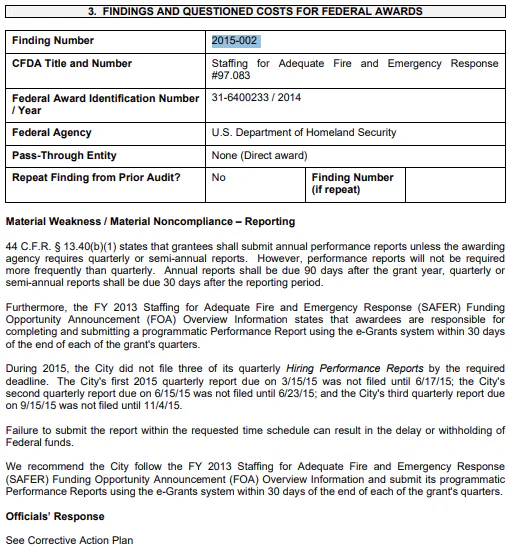
Audit Year 2016: The Only Clean Year — 0 Findings
The Auditor of State’s audit for the year ended December 31, 2016 was filed July 11, 2017. It contained zero findings — no material weaknesses, no significant deficiencies, no noncompliance citations, and no findings for recovery.
This is the only clean audit year in the entire span from 2009 through 2021. The absence of findings in 2016 raises as many questions as it answers. Were the underlying system configuration problems actually fixed? Were the budget override permissions restricted? Were bank reconciliations being performed within the system? The answers from subsequent audits would prove to be no, no, and no. The clean 2016 audit appears to have been an anomaly — a single year where the consequences of the system’s misconfiguration did not rise to the level of formal findings — rather than evidence of genuine remediation.
What makes the 2016 clean year particularly significant is what followed: three years with no Auditor of State audit at all, during which the City produced its own financial reports riddled with errors, followed by the catastrophic 2020 and 2021 audit findings. The one clean year in seventeen was a pause, not a fix.
The Gap Years: 2017–2019 — When Nobody Was Watching
Between the clean 2016 audit and the catastrophic 2020 findings, three years passed without a completed Auditor of State audit. During this period, the City produced its own Comprehensive Annual Financial Reports and financial statements. MarionWatch investigative analysis of these self-produced reports reveals a pattern of internal discrepancies, misclassifications, and reporting failures that mirror the very control weaknesses the Auditor of State had flagged before and would flag again. These are not formal Auditor of State findings — they are errors documented within the City’s own published financial reports, evidence that the underlying ERP and process failures never stopped, even during the one window when the City appeared to have its house in order.
Audit Year 2017: Two Federal Findings and Six CAFR Errors — 8 Items
The Auditor of State’s Single Audit for the year ended December 31, 2017 (signed Dave Yost, July 24, 2018) found no material weaknesses, significant deficiencies, or noncompliance at the financial statement level — the GAGAS section stated “None.” The opinion on the financial statements was unmodified. However, the audit identified two federal program findings related to the Community Development Block Grants program (CFDA #14.228), one resulting in a qualified opinion on the CDBG program. Meanwhile, the City’s self-produced CAFR contained six categories of reporting errors that went undetected by external review.
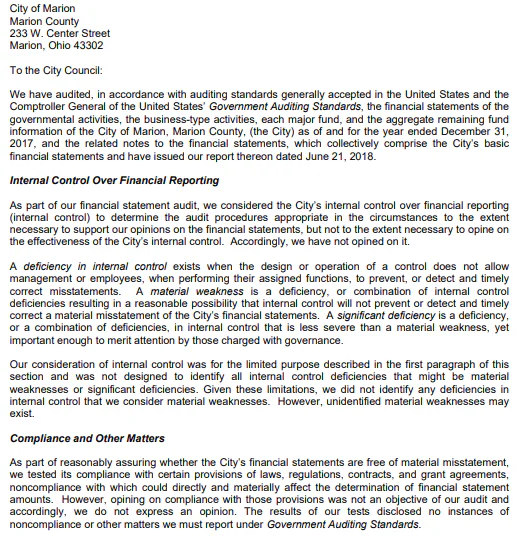
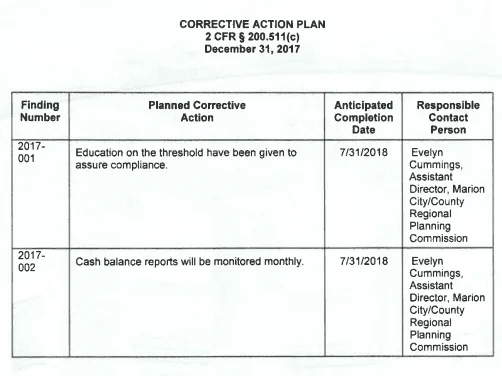
Auditor of State Findings — Federal Programs
The following two findings were issued by the Ohio Auditor of State as part of the Single Audit for the year ended December 31, 2017. Both relate to the Community Development Block Grants program (CFDA #14.228), passed through the Ohio Development Services Agency from the U.S. Department of Housing and Urban Development.
Finding 2017-001: Procurement, Suspension and Debarment — Material Weakness / Noncompliance
“2 CFR 2400.101 gives regulatory effect to the Department of Housing and Urban Development for 2 CFR 200.318 through 200.320, which provides: 2 CFR 200.320(b) states that small purchase procedures are those relatively simple and informal procurement methods for securing services, supplies or other property that do not cost more than the Simplified Acquisition Threshold. If small purchase procedures are used, price or rate quotations must be obtained from an adequate number of qualified sources. 2 CFR 200.318(c)(1) requires the City to maintain written standards of conduct covering conflicts of interest and governing the actions of its employees engaged in the selection, award and administration of contracts. 2 CFR 200.319(c) requires the City to have written procedures for procurement transactions. 2 CFR 200.320(d)(3) requires the City to have a written method for conducting technical evaluations of the proposals received and for selecting recipients. One of seven (14%) expenditures tested did not follow the proper method of procurement by small purchase procedures. In addition, as of December 31, 2017 the City did not have proper internal controls in place to ensure compliance with Federal procurement requirements, including required procurement policies and procedures. Procurement policies were not updated in accordance with the new Uniform Guidance requirements and therefore were not effective controls to ensure compliance.”
Plain-Language Explanation. Federal rules require cities spending grant money to follow specific procurement rules: written conflict-of-interest policies, written procurement procedures, written methods for evaluating proposals, and documented price quotations for small purchases. The City of Marion had none of these. When the Auditor tested seven CDBG expenditures, one (14%) failed to follow even basic small purchase procedures — federal money spent without documented competitive pricing.
The absence of written procurement policies is not merely a paperwork failure. Without written standards of conduct, there is no mechanism to prevent conflicts of interest in contract awards. Without written procedures, each employee makes procurement decisions ad hoc. The City was spending federal money with no documented guardrails.
Forensic New World ERP IT Analysis. New World ERP’s Purchasing module includes configurable procurement workflow capabilities: approval routing based on dollar thresholds, vendor conflict-of-interest flagging, purchase order approval chains, and documentation attachment requirements. The Accounts Payable module can enforce a three-way match (purchase order, receiving report, and invoice) before payment.
Because none of these features were configured for federal procurement compliance, the system processed CDBG expenditures without any automated compliance controls. A properly configured New World implementation for federal grant management would utilize the following built-in functions:
- Dollar-Threshold Routing: Automatically requiring documented quotes for purchases exceeding specific limits (e.g., $3,500).
- Mandatory Documentation: Requiring procurement records to be attached within the system before a purchase order can be approved.
- Vendor Validation: Integrating checks against the System for Award Management (SAM.gov) to ensure federal eligibility.
The complete absence of these controls indicates the Purchasing module was configured for basic operations only, with no consideration of the specific regulatory requirements associated with the City’s federal program portfolio.
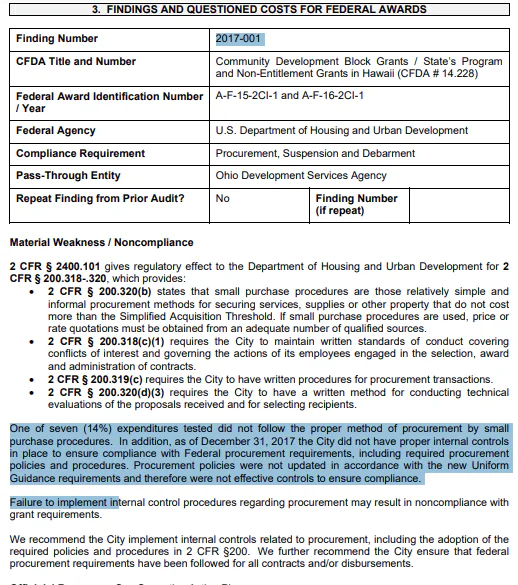
Finding 2017-002: Cash Management — Material Weakness / Noncompliance (Qualified Opinion)
“2 CFR 200.303(a) states that the non-Federal entity must establish and maintain effective internal control over the Federal award that provides reasonable assurance that the non-Federal entity is managing the Federal award in compliance with Federal statutes, regulations, and the terms and conditions of the Federal award. 2 CFR 200.305(b) states that for non-Federal entities other than states, payment methods must minimize the time elapsing between the transfer of funds from the United States Treasury or the pass-through entity and the disbursement by the non-Federal entity. Additionally, the Ohio Development Services Agency Program Policy Notice OCD 17-01, Section (A)(2)(f) further requires that the grantee develop a cash management system to ensure disbursed funds-on-hand balance is less than $5,000 within 30 days of receiving funds. During 2017, for Award Number A-F-15-2CI-1, the drawdown requests were not spent below a $5,000 balance within 30 days for the periods of 01/01/17 through 05/08/17 and 06/21/17 through 12/31/17. The balances during 01/01/17 through 05/08/17 ranged from $6,966 to $98,516, and the balances during 06/21/17 through 12/31/17 ranged from $8,536 to $23,366.”
Plain-Language Explanation. The City drew down federal CDBG funds but sat on them instead of spending them promptly. Federal rules require grant money to be disbursed quickly — specifically, the Ohio Development Services Agency required the balance to drop below $5,000 within 30 days. For most of 2017, the City held between $6,966 and $98,516 in unspent federal funds, far exceeding the threshold.
This finding was severe enough to produce a qualified opinion on the CDBG program — the most serious outcome short of an adverse opinion. A qualified opinion means the Auditor concluded that the noncompliance was material to the program. The City’s corrective action plan promised only that “cash balance reports will be monitored monthly” — a manual process with no system enforcement.
Forensic New World ERP IT Analysis. New World ERP’s Grant Management and Project Accounting modules include the functional capacity to track drawdown dates, calculate days-outstanding for each grant fund balance, and generate automated alerts when balances exceed configurable thresholds.
The federal $5,000/30-day rule represents a standard cash management requirement that can be programmed as an automated compliance check within the system. When properly configured, the ERP is designed to flag growing balances after the 30-day window and alert the grant administrator to initiate a disbursement or return of funds.
Because the City did not utilize these automated monitoring features, the CDBG fund balance reached $98,516—nearly twenty times the allowable threshold—without triggering a single systemic alert. The failure to implement these built-in controls led to several structural oversight gaps:
- Manual Workaround Reliance: The corrective action plan’s promise of “monthly monitoring” confirms that the City was attempting to replace automated ERP functions with manual processes.
- Structural Review Delays: A monthly manual review of a 30-day requirement creates an inherent compliance lag; a balance could exceed the threshold on the first day of the month and remain undetected until the next review cycle, guaranteeing a period of noncompliance.
- Absence of Threshold Enforcement: By failing to configure the module with the $5,000 ceiling, the City bypassed the system’s ability to act as a real-time gatekeeper for federal cash balances.
The persistence of this excess balance demonstrates that the ERP was being used as a historical record-keeper rather than a proactive compliance tool. Without the configuration of these automated drawdown and threshold alerts, the City lacked the systemic infrastructure necessary to meet federal cash management standards.
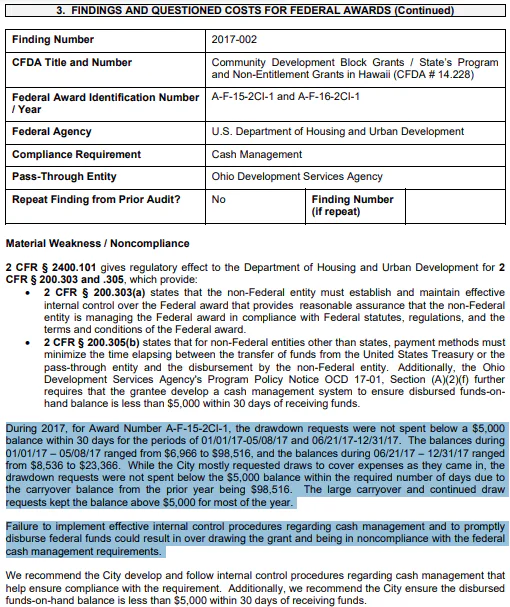
City Self-Produced CAFR Errors — Report Year 2017
The following six errors were not identified by the Auditor of State. They are discrepancies documented within the City’s own 2017 Comprehensive Annual Financial Report, which covered fiscal year 2016. The CAFR was produced using the New World ERP system’s financial reporting tools. The Auditor of State issued an unmodified opinion, meaning these errors either fell below the materiality threshold or were not detected.
Error 2017-A: Net Position Discrepancies — Governmental and Business-Type Activities
“The reported net position for governmental activities was $41,380,569. Adjustments for capital assets and long-term liabilities revealed discrepancies. The reported net position for business-type activities was $12,765,278. Further analysis indicated miscalculations in the depreciation of assets and unaccounted liabilities.”
Plain-Language Explanation. The City’s CAFR reported governmental net position of $41,380,569 and business-type net position of $12,765,278. When capital asset schedules were reconciled against these figures — comparing depreciation entries, accumulated depreciation balances, and long-term liability amortization — the numbers did not add up. Net position is the fundamental measure of a government’s financial health. When it cannot be independently verified against supporting schedules, the entire financial statement becomes unreliable.
Forensic New World ERP IT Analysis. In New World ERP, the net position for governmental activities is a calculated value derived from the integration of the General Ledger, the Fixed Assets module, and debt management accounts. A properly configured system automates the consolidation of these components to reflect an accurate financial standing.
The persistent discrepancies establish that the City was not utilizing an integrated workflow between these modules. New World is designed to maintain financial integrity through the following systemic links:
- Fixed Assets Integration: The Fixed Assets module includes the functional capacity to automatically calculate and post depreciation entries directly to the General Ledger. Because this configuration was not active, the capital asset component of the net position remained misstated.
- Long-Term Liability Mapping: The system tracks long-term debt within specific GL accounts designed to offset asset values. The failure to reconcile these accounts suggests a breakdown in the mapping between debt records and the primary ledger.
- Automated Net Position Calculation: When modules are fully integrated, the ERP performs a GAAP-compliant conversion of fund-level data into government-wide statements.
The reliance on manual adjustments rather than these automated workflows points to a structural configuration failure likely traceable to the July 2009 implementation. By failing to bridge the gap between the Fixed Assets module and the General Ledger, the City bypassed the ERP’s ability to provide a real-time, accurate view of its technical solvency and overall net position.
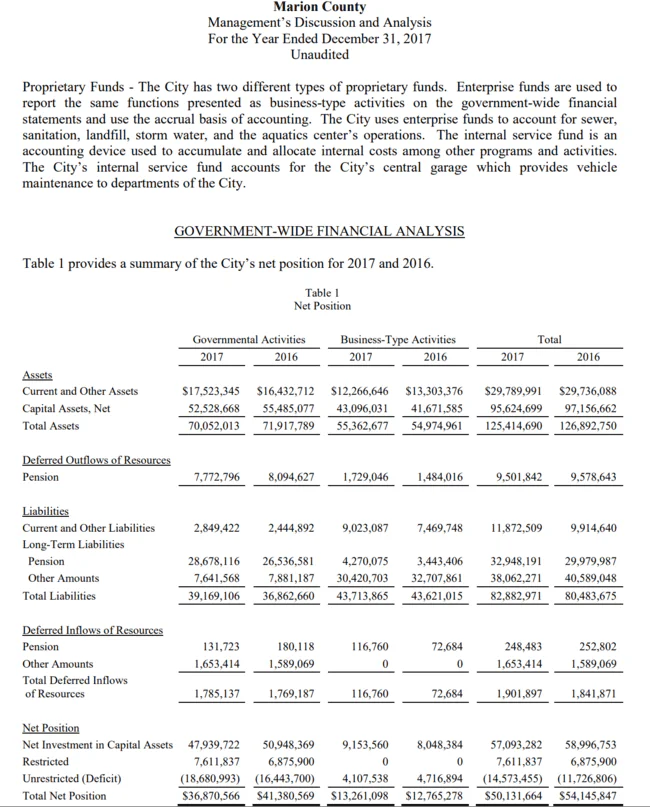
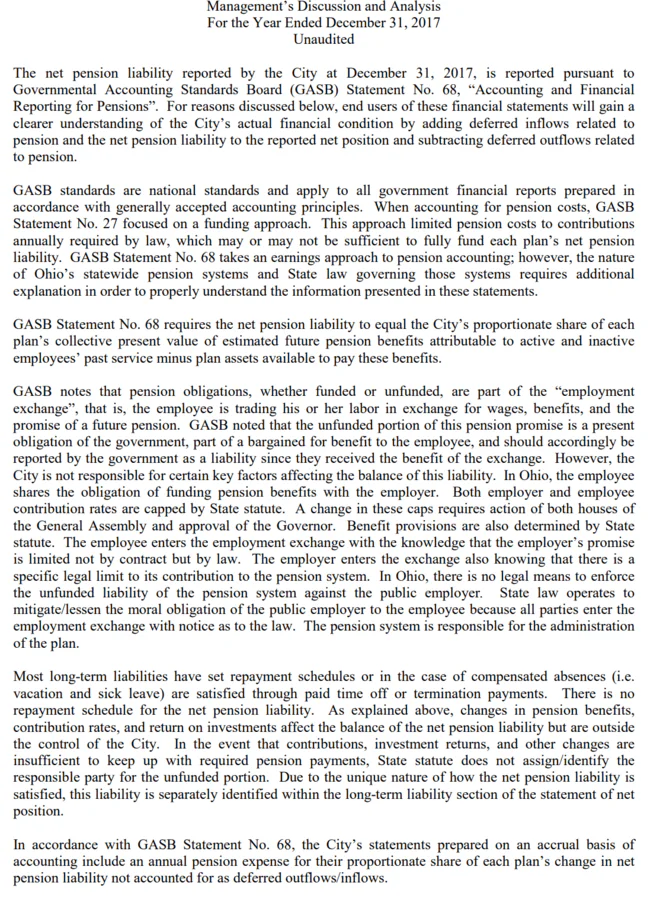
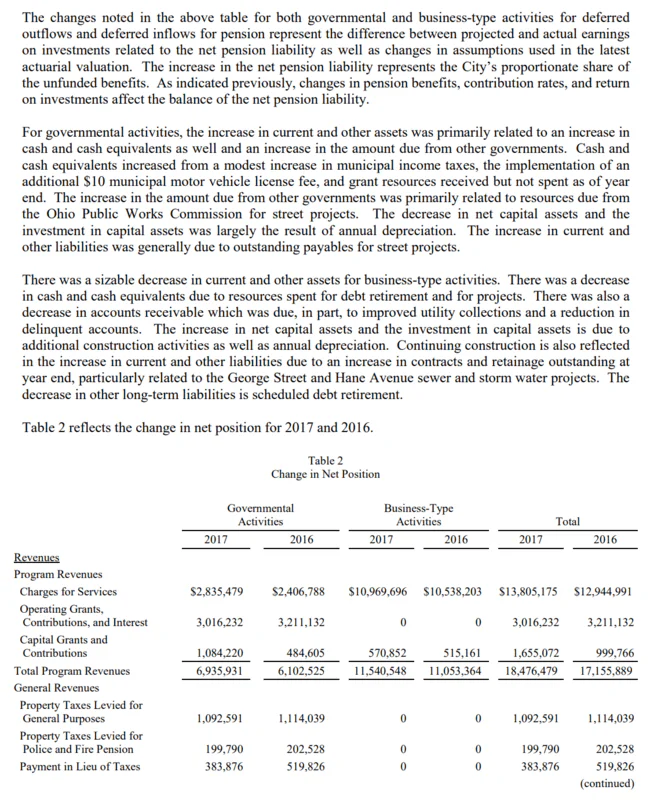
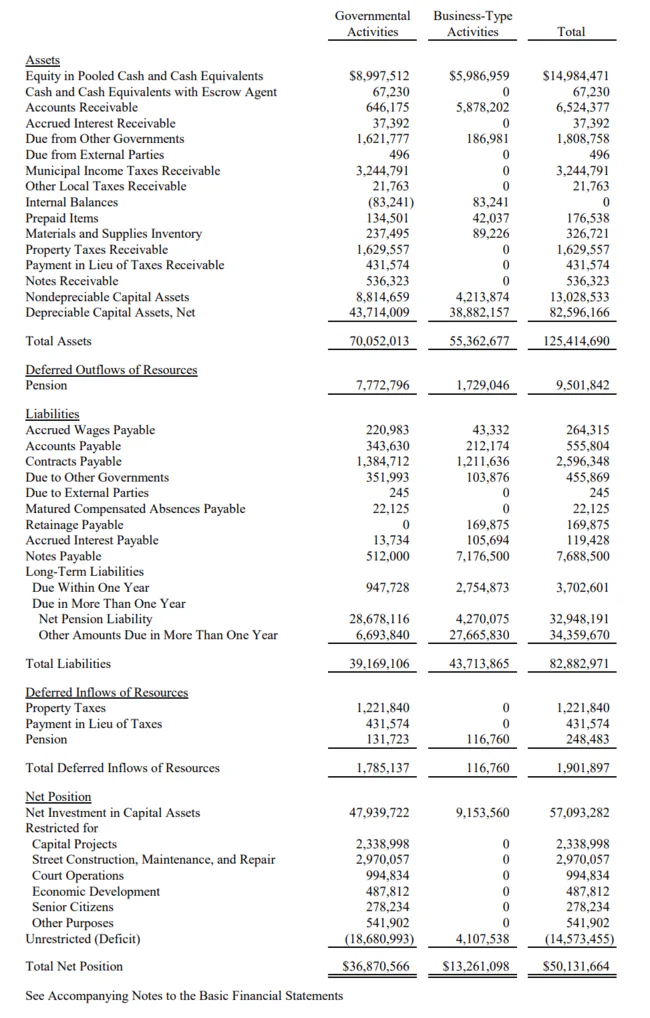
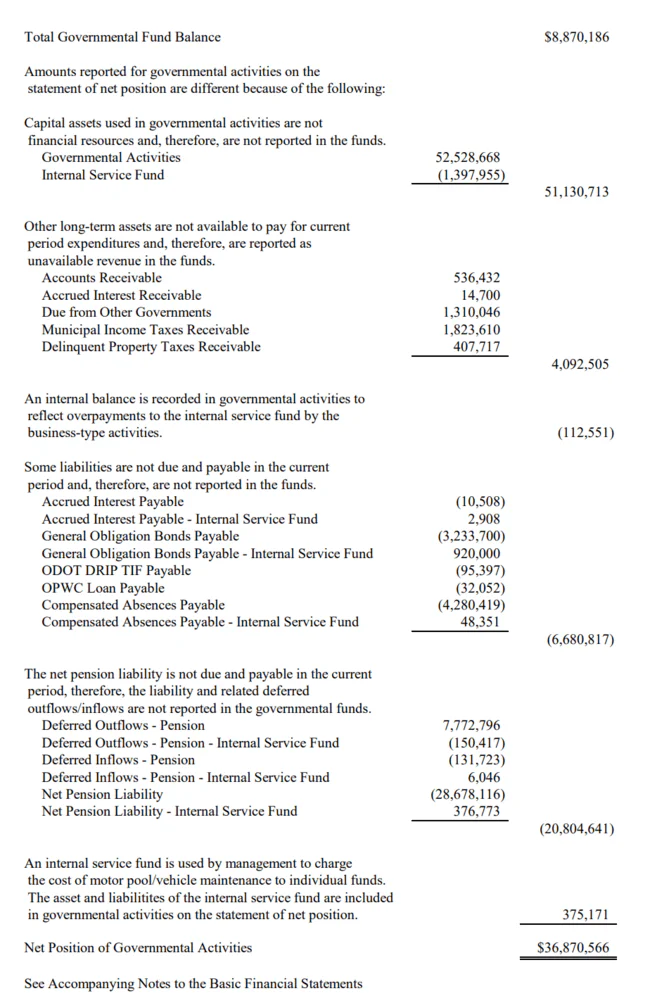
Error 2017-B: Revenue Misreporting — Property Tax and Income Tax
“Property tax revenues were reported as $1,259,812. However, actual collections, including delinquent taxes and penalties, were higher, indicating underreporting. Municipal income taxes were reported as $15,882,193. Cross-verification with collections data indicated discrepancies.”
Plain-Language Explanation. The City underreported property tax revenue by failing to include delinquent tax collections and associated penalties. Municipal income tax revenue of $15,882,193 also did not match actual collections data. Revenue underreporting means the financial picture presented to the public showed less revenue than the City actually received.
Forensic New World ERP IT Analysis. Revenue recognition in New World ERP requires precise fund and account code mapping to ensure that collections are recorded in the correct financial period and category. A properly configured General Ledger acts as the single source of truth, but this relies entirely on the accuracy of the underlying chart of accounts and posting logic established during implementation.
The persistent discrepancies establish that the ERP’s revenue posting configuration was likely flawed, resulting in two primary systemic failures:
- Account Mapping Errors: Inaccurate mapping within the revenue interface caused collections to be directed to the wrong accounts or funds. Because these funds were incorrectly categorized, the system-generated reports excluded them from the Comprehensive Annual Financial Report (CAFR) revenue totals, leading to structural underreporting.
- Interface Configuration Gaps: For income tax, New World is designed to interface with third-party collection systems to automate the posting of receipts. If this interface is not configured for automatic, real-time posting, the system relies on manual batch entries. This manual reliance creates timing differences and omissions that produce the exact variances identified in the audit.
New World includes the functional capacity to prevent these errors through automated reconciliation tools and strict fund integrity rules that validate every transaction against the established budget and fund structure. However, by operating with a misaligned account map and a non-automated income tax interface, the City bypassed the ERP’s ability to provide a complete and accurate picture of its revenue streams. This failure transformed the system into a source of financial distortion rather than a tool for accurate reporting.
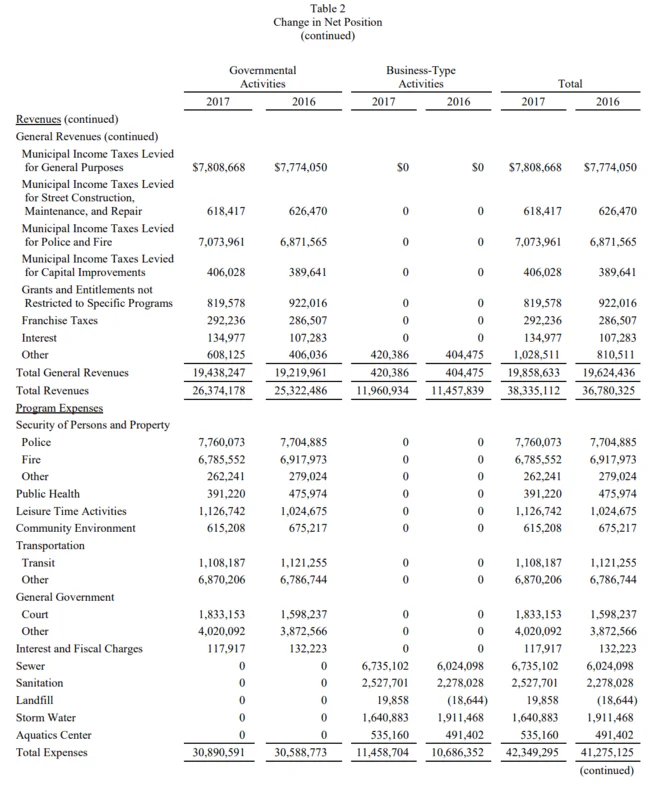
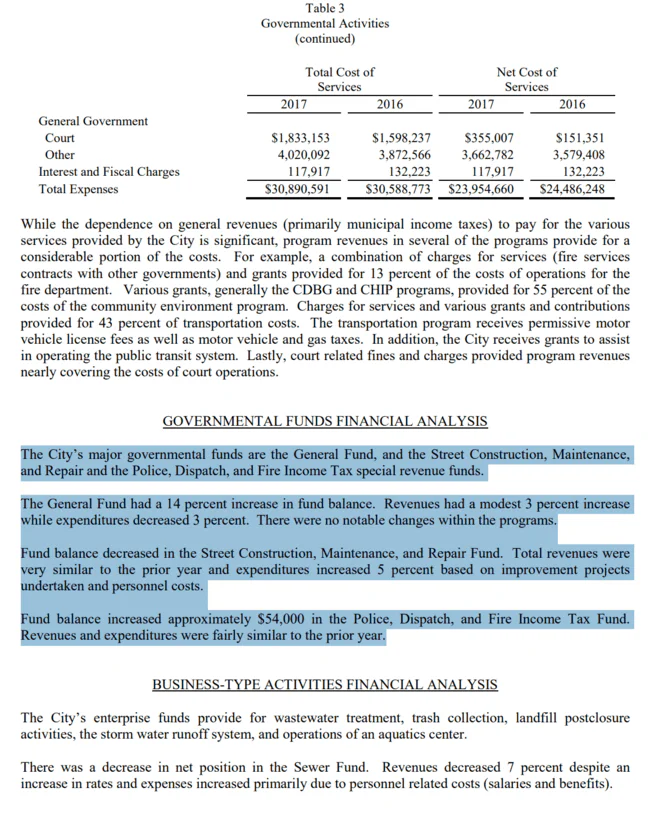
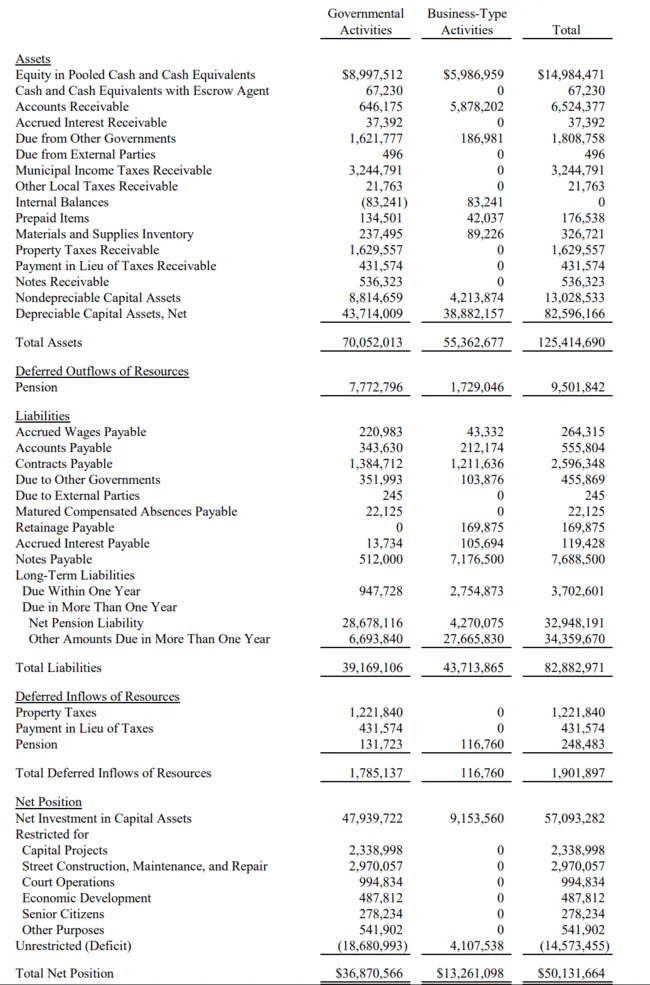
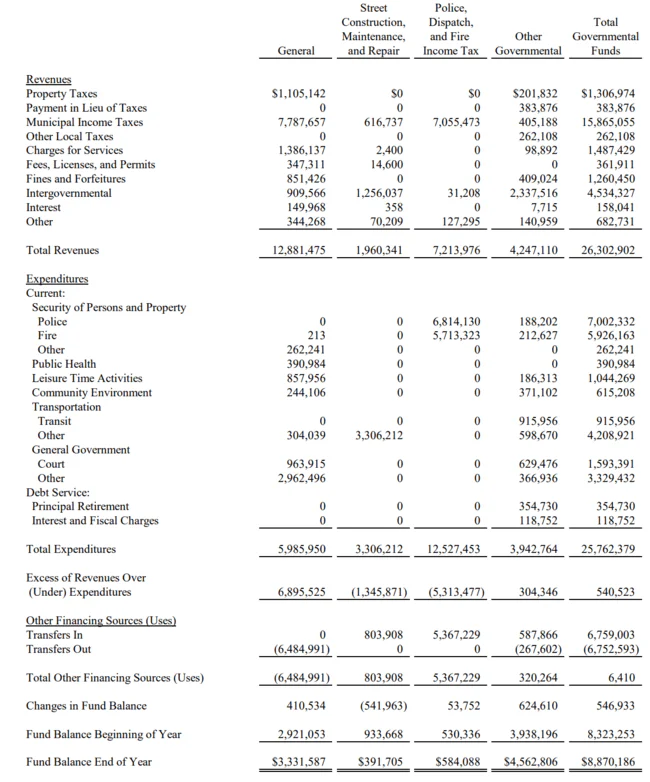
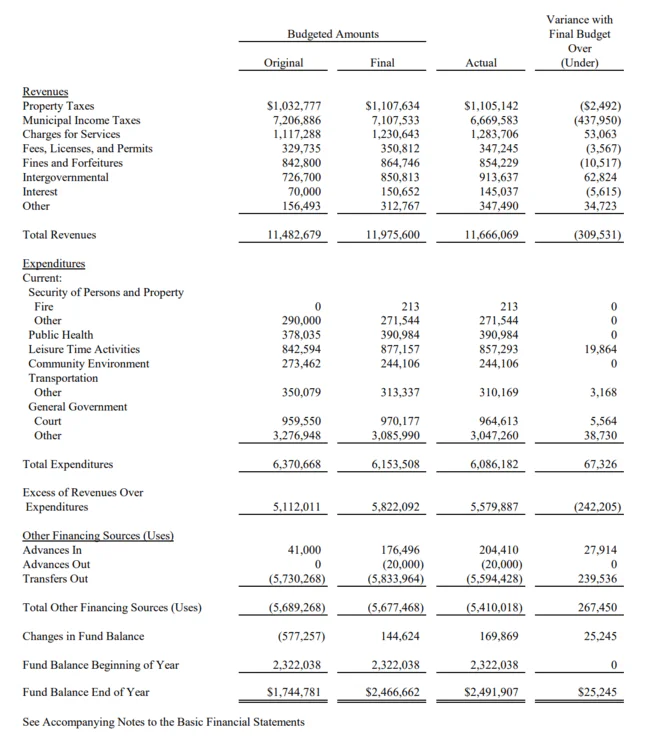
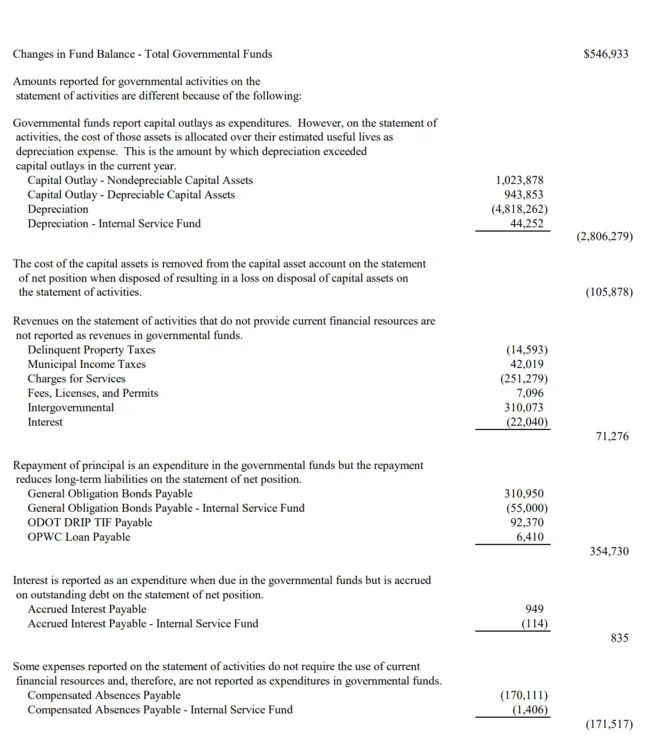
Error 2017-C: Expenditure Inaccuracies — Departmental Allocations
“Total expenditures for governmental activities were reported as $25,560,551. A detailed review of departmental allocations revealed inconsistencies. Reported expenditures for police services were $6,854,807, but actual expenses were higher. Similar inconsistencies were found in fire services and public health.”
Plain-Language Explanation. The CAFR understated total spending across multiple departments. Police expenditures alone were understated — the reported figure did not include all personnel and equipment costs. Fire services and public health showed similar underreporting.
Forensic New World ERP IT Analysis. This pattern points to a systemic chart-of-accounts mapping issue. Departmental expenditure rollups depend on every expense being coded to the correct organizational unit and fund. If the ERP’s organizational hierarchy does not match the CAFR’s reporting structure, entire categories of expenditures can be omitted from summary reports.
New World ERP includes the functional capacity to prevent these reporting gaps through account string validation within the Purchasing module. This feature is designed to enforce correct departmental coding at the point of purchase order entry by:
- Hierarchical Validation: Ensuring that the organizational unit, fund, and object code selected by the user form a valid combination within the system’s architecture.
- Mandatory Field Configuration: Blocking the processing of transactions that lack a complete or valid account string.
- Automated Rollup Rules: Mapping transaction-level data to the correct summary levels required for GAAP-compliant financial reporting.
The omission of expenditure categories from summary reports establishes that the ERP’s organizational hierarchy was misaligned with the City’s actual reporting needs. Because the system’s built-in validation rules were either improperly mapped or entirely inactive, the ERP allowed the entry of inconsistent data. This configuration failure bypassed the system’s ability to act as an automated control, forcing a reliance on manual reconciliations that failed to bridge the gap between departmental spending and final financial statements.
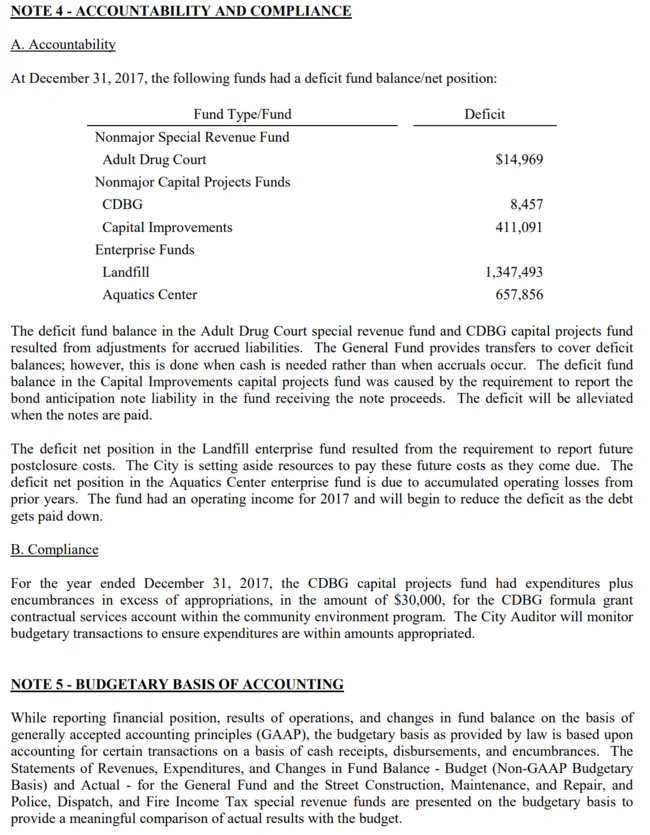
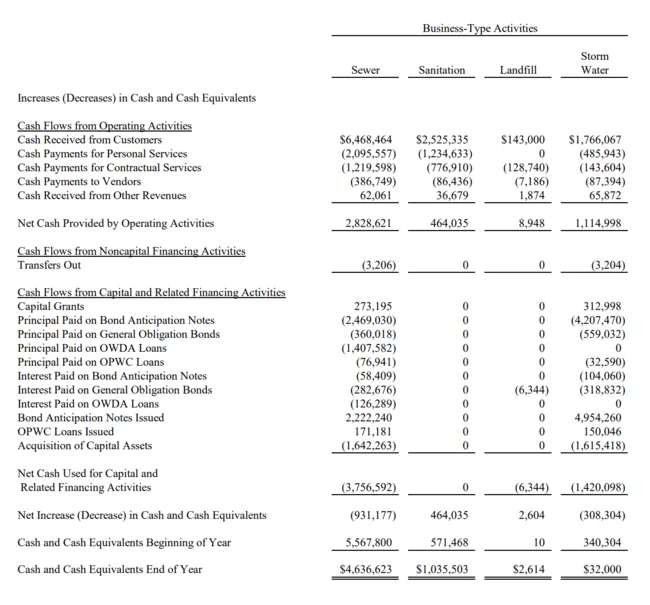
Error 2017-D: Debt Service Calculation Errors
“Principal retirement was reported as $343,050. A detailed review indicated discrepancies in scheduled debt repayments and actual payments made. Interest and fiscal charges were reported as $132,981. Cross-verification with debt service records indicated underreporting of interest payments.”
Plain-Language Explanation. The CAFR’s debt service section reported $343,050 in principal retirement and $132,981 in interest charges. Neither figure matched actual debt service payment records. If principal payments are misstated, the City’s reported outstanding debt is wrong, affecting credit ratings and legally required debt limit calculations.
Forensic New World ERP IT Analysis. Amortization schedules and debt service tracking are managed within the General Ledger through the use of dedicated debt management accounts. New World ERP includes the functional capacity to maintain individual schedules for each bond issue, ensuring that payments are accurately split between principal and interest components.
The reported discrepancies establish that the City was not utilizing these automated debt-tracking features. A properly configured system maintains financial integrity through several key controls:
- Principal and Interest Splitting: The Accounts Payable module can be configured to validate debt service payments against the amortization schedules stored in the General Ledger. If payments are coded to the incorrect account string, the system is designed to flag the variance before the transaction is finalized.
- Bond-Specific Debt Accounts: New World supports the creation of unique accounts for each bond issue. This granularity is essential for producing GASB-required disclosures automatically. Because these structured accounts were likely never established, the system could not generate the necessary schedules, forcing a reliance on manual compilation.
- Automated Periodic Entries: The system possesses the logic to automate the recording of periodic entries, ensuring that debt balances in the General Ledger remain reconciled with the actual payment history.
The failure to match reported figures with actual payments demonstrates that the ERP’s debt management capabilities were bypassed. Without the configuration of these bond-specific schedules and account strings, the system functioned as a basic check-writing tool rather than a comprehensive financial management platform. This necessitated a manual, error-prone process to meet reporting requirements that the system was natively equipped to handle.
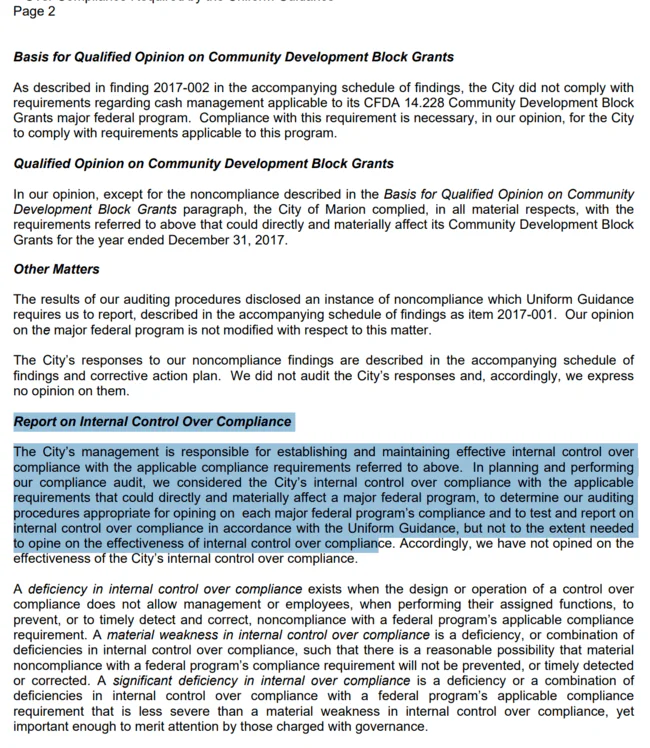
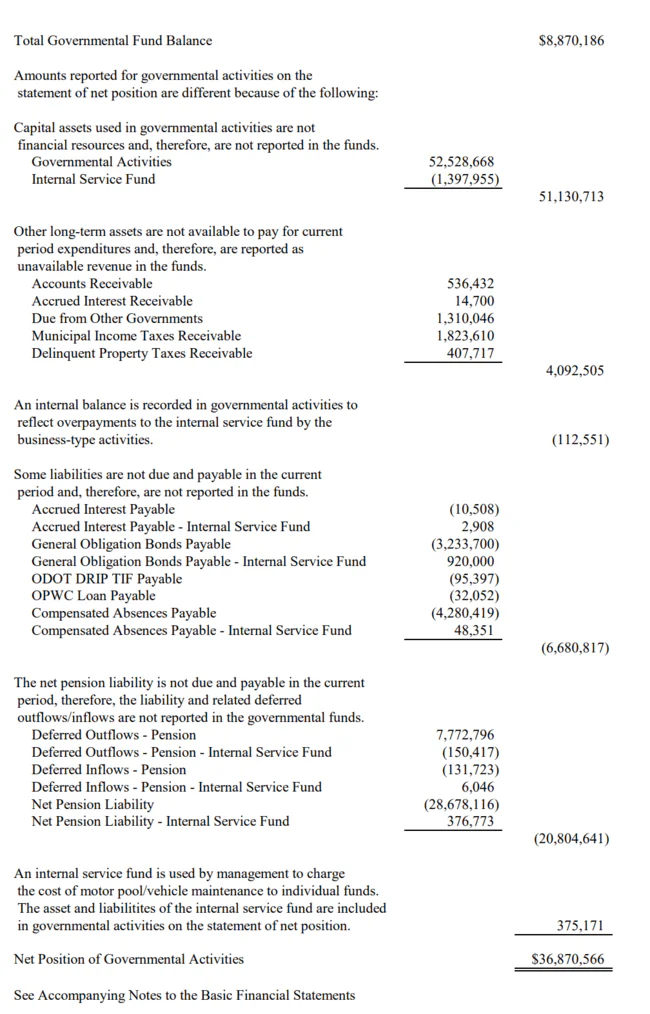
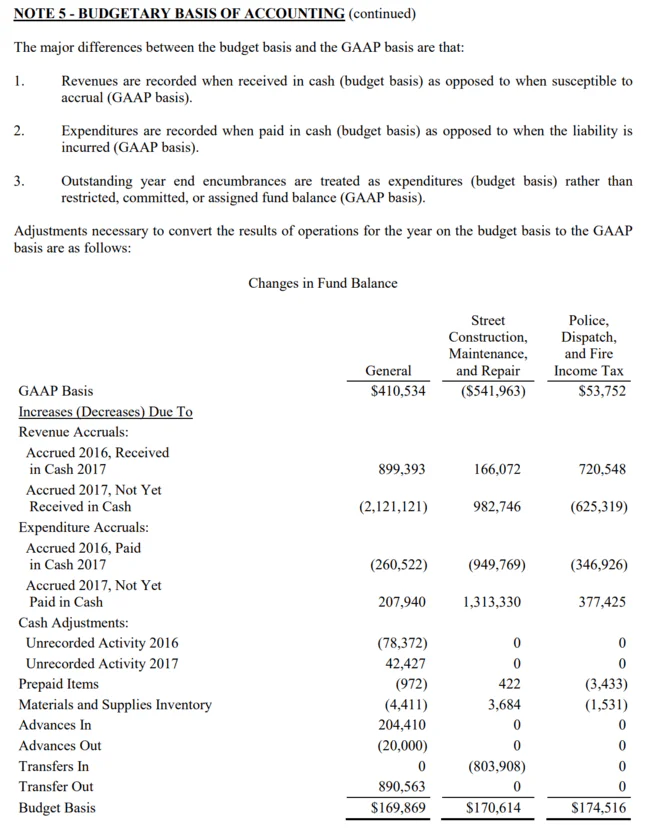
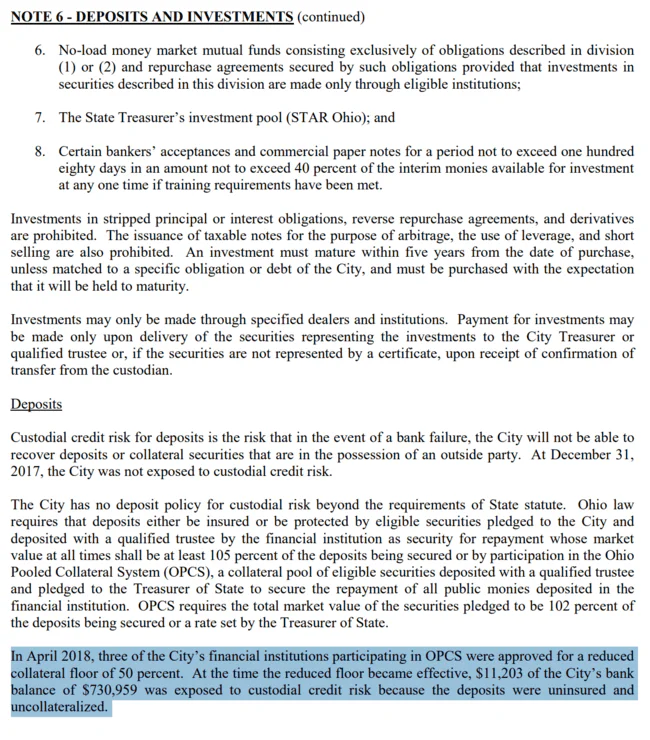
Error 2017-E: Statistical Data Inconsistencies
“The reported population was 36,701. Cross-verification with census data indicated a higher actual population. Personal income data and unemployment rates showed discrepancies when cross-verified with external sources.”
Plain-Language Explanation. The CAFR’s statistical section reported incorrect population, income, and employment data. While statistical data does not directly affect fund balances, inaccurate statistics undermine report credibility and affect per-capita calculations used in grant applications and funding formulas.
Forensic New World ERP IT Analysis. While statistical data is typically compiled outside the ERP from external sources, the CAFR preparation process lacked the adequate quality control reviews necessary to ensure data integrity. This process failure parallels the systemic ERP configuration gaps documented throughout the City’s audit history.
New World ERP includes the functional capacity to mitigate these risks through its Budgeting and Planning modules. In a properly configured environment, external statistical data acts as a critical input for automated revenue modeling. If the system is provided with inaccurate or outdated population figures, the following systemic distortions occur:
- Skewed Revenue Estimates: Budget projections for per-capita distributions or utility demand rely on accurate population metrics. Inaccurate inputs lead the ERP to generate inflated or deflated revenue forecasts, creating a structural mismatch between the budget and actual financial performance.
- Capacity Modeling Failures: ERP systems use statistical data to project infrastructure needs and service levels. Outdated figures prevent the system from accurately forecasting long-term capital requirements or operational expenses.
- Quality Control Gaps: The absence of a formal verification process for external data means that the “garbage in, garbage out” principle remains unchecked. New World supports document attachment and workflow notes, which should be used to document the source and verification of all statistical inputs used in CAFR schedules.
The reliance on unverified external data establishes that the City’s financial reporting process remained disconnected from the ERP’s analytical capabilities. Without a configured quality control workflow to validate the statistical data feeding into budget projections, the system’s ability to produce reliable, forward-looking financial plans was fundamentally compromised.
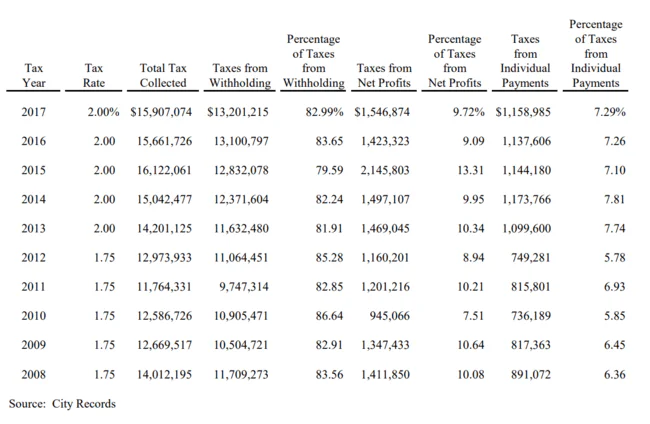
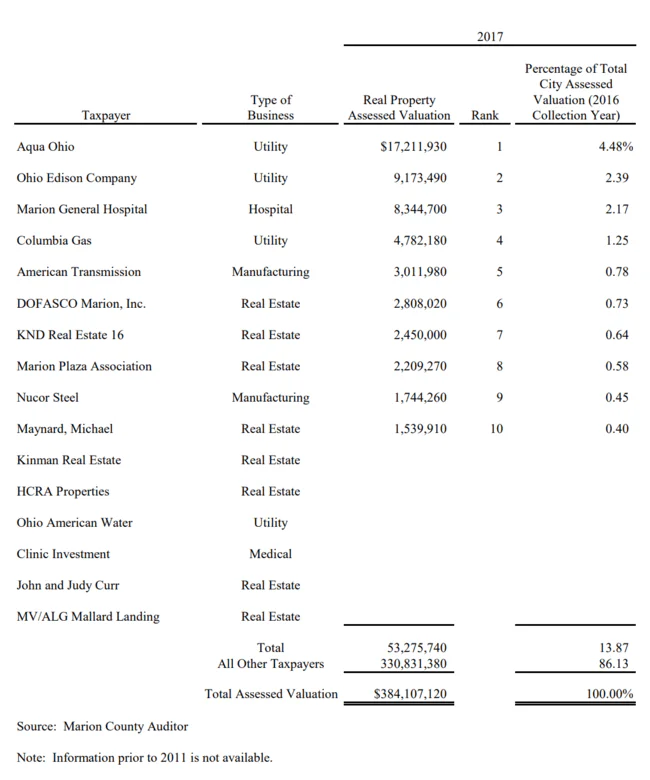
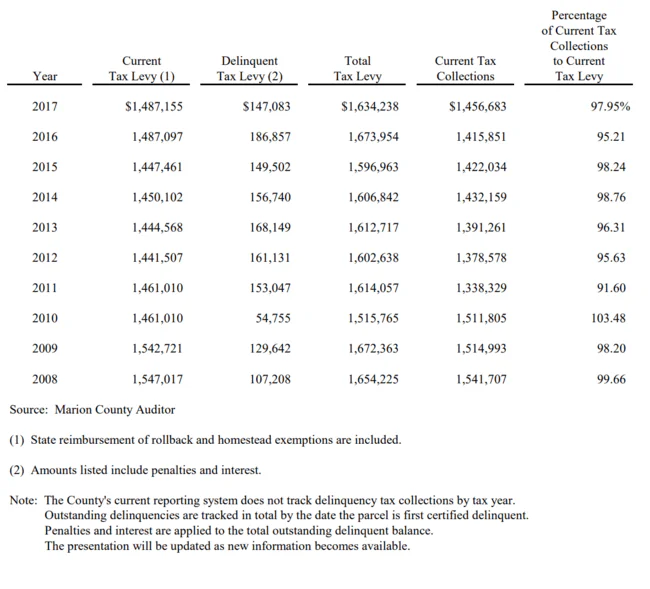
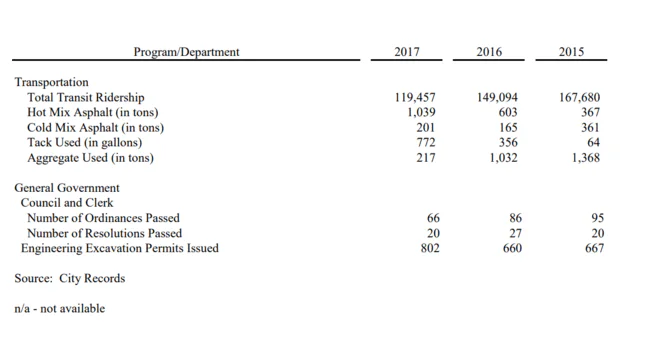
Error 2017-F: Fund Balance Irregularities
“The General Fund balance was reported as $2,921,053. A detailed review indicated discrepancies in the reported balance and actual balance. Similar irregularities were found in other governmental funds.”
Plain-Language Explanation. The General Fund balance — the single most important number in municipal finance — was reported as $2,921,053 but did not match actual balance when supporting records were reviewed. Fund balance is the cumulative result of all revenues minus all expenditures. If it is wrong, then revenues, expenditures, or prior-year balances are also wrong.
Forensic New World ERP IT Analysis. In New World ERP, fund balances are designed to roll forward automatically during the year-end close process. A properly executed close ensures that the ending balance of one fiscal year becomes the exact beginning balance of the next. When these balances fail to reconcile, it establishes a breakdown in the system’s foundational accounting logic.
The “significant unsupported differences” later documented by the Auditor of State in 2021 indicate that the ERP’s General Ledger was not functioning as a closed, validated system. This failure typically stems from three specific configuration or process gaps:
- Transaction Misallocation: If the system is not configured with strict fund-integrity rules, transactions can be posted to the wrong funds throughout the year. New World includes “balancing fund” logic that should automatically block any entry that doesn’t balance within a specific fund, preventing the cross-fund erosion identified in the audit.
- Initial Balance Errors: If the beginning balances entered during the July 2009 implementation or subsequent fiscal years were unverified or forced into the system without reconciliation, every subsequent “automatic” roll-forward would carry and compound that original error.
- Report Template Misconfiguration: The CAFR preparation tools within New World rely on templates that map GL accounts to reporting lines. If these templates are misconfigured, the report may omit specific accounts or pull data from incorrect funds, creating a variance between the system’s trial balance and the final printed statements.
New World’s Trial Balance report is the primary tool for ensuring financial integrity; it should produce fund balances that tie exactly to the CAFR. The persistence of unsupported differences establishes that the City was manually overriding or bypassing the ERP’s year-end close procedures. Instead of using the system to identify and correct the source of the variances, the City allowed the General Ledger to drift from the audited financial reality, turning a tool meant for precision into a source of structural reporting errors.
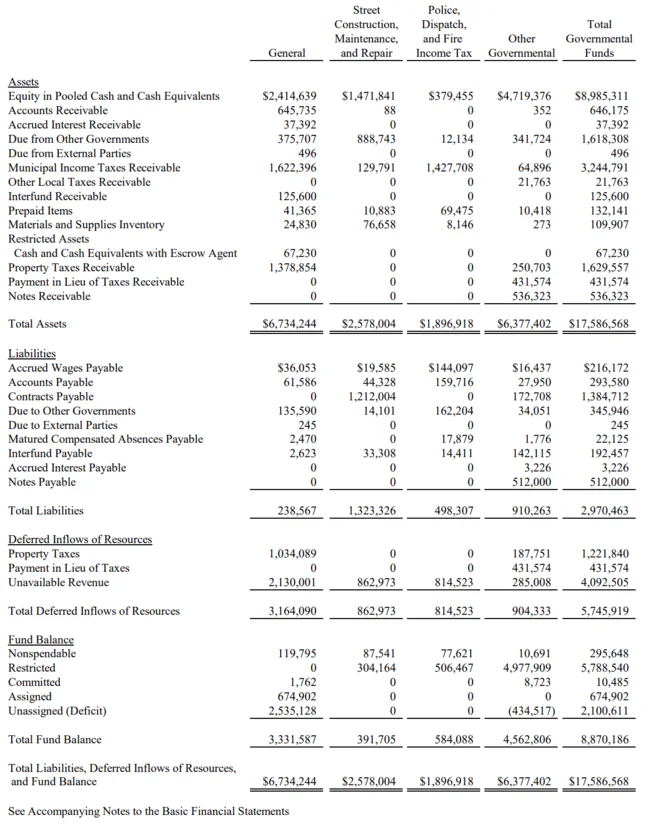
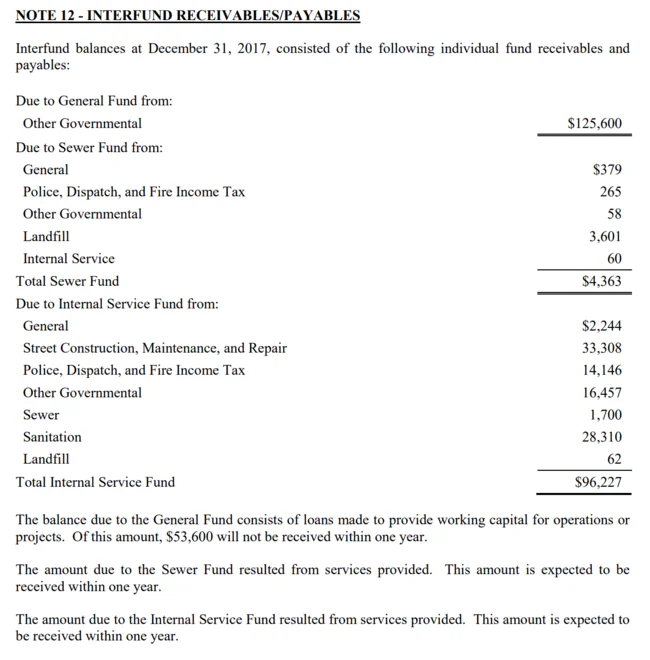
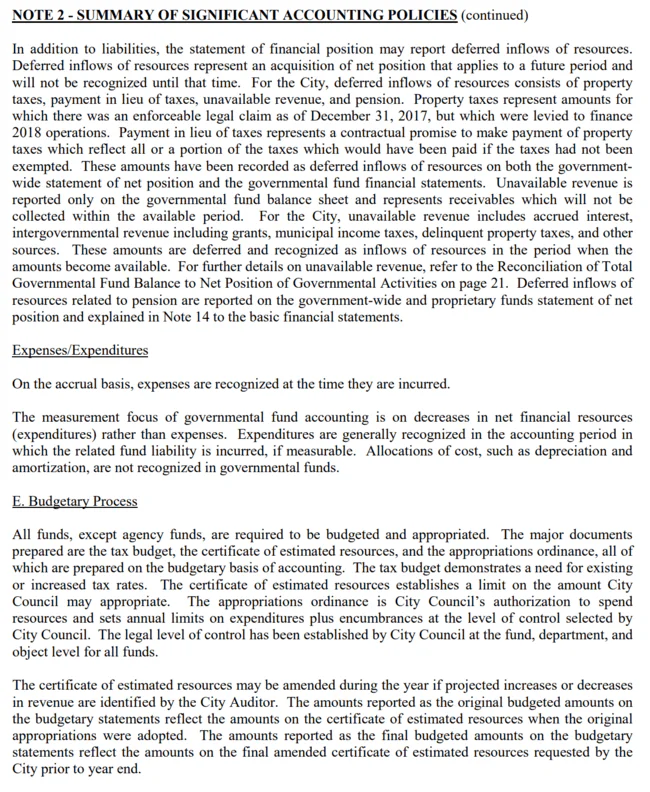
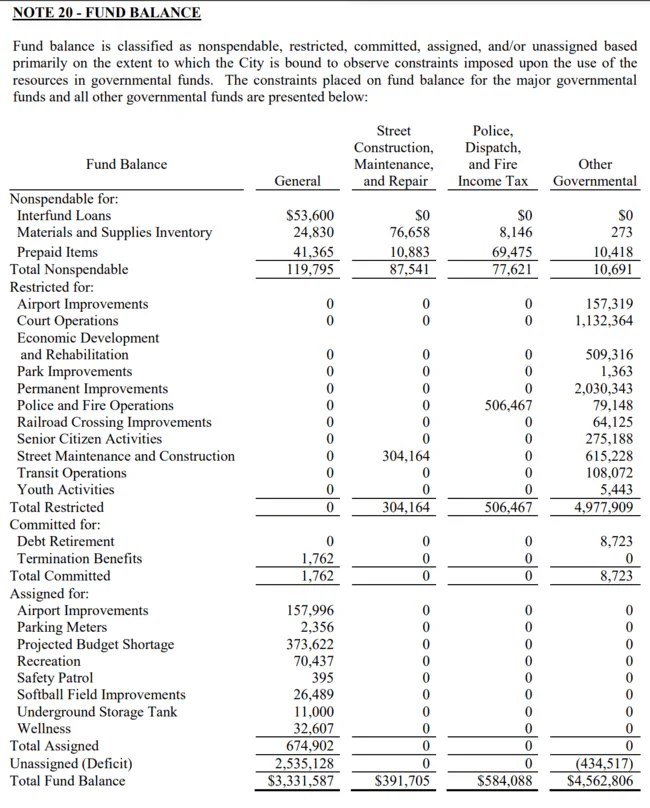
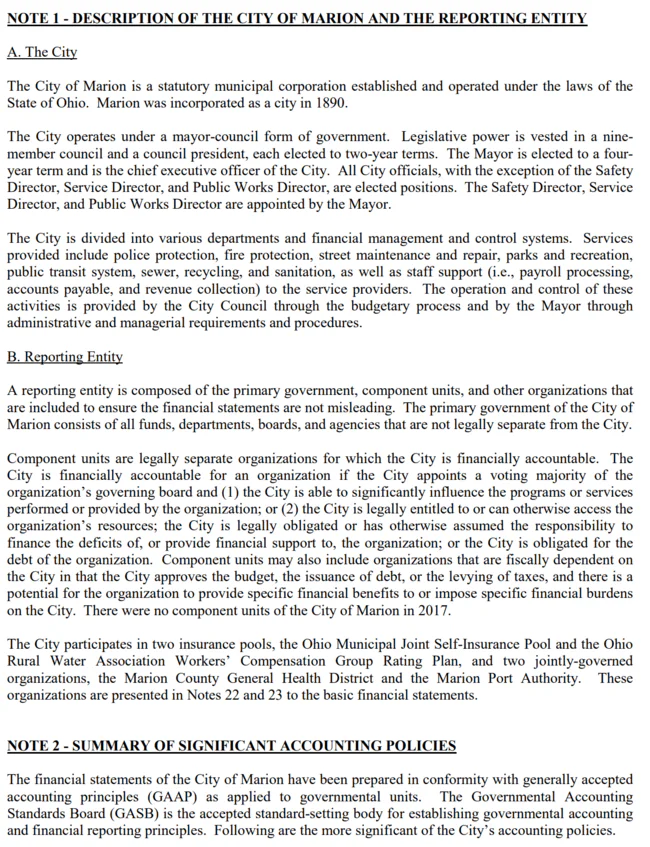
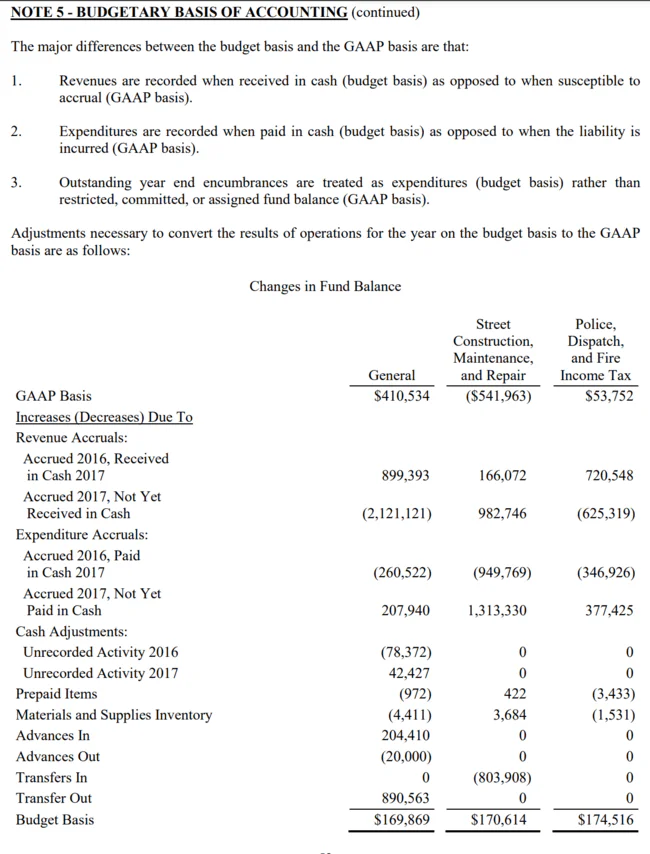
Audit Year 2018: One Federal Finding and Six CAFR Errors — 7 Items
The Auditor of State’s Single Audit for the year ended December 31, 2018 (signed Keith Faber, August 15, 2019) again found no issues at the financial statement level — GAGAS stated “None.” However, the audit identified one federal program finding related to the Formula Grants for Rural Areas program (CFDA #20.509) — a material weakness in capital asset management. Meanwhile, the City’s self-produced CAFR — covering fiscal year 2017 — contained six categories of reporting errors, including a $5,128,212 unexplained gap between expenditure totals.
Auditor of State Findings — Federal Programs
The following finding was issued as part of the Single Audit for the year ended December 31, 2018. It relates to the Formula Grants for Rural Areas program (CFDA #20.509), passed through the Ohio Department of Transportation from the U.S. Department of Transportation.
Finding 2018-001: Equipment and Real Property Management — Material Weakness / Noncompliance
“2 CFR 1201.1 gives regulatory effect to the Department of Transportation for 2 CFR 200.313(d) which provides that procedures for managing equipment (including replacement equipment), whether acquired in whole or in part under a Federal award, until disposition takes place will, as a minimum, meet the following requirements: (1) Property records must be maintained that include a description of the property, a serial number or other identification number, the source of funding for the property (including the FAIN), who holds title, the acquisition date, and cost of the property, percentage of Federal participation in the project costs for the Federal award under which the property was acquired, the location, use and condition of the property, and any ultimate disposition data including the date of disposal and sale price of the property. (2) A physical inventory of the property must be taken and the results reconciled with the property records at least once every two years. Furthermore, the City’s Fixed Asset Procedures, Annual Physical Inventory section, provides that each department or division is required to conduct an annual physical inventory. As of December 31, 2018, the City had not performed a physical inventory of capital assets within the prior two fiscal years. Additionally, the City’s capital asset listing does not indicate the percentage of Federal participation in the project costs for the Federal award under which the property was acquired.”
Plain-Language Explanation. The City had not physically counted its assets in at least two years — violating both federal requirements (which mandate inventory every two years) and the City’s own Fixed Asset Procedures (which require annual inventory). The asset records were missing required federal data: the percentage of federal funding for each asset, the Federal Award Identification Number, and other elements federal regulations require. The City literally did not know what it owned, where it was, what condition it was in, or which assets were purchased with federal money.
This finding was classified as both a material weakness in internal control and noncompliance. For federally funded equipment, the inability to demonstrate proper stewardship means the City could not account for how federal transportation grant money was spent on equipment.
Forensic New World ERP IT Analysis. New World ERP’s Fixed Assets module is designed to serve as a comprehensive compliance engine for federal property management. It includes dedicated fields for every data element mandated by 2 CFR 200.313(d), including:
- Federal Funding Transparency: Fields for the Federal Award Identification Number (FAIN) and the federal participation percentage.
- Asset Lifecycle Tracking: Integrated records for acquisition date, cost, serial number, and physical condition.
- Custodial Controls: Specific data points for the title holder, location, and final disposition data.
Because the City failed to utilize these capabilities, it bypassed the ERP’s inherent ability to automate the inventory reconciliation workflows required by its own internal procedures. New World possesses the functional capacity to enforce these controls through the following built-in features:
- Departmental Inventory Lists: The system can generate pre-populated, department-level reports for physical verification, eliminating the need for manual spreadsheets.
- Certification Tracking: The module supports a workflow that tracks departmental count submissions and automatically flags those that fail to meet the mandatory 60-day certification window.
- Physical Count Discrepancy Flagging: The system is designed to compare physical count results against existing system records, generating exception reports for management review.
The fact that no physical inventory was performed for over two years establishes that these workflow features were never configured. By leaving these tools inactive, the City transformed a system capable of meeting stringent federal property standards into a passive and neglected database. This failure to implement the module’s tracking and alerting functions ensured that straightforward compliance obligations—such as the annual physical count and departmental certification—simply fell through the cracks.
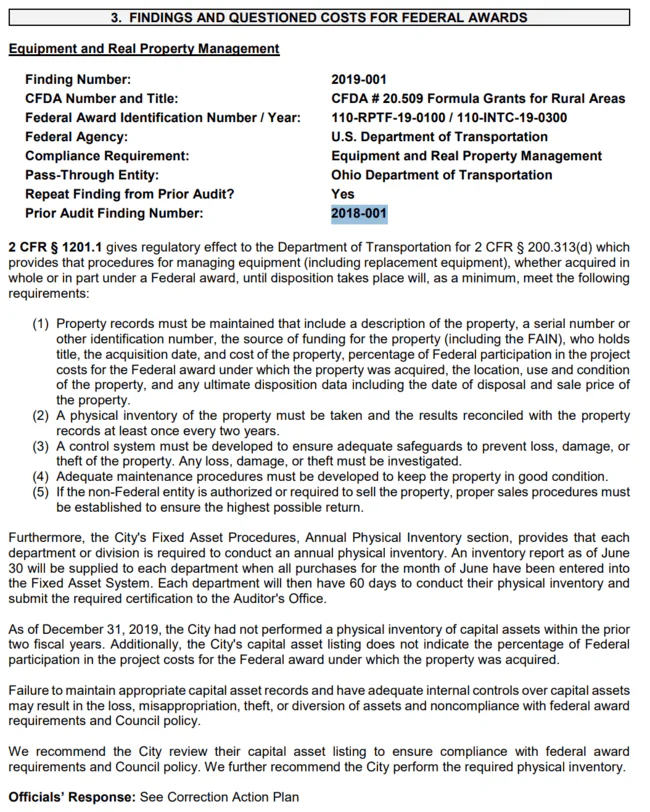
City Self-Produced CAFR Errors — Report Year 2018
For the second consecutive year, the City’s self-produced financial report contained significant errors not flagged by the Auditor of State. The 2018 report covered fiscal year 2017 data. The errors grew more alarming: a $5,128,212 gap between two expenditure totals within the same report demonstrated the City could not reconcile its own numbers.
Error 2018-A: Expenditure Discrepancy — $5.1 Million Gap
“In the Changes in Fund Balance — Governmental Funds section, the total expenditures for 2017 are reported as $25,762,379. However, in the Statement of Activities for Governmental Activities, the figure is $30,890,591. This discrepancy of $5,128,212 suggests significant errors in data compilation or categorization.”
Plain-Language Explanation. Two different statements within the same financial report showed government spending totals that differed by $5,128,212. While there are legitimate reconciling items between fund-level and government-wide statements under GAAP (capital asset additions, depreciation, long-term debt changes), a $5.1 million gap without adequate reconciliation disclosure indicates these conversion entries were either missing or incorrectly calculated.
Forensic New World ERP IT Analysis. New World ERP operates on a modified accrual basis for governmental funds but must convert to full accrual for government-wide statements. A $5.1 million discrepancy establishes that the GAAP conversion entries were either missing, miscalculated, or incorrectly applied within the system.
The ERP includes a dedicated CAFR conversion module designed to automate these adjustments. A properly configured system maintains financial integrity through several automated workflows:
- Automated Reclassification: The module is designed to automatically move data from the modified accrual ledger to the full accrual ledger, ensuring that long-term assets and liabilities are properly reflected.
- Conversion Entry Validation: The system provides a framework for recording GAAP-specific adjustments—such as internal service fund eliminations and capital asset entries—with built-in balancing rules to prevent out-of-balance conditions.
- Integrated Reporting Templates: New World’s reporting engine uses these conversion entries to bridge the gap between fund-level financial statements and government-wide statements.
The magnitude of the error indicates that the conversion was likely performed through manual calculations outside of the ERP or that the conversion module itself was misconfigured. By failing to utilize the system’s automated GAAP conversion tools, the City bypassed the internal logic meant to ensure that millions of dollars in adjustments were accurately captured and reported. This reliance on manual intervention in a complex accounting process transformed a routine system function into a source of significant financial distortion.
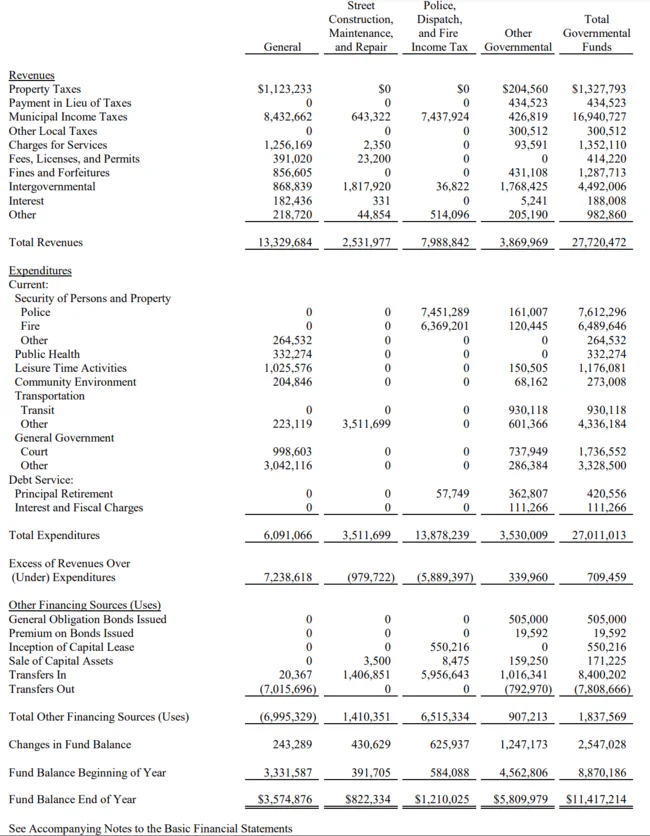
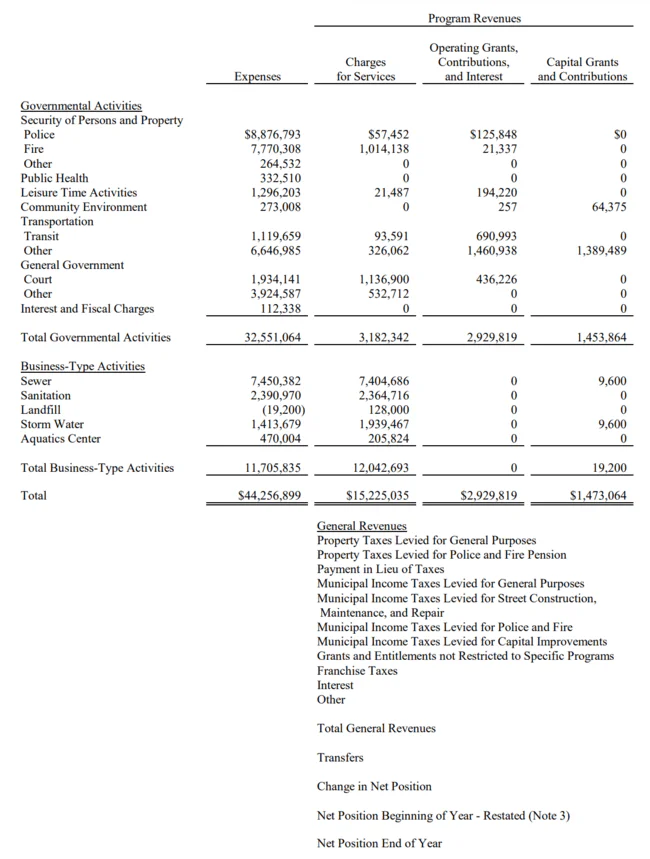
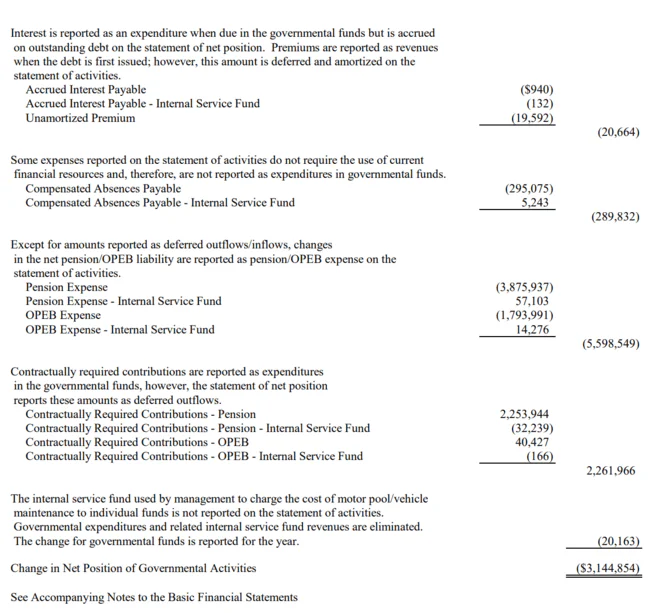
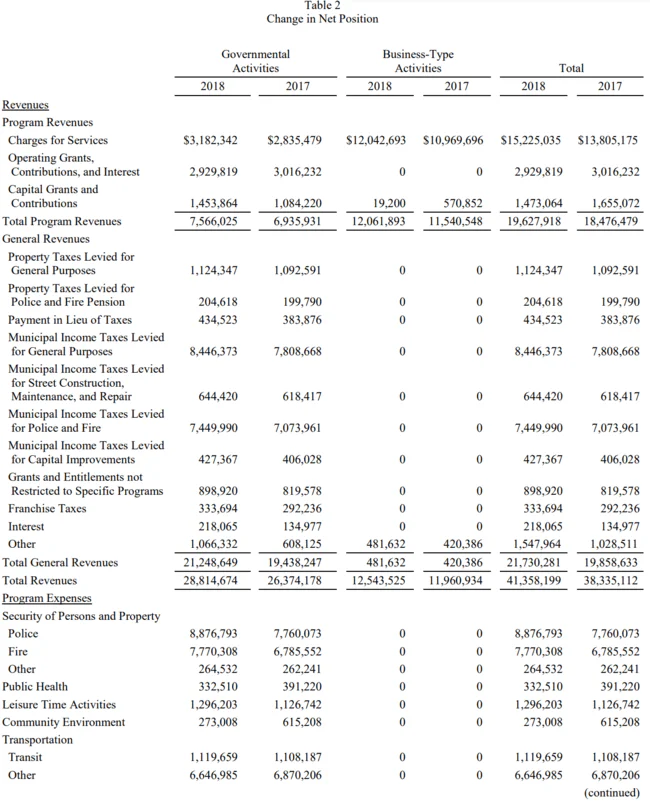
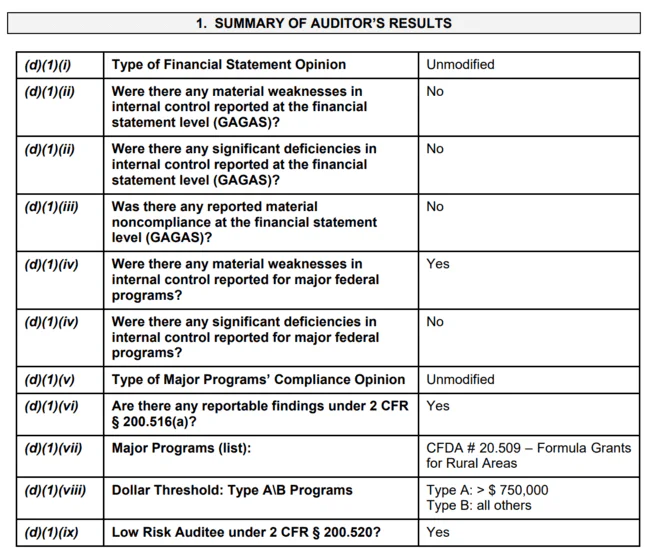
Error 2018-B: Variance in Municipal Income Taxes
“Revenue from Municipal Income Taxes for 2017 is listed as $15,907,074 in one section, while another reports it as $15,865,055, creating a discrepancy of $42,019.”
Plain-Language Explanation. The City’s most important revenue source — income taxes, funding approximately 73% of governmental operations — was reported with two different numbers in the same report. A $42,019 variance reveals the report was not internally consistent.
Forensic New World ERP IT Analysis. Income tax revenue in New World is designed to be sourced from a single, centralized General Ledger account group. When two different CAFR schedules display conflicting figures, it establishes a fundamental breakdown in the system’s reporting logic and configuration.
New World’s reporting engine ensures data integrity through standardized queries and mapped templates. Discrepancies between schedules typically stem from two specific system failures:
- Query Misalignment: The report templates may be pulling from different data queries or overlapping account ranges. If one schedule is configured to pull from a “Cash” query while another pulls from an “Accrual” query without proper reconciliation, the resulting CAFR will be internally inconsistent.
- Manual Data Overrides: The ERP includes the functional capacity to generate reports directly from live ledger data. However, if staff manually override system-generated figures within the reporting module to “force” a balance, it creates a disconnected record. These overrides bypass the system’s internal controls and often fail to update all related schedules, leading to the identified variances.
This type of report configuration error highlights a failure in the CAFR quality control process. A properly configured New World environment includes a “Statement of Ties” or reconciliation check that ensures every figure in the statistical section or supplemental schedules traces back to the primary financial statements. By operating with misaligned report templates, the City allowed the ERP to produce contradictory data, effectively negating the system’s role as a single source of truth for municipal revenue.
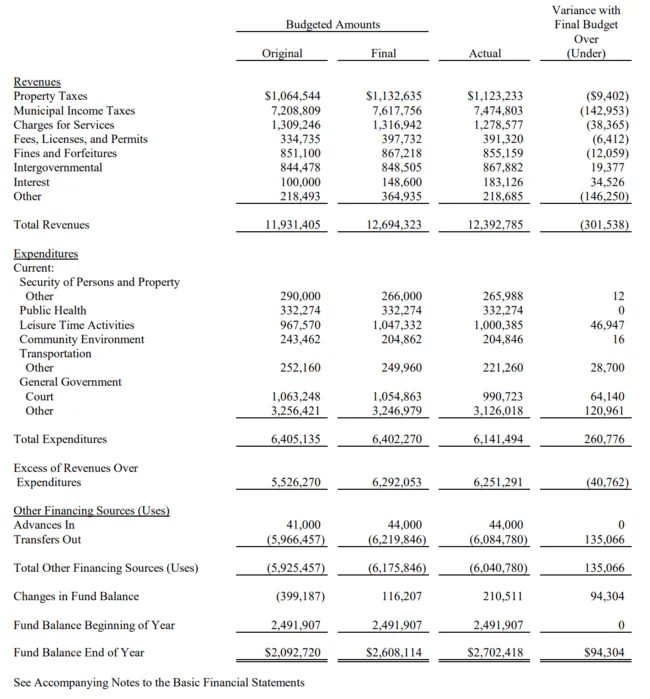
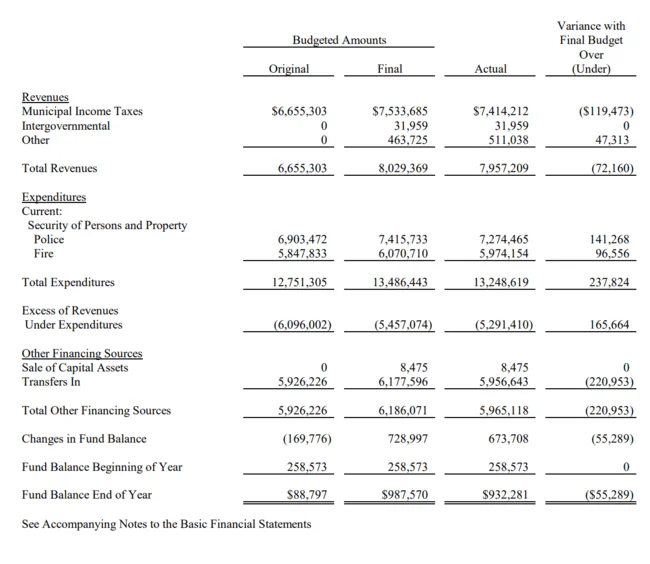
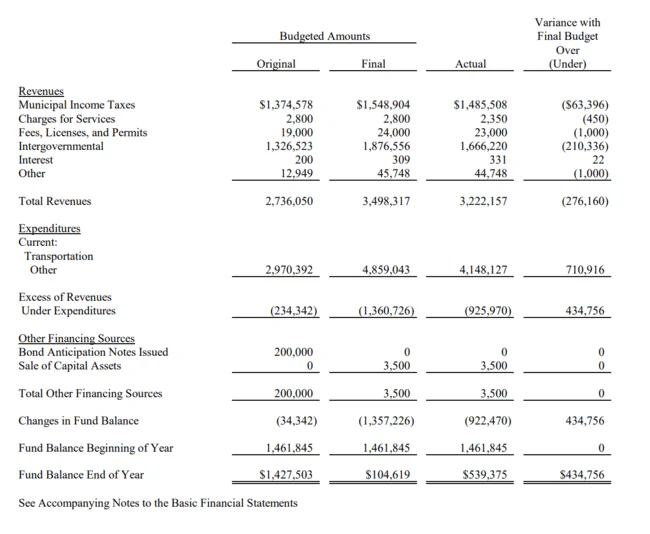
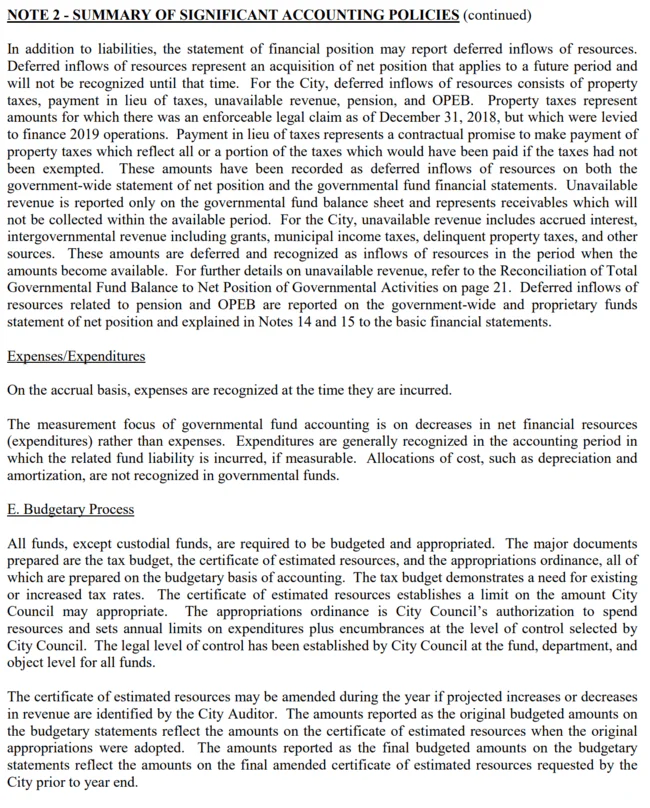
Error 2018-C: Incomplete Year-on-Year Comparison for Principal Sewer Customers
“The report lists significant entities and their contributions but fails to provide a comprehensive year-on-year comparison. This omission obscures trends in water usage and revenue from key clients, impairing long-term planning and analysis.”
Plain-Language Explanation. The CAFR’s statistical tables for sewer utility customers were incomplete — they listed major customers but did not show how usage changed over time, making it impossible to spot trends or plan for infrastructure needs.
Forensic New World ERP IT Analysis. The Utility Billing module in New World ERP is designed to serve as a comprehensive repository for historical consumption and billing data. A properly configured system uses this data to generate year-over-year comparison reports, which are standard outputs for analyzing revenue trends, infrastructure demand, and billing accuracy.
The omission of these comparisons in the City’s financial reporting suggests a breakdown in the system’s data architecture or reporting configuration. New World maintains this historical continuity through several key functional capacities:
- Integrated Consumption History: The module tracks every meter reading and billing cycle, allowing the reporting engine to perform multi-year horizontal analyses. If the reporting templates were not configured to pull this historical data, the system’s analytical value was essentially deactivated.
- Data Migration Integrity: During the July 2009 implementation, a critical step involves the migration of legacy utility statistics. If prior-year data was not properly mapped and imported into New World, the system would lack the baseline necessary to produce comparative reports, forcing the City to rely on external, manual spreadsheets.
- Automated Trend Analysis: The ERP’s reporting tools include built-in functions to calculate percentage variances and consumption shifts between fiscal periods. These are designed to be “push-button” reports that require no manual compilation.
The absence of these standard comparisons indicates that the Utility Billing module was being used strictly for transactional processing rather than strategic management. By failing to bridge the gap between historical consumption and current billing cycles—either through a configuration error or a failed data migration—the City bypassed the ERP’s ability to provide a data-driven perspective on its most significant enterprise operation.
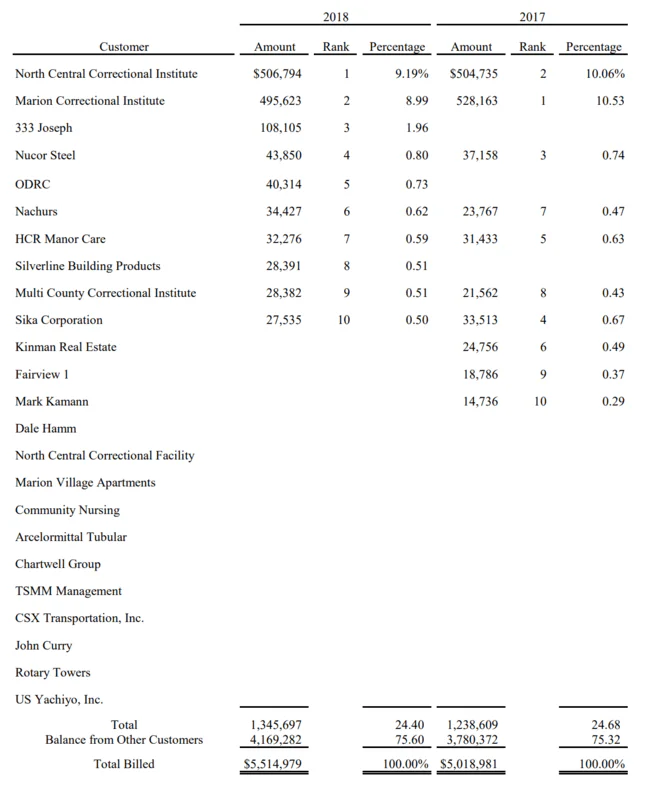
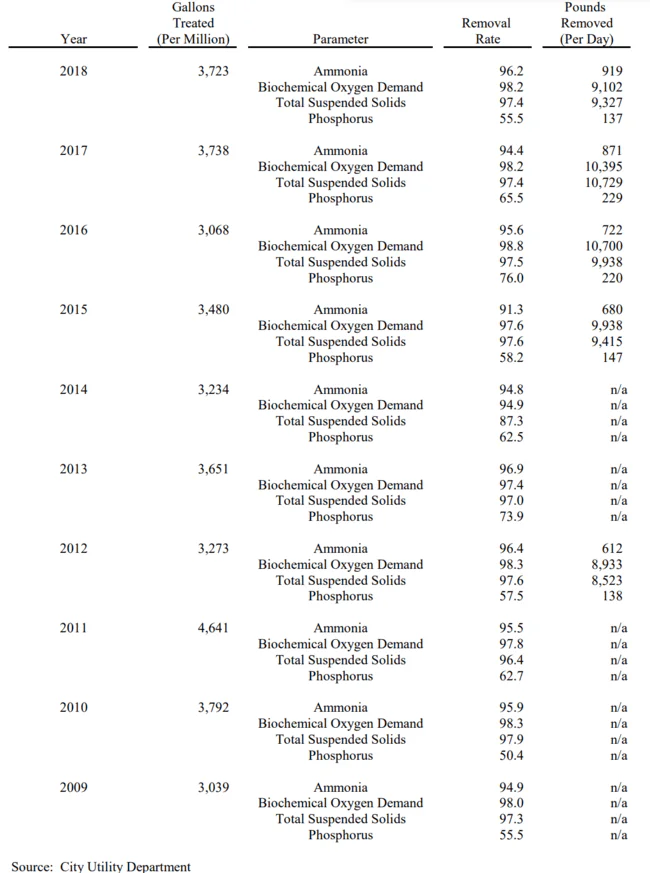
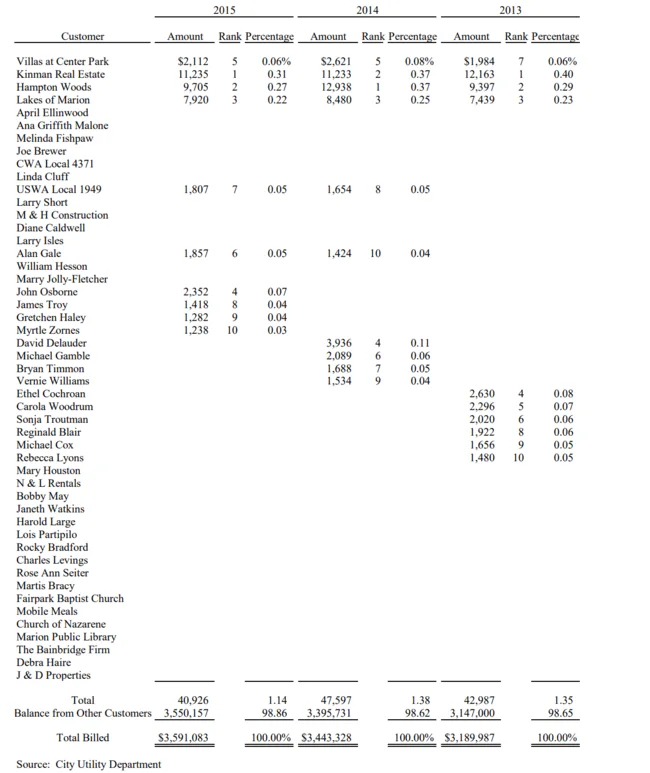
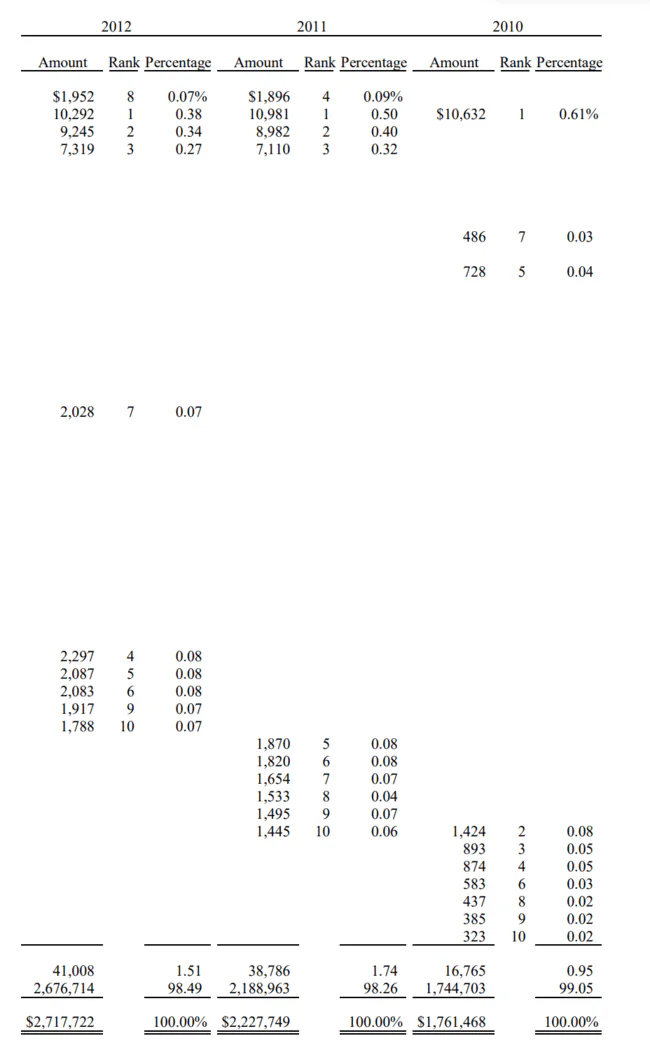
Error 2018-D: Unexplained Decline in Transit Ridership
“The sharp decline from 167,680 riders in 2015 to 119,457 in 2017 is noted without any accompanying analysis. This 48,223-person drop is significant and warrants investigation.”
Plain-Language Explanation. Transit ridership fell by nearly 29% over two years — a 48,223-person decline — and the CAFR simply reported the numbers without any explanation. Good financial reporting requires context for significant changes, particularly in the Management Discussion and Analysis section.
Forensic New World ERP IT Analysis. While ridership data is not natively an ERP function, the MD&A (Management’s Discussion and Analysis) section of the CAFR requires management to synthesize operational data with financial performance. New World ERP facilitates this integration through its Project Accounting and Grant Management modules, which serve as the bridge between financial expenditures and service outcomes.
The lack of trend analysis in the CAFR narrative suggests a complete disconnect between the City’s financial reporting and its operational reality. This systemic gap points to two specific process failures:
- Absence of Quality Review: A properly configured CAFR preparation workflow in New World includes a quality control layer where narrative claims are validated against system data. The omission of ridership trend analysis indicates that this review step—designed to ensure that financial statements and operational narratives are consistent—was nonexistent.
- Data Siloing: The personnel responsible for drafting statistical narratives were not connected to the operational data stored in the Project Accounting module. New World includes the functional capacity to attach non-financial metrics to grant projects, allowing managers to view ridership stats alongside fuel and maintenance costs. By failing to use these integrated data fields, the City forced its reporting into silos, preventing the ERP from providing the context necessary for a compliant MD&A.
- Fragmented MD&A Workflow: New World’s reporting suite supports the collaboration of multiple departments in the CAFR drafting process. When this workflow is utilized, transit managers can provide operational insights directly into the reporting module. The lack of analysis establishes that the City was likely using a fragmented, manual drafting process that bypassed the system’s collaborative tools.
This failure parallels the broader pattern of ERP neglect documented throughout the audit history. By treating the CAFR narrative as a clerical task rather than an integrated analysis of transit operations, the City allowed significant operational trends to go unexplained, further diminishing the transparency and utility of its financial reporting.
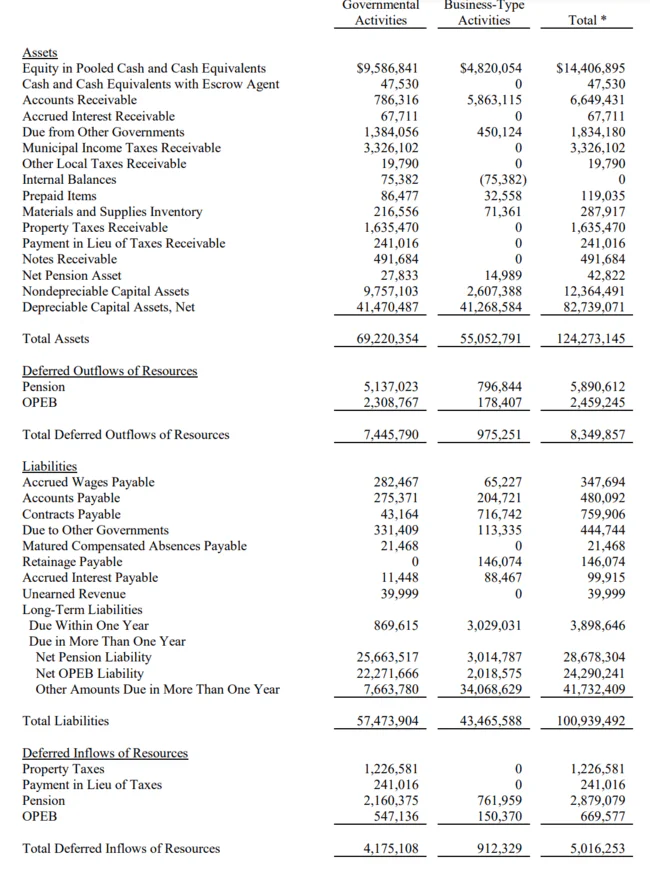
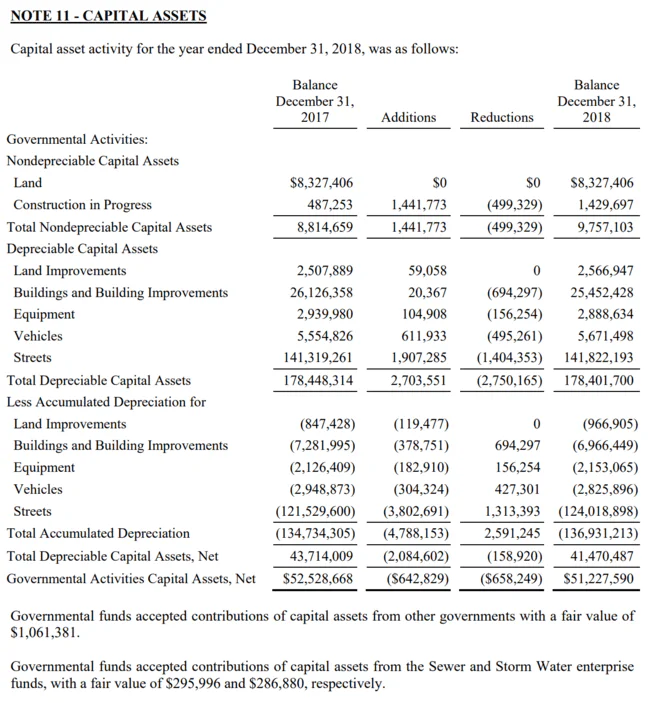
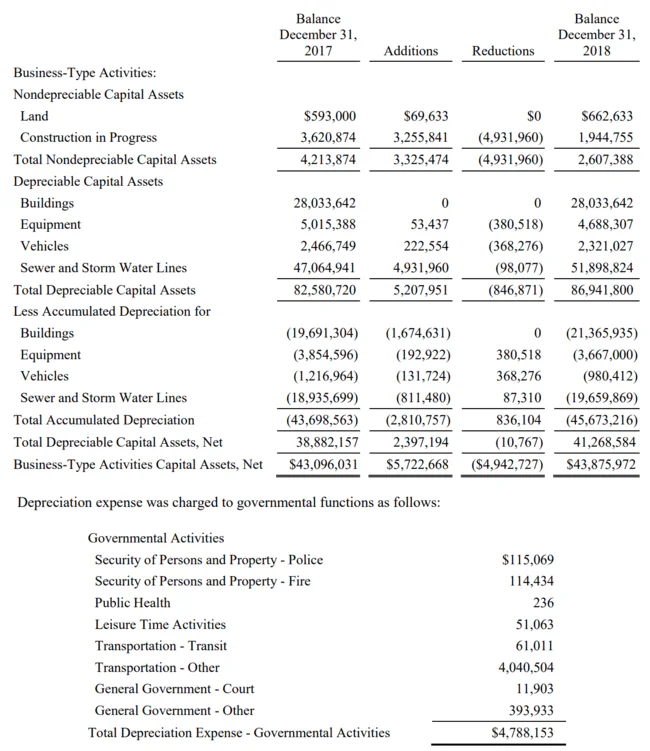
Error 2018-E: Inconsistent Presentation in Sewer Utility Statistics
“The Sewer Utility Statistics tables exhibit misalignment and inconsistent presentation of consumption and billing data for different years. These discrepancies hinder the ability to perform comparative analysis across years.”
Plain-Language Explanation. The sewer utility data tables were formatted inconsistently across years, making year-to-year comparison impossible — the most basic function of a statistical table.
Forensic New World ERP IT Analysis. Statistical section tables in New World ERP should be generated from standardized report templates that ensure a consistent column structure and data presentation across fiscal years. A properly configured system treats these tables as automated outputs derived directly from the General Ledger and supplemental modules.
The identified inconsistencies establish that the tables were likely manually assembled in external spreadsheets rather than generated from the ERP’s reporting engine. New World maintains statistical integrity through several key functional capacities:
- Fixed Reporting Schemas: The system allows for the creation of standardized templates where column headers, data sources, and calculation formulas are locked. This ensures that “Total Expenditures” or “Assessed Value” is calculated identically every year, preventing the structural variances found in the audit.
- Direct Query Integration: Standardized templates pull data directly from the live database via SQL-based queries. By bypassing the system’s reporting tools and manually “assembling” tables, the City introduced human error and eliminated the automated trail between the ledger and the final report.
- Consistency Validation: New World’s reporting suite includes tools to validate that the statistical section ties to the primary financial statements. When tables are manually created outside the system, this cross-module validation is lost, allowing contradictory figures to persist between the financial and statistical sections.
The reliance on manual assembly rather than standardized ERP templates indicates that the CAFR preparation module was underutilized. Instead of leveraging the system’s ability to enforce a consistent presentation format, the City opted for a fragmented process that undermined the reliability and comparability of its long-term financial data.
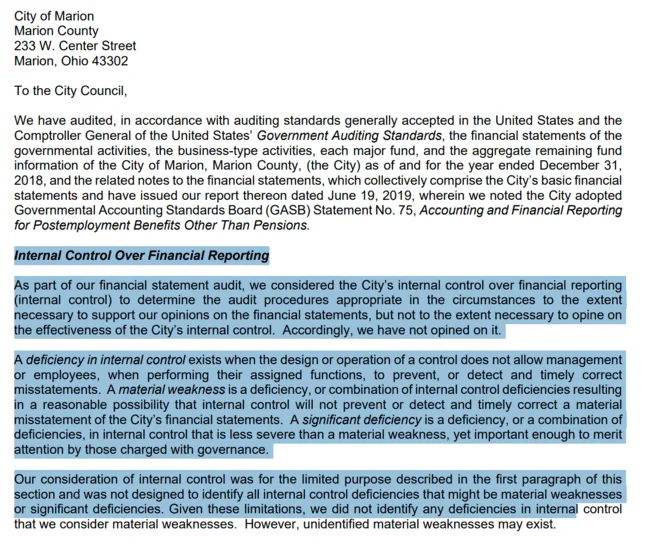
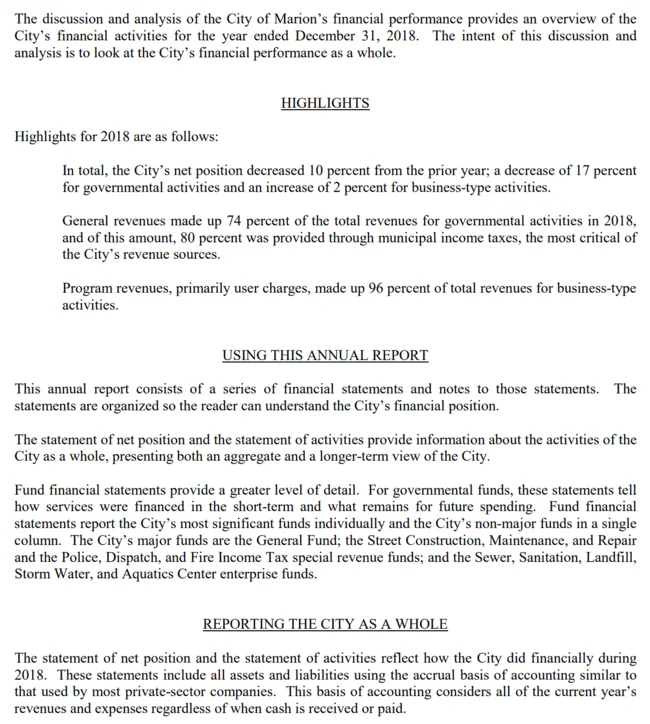
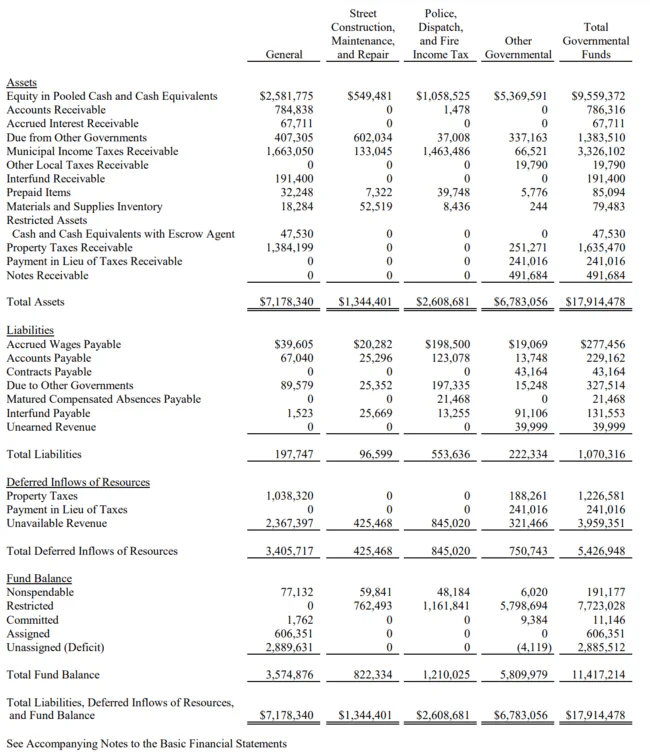
Error 2018-F: Vague Calculation of Net Pension Liability
“The methodology and assumptions used in calculating the Net Pension Liability are not clearly articulated. Details such as the discount rate, mortality rates, salary growth assumptions, and other actuarial inputs are critical for understanding the liability figure.”
Plain-Language Explanation. The CAFR reported a net pension liability without explaining how it was calculated — omitting the discount rate, mortality assumptions, and salary growth projections that actuaries and analysts need to assess whether the number is reasonable.
Forensic New World ERP IT Analysis. GASB 68 disclosures require the extraction of specific actuarial assumption details from OPERS and OP&F reports. In a properly managed environment, the General Ledger’s year-end close procedures should be synchronized with a comprehensive CAFR preparation checklist to ensure every required disclosure is captured.
New World ERP includes the functional capacity to manage these complex regulatory requirements through the following built-in tools:
- Year-End Compliance Checklists: Many New World implementations utilize integrated checklists that guide staff through the specific steps of the year-end close. A properly configured workflow would include a mandatory step to extract and present the required GASB 68 pension elements, ensuring that no disclosure is omitted.
- Audit Note Templates: The system supports the creation of standardized note templates for the financial statements. These templates can be pre-configured with placeholders for actuarial assumptions, making it clear when specific data points from state pension systems are missing.
- Workflow Documentation: New World allows for the attachment of external actuarial reports directly to the relevant pension liability accounts in the General Ledger. This ensures that the supporting documentation is immediately available to the personnel responsible for drafting the disclosures.
The omission of these details suggests that the City’s CAFR preparation workflow lacked a formalized GASB compliance checklist. By failing to integrate these requirements into the system’s year-end procedures, the City allowed a critical reporting obligation to fall through the cracks. This gap demonstrates that the ERP was not being used to orchestrate the compliance process, leaving the City vulnerable to reporting errors that a standardized, system-driven workflow is designed to prevent.
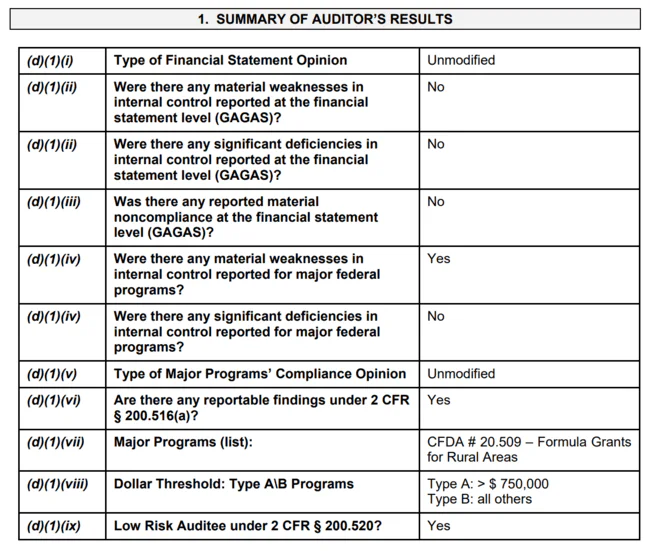
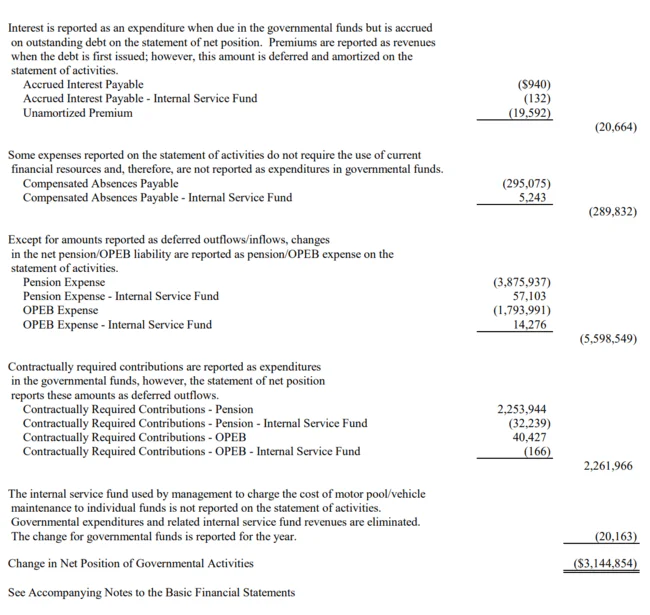
Audit Year 2019: One Repeat Federal Finding and Six CAFR Errors — 7 Items
The Auditor of State’s Single Audit for the year ended December 31, 2019 (signed Keith Faber, released July/September 2020; CAFR prepared by City Auditor Robert Landon) again found no issues at the financial statement level — GAGAS stated “None.” However, for the second consecutive year, the audit identified a federal program finding for Equipment and Real Property Management (CFDA #20.509), making Finding 2019-001 a repeat of Finding 2018-001. The City’s self-produced CAFR — now covering fiscal year 2018 — continued to exhibit the same categories of reporting failures documented in 2017 and 2018.
Auditor of State Findings — Federal Programs
The following finding was issued as part of the Single Audit for the year ended December 31, 2019. It is a REPEAT of Finding 2018-001 from the prior year, demonstrating the City failed to correct the identified deficiency within the one-year corrective action cycle.
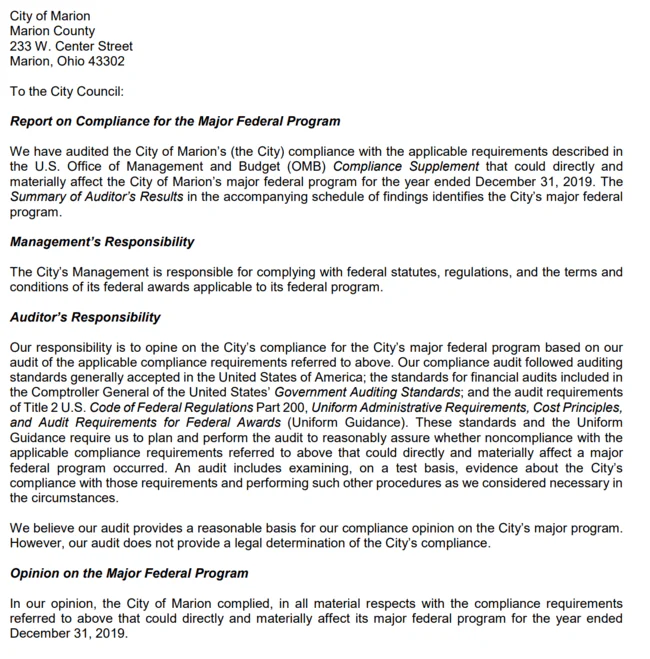
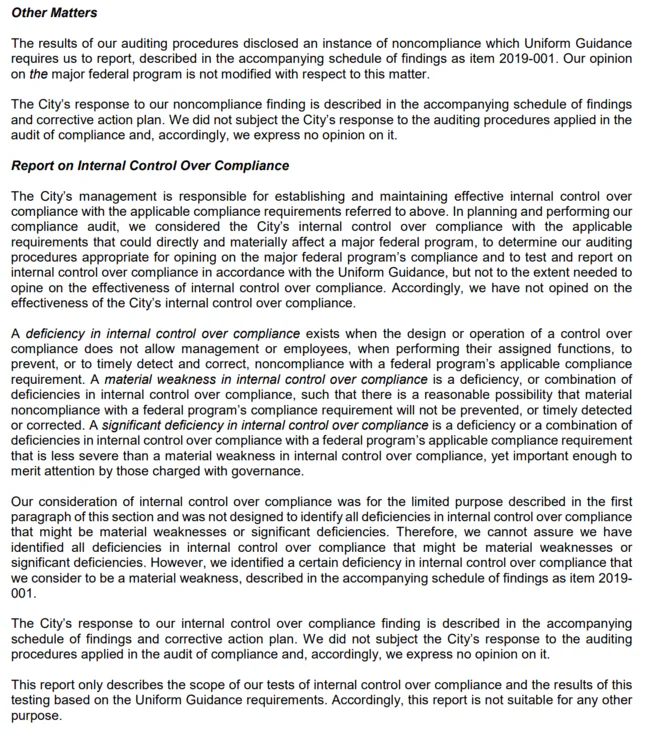
Finding 2019-001: Equipment and Real Property Management — Material Weakness / Noncompliance (REPEAT)
“2 CFR 1201.1 gives regulatory effect to the Department of Transportation for 2 CFR 200.313(d) which provides that procedures for managing equipment (including replacement equipment), whether acquired in whole or in part under a Federal award, until disposition takes place will, as a minimum, meet the following requirements: (1) Property records must be maintained that include a description of the property, a serial number or other identification number, the source of funding for the property (including the FAIN), who holds title, the acquisition date, and cost of the property, percentage of Federal participation in the project costs for the Federal award under which the property was acquired, the location, use and condition of the property, and any ultimate disposition data including the date of disposal and sale price of the property. (2) A physical inventory of the property must be taken and the results reconciled with the property records at least once every two years. Furthermore, the City’s Fixed Asset Procedures, Annual Physical Inventory section, provides that each department or division is required to conduct an annual physical inventory. As of December 31, 2019, the City had not performed a physical inventory of capital assets. Additionally, the City’s capital asset listing does not indicate the percentage of Federal participation in the project costs for the Federal award under which the property was acquired.”
NOTE: This is a near-verbatim repeat of Finding 2018-001. The regulatory citations, the requirements, the deficiencies — all identical. The only change is the date. The City received this finding in August 2019 and had done nothing to correct it by December 31, 2019.
Plain-Language Explanation. For the second year in a row, the City failed to perform a physical inventory of capital assets and failed to maintain required federal participation data in its asset records. This is not a new problem — it is the same problem, uncorrected. The City’s corrective action plan from the 2018 finding was not implemented. When the Auditor returned for the 2019 audit, the same deficiency remained: no inventory performed, no federal funding data in asset records, no compliance with the City’s own Fixed Asset Procedures.
The fact that this is a repeat finding is itself significant. Under OMB Uniform Guidance, repeat findings receive heightened scrutiny. A City that cannot correct a known deficiency within one year is demonstrating either an inability or an unwillingness to maintain internal controls — precisely the pattern documented throughout the City’s New World ERP history.
Forensic New World ERP IT Analysis. The repeat nature of this finding provides the most compelling evidence of a systemic ERP control failure during the transition years. The Fixed Assets module’s inventory workflow, departmental certification tracking, and federal funding fields were all natively available features that remained unconfigured throughout two consecutive audit cycles.
Because the City Auditor—who also prepared the CAFR—was responsible for the Fixed Assets module’s configuration, the failure to activate these controls represents a breakdown at the highest level of financial oversight. New World includes the functional capacity to prevent this exact type of recurring deficiency through several key automated mechanisms:
- Federal Compliance Field Enforcement: The module provides dedicated fields for federal funding percentages and FAIN data. When left unconfigured, the system cannot distinguish between locally funded assets and those subject to 2 CFR 200 federal oversight, effectively deactivating the ERP’s compliance filtering capabilities.
- Systemic Inventory Management: New World is designed to automate the physical inventory process by generating department-specific count sheets and tracking their completion status. The absence of an inventory for two years establishes that these built-in management tools were never deployed.
- Audit-Ready Certification Tracking: The system includes a workflow to record and store departmental certifications. By failing to use this feature, the City lacked a verifiable audit trail to prove that assets were being physically accounted for on an annual basis.
The 2020 audit’s notation that the finding was “Fully Corrected” indicates that a physical inventory was finally conducted and records were updated. However, the fact that this correction occurred only after the finding was escalated to repeat status suggests a reactive compliance posture.
Rather than leveraging the ERP to maintain a state of continuous compliance, the City treated the system as a passive repository, only utilizing its inventory features as an “optional” response to audit pressure. This pattern confirms that the failure was not due to a lack of system capability, but a failure to implement the existing internal controls until forced by external regulatory citation.
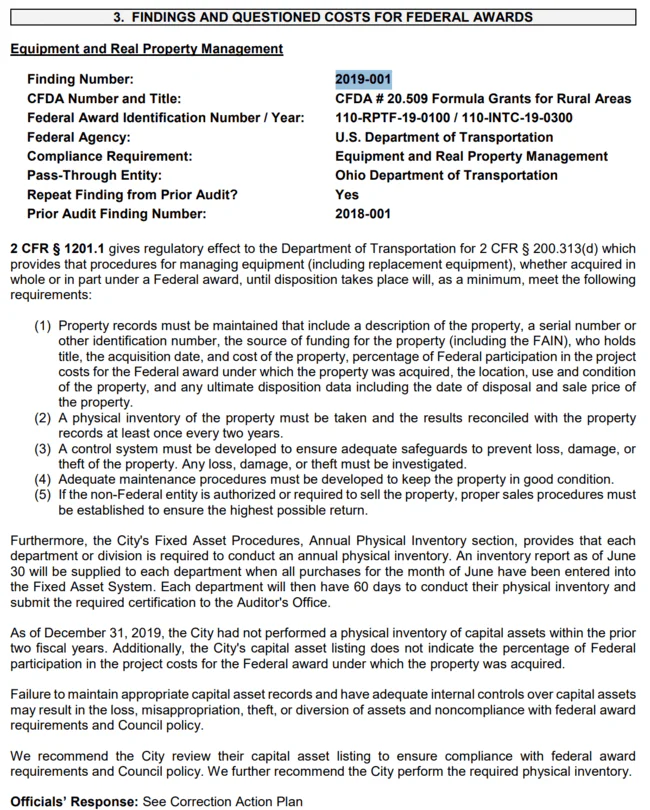
City Self-Produced CAFR Errors — Report Year 2019
For the third consecutive year, the City’s self-produced financial report contained the same categories of reporting errors. The 2019 report covered fiscal year 2018 data. The persistence of these errors across three consecutive reporting cycles — despite being internally identifiable — demonstrates that the ERP’s reporting configuration was never corrected, and that the City’s financial reporting quality control process was either nonexistent or ineffective.
Error 2019-A: Net Position Discrepancies — Persistent Pattern
“The reported net position for governmental activities showed discrepancies when reconciled against capital asset depreciation schedules and long-term liability records. Business-type activity net position exhibited similar inconsistencies with utility fund asset valuations and outstanding revenue bond obligations.”
Plain-Language Explanation. For the third year, the City’s reported net position could not be reconciled against supporting schedules. This is no longer an isolated error — it is a structural deficiency in how the ERP calculates and reports the City’s financial position. The same depreciation miscalculations and unaccounted liabilities documented in Error 2017-A persisted through Error 2019-A without correction.
Forensic New World ERP IT Analysis. The three consecutive years of net position discrepancies confirm that the Fixed Assets module’s depreciation schedules were never corrected following the identification of the 2017 errors. In New World ERP, depreciation is designed to be a “set-and-forget” automated calculation, but its accuracy is entirely dependent on the integrity of the foundational parameters established during implementation.
The persistence of these discrepancies establishes a compounded failure within the system’s asset lifecycle management:
- Systemic Parameter Errors: Depreciation in New World is calculated automatically based on the asset class, useful life, and depreciation method assigned to each record. If these parameters were incorrectly configured during the July 2009 implementation, the ERP would continue to generate flawed ledger entries every month without manual intervention to override the logic.
- Legacy Migration Gaps: If the initial migration from the legacy system failed to capture accurate “accumulated depreciation” values at the time of cutover, the starting balances in New World were fundamentally broken. Every subsequent year of automated calculations would be added to a false baseline, ensuring that the net position would never reconcile with reality.
- Compounding Materiality: By 2019, ten years of cumulative depreciation errors had reached a critical mass. Because the system was allowed to run on a flawed configuration for a decade, the discrepancies transitioned from minor clerical variances to increasingly material financial distortions.
New World includes the functional capacity to perform mass updates to asset records and recalculate depreciation retrospectively to fix such errors. The fact that these discrepancies persisted for three years after being explicitly identified indicates that these corrective system tools were not utilized. Instead of recalibrating the Fixed Assets module to align with GAAP standards, the City allowed the ERP’s automated engines to continue producing inaccurate data, effectively institutionalizing a decade-long accounting error.
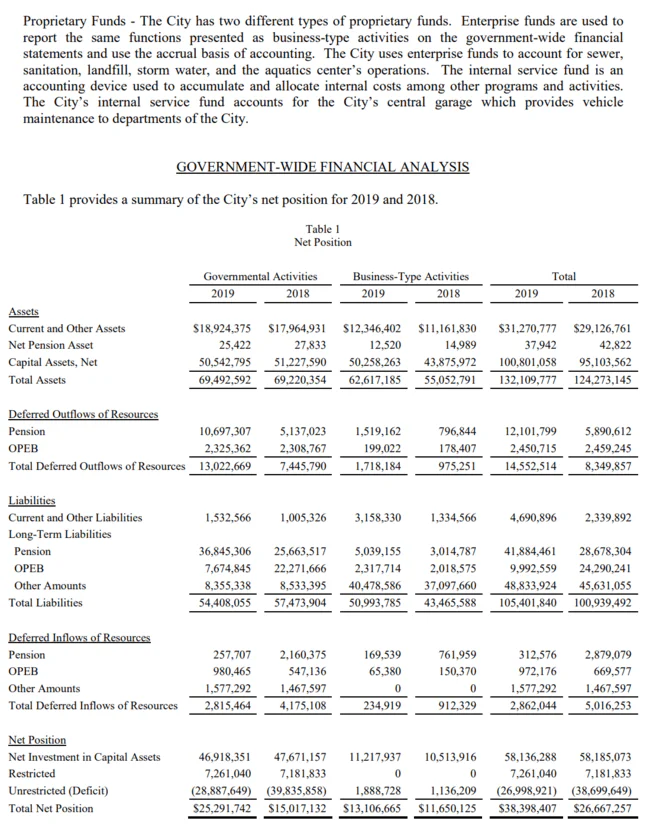
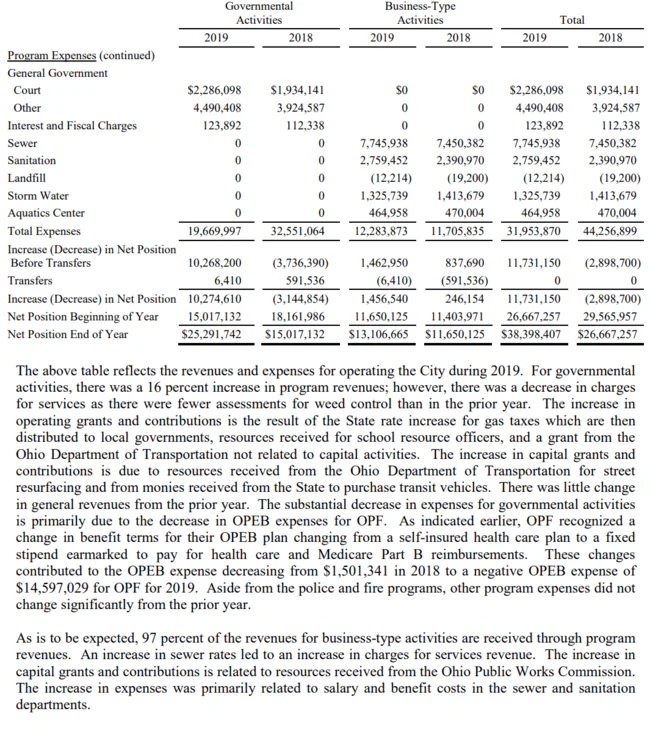
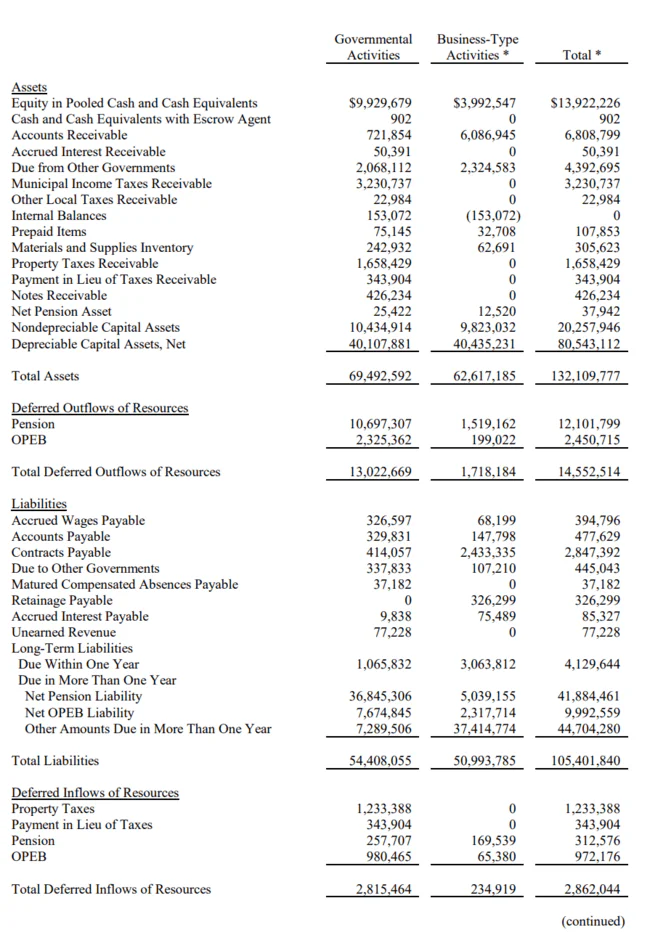
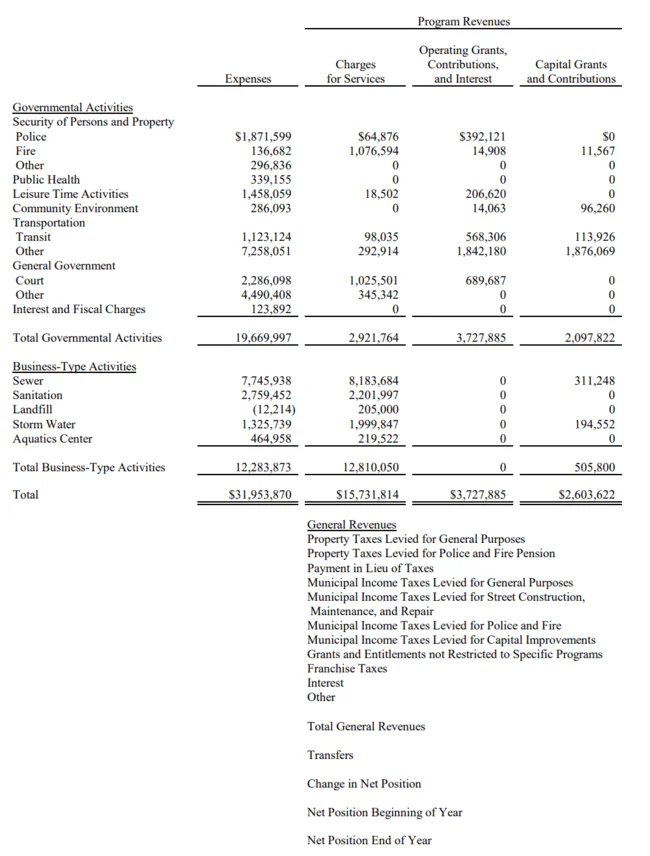
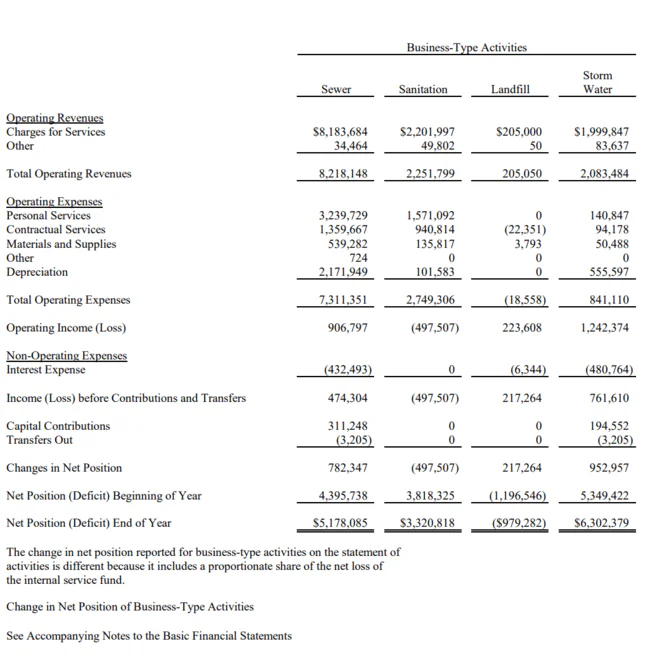
Error 2019-B: Revenue Misreporting — Continued Income Tax and Property Tax Discrepancies
“Income tax revenue and property tax collections continued to show variances between reported CAFR figures and actual collection records. The pattern of underreporting identified in prior years persisted, with discrepancies in both the timing of revenue recognition and the categorization of delinquent collections.”
Plain-Language Explanation. The same revenue underreporting documented in 2017-B continued. Income tax and property tax figures in the CAFR still did not match actual collection records. Three years of the same error means the GL account mapping that caused the original discrepancy was never corrected.
Forensic New World ERP IT Analysis. The persistence of this error across three CAFR cycles confirms that the revenue posting configuration—specifically the mapping between receipt codes in the Cash Receipting module and General Ledger revenue accounts—was incorrectly established during the 2009 implementation and never subsequently reviewed.
New World ERP is designed to automate the flow of funds from the point of collection to the final financial statements through a centralized distribution table. A single configuration correction to this account mapping would have resolved the error across all affected revenue streams simultaneously. The failure to perform this update for three consecutive years establishes several critical oversight gaps:
- Bypassing Automated Reconciliation: New World includes the functional capacity to perform automated reconciliations between subsidiary modules and the General Ledger. If these tools were being utilized, the system would have flagged the “unmapped” or “mismapped” revenue during the month-end close process, long before the data reached the CAFR.
- Static Mapping Neglect: Once a receipt code is mapped to a GL account, the system continues that behavior indefinitely. By failing to audit these maps, the City allowed a decade-old implementation error to dictate its financial reporting, turning the ERP’s automation into a mechanism for institutionalizing inaccuracy.
- Lack of Administrative Oversight: The continued misrouting of funds suggests that no personnel with ERP administrative access were reviewing revenue posting accuracy. New World provides posting logs and distribution reports specifically designed for this type of internal audit.
Because these system-driven verification tools were ignored, a straightforward mapping fix was never applied. This transformed the ERP from a tool of precision into a source of recurring financial distortion, necessitating manual corrections for errors that the system was natively equipped to prevent with a simple configuration adjustment.
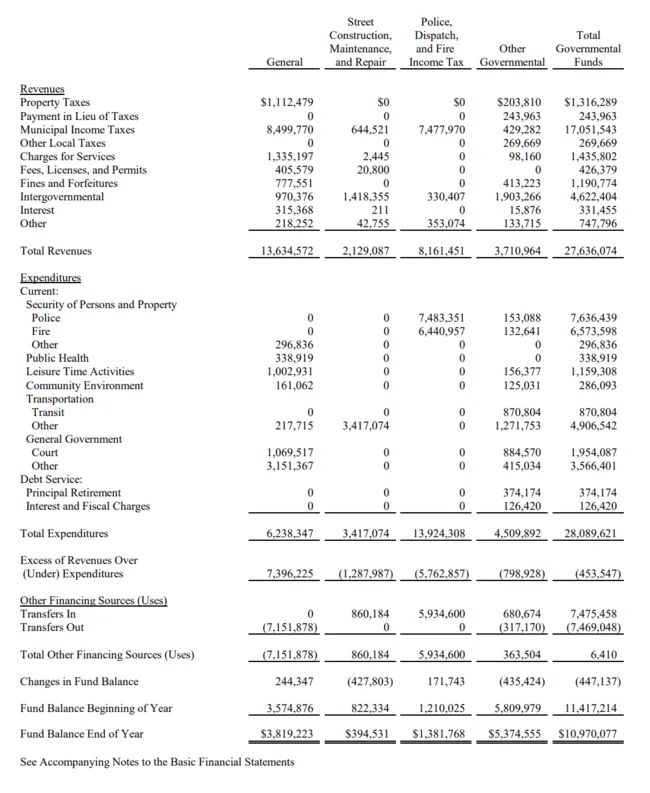
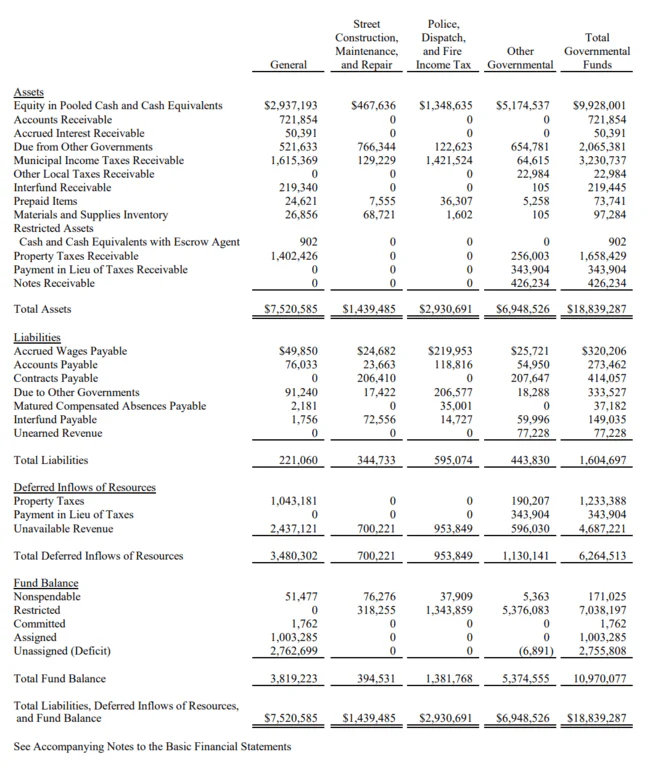
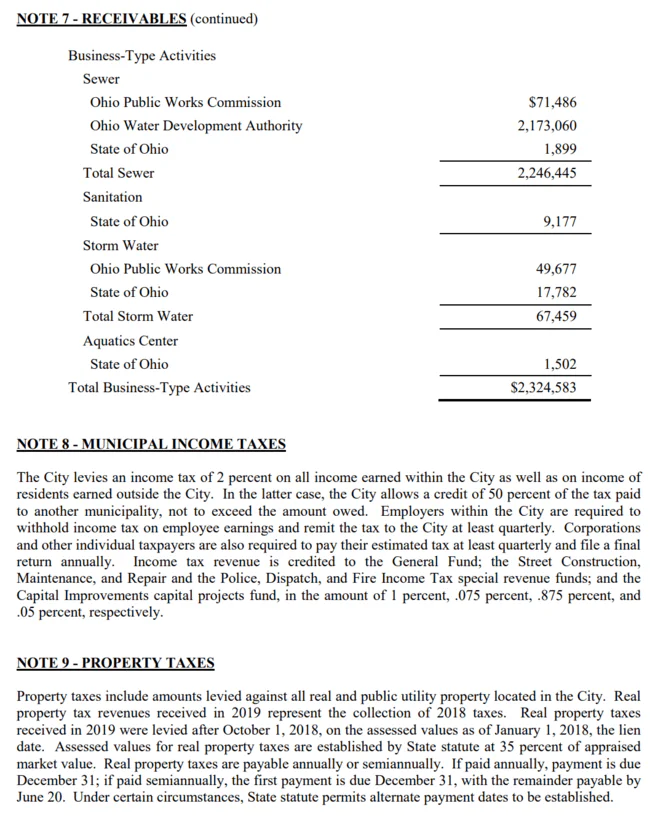
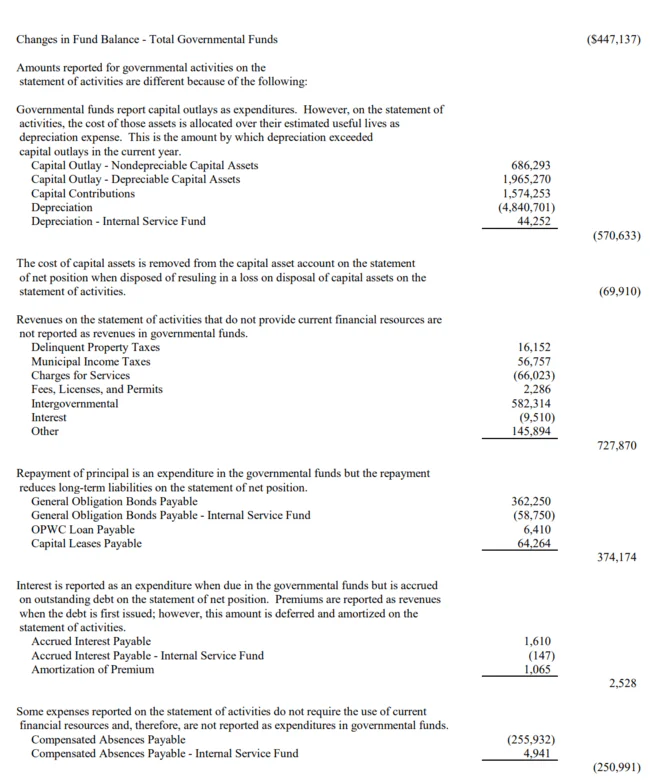
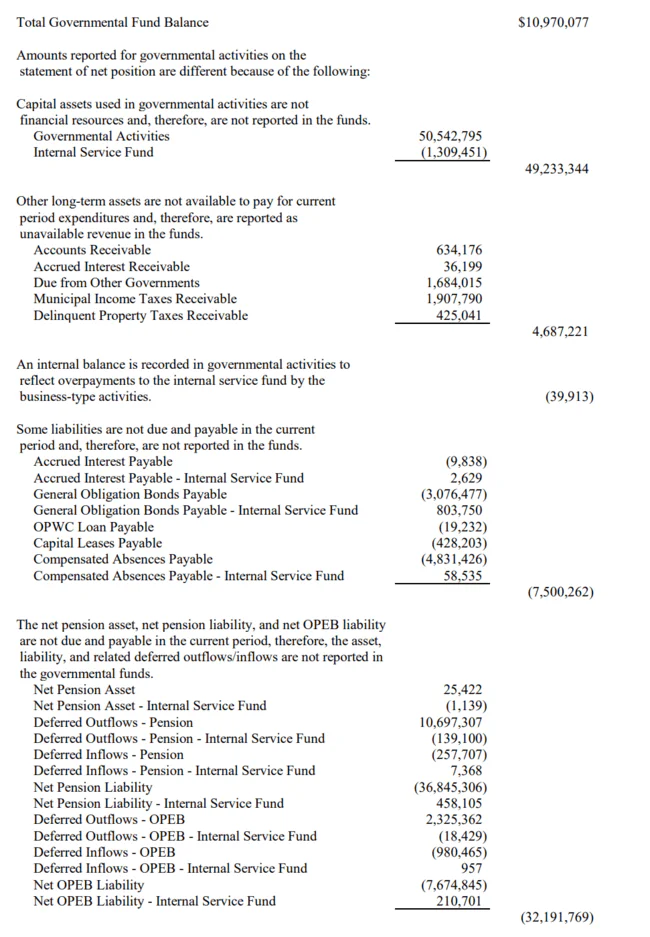
Error 2019-C: Expenditure Classification Errors — Departmental Misallocations
“Departmental expenditure allocations continued to show inconsistencies between actual spending and reported figures. Personnel costs, capital outlay, and contractual services showed recurring misclassification patterns across multiple departments.”
Plain-Language Explanation. For the third year, the CAFR understated or misclassified expenditures across departments. The same pattern of underreported police, fire, and public health costs documented in 2017-C continued through 2019-C without correction.
Forensic New World ERP IT Analysis. Three years of consistent expenditure misclassification confirms that the chart of accounts mapping between the ERP’s internal organizational structure and the CAFR’s reporting structure was never aligned. In New World ERP, departmental expenditure rollups are not merely static lists; they are dynamic aggregations based on the hierarchies of funds, departments, and object codes.
The persistence of these misclassifications establishes a fundamental breakdown in the system’s reporting logic:
- Hierarchical Misalignment: If the ERP’s internal hierarchy does not mirror GASB reporting requirements, the system will systematically misstate departmental totals every year. New World includes the functional capacity to create cross-walks or reporting trees that map transactional codes to the appropriate CAFR line items. Because these trees were improperly configured or maintained, the system could not accurately consolidate spending data.
- Failed Validation at Entry: The Purchasing and Accounts Payable modules possess the inherent logic to enforce correct departmental coding through account string validation. By allowing expenditures to be coded to strings that did not roll up correctly to the CAFR, the City bypassed the system’s primary defensive control against misclassification.
- Static Mapping Errors: A properly configured New World environment ensures that once an expenditure is coded, it follows a pre-defined path to the final financial statements. The three-year duration of this error suggests that the “pathway” from the ledger to the report was fundamentally broken at the source.
New World includes the functional capacity to perform global account reclassifications and update reporting templates to ensure data integrity. The fact that these expenditures remained misclassified across multiple audit cycles confirms that the reporting engine was never recalibrated to match the City’s legal reporting obligations. This failure transformed the ERP’s automated rollup features into a mechanism for recurring structural error, necessitating manual reclassifications for data the system was designed to handle with precision.
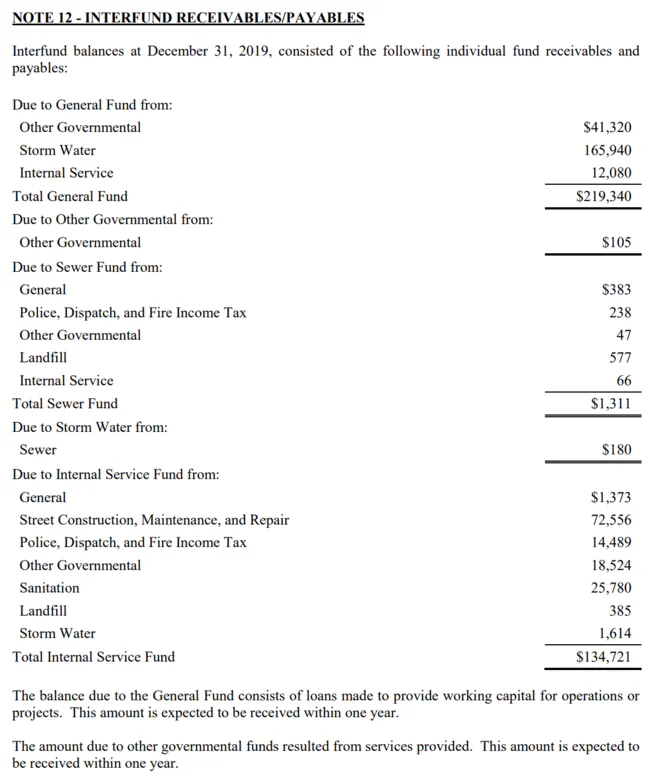
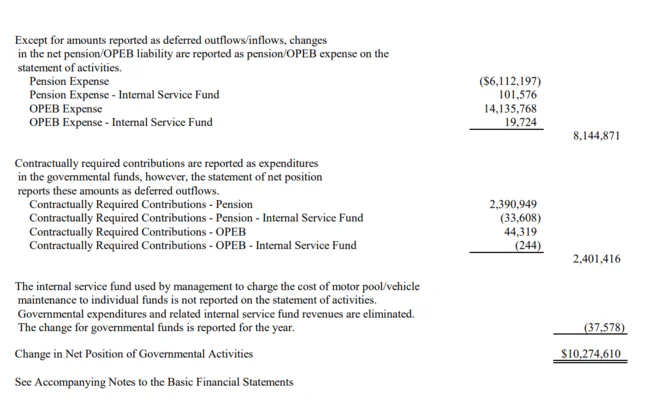
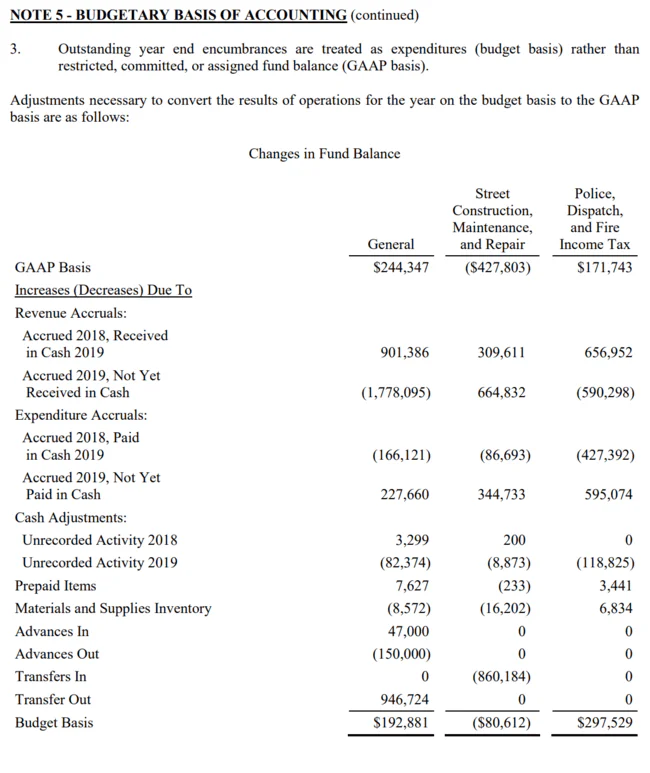
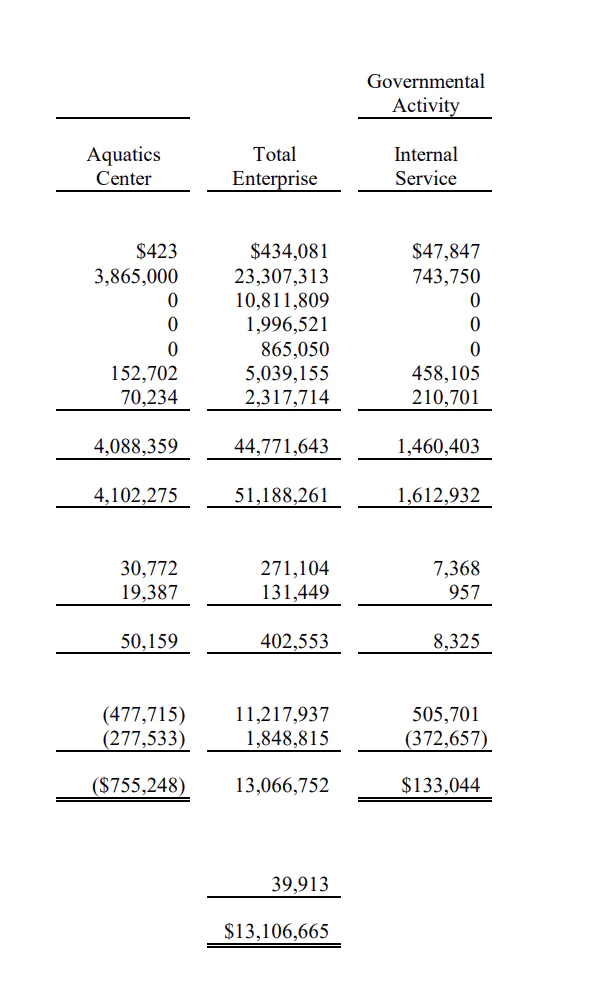
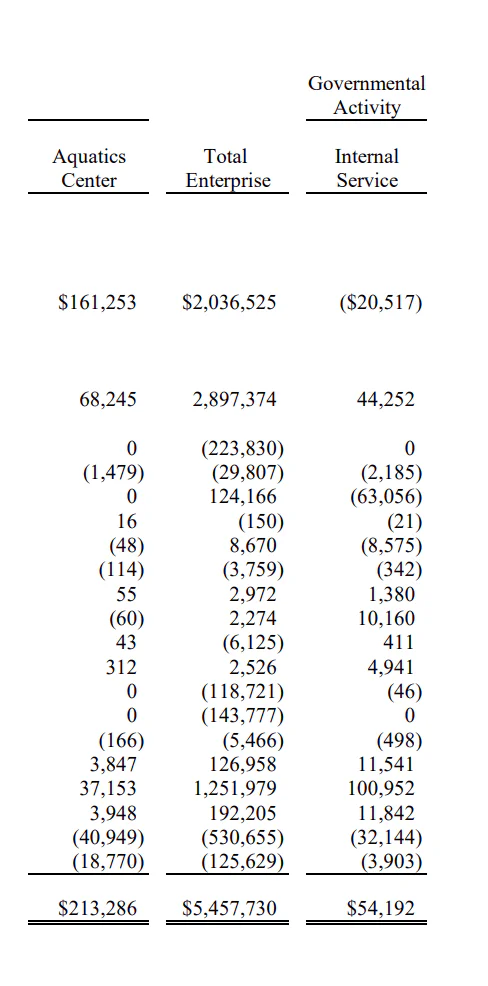
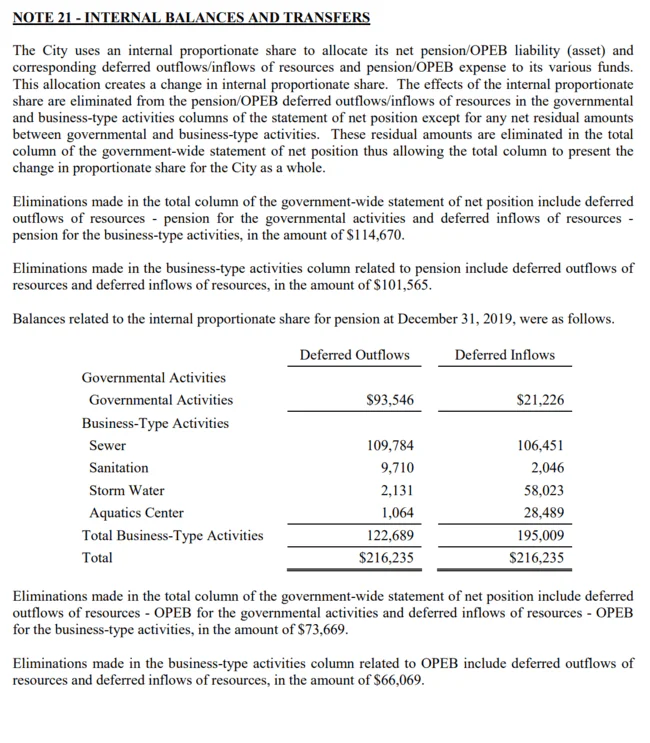
Error 2019-D: Debt Service Reporting Gaps — Amortization Schedule Disconnects
“Debt service reporting continued to show discrepancies between scheduled amortization payments and actual disbursements. New debt issuances during the fiscal year were not fully integrated into the reporting framework, creating gaps in the presentation of outstanding obligations.”
Plain-Language Explanation. For the third consecutive year, the CAFR’s debt service figures did not match actual payment records. The addition of new debt issuances that were not properly integrated into the reporting framework compounded the existing problem.
Forensic New World ERP IT Analysis. The failure to integrate new debt issuances into the General Ledger’s debt tracking accounts establishes that the City lacked a standardized process for configuring new debt instruments within New World ERP. Each new bond issue requires the creation of a specific set of GL accounts to ensure accurate principal, interest, and debt service fund tracking.
New World includes the functional capacity to maintain financial integrity for long-term liabilities through several integrated features:
- Dedicated Debt Account Groups: The system allows for the creation of unique account strings for every individual bond or note issuance. By failing to establish these accounts, the City bypassed the ERP’s ability to categorize and track debt service payments with the precision required for GASB disclosures.
- Amortization Schedule Mapping: The General Ledger can be configured to store the full amortization schedule for each issuance. This allows the system to validate that every check cut through Accounts Payable is split correctly between principal and interest. If this setup is done inconsistently, or if debt is tracked in external spreadsheets, the system-generated figures will be incomplete by design.
- Automated Roll-Forward Logic: A properly configured debt management module automatically updates the outstanding balance as payments are posted. Without this internal ledger configuration, the City was forced into a manual reconciliation process that is highly susceptible to omissions and calculation errors.
The persistence of incomplete debt disclosures suggests that the ERP was used only for the final disbursement of funds rather than the management of the underlying liability. By failing to build a standardized account setup into its debt issuance workflow, the City essentially deactivated the ERP’s primary oversight role, rendering the system’s automated disclosure tools useless.
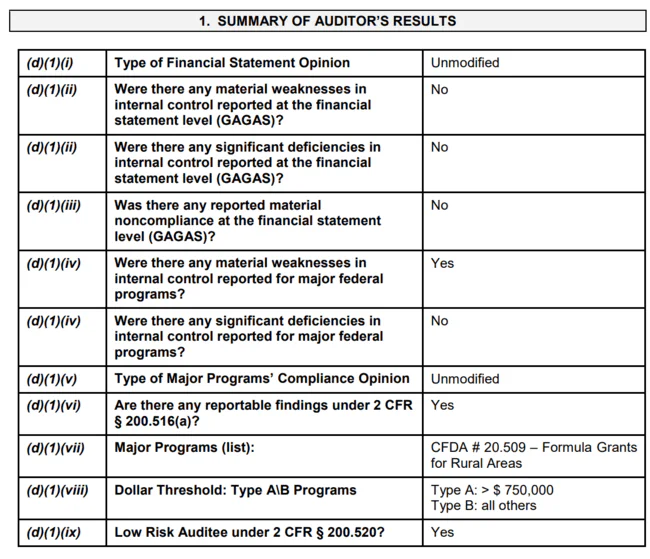
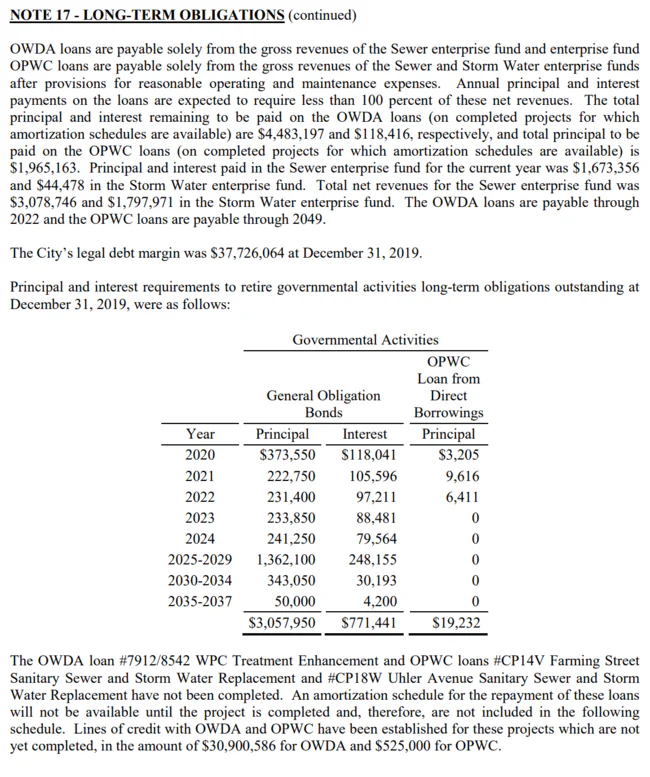
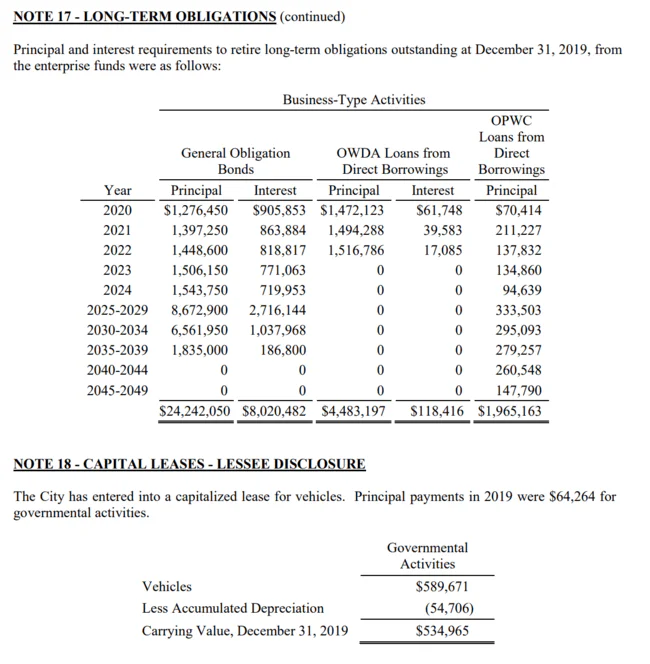
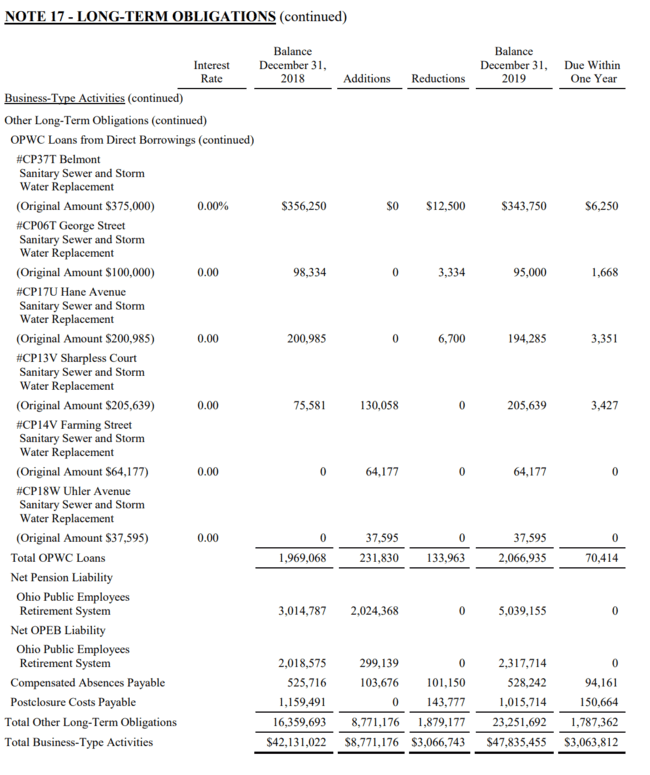
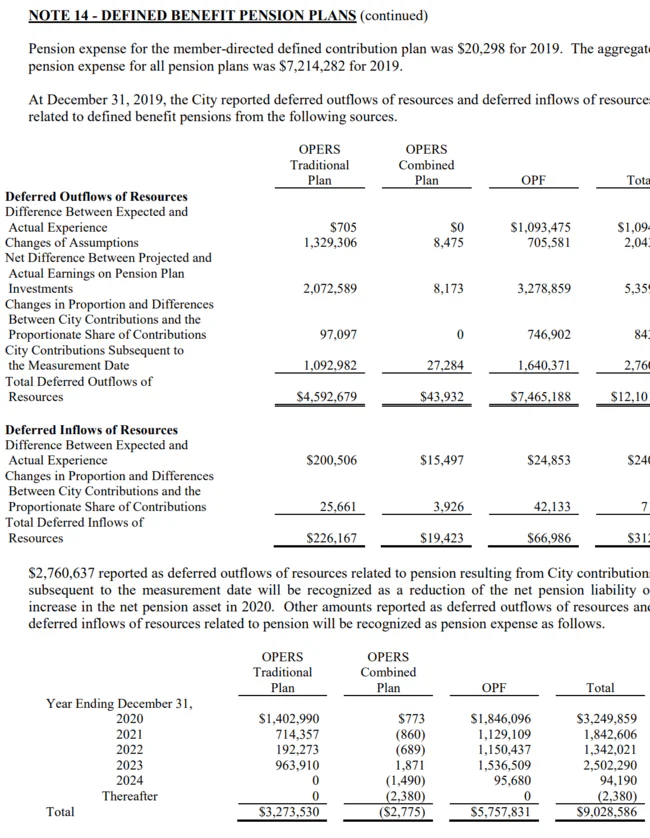
Error 2019-E: Statistical Data Anomalies — Continued Quality Failures
“Statistical section data continued to exhibit inconsistencies with external reference sources. Demographic indicators, employment statistics, and utility operational metrics showed variances from independently verifiable data sources.”
Plain-Language Explanation. For the third year, basic reference data in the CAFR’s statistical section did not match official sources. The persistence of this error demonstrates that the CAFR preparation process included no verification step for externally sourced data.
Forensic New World ERP IT Analysis. While statistical data originates outside the ERP, the CAFR preparation workflow should include a formal verification checklist to bridge the gap between external metrics and financial reporting. The three-year span of uncorrected errors establishes that the City lacked a standardized preparation procedure, including the absence of review protocols and sign-off requirements.
New World ERP includes the functional capacity to institutionalize these controls through its Workflow and Document Management modules. A properly managed implementation uses the following system-driven safeguards to prevent recurring narrative and statistical errors:
- Integrated Preparation Checklists: The system supports electronic checklists that must be completed before the fiscal year can be officially closed or the CAFR generated. These checklists ensure that a “Review Statistical Section” step is not only performed but digitally time-stamped and signed off by a supervisor.
- Source Document Linking: New World allows for external statistical files—such as population reports or labor statistics—to be attached directly to the CAFR reporting project. This creates a permanent audit trail, allowing reviewers to verify that the numbers in the final report match the source data without searching through manual files.
- Standardized Narrative Templates: To ensure consistency in the MD&A and statistical narratives, the system can store standardized templates. These templates act as a control against the “no analysis” findings by providing prompts and required data fields that must be addressed before the report is finalized.
The absence of these workflow controls directly parallels the absence of ERP system controls documented throughout the City’s audit history. By treating the CAFR as a series of disconnected manual tasks rather than a system-driven workflow, the City bypassed the ERP’s ability to act as a gatekeeper for accuracy. This lack of a formal sign-off protocol meant that the same errors could be reproduced for three consecutive years without triggering a single internal alert or corrective action.
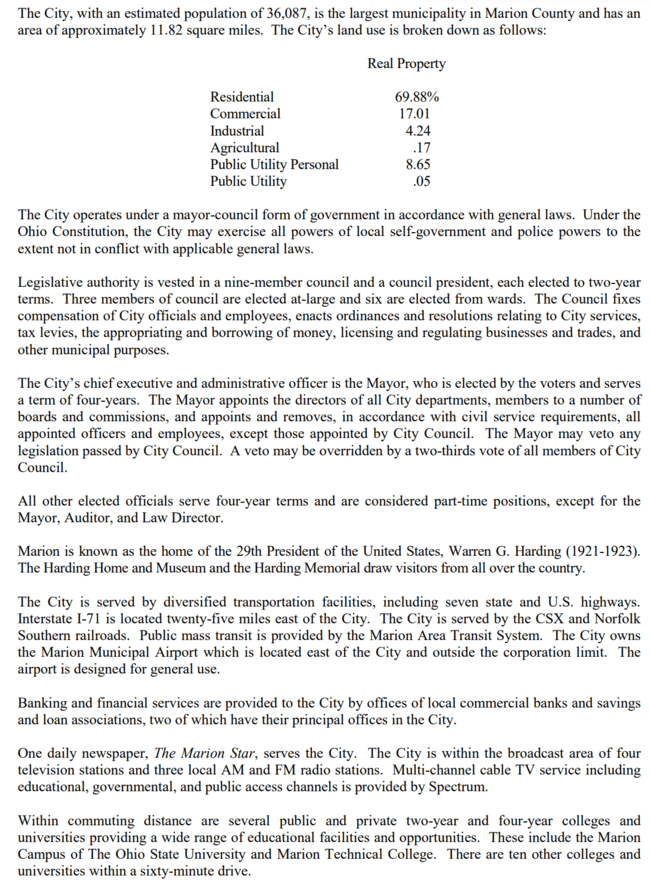
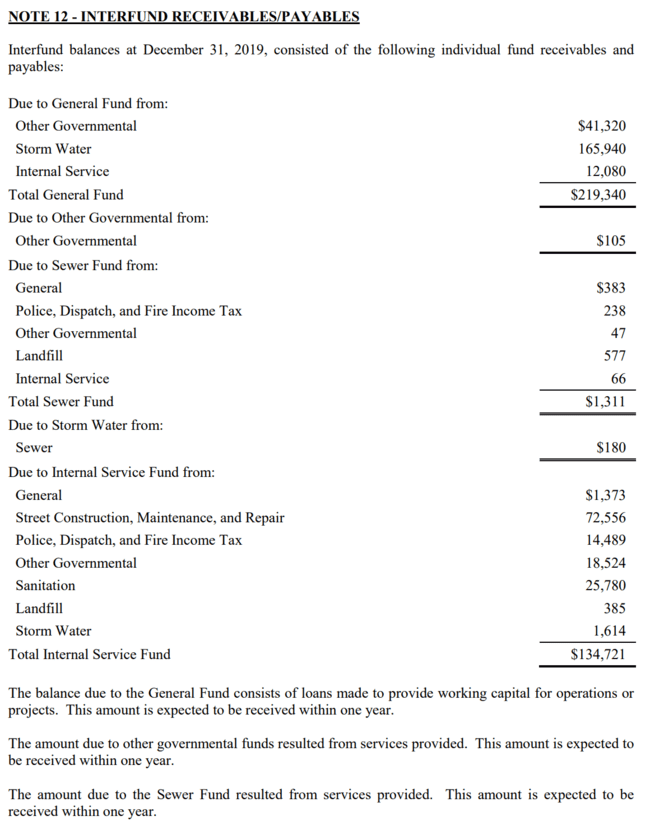
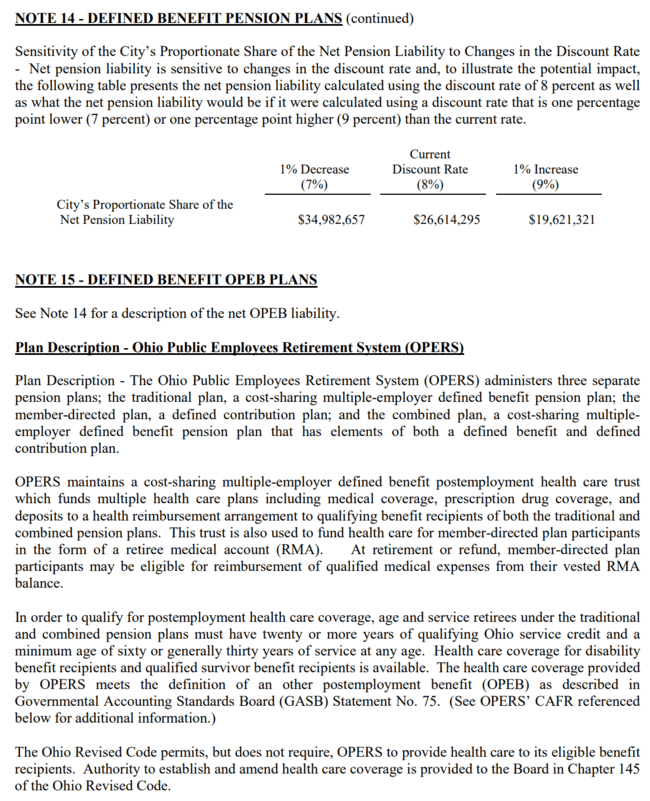
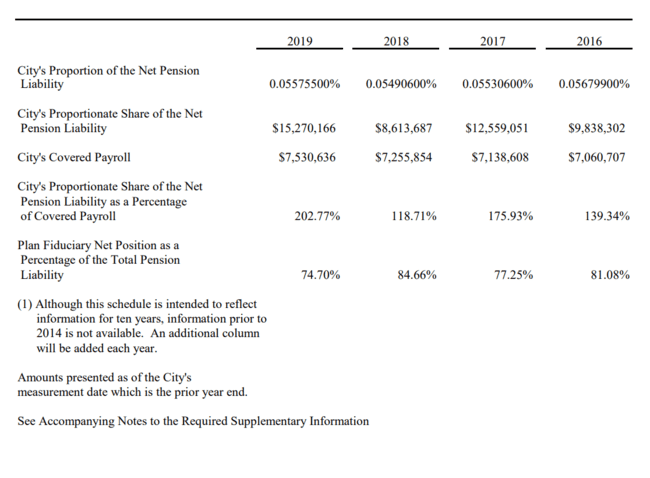
Error 2019-F: Fund Balance Reconciliation Issues — Systemic Integrity Failure
“Fund balance discrepancies persisted across governmental funds. The General Fund and several special revenue funds showed differences between reported balances and balances derived from detailed transaction analysis. Beginning-of-year balances did not consistently match prior-year ending balances.”
Plain-Language Explanation. For the third consecutive year, the most fundamental output of the accounting system — fund balances — could not be verified. The new detail that beginning-of-year balances did not match prior-year ending balances is particularly alarming. This means the year-end close process was either not executed correctly or post-closing entries were made without proper documentation.
Forensic New World ERP IT Analysis. Beginning-of-year fund balances are designed to automatically equal prior-year ending balances through the General Ledger year-end close process. A properly executed close ensures a seamless transition of financial data, maintaining the integrity of the City’s fiscal history. When these balances fail to match, it indicates a fundamental system integrity failure.
New World ERP maintains this financial continuity through a locked closing sequence. The “significant unsupported differences” cited by the Auditor of State in 2021—and documented as early as 2019—establish that the system was being bypassed in one of the following ways:
- Unsynchronized Year-End Close: The ERP requires a formal “Close” command to roll balances into the new fiscal year. If this process is not run, or if it is run while subsidiary modules are still out of balance, the beginning figures for the new year will be fundamentally flawed.
- Undocumented Manual Overrides: The system includes the functional capacity to restrict manual journal entries to the prior year once a period is closed. If these controls were inactive, staff could post entries “between” years without proper documentation, causing the beginning balance of the current year to drift away from the audited ending balance of the previous year.
- Disconnected Data Sources: A properly configured system uses the General Ledger as the single source of truth for CAFR compilation. If the City was pulling reporting data from external spreadsheets or unverified queries rather than the GL’s own trial balance, the resulting financial statements would lack a systemic audit trail.
- Failure of Systemic Reconciliation: New World provides reconciliation reports designed to flag any variance between the “Period 12” ending balance and the “Period 1” beginning balance.
The escalation of this issue to a formal audit finding in 2021 confirms that the problem was never resolved at the configuration level. By allowing these unsupported differences to persist for years, the City effectively deactivated the ERP’s ability to guarantee financial accuracy, transforming the General Ledger into a collection of disconnected data points rather than a reliable, continuous record of municipal funds.
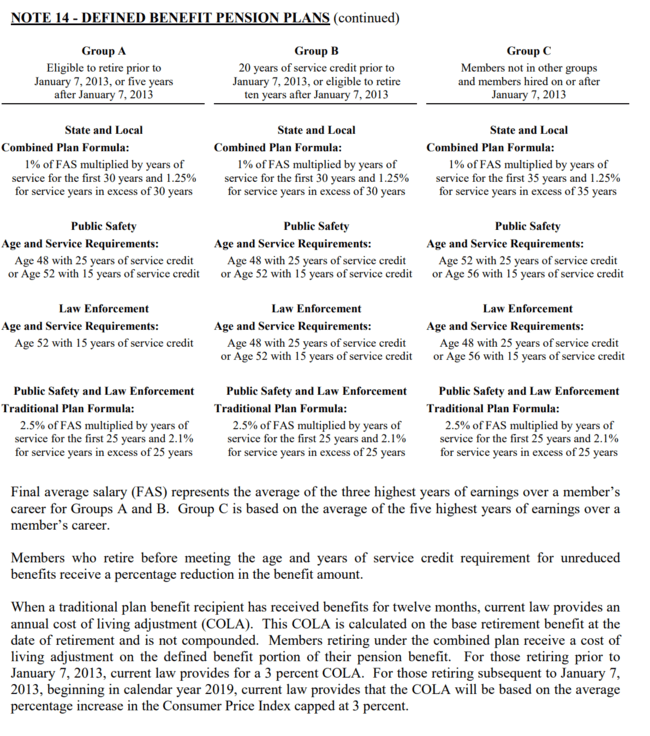
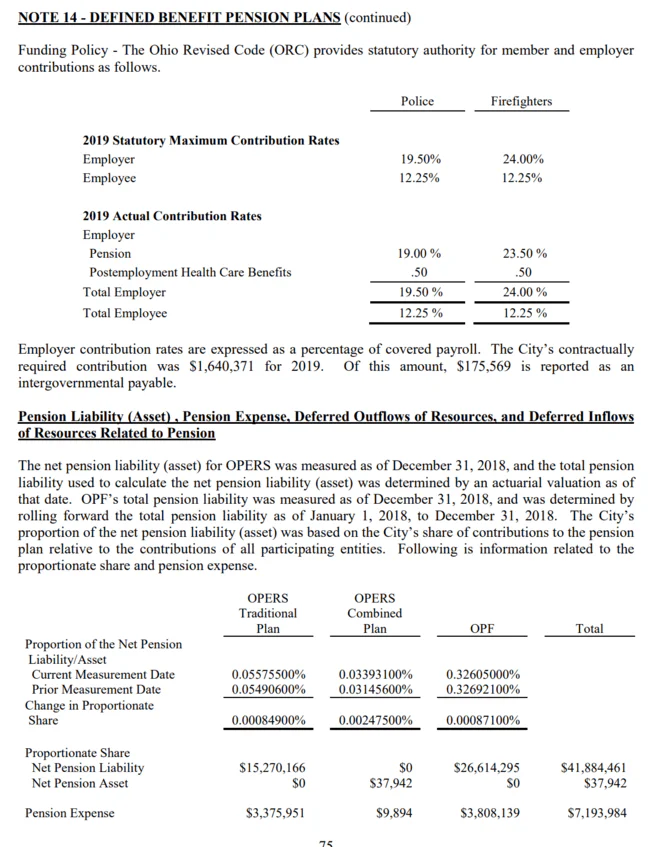
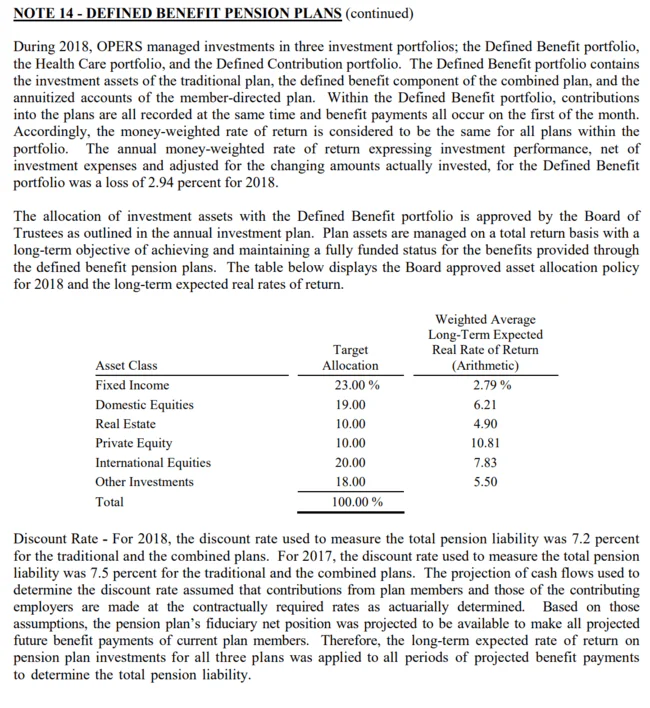
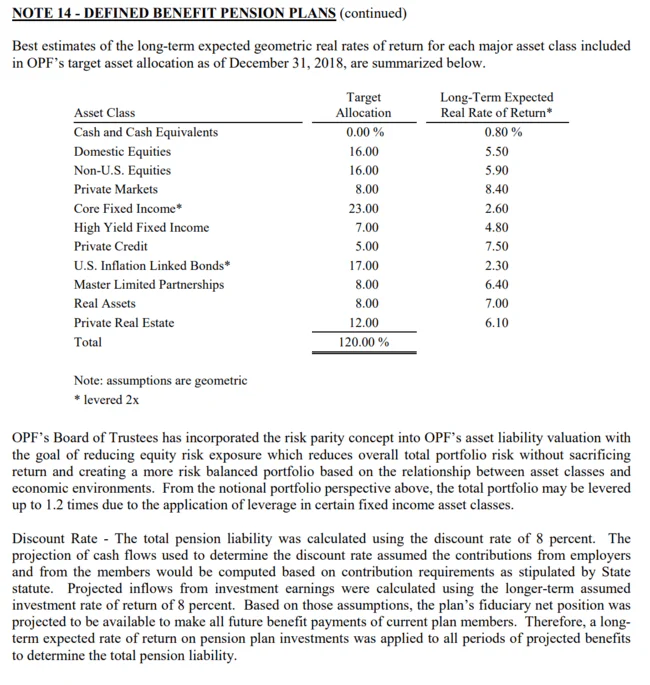
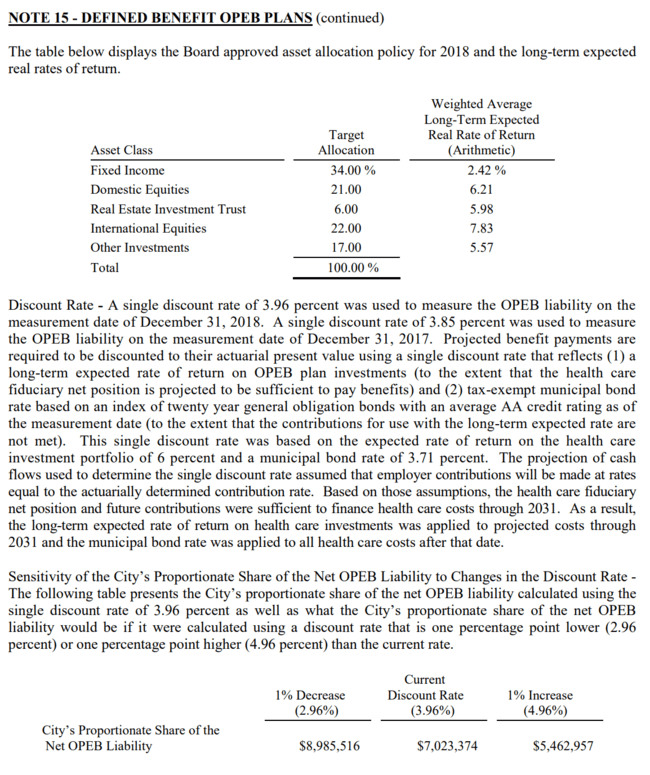
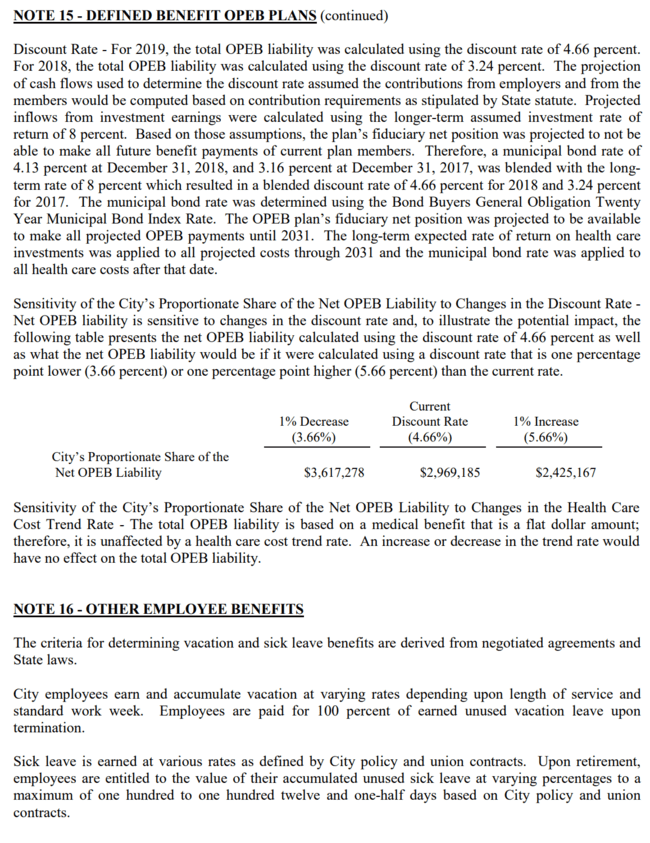
Audit Year 2020: The $314,347 Gap and the $1.18M Misdirection — 6 Findings
The Auditor of State’s audit for the year ended December 31, 2020 was filed in 2022. After the clean 2016 audit and three years without an Auditor of State audit, the 2020 findings were catastrophic. The bank reconciliation was off by $314,347. Federal tax withholdings of $1,184,754 were sent to the wrong government agency. Findings for Recovery were issued against two City Auditors.
Finding 2020-001: Bank-To-Book Reconciliations — Material Weakness
“The December 31, 2020 reconciliation was unreconciled by $314,347, with the book balance being greater than the bank balance due to the lack of monthly bank-to-book reconciliations and the complexity of the City’s accounting software (i.e. hybrid cash/accrual basis).”
Plain-Language Explanation. The City ended 2020 with a $314,347 gap between what the bank said the City had and what the City’s own books said. The book balance was higher — meaning the City’s records showed $314,347 more than actually existed in the bank. The reconciliation also included an unsupported deposit in transit of $47,462 — a claimed deposit with no documentation. The Auditor explicitly cited “the complexity of the City’s accounting software” as a contributing factor — a direct reference to the New World ERP system.
A $314,347 bank-to-book discrepancy is not a rounding error. It means the City did not know, within a third of a million dollars, how much money it actually had. Monthly bank reconciliations — the most basic financial control — were not being performed.
Forensic New World ERP IT Analysis. The Auditor’s explicit reference to the “complexity of the City’s accounting software (i.e. hybrid cash/accrual basis)” marks a critical pivot in the audit record. It identifies the accounting system’s configuration not just as a passive witness to errors, but as a direct cause of failure.
In New World ERP, the “hybrid cash/accrual basis” indicates a fundamental chart of accounts design flaw dating back to the July 2009 implementation. When a General Ledger is configured with inconsistent accounting bases—recording some transactions on a cash basis and others on an accrual basis—the system’s internal logic for balancing funds is compromised, making reconciliation between the GL and bank statements structurally difficult.
The Breakdown of Automated Controls
The software contains the inherent logic to prevent these discrepancies, yet those controls remained dormant. The 2021 corrective action plan’s admission that “the system will not allow a reconciliation to be posted with a difference” confirms that the ERP was designed to act as a hard gatekeeper for financial accuracy.
- Bank Reconciliation Program: If properly configured, this module imports bank statement data and systematically matches it against GL transactions. The failure to reconcile for over a decade suggests this program was either never activated or was bypassed in favor of manual processes.
- Systemic Deposit Tracking: The unsupported $47,462 deposit in transit is a hallmark of manual tracking. In a configured environment, New World tracks outstanding deposits as system-generated records that must be cleared against a specific bank statement entry. An “unsupported” figure indicates that someone manually entered a value into a spreadsheet or report to force a balance, rather than letting the system verify the transaction.
- The “Hard Stop” Failure: Because the software’s “no-difference” posting rule was likely ignored or disabled, the City was able to finalize periods without a true reconciliation. This bypassed the ERP’s primary defense against embezzlement, clerical errors, and missing funds.
Structural vs. Operational Failure
The Auditor’s focus on the software’s complexity highlights that the City was fighting its own infrastructure. By operating a “hybrid” system, the City created a environment where the General Ledger and the bank records were speaking different languages.
A properly implemented New World environment uses automated balancing rules and inter-fund posting logic to handle the conversion between cash and accrual data. By failing to align the chart of accounts with a consistent basis, the City transformed its most powerful financial tool into a source of complexity that masked a decade of “significant unsupported differences.”
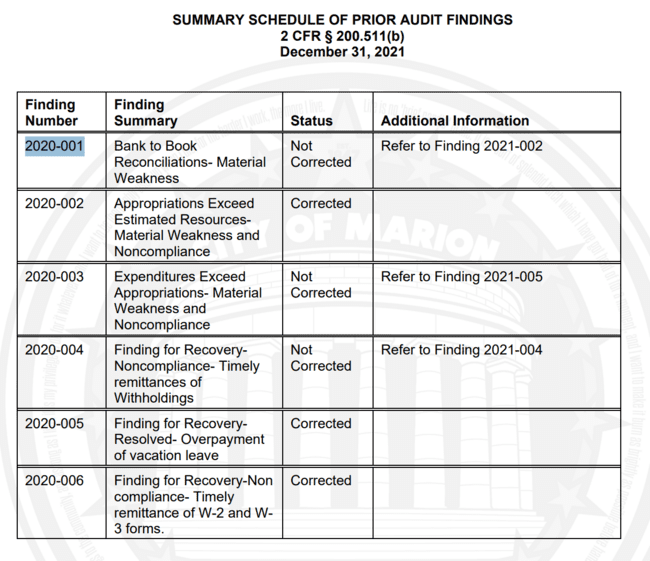
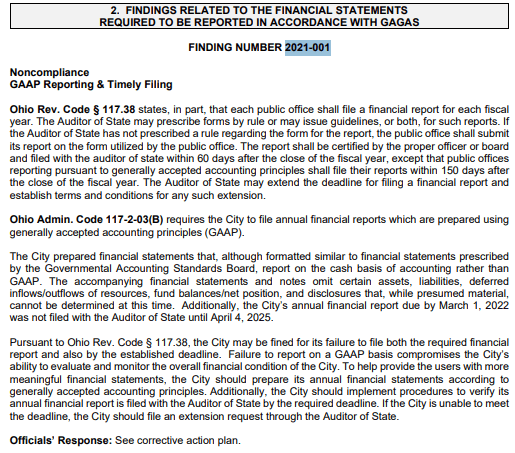
Finding 2020-002: Appropriations Exceed Estimated Resources — Material Weakness and Noncompliance
“At December 31, 2020 the City’s appropriations exceeded the amount certified as available by the budget commission.”
Plain-Language Explanation. Return of the appropriations-exceed-resources finding after the clean 2016 year. The City again appropriated more than its certified available resources — the same violation documented in 2009, 2010, and 2011. After a brief period of apparent compliance, the fundamental budget validation gap reasserted itself.
Forensic New World ERP IT Analysis. The Budgeting module’s validation against the County Budget Commission’s certificate of estimated resources was still not configured — or had been disabled since the 2016 audit period. The return of this finding after a four-year gap suggests that whatever manual process was used during the 2013–2016 period to prevent the violation was abandoned, and the system was never configured to enforce it automatically. This is a single configuration setting in the Budgeting module — and it remained uncorrected for over a decade.
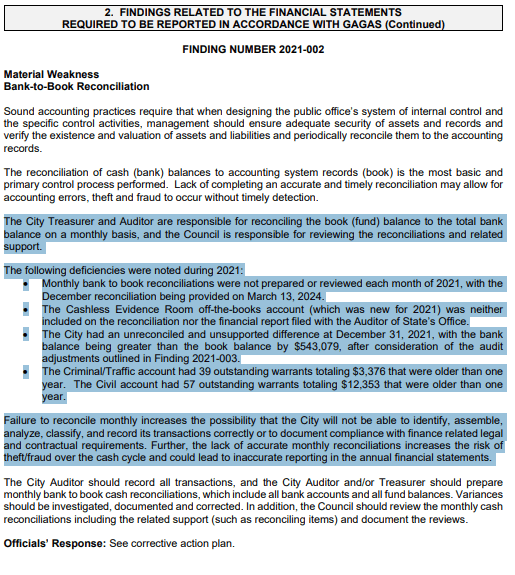
Finding 2020-003: Expenditures Exceed Appropriations — Material Weakness and Noncompliance
“The City erroneously remitted 3rd and 4th quarter 2020 Federal tax withholdings to the Ohio Department of Taxation rather than the Internal Revenue Service. Correcting payments were made to the Internal Revenue Service on February 9, 2021 in the amount of $1,184,754.”
Plain-Language Explanation. This is the most dramatic single failure in the entire audit record. Beginning in June 2020, the City sent federal income tax withholdings — money deducted from employee paychecks for federal taxes — to the Ohio Department of Taxation instead of the Internal Revenue Service. The error went undetected for seven months, from June 2020 through January 2021. The 3rd and 4th quarter 2020 withholdings totaling $1,184,754 went to the wrong agency.
When the error was discovered in January 2021, the City made correcting payments of $1,184,754 to the IRS on February 9, 2021. But the City did not appropriate funds for these correcting payments until November 8, 2021 — nine months after the expenditure was made. This means the City spent $1.18 million without legal appropriation authority, in direct violation of Ohio Rev. Code § 5705.41(B).
Forensic New World ERP IT Analysis. Federal tax withholding remittance is processed through the Payroll/HR module, which calculates withholdings and generates payment files for transmitting agencies. The payee for federal income tax withholdings is the IRS (via EFTPS—the Electronic Federal Tax Payment System).
For a payment to be directed to the Ohio Department of Taxation (ODT) instead of the IRS, a fundamental breakdown occurred in the ERP’s automated tax remittance workflow. This error establishes that the system was configured incorrectly or bypassed through one of three scenarios:
- Payee Configuration Error: The payroll tax remittance setup within the module was incorrectly mapped, directing federal withholding funds to the state agency’s vendor ID.
- Manual Payment Redirection: A manual payment was initiated outside the automated EFTPS file generation, resulting in the funds being sent to the wrong agency.
- Transmission Destination Failure: The EFTPS payment file itself was submitted to the incorrect destination due to a lack of oversight in the transmission protocol.
The Failure of Reconciliation Controls
In a properly configured New World environment, these scenarios are mitigated by automated reconciliation processes. The fact that this error persisted for seven months confirms that no payroll tax reconciliation was being performed. A standard control environment uses the following system-driven checks:
- Payroll Register Comparison: Comparing the total amounts withheld per the payroll register against the amounts remitted per the bank statement, specifically matched to the correct payee.
- Agency-Specific Liability Tracking: The General Ledger should be configured to track payroll tax liabilities by agency—utilizing separate liability accounts for federal withholdings (IRS) and state withholdings (ODT).
- Automated Flagging of Balances: If these accounts were properly configured and reconciled, the liability account for IRS withholdings would have shown an increasing, unpaid balance, while the ODT account would have reflected unexpected payments or overages.
This systemic failure demonstrates that the Payroll/HR module was operating as a standalone processing tool rather than an integrated component of the City’s financial controls. By failing to reconcile the GL liability accounts against actual remittances, the City bypassed the ERP’s ability to act as an early-warning system, allowing a critical tax compliance error to remain undetected for more than half a fiscal year.
Finding 2020-004: Finding for Recovery — Robert Landon III ($154,399) — Noncompliance
“Beginning in June 2020, the City erroneously remitted the federal income taxes to the state. The error was not identified and corrected in the system until January 2021. As a result, the City incurred $154,399 in late fee penalties and interest.”
Plain-Language Explanation. A Finding for Recovery of $154,399 was issued against Robert Landon III (City Auditor) and his bonding company, Auto-Owners (Mutual) Insurance Company. The $154,399 represents penalties and interest assessed by the IRS for the seven months of misdirected federal tax withholdings. Under Ohio law, the City Auditor is personally responsible for penalties incurred due to errors in the Auditor’s office.
Forensic New World ERP IT Analysis. The $154,399 in penalties is a direct, quantifiable cost of the Payroll module’s misconfigured tax remittance setup and the absence of payroll tax reconciliation procedures. This is not an abstract system configuration issue — it is $154,399 that taxpayers must pay because the ERP was not configured to remit payroll taxes to the correct agency, and because no reconciliation process existed to catch the error. The system’s audit trail should contain the complete record of every payroll tax payment — amount, date, payee, payment method — that would document exactly when the configuration was changed and by whom.
Finding 2020-005: Finding for Recovery — Alexander Bailey ($541, Resolved) — Noncompliance
“Former Marion Municipal Court employee Alexander Bailey erroneously received a vacation leave payout at separation in the amount of $541 contrary to the Marion County Municipal Court Employee Handbook’s policy.”
Plain-Language Explanation. A relatively small Finding for Recovery of $541 was issued against Alexander Bailey and Robert Landon III for an erroneous vacation leave payout at separation. This was resolved through a repayment plan.
Forensic New World ERP IT Analysis. The Payroll/HR module’s separation processing in New World ERP is designed to act as a final control gate, ensuring that leave payouts adhere strictly to the applicable employee handbook or collective bargaining agreement. A properly configured system automates the validation of eligibility, preventing unauthorized disbursements before a check is even cut.
The processing of an ineligible payout establishes that the system’s business rule engine was either unconfigured or bypassed. New World maintains policy integrity through several integrated functional capacities:
- Policy-Driven Payout Rules: The system allows for the configuration of specific “payout triggers” based on employment status, years of service, or department-specific policies (such as the Court’s employee handbook). If these rules are not mapped to the separation workflow, the ERP treats every leave balance as a payable liability, regardless of eligibility.
- Separation Checklist Validation: New World supports an electronic separation checklist that can require a “policy compliance” sign-off. If the checklist does not include a mandatory validation step against the handbook policy, the system allows the payout to proceed without a systemic challenge.
- Leave Accrual Integration: The Payroll module should be linked to the specific leave-accounting rules that define when an employee is “vested” for a payout. When these rules are inactive, the ERP fails to act as a gatekeeper, allowing ineligible payouts to slip through as routine transactions.
While the specific dollar amount in this instance may be small, it illustrates a broader systemic vulnerability. By failing to embed the City’s official policies into the Payroll module’s configuration, the ERP’s ability to enforce internal controls was neutralized. This absence of configured business rules transformed a tool meant for regulatory precision into a passive processing engine that allowed policy violations to occur unchecked.
Finding 2020-006: Finding for Recovery — Kelly Carr ($22,500) — Noncompliance
“The City Auditor’s Office filed the 2018 information returns on February 20, 2019, which was after the January 31st filing deadline, thus incurring a $50 penalty on each of the City’s 450 returns for a total of $22,500 in penalties from the Internal Revenue Service.”
Plain-Language Explanation. A Finding for Recovery of $22,500 was issued against former City Auditor Kelly Carr and her bonding company for IRS penalties incurred when the City’s 2018 W-2 information returns were filed 20 days late. The City had 450 employees, and the IRS assessed a $50 penalty per late return. This is a straightforward compliance failure — the January 31 filing deadline for W-2s is one of the most well-known deadlines in payroll administration.
Forensic New World ERP IT Analysis. The Payroll/HR module in New World ERP is designed to automate the generation and electronic filing of W-2 forms as a standard year-end function. The system possesses the capability to produce these forms immediately following the processing of the final payroll of the year and the completion of any year-end adjustments.
A 20-day delay—missing the January 31 deadline and filing on February 20—establishes a significant breakdown in the City’s payroll management workflow. This delay typically stems from one of three systemic or process failures:
- Delayed Year-End Close: If the year-end payroll close process was not initiated or completed in a timely manner, the system could not lock the data necessary to generate accurate W-2s.
- Unresolved Generation Errors: The W-2 generation process includes validation checks for missing Social Security numbers, address errors, or tax ID mismatches. A 20-day gap suggests that errors were encountered but the City lacked the technical or administrative resources to resolve them before the federal deadline.
- Filing Step Oversight: In many ERP environments, “generating” the forms and “filing” them are distinct steps. Without a configured workflow to track the submission status, the final transmission to the Social Security Administration can be easily overlooked.
The Cost of Missing Automated Notifications
The resulting $22,500 penalty represents a direct consequence of failing to utilize the ERP’s internal monitoring tools. New World includes the functional capacity to prevent such fines through:
- Scheduled Notifications: The system can be configured with automated alerts—such as “W-2s due to IRS by January 31″—that notify the payroll administrator and City Auditor well in advance of the deadline.
- Compliance Dashboards: Management dashboards can track the progress of year-end tasks, providing a visual indicator of whether filing has been completed or is currently overdue.
- Automated Workflow Deadlines: The ERP supports the creation of hard deadlines within the year-end module that require a “Submission Confirmed” status to clear the project.
By failing to implement these basic notification and tracking features, the City bypassed the ERP’s ability to act as a regulatory safeguard. This omission transformed a routine, system-driven filing requirement into a costly administrative failure, demonstrating that the software’s compliance tools were left dormant while the City incurred significant, avoidable penalties.
Audit Year 2021: Qualified Opinions, The System Finally Named — 6 Findings
The Auditor of State’s audit for the year ended December 31, 2021 was filed October 15, 2025 and certified for release November 13, 2025. Qualified opinions were issued on most fund statements. The City changed from GAAP-basis to cash-basis financial presentation. A contracted accounting firm had to post 54 adjusting entries for FY 2020 and 52 for FY 2021, with 65 additional adjustments identified during the audit itself. Most significantly, the corrective action plans in this audit explicitly name the New World system for the first time and document the October 27, 2025 removal of budget override permissions.
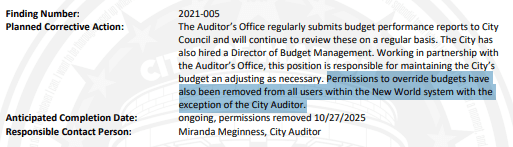
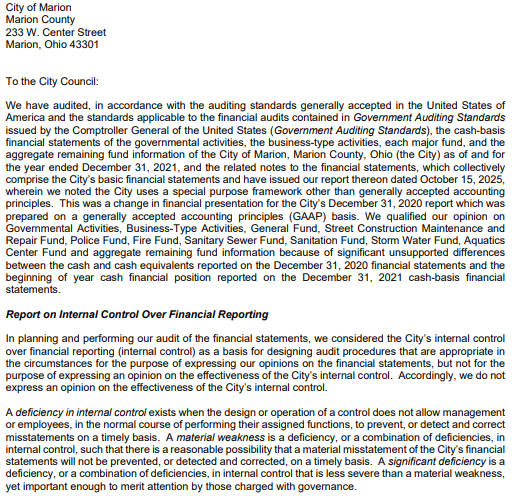
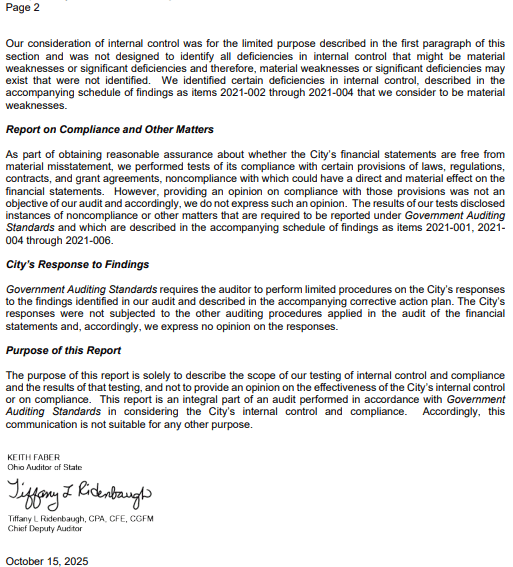
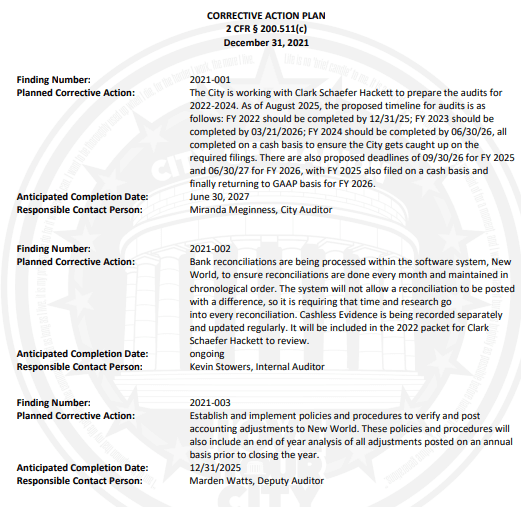
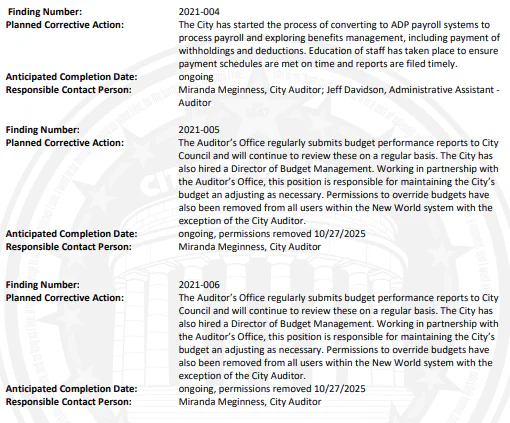
Finding 2021-001: GAAP Reporting & Timely Filing — Noncompliance
“Ohio Rev. Code § 117.38 states, in part, that each public office shall file a financial report for each fiscal year.”
Plain-Language Explanation. The City failed to file timely GAAP-basis financial reports. The annual report for fiscal year 2021, due March 1, 2022, was not filed until April 4, 2025 — more than three years late. The City chose to present cash-basis statements instead of the required GAAP-basis statements. As of the corrective action plan (August 2025), the City was working with Clark Schaefer Hackett on audits for 2022–2024 and did not plan to return to GAAP-basis reporting until fiscal year 2026.
Forensic New World ERP IT Analysis. The City’s abandonment of GAAP-basis reporting represents the ultimate consequence of the flawed chart of accounts and General Ledger configuration decisions made during the 2009 implementation. After seventeen years of operating with a system that was never properly configured for dual-basis (cash and accrual) accounting, the transition to a cash-only reporting model was a move of necessity rather than strategy.
New World ERP’s Financial Statement Designer possesses the functional capacity to produce GAAP-compliant statements, but it operates under the “garbage in, garbage out” principle. For the system to generate these reports, the General Ledger must contain the underlying accrual-basis data. The total failure to produce these statements indicates several deep-seated systemic issues:
- Lack of Accrual Data Integration: A properly configured New World environment uses a “dual-ledger” or “reporting-basis” architecture. This allows the system to track cash-basis transactions for daily operations while simultaneously maintaining accrual entries for depreciation, pension liabilities, and accounts receivable. The City’s inability to report under GAAP confirms that its GL was likely configured as a single-basis (cash) system, rendering the Financial Statement Designer’s accrual templates useless.
- The High Cost of Systemic Neglect: The three-year filing delay establishes that the City could not extract auditable financial data from its own ERP without extensive, costly intervention from outside consultants. This indicates that the General Ledger was being used as a simple checkbook rather than a sophisticated financial management tool.
- Broken Automated Close Cycles: New World is designed to automate the transition between fiscal years. The inability to produce statements for three years suggests that the year-end close procedures were never finalized within the system, leaving the General Ledger in a state of perpetual limbo and preventing any automated reporting from taking place.
By abandoning GAAP-basis reporting, the City essentially surrendered to its own implementation failures. Rather than correcting the chart of accounts and activating the ERP’s accrual-tracking features, the City opted for a reporting model that requires less complexity, but also provides significantly less transparency. This decision marks the final step in a seventeen-year trajectory where the accounting software’s most advanced compliance and transparency features were discarded in favor of manual, low-functionality alternatives.
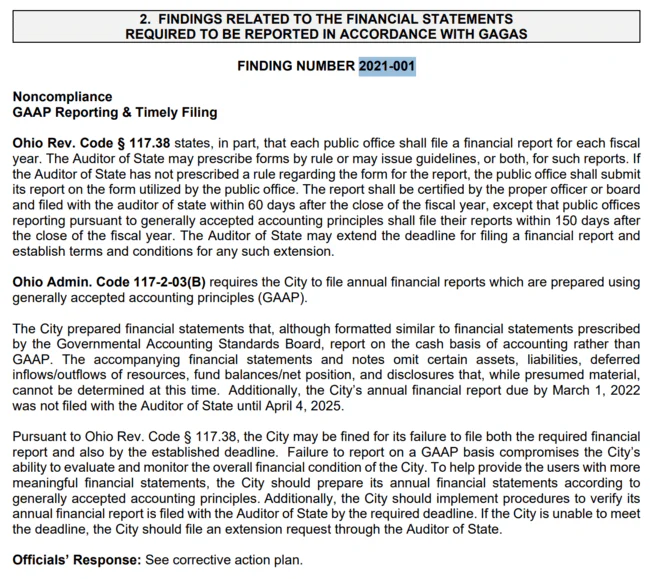
Finding 2021-002: Bank-to-Book Reconciliation — Material Weakness
“The reconciliation of cash (bank) balances to accounting system records (book) is the most basic and primary control process performed.”
Plain-Language Explanation. Monthly bank reconciliations were not prepared each month of 2021. The December reconciliation was not provided to auditors until March 13, 2024 — more than two years after year-end. The Cashless Evidence Room account was excluded entirely. The unreconciled difference was $543,079 — with the bank balance exceeding the book balance, meaning the City’s GL showed $543,079 less than the bank. The Criminal/Traffic account had 39 outstanding warrants ($3,376) older than one year; the Civil account had 57 ($12,353).
The corrective action plan makes a critical statement: “Bank reconciliations are being processed within the software system, New World, to ensure reconciliations are done every month and maintained in chronological order. The system will not allow a reconciliation to be posted with a difference, so it is requiring that time and research go into every reconciliation.”
Forensic New World ERP IT Analysis. This corrective action is the most important ERP-related statement in the entire seventeen-year audit record. It confirms three critical facts:
- Latent System Capability: The City is now using “the software system, New World” for bank reconciliations. This strongly implies the module was not being used previously, meaning the Cash Management module’s Bank Reconciliation program was either not purchased, not configured, or simply ignored for over twelve years.
- Built-in Control Enforcement: The statement that “the system will not allow a reconciliation to be posted with a difference” confirms that a “hard-stop” control existed within the software all along. This built-in discipline was designed to prevent the very discrepancies that have plagued the City, yet it remained unutilized.
- Forced-Balance Discipline: The requirement that “time and research go into every reconciliation” indicates that previous efforts (when they occurred) were performed outside the system—likely in manual spreadsheets—without the systemic rigors and validation checks that New World enforces.
The $543,079 unreconciled difference—an increase from the $314,347 gap in 2020—along with the total exclusion of entire bank accounts, demonstrates the cumulative consequence of bypassing the system’s automated reconciliation tools. By failing to integrate bank statement data directly into the ERP, the City allowed its financial records to drift further from reality each year.
The move to finally utilize the software’s reconciliation block represents a shift from manual, error-prone workarounds to the systematic accountability the ERP was originally intended to provide. It highlights that the solution to a decade of “significant unsupported differences” was not more personnel or new software, but the activation of the internal controls already present in the existing system.
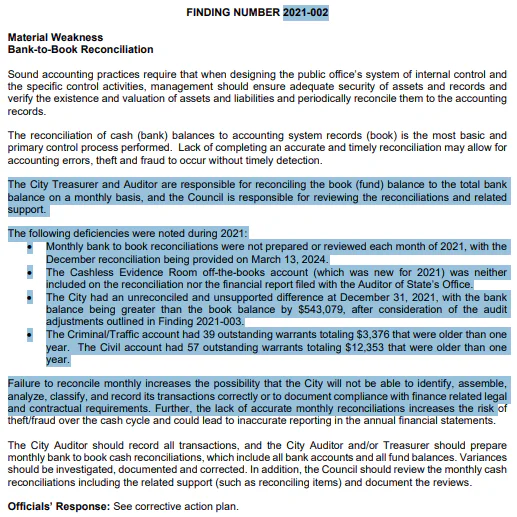
Finding 2021-003: Financial Reporting — Material Weakness
“The existence of audit adjustments indicates a lack of or failure of controls over the posting of financial transactions.”
Plain-Language Explanation. The scale of adjustments required tells the story: a contracted accounting firm posted 54 adjusting entries for fiscal year 2020 and 52 for fiscal year 2021. The audit itself identified 65 additional adjustments. These adjustments spanned virtually every major fund: General Fund, Police Fund, Fire Fund, Tax Increment Financing Fund, Sewer Fund, Sanitation Fund, Storm Water Fund, and Aquatic Center Fund. Three additional misstatements ranged from $34,197 to $41,564. Corrections were also made to debt disclosures.
The corrective action plan states: “Establish and implement policies and procedures to verify and post accounting adjustments to New World.” This confirms that the City was not systematically posting adjustments to the New World General Ledger — adjustments were being made outside the system or not made at all until auditors required them.
Forensic New World ERP IT Analysis. The volume of audit adjustments—171 across two fiscal years—is extraordinary and serves as a definitive indicator of a non-functional internal control environment. In a properly configured New World ERP, routine transactions like payroll, accounts payable, and receipts post automatically to the General Ledger (GL). Adjusting entries should be restricted to year-end accruals and complex estimates.
When a City requires 171 adjustments to achieve an auditable state, it confirms that the General Ledger did not reflect financial reality. This volume suggests several systemic failures:
- Transactional Disconnect: Routine daily operations were either not posting correctly or were being recorded with such pervasive errors that the system’s automated trail became unreliable.
- Accumulated Latency: Errors were allowed to accumulate without detection because the system’s built-in reconciliation and validation tools were bypassed.
- Authoritative Record Failure: The corrective action’s reference to “verify and post accounting adjustments to New World” confirms that the GL was not being used as the authoritative financial record. Instead, the City was operating out of parallel systems—spreadsheets, sub-systems, and manual records—that were never synchronized with the ERP.
Violation of Professional Standards
Per AICPA and GFOA standards, the General Ledger must serve as the single system of record. To maintain financial integrity, all adjustments must be:
- Posted within the System: Adjustments should not live on external “worksheets” but must be recorded as system-level entries.
- Documented: Every adjustment requires an attached justification and source documentation, a feature New World supports but the City neglected.
- Approved within an Audit Trail: The system’s workflow must enforce a segregation of duties where adjustments are reviewed and approved electronically, creating a permanent, tamper-proof record.
The necessity for 171 manual adjustments indicates that the ERP’s role as a “Single Source of Truth” had been entirely abandoned. By maintaining data in parallel manual systems and only attempting to “fix” the GL at year-end, the City turned its most sophisticated financial tool into a historical filing cabinet for after-the-fact corrections, rather than a proactive engine for municipal accountability.
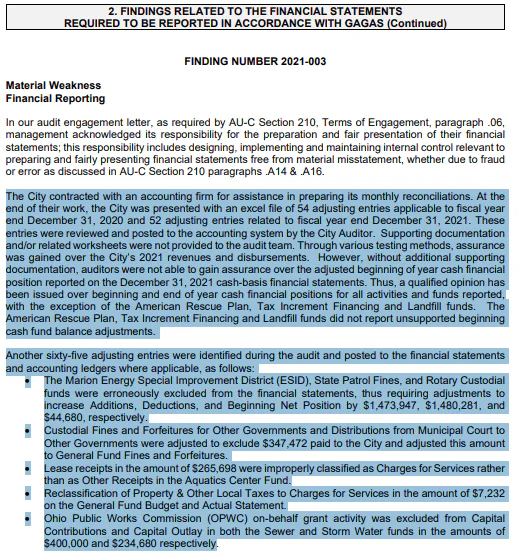
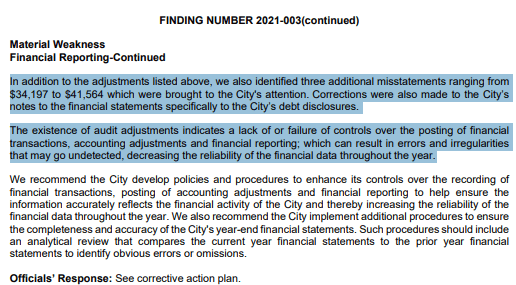
Finding 2021-004: Employee Withholding Remittances — Noncompliance & Material Weakness
“The City has also incurred additional penalties and interest prior to and subsequent to fiscal year 2021, totaling $279,036.80, and an additional $146,169.38 was abated.”
Plain-Language Explanation. Employee withholding remittances were late to multiple agencies: IRS ($31,698.27 in penalties, $16,060.35 abated), Ohio DJFS ($1,096.19), OPERS ($1,676.41), Ohio Department of Taxation (school district taxes not properly withheld, $76 reimbursed), and Ohio Police & Fire Pension Fund ($5,941.92). Total penalties and interest prior to and subsequent to fiscal year 2021: $279,036.80, plus an additional $146,169.38 that was abated through negotiation. The City was converting to ADP payroll processing to address the problem.
Forensic New World ERP IT Analysis. The failure to remit withholdings to five separate agencies confirms that the Payroll/HR module’s automated remittance engine was effectively non-functional. In a standard New World environment, this process is a “closed-loop” system: withholdings are calculated, liability accounts are credited, and payment files (EFTPS for federal, ACH for state/local) are generated as a direct output of the pay cycle.
The shift to ADP is a formal admission of ERP abandonment. Rather than correcting the internal configuration of the existing module, the City opted to outsource the entire function, signaling that the technical debt or administrative failure within New World had become insurmountable.
The Breakdown of the Automated Remittance Cycle
The late remittances and subsequent $279,036.80 in penalties highlight three specific failures in the system’s intended workflow:
- Failure of the Remittance Task Queue: New World includes a task management system designed to trigger remittance payments immediately following payroll finalization. Late payments to multiple agencies suggest these tasks were either not configured or were manually ignored pay period after pay period.
- Liability Account Neglect: The ERP automatically creates entries in agency-specific liability accounts. If these accounts were monitored, the escalating balances would have acted as a “red alert” that funds were being withheld from employees but not sent to the government. The multi-agency failure confirms no such monitoring occurred.
- Misconfiguration vs. Outsourcing: Configuring the Payroll module for tax compliance is a foundational implementation step. The decision to outsource to ADP suggests the City’s New World environment lacked the Tax Table updates and EFT (Electronic Funds Transfer) mappings necessary to satisfy various taxing authorities, likely due to the “hybrid” accounting complexities previously cited.
The Cumulative Financial Impact
The total penalty figure—exceeding $425,000 when including abated amounts—serves as the ultimate “tax” on ERP misuse. These were not unavoidable costs; they were the direct result of:
- System Latency: Using the module for check printing but bypassing its electronic filing and remittance features.
- Manual Intervention: Attempting to track complex tax deadlines through manual memory or spreadsheets instead of system-driven alerts.
- Control Deactivation: Disconnecting the payroll function from the General Ledger’s oversight, allowing liabilities to sit unpaid for months without triggering a systemic block.
By moving to ADP, the City essentially “bought” its way out of a configuration crisis it couldn’t solve internally. This move effectively offloaded the liability for filing accuracy to a third party, but it also solidified the legacy of the New World implementation as a system that was purchased for its power but utilized only for its most basic—and ultimately failed—clerical tasks.
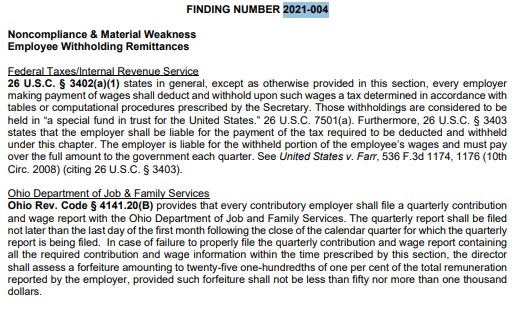
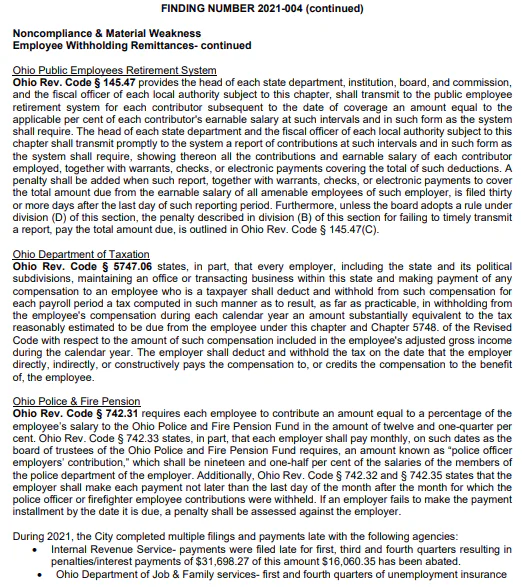
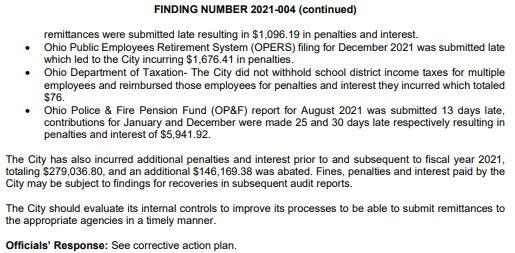
Finding 2021-005: Expenditures Exceed Appropriations — Noncompliance
“Ohio Rev. Code § 5705.41(B) prohibits a subdivision or taxing authority unit from making any expenditure of money unless it has been appropriated in accordance with the Ohio Revised Code.”
Plain-Language Explanation. Expenditures exceeded appropriations in multiple funds: General Fund Judicial ($44,905 over), Leisure Time ($20,722 over), Transfers Out ($1,150,886 over), Street Maintenance ($71,291 over), Police ($567,688 over), and Fire ($625,738 over). The Police and Fire overages alone exceeded $1.1 million — representing massive, uncontrolled spending beyond what Council authorized.
The corrective action plan contains the smoking gun: “The City has also hired a Director of Budget Management… Permissions to override budgets have also been removed from all users within the New World system with the exception of the City Auditor. Anticipated Completion Date: ongoing, permissions removed 10/27/2025.”
Forensic New World ERP IT Analysis. This corrective action serves as the definitive confirmation of the root cause that has undermined the City’s financial integrity since 2009. For sixteen years, three months, and twenty-seven days—from the initial July 2009 implementation until October 27, 2025—the New World system was essentially operating without its most critical fiscal guardrail.
By allowing every user with spending authority the permission to override budget checks, the City rendered the ERP’s primary defensive mechanism moot. The Purchasing module correctly identified insufficient funds, yet the system’s configuration allowed those same users to bypass the warning and proceed with transactions.
A Failure of Systemic Oversight
The facts established in the 2021 Single Audit (released in late 2025) paint a clear picture of internal control abandonment:
- The Dormant “Hard Stop”: The software possessed the capability to block unbudgeted spending, but it was intentionally configured to allow overrides. While the system logged every instance of a bypass, the audit record suggests those logs were never monitored, creating a sixteen-year “blind spot” in the City’s fiscal oversight.
- Industry Standard Realignment: Restricting override permissions to the City Auditor alone aligns the City with GFOA and Auditor of State best practices. This ensures that overrides are treated as extraordinary events rather than routine administrative clicks.
- Institutionalizing Budgetary Control: The creation of the Director of Budget Management position—and the hiring of specialized personnel to fill it—signifies an admission that configuration changes alone are insufficient. It acknowledges that the City needed a human “firewall” to partner with the Auditor’s Office in maintaining the integrity of the appropriations process.
The October 27, 2025 Deadline
The timing of this change is particularly telling. The implementation of this practice on October 27, 2025, coincided with intense state scrutiny and the looming threat of the City’s financial situation deteriorating further. The removal of these permissions for all users except the Auditor was not a proactive management choice, but a reactive survival measure forced by a decade of “significant unsupported differences” and mounting audit findings.
By finally locking down the override function, the City has moved to stop the bleeding. However, the $543,079 unreconciled difference and the history of fiscal instability remain as the cumulative debt of sixteen years spent bypassing the very system designed to protect the City’s treasury.
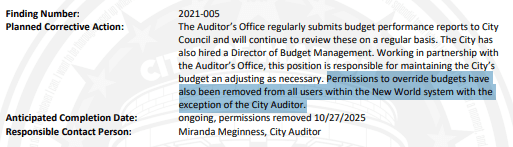
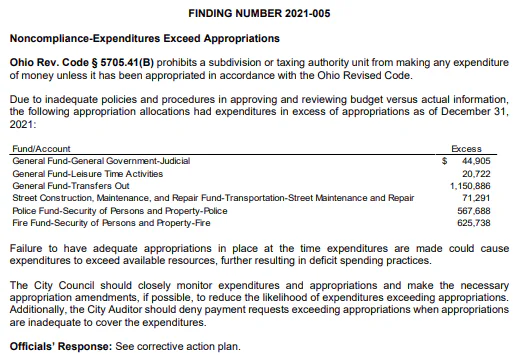
Finding 2021-006: Negative Fund Balances — Noncompliance
“Ohio Rev. Code § 5705.10(I) requires that money paid into any fund shall be used only for the purposes for which such fund is established.”
Plain-Language Explanation. Multiple funds ended 2021 with deficit balances: Parks ($23,375 deficit), Police ($138,266 deficit), Fire ($48,213 deficit), Storm Water ($106,176 deficit), and Landfill ($719 deficit). The Police and Fire fund deficits are directly connected to the expenditure overages documented in Finding 2021-005 — when those departments spent $567,688 and $625,738 beyond their appropriations, their fund balances were driven negative. The same corrective action referencing the New World budget override removal applies here.
Forensic New World ERP IT Analysis. The failure to configure fund balance controls within the General Ledger (GL) through 2021 represents a secondary, yet equally critical, abandonment of the New World ERP’s defensive architecture. While budget-to-actual controls monitor the “Spending Side” (Appropriations), fund balance controls monitor the “Solvency Side” (Total Resources).
A properly implemented ERP uses a two-tier validation system:
- The Budget Gate: Blocks expenditures exceeding the legal spending authority (Appropriations).
- The Fund Gate: Blocks any transaction—regardless of budget—that would result in a negative cash or fund position (Net Resources).
The restriction of override permissions on October 27, 2025, addressed the first gate, but it does not inherently guarantee the second. New World maintains fund-level integrity through specific functional settings that were neglected for sixteen years:
Systemic Fund Balance Protections
The ERP includes native features designed to act as a “hard stop” against deficit spending:
- Fund-Level Deficiency Checks: This configuration prevents any transaction—including interfund transfers, journal entries, and payroll postings—from being finalized if the resulting balance would drop below $0. This is distinct from budget checks and acts as the ultimate safeguard for the City’s treasury.
- Interfund Transaction Mapping: New World manages the relationship between funds via automated “Due To/Due From” entries. If these are not configured with a “No Deficit” rule, the system will allow the General Fund to “lend” money to a special revenue fund that has no cash, creating an undocumented and unsupported deficit.
- Real-Time Cash Validation: The system can be set to validate available cash in the Cash Management module before an Accounts Payable batch is posted. If this was unconfigured, the City could cut checks for budgeted items even if the bank account lacked the actual funds to cover them.
Verification of Current Configuration
Whether the “Fund Gate” was activated alongside the “Budget Gate” is a critical distinction for the City’s current fiscal health. A public records request targeting the System Configuration Report or Global Setting Audit Trail would be necessary to confirm if:
- The “Allow Negative Fund Balance” flag has been toggled to “No.”
- The “Verify Cash at Posting” control is active.
- The Director of Budget Management has exclusive authority over fund-level adjustments, mirroring the Auditor’s budget override restriction.
The absence of these fund-level controls allowed for the “significant unsupported differences” and $543,079 unreconciled gap found in the 2021 audit. Without a hard-stop on fund balances, the City remains vulnerable to “paper” solvency that doesn’t exist in the bank, proving that the ERP’s configuration is the only true barrier between fiscal transparency and systemic deficit.