


 Written by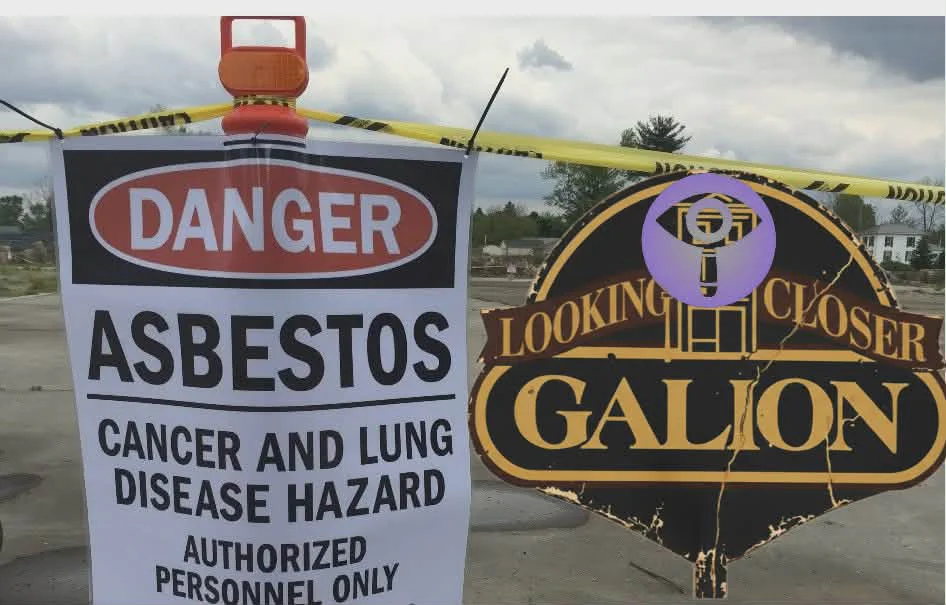
For decades, the industrial boom in Galion, Ohio, brought jobs and economic life to the city. But it also left behind a toxic legacy that residents are still dealing with today. As families live next to poisoned soil and struggle with a heavily burdened water supply, a glaring, uncomfortable question are being asked by Galion residents:
Why have state and federal environmental protection agencies allowed this contamination to persist in our backyards for so long?
Our exhaustive investigation at Marionwatch.com—drawing on decades of EPA records, court filings, public health data, and a careful analysis of local visual evidence—reveals a deeply documented history of environmental citations and repeated non-compliance spanning from 1980 to the present day in Galion.
But beyond the dry bureaucratic records lies a much darker, emotional reality for the families of Galion. This is a community where parents are forced to wonder if the dirt their children played in was laced with cancer-causing agents, and where a glass of tap water comes with a lingering fear of chemical exposure.
Looking at the sheer length of time these hazards have been allowed to sit idle, another deeply troubling question must be posed:
Are the EPA and the City of Galion actively downplaying the severity of this contamination while perpetually pushing off the deadlines to fix it?
While the federal government possesses the authority to step in and mandate cleanups for public safety, a toxic combination of legal loopholes, bureaucratic communication failures, and a persistent culture of delayed enforcement has abandoned the citizens of Galion.
The regulatory paralysis stems from a perfect storm of systemic failures:
- The “Potentially Responsible Party” (PRP) & Bankruptcy Loophole: Under federal law, the EPA’s primary strategy is to force the private polluter—the PRP—to perform and pay for the cleanup. However, when a polluting factory goes bankrupt and claims they lack financial resources, regulators are severely limited. The hazard is frequently left in the dirt while the property falls into tax delinquency, transferring the toxic burden onto the public.
- Decades of Unenforced Orders and Pushed Deadlines: Historical records show that the Ohio EPA frequently cited Galion facilities, issued Notices of Violation, and secured court-ordered consent decrees, only to find during follow-up inspections years later that the responsible parties simply ignored the orders. Instead of swift action, deadlines are routinely extended.
- Information Silos and “Shadow Registries”: Federal and state agencies frequently test sites and log the dangerous results into isolated databases that are entirely disconnected from local governments. This leads to years-long gaps where communities are unknowingly exposed to severe health hazards.
- Assessment vs. Remediation Funding: Properties often sit vacant because municipal governments lack the millions of dollars required for soil decontamination. Federal grants awarded to cities like Galion are often strictly assessment grants, which only pay for testing the scope of the pollution, not the actual physical removal of the dirt.
This article takes a definitive, site-by-site look at Galion’s ground contamination, examining the current ownership of these toxic sites, the decades of repeated non-compliance, the hidden dangers of abandoned schools, the severe strain on the municipal water system, and the disturbing trend of officials minimizing the threat to the public.
The Eagle Crusher Site: Visual Proof of a Downplayed Crisis
The most alarming incident of environmental mismanagement in recent Galion history centers on the former Eagle Crusher plant.
This case serves as a textbook example of regulatory communication failures, the devastating human cost of government loopholes, and the direct risks abandoned industrial sites pose to residential neighborhoods.
In 2009, a Marion-based company called Recycling Creations purchased the abandoned Eagle Crusher property. In February 2010, the company demolished the primary building. Older industrial structures heavily used asbestos for insulation and fireproofing.
When demolished without strict safety protocols, asbestos breaks down into microscopic fibers that easily become airborne and settle into the surrounding soil.
Right after the demolition in February 2010, the U.S. EPA tested the massive piles of debris left on the lot and confirmed severe asbestos contamination. The EPA initially deferred to the private owner, Recycling Creations, who indicated they planned to treat the remaining material as contaminated.
However, the owner abandoned the property, accumulating $7,773 in delinquent county taxes. In a massive failure of inter-agency communication, the EPA never informed Galion city officials, the local health department, or the people living right next to the site that the private cleanup had failed and the hazard remained.
For six long years, the pulverized, asbestos-laced debris sat exposed to the weather. High winds and heavy rain continuously agitated the material, threatening to spread toxic fibers into the nearby neighborhood.
Inhaling these fibers over time can cause mesothelioma and lung cancer. Throughout this entire six-year gap, neighborhood children were seen routinely playing in and around the exposed debris.
The truth only came out in 2016 when a local citizen innocently suggested to the city council that the flat, empty lot on Pershing Street be repurposed as a safe e-bike park for children.
Forced to respond to a proposal that would invite children onto the land for recreation, the city council had to publicly disclose that the property still harbored significant asbestos contamination.

Analyzing the Viral Evidence and Disappearing Warnings
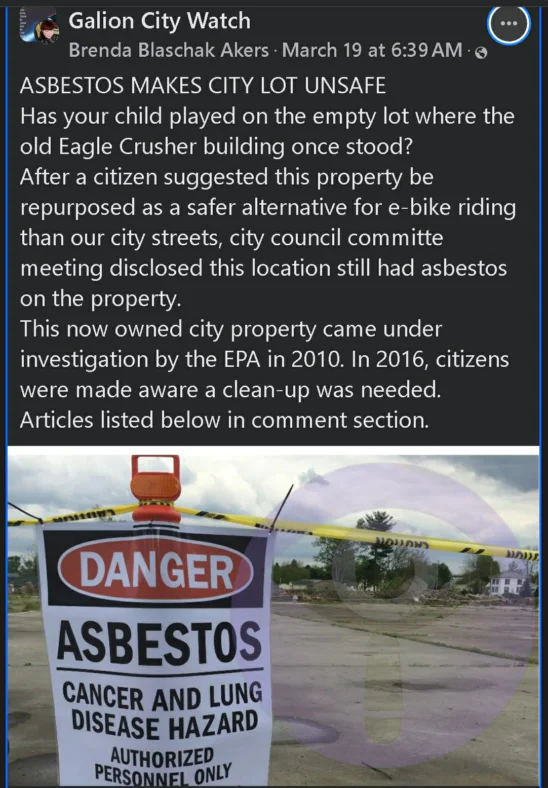
The community’s absolute horror and outrage were perfectly captured in a viral image circulated among residents, which serves as the core visual evidence of how callously this threat was managed.
A careful analysis of the image reveals a social media post with the bold, desperate headline: “ASBESTOS MAKES CITY LOT UNSAFE.”
The text of the post asks a chilling question that no parent should ever have to answer: “Has your child played on the empty lot where the old Eagle Crusher building once stood?” Because of issues surrounding who said what, the original post’s text was later updated to state that the contamination was “disclosed at a committee council meeting.” The post continued to detail the maddening timeline of the government’s failure:
“This now owned city property came under investigation by the EPA in 2010. In 2016, citizens were made aware a clean-up was needed.”
The picture utilized in that 2016 post captured the last time the issue was formally addressed by the authorities. Locals report that while the contaminated lot was initially roped off with asbestos warning signs and caution tape, those barriers gradually disappeared from the lot over time. To date, only the EPA would know if they ever came back out and officially declared the ground to be asbestos-free.
A Decade of Inaction: 2020 to 2026
According to Crawford County Auditor real estate records, the City of Galion officially took over the Pershing Street lot in 2020.
However, municipal ownership did not immediately translate into public safety or accountability.
Further frustrating the community is the sheer scale of the city’s overall property holdings. Residents point out that the City of Galion owns almost 400 parcels of land. With such a massive, diverse municipal portfolio at their disposal, the suggestion to route children to a known toxic site for e-bike riding—rather than utilizing any of the hundreds of other safe, alternative parcels—has left citizens entirely baffled and angry.
A full decade after the initial public outrage in 2016, the nightmare continues.
In 2026, during a city council committee meeting, several frustrated citizens once again approached the open forum to draw attention to the empty lot on Pershing Street.
They explicitly stated during the meeting that an e-bike park should absolutely not be placed there because the vital asbestos clean-up had still not been done.
Shockingly, the city council committee members did not rebuke or deny the citizens’ statements regarding the lack of cleanup. Even worse, they have completely failed to address the issue since that meeting, allowing the contaminated site to linger as a permanent scar on the neighborhood.
The Electroplating Era: A Decades-Long Pattern of Non-Compliance
While asbestos is a highly visible danger, Galion also suffers from a more invisible threat: heavy metal saturation from its history of electroplating.
These facilities used heavy metals, highly caustic acids, and toxic chemical solvents to coat materials. For years, the toxic liquid waste from these processes was improperly handled or illegally dumped directly into the soil, causing deep groundwater and soil contamination.
The historical handling of two prominent Galion facilities perfectly illustrates why the EPA has struggled to clean up the city.
Galion Plating Corporation (343 South East Street) Galion Plating operated as a small electroplating facility until it closed in May 1984. Environmental investigators found a disturbing pattern of illegal waste disposal directly onto the bare ground. Deep soil samples revealed severe contamination from cadmium, chromium, and lead. Cadmium is highly toxic, causes kidney failure, and moves rapidly into groundwater. Chromium was often used in its hexavalent form (Chromium-6), a potent carcinogen that dissolves easily in water.
The Ohio EPA tried to take formal legal action against Galion Plating under the Resource Conservation and Recovery Act (RCRA), the primary federal law governing hazardous waste. However, the enforcement was abruptly dropped when an economic feasibility study proved the owner was completely bankrupt and couldn’t afford the closure costs. The toxic soil remained in place for decades, posing a constant runoff risk to the local Olentangy River watershed.
According to Crawford County Auditor records, the property was ultimately forfeited to the State of Ohio (listed under Martha Porter, etc.) for nonpayment of taxes.
Southside Plating Corporation (963-965 Edwards Street) The timeline of Southside Plating reveals an astonishing pattern of perpetually pushed deadlines and unenforced mandates. The facility operated a cyanide metal plating business from 1971 to 1986. During its operation, stripping sludges containing cyanide, cadmium, and hexavalent chromium were disposed of directly onto the soil.
Here is how the EPA’s enforcement played out over the next 30 years:
- 1988: The Ohio Attorney General’s Office filed a complaint against Southside Plating for the illegal treatment, storage, and disposal of hazardous wastes without a permit.
- 1990 & 1992: A legal Consent Order was signed, and a formal closure plan was approved by the EPA, mandating the owner clean up the site.
- 2000: Eight years after the closure plan was approved, an Ohio EPA follow-up inspection revealed that the required closure work was never completed. The EPA initiated further enforcement action, but the owners maintained they did not have the financial resources to implement the cleanup.
- 2012 to Present: The property was purchased in September 2012 by a private homeowner who currently resides on the property. The homeowners were made aware that RCRA closure obligations still exist, but maintained they could not afford the industrial cleanup.
- 2020: Recognizing the site posed a severe, long-term threat to human health, the Ohio EPA finally secured federal RCRA grant funds to bypass the indigent owners and clean it up themselves. In December 2020—over three decades after the initial lawsuit—crews finally excavated approximately 552.5 tons of hazardous, contaminated soil from the property and replaced it with clean backfill.
The Complete Roster of Contamination: Other Industrial Sites (1980-Present)
To understand the true scale of the problem, we must look beyond just the most infamous sites.
A comprehensive review of EPA records, Cessation of Regulated Operations (CRO) documents, and Olentangy River watershed studies from 1980 to the present day reveals that Galion has been dotted with numerous other ground contamination and hazardous waste hazards:
- Peco II, Inc. / ITT North Powersystems Corp. (1376 SR 598): This massive facility manufactured power systems and transformers. Ohio EPA records indicate they managed highly hazardous wastes, including corrosive plating solutions, lacquer thinner, freon, methylene chloride, trichloroethylene (TCE), styrene, fluxes, and aromatic hydrocarbons. The site required a formal RCRA closure plan for a hazardous waste container storage pad with an underground spill containment vault.
- Galion-Polk Township Dump: An abandoned municipal dump site near the river where historical EPA monitoring documented severe exceedences for heavy metals like cadmium, alongside elevated total phosphorus and fecal coliforms leaking into the local water supply.
- Galion Amco, Inc.: Subjected to federal health hazard evaluations and ATSDR scrutiny over the years regarding the handling of cyanide and other toxic substances.
- Komatsu Dresser (352 South Street) & HTI Hydraulic Technologies LLC (850 South Street): Both facilities, heavily involved in heavy machinery and hydraulic operations, required strict oversight under the EPA’s Cessation of Regulated Operations (CRO) program to ensure industrial chemicals were not left abandoned when operations shifted.
- Industrial Stormwater Threats: Ground contamination isn’t just about what’s buried; it’s about what washes away. Numerous other Galion factories have been cited in Ohio EPA watershed reports for operations requiring industrial stormwater permits due to the severe risk of washing ground pollutants directly into the Olentangy River basin. These include Galion Auto Wrecking / GAW Processors (845 Harding Way West), A & G Manufacturing, Flick Packaging, McClain E-Z Pack, K & B Products, and Ferro Graphics.

Large Industrial Footprints and the Voluntary Action Program (VAP)
In addition to the sites requiring direct EPA enforcement, Galion’s largest industrial footprints are managed through the Ohio EPA’s Voluntary Action Program (VAP). This program allows private companies to hire certified professionals to clean their own land to state standards in exchange for legal liability protection.
Massive properties tracked under this program include the former Peabody Galion plant at 500 Sherman Street and the North Electric / Hydranamics site at 820 Edwards Street.
- Peabody Galion (500 Sherman St): Peabody Galion manufactured heavy refuse trucks and hydraulic systems, a process that inherently involved high volumes of hydraulic lubricants and chemical solvents that degrade soil quality through micro-spills and unlined storage. The facility is currently occupied by Mosier Industrial Services, a company specializing in plant demolition, heavy crane rigging, and equipment relocation.
- North Electric / Hydranamics (820 Edwards St): North Electric manufactured complex telecommunications equipment, a process notorious for utilizing cancer-causing PCBs and the highly mobile chemical degreaser trichloroethylene (TCE). TCE rapidly sinks through porous soil and severely contaminates deep groundwater aquifers. The property was previously owned by the Carter Machine Company, and has recently appeared in federal bankruptcy court filings associated with Hydranamics and Hydraulic Hose & Assembly.
The Hidden Danger of Old Schools
When we think of toxic waste, we think of factories. But recent environmental initiatives have highlighted another major hazard: abandoned public educational infrastructure.
Mid-century schools were heavily built with asbestos floor tiles, lead paint, and massive underground heating oil tanks (USTs).
When these schools sit vacant or are demolished improperly, those steel oil tanks corrode and leak petroleum into the groundwater, while asbestos and lead mix into the topsoil.
Historical public records show that the Galion City School District underwent massive consolidation. In 2008 alone, the district demolished Dawsett Elementary, North Elementary, and Renschville Elementary. Older buildings, like the East School at 127 E. North Street, faced structural decay while waiting for demolition bids. The large plots of land where these schools once stood have remained unused and suspected of soil contamination ever since.
The East School property is currently owned by the Carter family, who partnered directly with the Crawford County Land Bank to secure the state grant funding needed to finally demolish the structure.
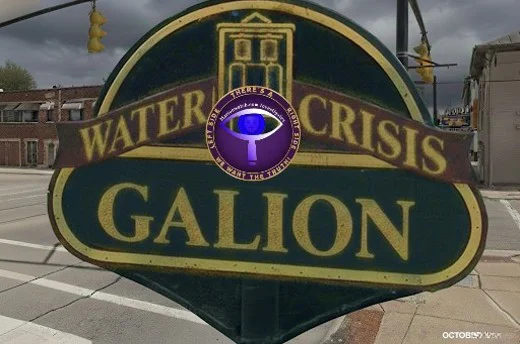
Downplaying the Water Crisis and Delaying the Fix
You cannot separate polluted dirt from polluted water.
When hazardous chemicals are dumped on the ground, they inevitably wash away in the rain or sink down into the water table.
This environmental reality directly impacts the Galion municipal water system. The City of Galion receives its drinking water from the Rocky Fork of the Olentangy River, a surface water source that flows into the Amann Reservoir.
Extensive Ohio EPA biological and water quality studies explicitly link Galion’s ground contamination to the degradation of the Olentangy River watershed.
A major EPA report documented that heavy metal contamination from the Galion Plating and Southside Plating facilities actively washed into the river via stormwater runoff and groundwater seepage.
Adding to the heavy metal runoff, the EPA has historically documented septic conditions in branches of the Rocky Fork caused by failed home sewage systems leaching directly into the water.
Because the city has to pull its drinking water from a watershed historically burdened by industrial seepage and agricultural runoff, the Galion Water Treatment Plant has to aggressively chemically treat the raw water.
This frequently leads to severe secondary problems, such as elevated levels of total trihalomethanes (TTHM)—toxic, cancer-causing byproducts formed when chlorine disinfectants react with high levels of organic matter.
Yet, when the public expresses genuine fear over these chemicals, officials often minimize the threat.
When the Environmental Working Group (EWG) detected cancer-causing Chromium-6 in the local water, Galion’s administration dismissed the findings, officially stating that the report “was issued by an alarmist advocacy group” and downplaying the levels by suggesting the source was merely “naturally occurring.”
Similarly, when the city was cited for violating federal limits for TTHMs, the city’s Communications Director quickly assured the public that “The TTHM levels detected do not pose an immediate health risk,” effectively telling residents not to worry about the long-term, cumulative cancer risks of the very water they drink every day.
This pattern of downplaying the crisis is matched only by the EPA’s willingness to perpetually push off the deadlines to fix it.
Recent Ohio EPA records reveal a staggering number of Notices of Violation (NOVs) issued to the Galion public water system in 2023 and 2024 for failing to properly maintain critical equipment, including broken surface wash valves on water filters.
Rather than enforcing immediate, hard deadlines to protect public health, the Ohio EPA routinely grants the city massive extensions. For example, when cited for major infrastructure failures requiring a $2.18 million overhaul of the Amann Pump House, the EPA approved an extension allowing the city until July 2025 just to submit the plans, pushing the actual completion date all the way to December 2027.
Even basic maintenance deadlines, like repairing daylighting issues on the Dawsett Street water tower, were granted extensions by the EPA, allowing the city to push the repair work back months at a time.
When officials call independent water testing “alarmist” while simultaneously asking the EPA for years-long extensions to fix broken water filters, it leaves the residents of Galion wondering who is actually prioritizing their safety.

Turning the Tide: Brownfield Grants and Taking Control
Despite the historical failures of federal regulators, a major paradigm shift occurred in the early 2020s, allowing Galion to finally take matters into its own hands.
In May 2022, the Biden Administration awarded Galion a highly competitive $500,000 EPA Brownfields Assessment Grant, funded by the Bipartisan Infrastructure Law.
This grant wasn’t for digging up dirt; it was strategically given to allow Galion to systematically map, test, and assess the exact contamination across 26 high-priority properties within the city limits.
These 26 sites specifically included the two former elementary schools. By conducting Phase I and Phase II environmental assessments (drilling soil cores and testing groundwater), the city laid the data-driven groundwork to secure future demolition funds. Because assessment grants cannot be used for physical cleanup, this step was a legally mandatory prerequisite before the city could apply for the massive state grants required to actually decontaminate the land.
Galion has kept this momentum going. In 2024, the Crawford County Land Reutilization Corporation (the county land bank) secured a $300,000 state grant specifically to assess the Jess Fab Shop.
This former electroplating factory is currently under the oversight of the land bank, having sat vacant for years carrying all the standard risks of deep soil and groundwater chemical saturation. The funds will be used to map the exact 3D spread of the contamination plume so it can be cleaned up and redeveloped, projected to create eight new jobs and retain eight existing ones.
Conclusion
The story of Galion’s ground contamination is a heartbreaking chronicle of industrial negligence, compounded by a broken, apathetic regulatory system.
For decades, the city has borne the toxic brunt of unregulated mid-century manufacturing, evidenced by the persistent heavy metals left by electroplating shops and the airborne asbestos left by sloppy demolition contractors.
But the truest tragedy lies in how these hazards have been handled by the very agencies sworn to protect the public.
When the EPA and state regulators are handcuffed by bankrupt polluters and severe funding limitations, properties are left to sit vacant. When city officials dismiss valid water quality reports as “alarmist” and the EPA perpetually pushes off enforcement deadlines for broken water infrastructure, the burden of survival is shifted entirely onto the shoulders of the community.
The inexcusable delays at the Eagle Crusher site on Pershing Street—where a deadly carcinogen went unaddressed by authorities for years and was later ignored in 2026 council meetings—permanently shattered the community’s trust in environmental regulators.
The people of Galion, and especially their children, deserve more than poisoned dirt, contaminated water, and endless bureaucratic extensions.
They deserve immediate, transparent action.
Fortunately, the recent aggressive pursuit of federal and state Brownfield grants shows that local organizations and land banks are no longer waiting for slow federal agencies to fix the problem.
By mapping, testing, and preparing dozens of sites for redevelopment, Galion is finally taking the necessary, proactive steps to reclaim its land.
But until the culture of downplayed risks and delayed enforcement is fully eradicated, the citizens of Galion must remain relentlessly vigilant to ensure their environment is truly made safe again.
Works Cited
- Brayton Purcell LLP. “Ohio Residents Informed of Asbestos Six Years Too Late.” BraytonLaw.com, 2026.
Link: https://www.braytonlaw.com/blog/ohio-residents-informed-of-asbestos-six-years-too-late/ - City of Galion. “2022 Annual Drinking Water Quality Report.” Galion.city, 2022.
- City of Galion. “Brownfield Site Assessment.” Galion.city.
Link: https://www.galion.city/419/Brownfield-Site-Assessment - City of Galion. “City Responds to Social Media Posts Regarding Water Distribution System.” Galion.city.
Link: http://galion.city/CivicAlerts.aspx?AID=444 - City of Galion. “Reports and Notifications – Drinking Water Standards & Brain Tumor Concerns.” Galion.city, 2023-2024.
Link: https://www.galion.city/315/Reports-and-Notifications - Crawford County Auditor. “Real Estate Search – Account 190022908000.” realestate.crawford-co.org.
- Environmental Litigation Group / The Telegram News. “Ohio’s asbestos crisis demands transparency, not a patchwork of shadow records.” TheTelegramNews.com.
Link: https://www.thetelegramnews.com/articles/ohios-asbestos-crisis-demands-transparency-not-a-patchwork-of-shadow-records/ - Ohio Department of Development. “2024 Brownfield Award Descriptions – Round 5.” Ohio Governor’s Office, 2024.
Link: https://content.govdelivery.com/attachments/OHIOGOVERNOR/2024/09/19/file_attachments/3003587/2024%2009XX%20Brownfield%20Award%20Descriptions%20-%20Round%205.pdf - Ohio Environmental Protection Agency (Ohio EPA). “Biological and Water Quality Study of the Olentangy River, Whetstone Creek and Select Tributaries.” Technical Report, 2003-2004.
Link: https://www.olentangywatershed.org/wp-content/uploads/2022/08/FinalOlyTSD2003.pdf - Ohio Environmental Protection Agency (Ohio EPA). “Biological and Water Quality Study of the Upper Olentangy River and Selected Tributaries.” Technical Report, 1994/1996.
Link: https://dam.assets.ohio.gov/image/upload/epa.ohio.gov/Portals/35/documents/olen94.pdf - Ohio Environmental Protection Agency (Ohio EPA). “Decision Document: Former Southside Plating Facility.” Division of Environmental Response and Revitalization, 2021.
Link: https://dam.assets.ohio.gov/image/upload/epa.ohio.gov/Portals/30/Southside%20Decision%20Document.pdf - Ohio Environmental Protection Agency (Ohio EPA). “Notice of Violation and Partial Resolution of Violation – City of Galion Public Water System.” Northwest District Office, 2024-2025.
- Richland Source. “Galion responds to controversial drinking water survey.” 2016.
- Richland Source. “Galion responds to EPA’s drinking water violation.” 2016.
Link: https://www.richlandsource.com/2016/11/30/galion-responds-to-epas-drinking-water-violation/ - United States Environmental Protection Agency (U.S. EPA). “Biden Administration Announces $6 Million to Tackle Polluted Brownfield Sites in Ohio.” EPA.gov Press Releases, May 12, 2022.
Link: https://www.epa.gov/newsreleases/biden-administration-announces-6-million-tackle-polluted-brownfield-sites-ohio