
 Written by

📑 Table of Contents 📑 Article TOC 📑 TOC 10 Sections Show Hide
U.S. & Infrastructure Watch | Investigative Analysis from an Information Technology Perspective
When a local police officer pulls a vehicle over along State Route 309 or a quiet county road after dark, the laptop mounted beside the steering wheel is their first line of defense.
In seconds, that terminal queries a massive federal backbone to tell the officer whether the driver has an active felony warrant, a history of violent offenses, gang ties, or a stolen vehicle.
That backbone—the FBI’s National Crime Information Center (NCIC)—has just been breached by hackers.
Confirmed over the weekend by three sources familiar with the matter and acknowledged Saturday morning by President Donald Trump—who told Fox News’ Kayleigh McEnany he had “just heard” about the intrusion and bluntly stated, “I will say that it’s not good. I don’t like that”—the NCIC hack is not just another data breach.
It strikes at the real-time nervous system of American policing, and it lands at the tail end of the most chaotic two-week stretch of government and critical-infrastructure IT failures in recent memory.
To an everyday citizen, the steady drumbeat of headlines—grounded airplanes, frozen farm-payment portals, darkened classified networks, and stalled banking systems—sounds like a run of terrible luck. To an information technology professional who builds, patches, and defends enterprise networks for a living, the official explanations coming out of Washington are raising every red flag in the playbook.
INSIDE THE FBI’S NCIC BREACH: WHY DATA MANIPULATION IS WORSE THAN DATA THEFT
Retired FBI Supervisory Special Agent Jason Pack, who spent years working in cybercrime and public information, cut straight to the real danger in an interview with Fox News Digital: if intruders altered records inside the NCIC, officers on the side of the road could walk into a traffic stop blind.
“What they worry about is if any of this data has changed, then it might affect officers’ safety on the side of the road,” Pack warned.
Pack calls the NCIC “America’s computer for law enforcement.” Rather than operating as a single sealed vault, it works like a nationwide hub-and-spoke network.
Roughly 56 state-level terminals feed live data out to hundreds of thousands of patrol car computers across the country, allowing officers to check warrants, criminal histories, missing children, gang members, and suspected terrorists.
From an IT security standpoint, there are two separate nightmares inside an intrusion like this:
● Confidentiality (What they stole): While the NCIC does not hold classified intelligence or sensitive FBI investigative case files, it is packed with Personally Identifiable Information (PII)—names, dates of birth, and Social Security numbers—for millions of Americans.
● Integrity (What they changed): In cybersecurity, stealing data is bad, but quietly changing data is lethal. If an attacker deletes a violent fugitive’s felony warrant, an officer approaches the driver’s window expecting a routine speeding stop. Conversely, if an attacker plants a false warning flag on an innocent citizen’s record, a routine traffic stop can escalate into a tragedy in seconds.
Pack noted there is no indication yet that any records were altered or that the NCIC is experiencing an outage, and the FBI’s incident response team is currently examining IP logs and metadata to trace the entry point.
With more than 100,000 authorized users across local, state, and federal agencies—plus state terminals and third-party vendors—the attack surface is enormous. Hackers do not necessarily have to smash through FBI headquarters’ front digital door; a single compromised password, an unpatched state terminal, or a breached vendor account can hand an intruder the keys.
Compounding the alarm, this marks the second cyberattack against the bureau in recent months.
In September 2026, the extortion group ShinyHunters breached an FBI job portal website and claimed to steal personal records belonging to bureau employees—an intrusion whose source the bureau had still not publicly resolved. Repeated breaches at the nation’s premier law enforcement agency point to a systemic vulnerability, not a one-off fluke.
THE TWO-WEEK CASCADE: A TIMELINE OF WHAT ACTUALLY WENT DOWN
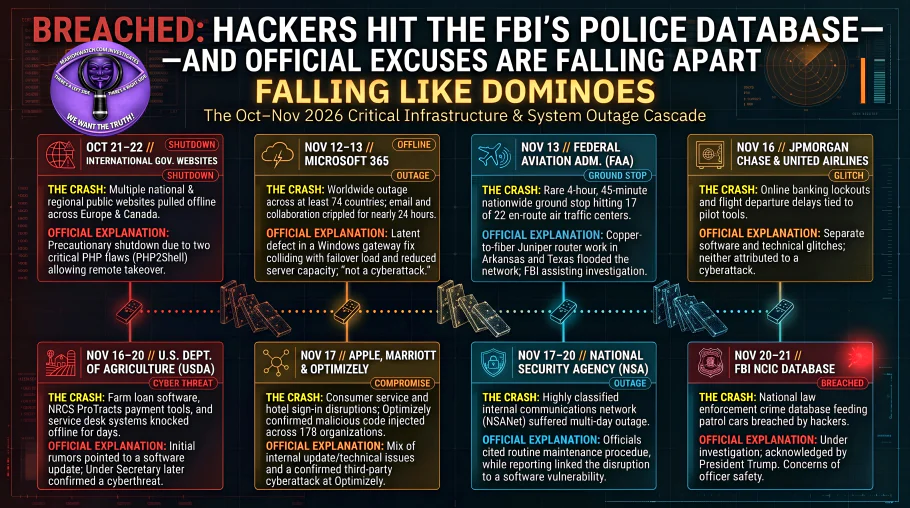
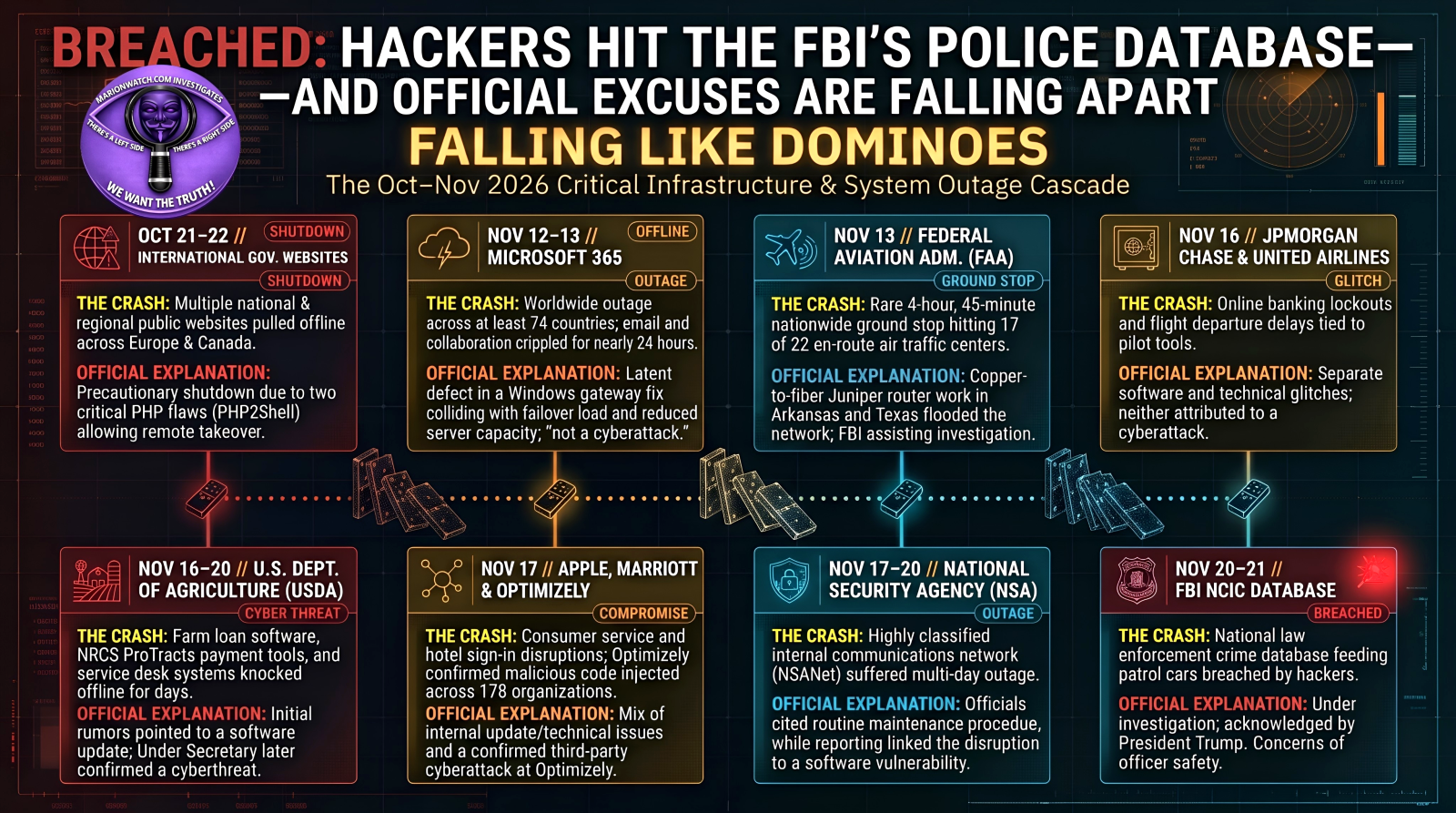
The FBI breach did not happen in a vacuum. Over roughly ten days in mid-November—building on emergency government website shutdowns that began in late October—critical public and corporate networks fell like dominoes.
Right in the middle of that storm, on November 19–20, the White House abruptly replaced National Cyber Director Sean Cairncross—tapping the Pentagon’s Chief Information Officer to take over—as the administration faced mounting scrutiny over the wave of tech failures.
Yet just days earlier, during a contentious November 18 House Homeland Security Committee hearing, Homeland Security Secretary Markwayne Mullin, FBI Deputy Director Christopher Raia, and Director of National Intelligence Jay Clayton insisted the outages were separate events caused by maintenance and technical changes, with “no indication” of a coordinated or state-sponsored cyberattack.
WHY “FAILED SYSTEM UPDATE” AND “ROUTINE MAINTENANCE” MAKE IT PROS SUSPICIOUS
When government agencies tell the public that critical systems are offline for days because of a “failed system update” or “routine maintenance,” non-technical audiences tend to shrug—everyone has had a Windows update freeze a home computer.
Enterprise and federal IT does not work like a home laptop. Here is why multi-day “update” outages immediately trigger suspicion among working systems administrators and network engineers:
1. REAL MAINTENANCE HAS ROLLBACKS—MEASURED IN MINUTES, NOT DAYS
In any properly managed data center, you never deploy a major patch straight to live production servers without three safety nets: a staging environment (a clone of the real network where you test the update first), high-availability redundancy (backup servers that take over seamlessly while primary ones reboot), and a rollback plan (instant virtual machine snapshots or configuration backups).
If a routine update breaks a government website or payment portal at 9:00 AM, competent engineers revert to the last known good state and restore service before lunch. When a system stays offline for three to five days, engineers are almost never struggling to click “undo.”
2. MULTI-DAY BLACKOUTS MATCH “CONTAINMENT AND FORENSICS”
There is one major scenario where IT teams deliberately yank the plug and keep systems dark for days: suspected or confirmed intrusion.
If security monitoring alerts you that an unauthorized actor is inside your network, you cannot simply roll back a patch or reboot a server. Rebooting can wipe volatile memory (RAM) that holds forensic evidence of how the hacker got in.
Worse, if the attacker already planted a hidden backdoor or stole administrator credentials, bringing the website back online just invites them right back in.
Instead, incident responders isolate the network, freeze affected systems, hunt for persistence across every server, reset passwords and encryption keys, and rebuild from verified clean backups. That takes days—and to the outside world, it looks like a mysterious multi-day outage.
3. THE TIMING BREAKS BASIC CHANGE-MANAGEMENT RULES
Look closely at the FAA’s November 13 nationwide ground stop.
The disruption was triggered around 3:30 PM Eastern on a Friday afternoon—peak air-travel hours—during copper-to-fiber router replacement work tied to sites in El Dorado, Arkansas, and Amarillo, Texas.
Standard IT change management strictly forbids touching live core routing hardware during peak daytime traffic; you make those swaps at 2:00 AM on a Sunday.
Similarly, the NSA—an agency built around hardened redundancy—suffered a multi-day “code yellow” outage on its classified NSANet network even as intelligence leadership framed recent federal disruptions around routine patching and maintenance.
Either federal change-control discipline has collapsed completely, or engineers are scrambling to apply emergency security patches they cannot wait until midnight to install.
4. WE JUST WATCHED THE “SOFTWARE UPDATE” COVER STORY COLLAPSE AT THE USDA
For readers in agricultural communities across North Central Ohio, the USDA incident is the clearest proof of how this messaging game gets played. Starting Monday, November 16, Farm Service Agency (FSA) loan software, NRCS ProTracts payment tools, and internal mapping software went down across the country—right as farmers were working ahead of a hard December 11 deadline for 2026 ARC/PLC crop program sign-ups.
While early chatter pointed toward a routine software update, USDA Under Secretary Richard Fordyce finally broke the script at a press event in Kansas City, confirming flatly that the week-long disruption was a “cyberthreat,” not a “software update.”
Although Fordyce stated no Personally Identifiable Information was lost, he confirmed systems had to be shut down in order to safely restart and restore operations.
In corporate and government crisis management, “routine maintenance” and “system update” have become default holding phrases used by legal and PR teams while investigators figure out whether a breach actually happened and how bad the damage is. It buys time—and it erodes public trust when the truth surfaces four days later.
THE BIGGER PICTURE: NOT ONE MASTER PLOT, BUT SOMETHING ARGUABLY MORE DANGEROUS
An honest IT investigation has to resist lazy conspiracy theories just as hard as it resists government spin.
While rumors raced across social media tying every glitch of the week into a single foreign cyber-assault—including false claims of a nationwide weather radar collapse on November 13, even though the National Weather Service’s only confirmed hiccup was a separate 40-minute website and data disruption on November 17—there is no public evidence proving that Microsoft’s email meltdown, JPMorgan’s software bug, and the FAA’s router flood were launched by one adversary hitting a single button.
What the evidence actually reveals is more unsettling than a movie-style super-hacker—because it cannot be fixed by arresting one group.
Three structural crises are colliding at the exact same time:
● AI-Speed Vulnerability Discovery (“Machine Speed” Warfare): Both Jason Pack and federal cybersecurity analysts are pointing to a new reality in late 2026: criminals and researchers alike are using artificial intelligence to hunt down deep bugs in core internet software and turn advisories into working exploits at “machine speed,” faster than human defenders can safely patch them. In late October, researchers disclosed PHP2Shell (CVE-2026-109618 and CVE-2026-109619)—actively exploited flaws so severe that governments abroad pulled websites offline rather than leave them exposed. Then on November 17, Oracle and CISA issued urgent warnings for Java4Shell (CVE-2026-114938), a critical memory-corruption flaw in the HotSpot Java Virtual Machine. When critical flaws drop every few weeks, overworked IT teams are forced into panic-patching—pushing rushed fixes into live production networks, which inevitably triggers crashes and outages.
● Brittle Legacy Hardware Colliding with Modern Upgrades: Look at what broke the FAA: federal contractors with L3Harris were upgrading an antiquated legacy copper telecommunications system to modern fiber using new Juniper routers. When a broadcast feature on the new routers flooded the flat, unsegmented legacy network, FAA Administrator Bryan Bedford admitted bluntly that “there’s no backup to the backup”—forcing controllers to cancel more than 12,000 flights on Friday alone while the agency scrambled to disable the feature across more than 60 routers. Across federal, state, and municipal governments, critical services are held together by duct tape bridging decades-old infrastructure and modern hardware.
● Documented Federal Negligence on Basic Security: On November 18—just days before news of the FBI NCIC breach broke—the U.S. Government Accountability Office (GAO) published Report GAO-27-108661. Its finding should alarm every taxpayer: out of 22 major civilian federal agencies reviewed, 17 failed to fully address federal Zero Trust cybersecurity guidance, leaving 40 open recommendations unaddressed. “Zero Trust” is not futuristic sci-fi; it is the modern IT baseline that says never automatically trust a user or device just because they are inside the network—verify every login, inventory every asset, and log every move. Nearly four out of five major federal agencies still do not have a complete grip on every actor and asset sitting on their own networks.
WHAT CITIZENS AND LOCAL OFFICIALS SHOULD TAKE AWAY
When Washington tells the public to stay calm and chalks up multi-day blackouts to routine updates, everyday Americans are right to ask harder questions.
At the local level, the consequences are not abstract. Ohio police departments depend on clean, uncorrupted NCIC data to keep officers and motorists alive during routine traffic stops. Midwest farm families depend on USDA and FSA portals working reliably when strict federal enrollment deadlines refuse to budge.
Until federal agencies stop hiding cyber incidents behind “maintenance” banners, modernize decades-old infrastructure with real redundancy before it collapses mid-flight, and actually implement the Zero Trust security standards their own watchdogs say they are failing to meet, November 2026 will not remain an anomaly. Cascading outages and quiet breaches are rapidly becoming America’s new normal.
For Marionwatch.com readers, the practical takeaway is straightforward: treat digital fragility as a fact of life. Keep paper copies of critical financial, medical, and government program filings—especially ahead of rigid deadlines like the USDA’s December 11 cutoff—freeze your credit files in case another federal database exposes Social Security numbers, and never blindly accept “just a routine update” when a critical public system goes dark for days without a transparent post-incident technical report.