 Written by

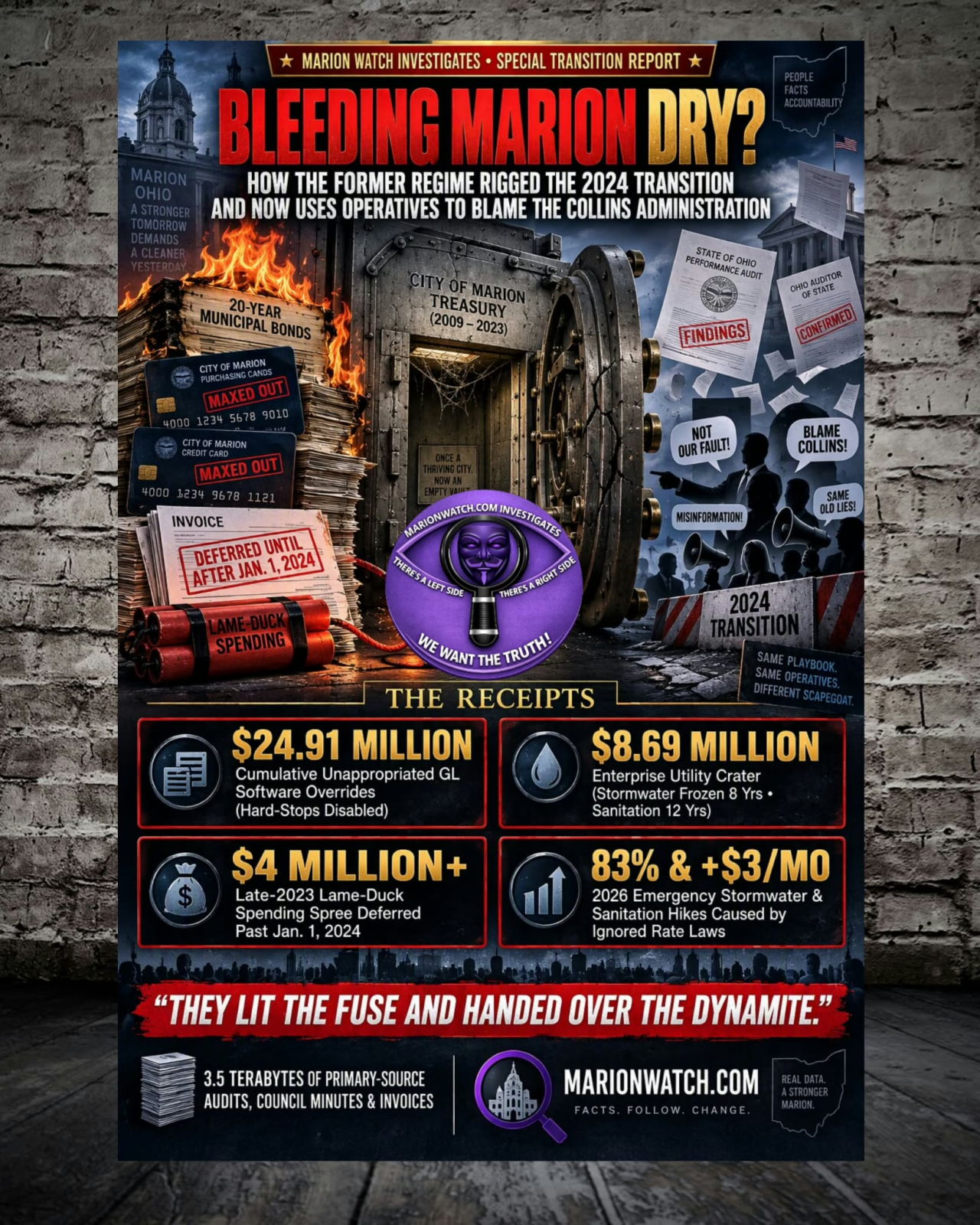
We are now moving forward into the administration transition phase of our investigation.
In our upcoming installments, we will be taking a very close, granular, and surgical look at the mountain of debt deliberately passed on to the Collins administration through a massive lame-duck spending spree executed just before the Schertzer regime walked out of City Hall.
The outgoing administration locked taxpayers into millions of dollars in deferred vehicle leases, unbudgeted equipment purchases, and multi-year contract spikes knowing full well those bills would not come due until after January 1, 2024.
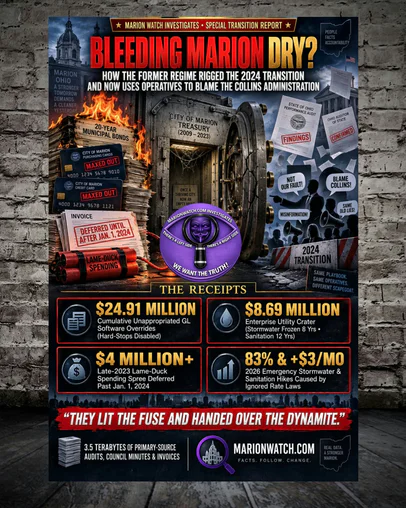
That immediate transition trap alone was millions—and when you factor in specifics such as the $8.69 million enterprise utility crater, the $436,447 in late-2023 IRS and pension penalties and consultant bailouts, the $1.33 million wasted on dormant software, and the $24.91 million in cumulative General Ledger overrides from their compromised New World ERP system, the total financial wreckage handed to the new administration easily tops mid-double-digit millions.
Yet right on cue, we have picked up a wave of chatter on social media regarding economic development cuts, utility rate spikes, and other associated cost hikes.
The Marion citizenry seems to think there may be former Schertzer administration officials positioning for a political campaign, and Marion Watch intends to use everything in our arsenal of data—now approaching 3.5 terabytes—to ensure that this never happens.
Apologists, minions, and political operatives for the old guard are working overtime to insist that these painful financial measures are the fault of the Collins administration.
In many ways, this is being executed in the exact same manner they attempted to discredit Marion Watch’s Silent Sabotage investigation of Marion’s IT and financial infrastructure.
That did not go well for them, because we come with massive amounts of primary-source receipts collected over nearly 20 years.
Let’s be crystal clear: the narrative that the Collins administration is at fault for the current Fiscal Emergency is yet another lie.
The fiscal emergency declaration would have, and should have happened years ago had the books not been cooked.
Every single one of these cost hikes and budget cuts is the direct, unavoidable receipt for a sixteen-year pattern of ignored laws, breached digital controls, and hidden deficits that were either mishandled or intentionally buried by the former Schertzer administration before they vacated office.
As working families open their utility bills to find an 83% hike in stormwater fees and new sanitation surcharges, the former regime’s defenders are spinning a frantic, coordinated political narrative to rewrite history.
It is an understandable survival tactic when you consider how severe the legal and political consequences may be if and when state and federal authorities look closely at Marion’s digital ledgers.
The panic from the former regime is palpable.
In a telling display during a live election night broadcast, Marion Watch was notified that none other than former Mayor Scott Schertzer took to a local rant podcast in a desperate attempt to discredit our platform—while simultaneously declaring that Marion Watch is “not credible” and “nothing to worry about.”
Make that make sense.
If our primary-source audits, forensic data, and professional backed assessments are “nothing to worry about,” why spend election night ranting about us into a microphone?
Why not come on a live broadcast with Marion Watch and our professional network to debate the records face-to-face, as we have repeatedly offered?
It likely has something to do with those pesky little receipts Marion Watch collects like treasure.
You cannot debate an official State of Ohio audit, a vendor invoice, or an internal security screenshot—and they know that if they sit across from us, their political comeback tour ends before it even begins.
They know that if they sit across from us on a live broadcast, there is no telling what Marion Watch will pull out of the vault next. We have a mountain of primary-source data, and if you were doing anything ethically or legally questionable inside City Hall between 2009 and today, chances are we have a dedicated folder with your name on it.
When subjected to forensic scrutiny, the revisionist talking points circulating on social media collapse on contact with the actual receipts—meeting the exact same fate as the former regime’s phony excuses for Marion’s Fiscal Emergency and their failed campaign to discredit the Silent Sabotage series:
● THE REVISIONIST SPIN: Fast-tracking commercial annexations by suspending City Council’s three-reading rule is a “suspicious” procedural overreach.
● THE FORENSIC REALITY: Feigning outrage over City Council suspending the three-reading rule is peak hypocrisy. Suspending readings is a standard parliamentary procedure that the former administration relied on for sixteen years to quietly ram through their own agenda without public scrutiny.
That includes rushing the nearly million-dollar purchase of the New World ERP software as an “emergency” measure while bypassing the Information Systems Committee—the very software disaster at the center of Marion’s financial collapse.
It includes the 2011 $3.5 million Lincoln Park Aquatic Center bond push and veto override, and it includes the October 23, 2023 lame-duck police union contracts that locked the incoming administration into $650,000 in immediate first-year costs and 18% multi-year wage spikes just weeks before the election.
Former regime defenders are trying to manufacture a scandal out of routine zoning procedure to distract the public from the multi-million-dollar financial traps they set on their way out the door.
● THE REVISIONIST SPIN: Pausing a $140,000 economic development director position and severing outside development ties proves the Collins administration has no plan to avoid budget cuts.
● THE FORENSIC REALITY: Why were those positions and outside contracts paused? Because the former administration left the City of Marion with roughly $8.9 million in deficit fund balances, an unreconciled digital vault, and a $4 million-plus lame-duck spending tab that triggered the Ohio Auditor of State to place Marion into Fiscal Caution and, ultimately, state-mandated Fiscal Emergency.
While the former regime loved to brag about “Award-Winning” 2018 and 2019 financial reports—which were nothing more than formatting participation trophies—those exact same audits proved the city’s governmental unrestricted net position had crashed to a staggering negative $39.8 million while hoarding over $6.08 million in uncollected utility receivables.
The incoming administration was forced to execute brutal 10% departmental budget cuts and freeze six-figure administrative salaries just to keep the city solvent.
You do not spend $140,000 on a new economic development salary when the previous regime maxed out the city’s credit cards, left over 20 negative line items in the budget, and handed over a bankrupt ledger that required outside forensic accountants just to figure out how much cash was actually in the bank.
● THE REVISIONIST SPIN: Utility fees are only rising because current leadership failed to “grow the tax base” or attract new retail grocery stores.
● THE FORENSIC REALITY: Anyone claiming that a new grocery store would have prevented water and trash hikes does not understand basic municipal finance—or is deliberately lying to you.
Income tax revenue from retail stores goes into the General Fund; it does not fund enterprise utilities. Under Ohio law and Marion’s own municipal code, enterprise funds like Stormwater, Sewer, and Sanitation must be 100% self-sustaining through user fees. You cannot “grow the general tax base” to plug an $8.69 million enterprise utility crater.
The new $13.20 stormwater rate and the $3.00 sanitation surcharge are not the result of a lack of retail stores. They are the unavoidable legal receipt for the Schertzer administration intentionally freezing stormwater rates from 2017 to 2025—ignoring four mandatory biennial review cycles—and leaving sanitation rates untouched for 12 straight years just to avoid political pushback before elections.
The Ohio Auditor of State placed Marion in Fiscal Emergency over an operating deficit topping $11.6 million. Had the previous administration simply followed the law, conducted mandatory rate reviews, adjusted utility rates incrementally, and prevented the $8.69 million drain on enterprise funds, nearly 75% of today’s Fiscal Emergency deficit would never have existed.
● THE REVISIONIST SPIN: Using environmental grants to clean up hazardous scrap tires or welcoming discount retail stores harms neighborhoods because of register pricing accuracy.
● THE FORENSIC REALITY: Complaining about a public health grant being used to clean up hazardous scrap tires is absurd—especially coming from the defenders of an administration that illegally burned millions of dollars in 20-year capital infrastructure loans to cover daily operating deficits.
In 2012 alone, the previous regime diverted $2,883,615 in Ohio Water Development Authority (OWDA) sewer loans to non-capitalized expenses, and burned another $2,655,194 in loan proceeds the exact same way in 2021.
Even more laughable is the former regime’s sudden, deep concern over retail price discrepancies at a store cash register. These are the exact same people who operated a compromised financial system that harbored an active felony embezzlement by a city utility supervisor for three full years.
To hide their own utility billing shortfalls, they executed massive, unverified bad-debt purges—wiping away $1.64 million in sanitation receivables in 2010, $1.64 million in 2011, and $1.19 million in 2012—while disabling the exact internal software controls designed to stop cash register theft inside City Hall.
THE RECEIPTS: THE LAWS & ORDINANCES THE FORMER REGIME IGNORED TO CREATE THE $8.69 MILLION UTILITY CRATER
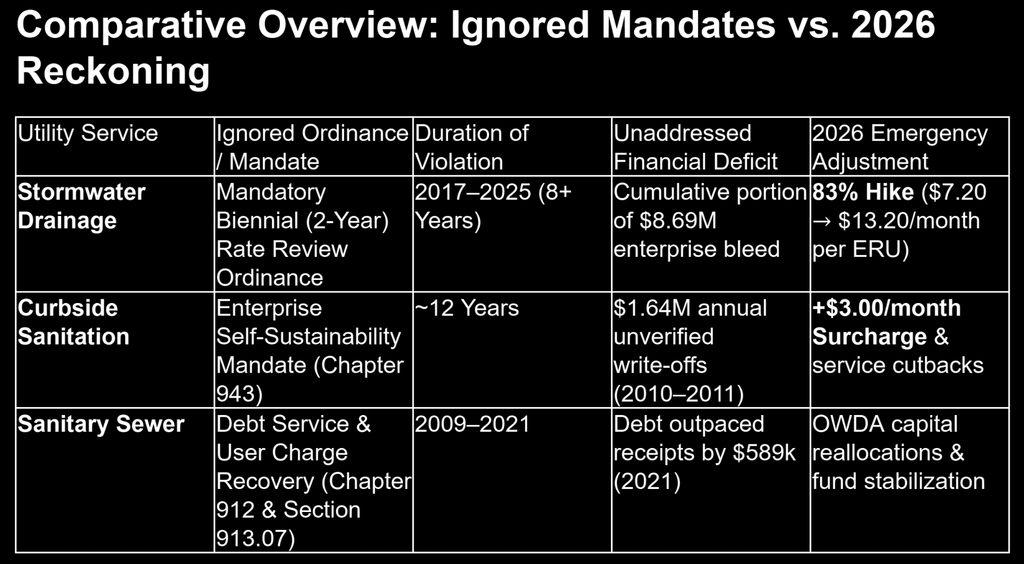
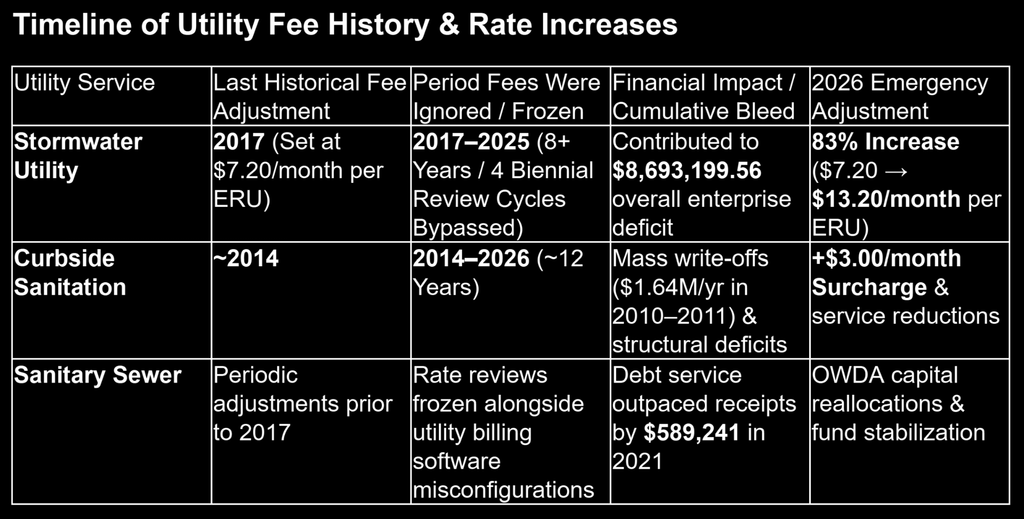
To understand just how deliberate this negligence was, examine the attached forensic summary tables and the specific municipal ordinances and statutory debt regulations the former administration violated for over a decade:
● Mandatory Biennial Stormwater Rate Review Ordinance (Chapter 943 / Stormwater Utility Code): City ordinances explicitly mandate a comprehensive review of stormwater utility rates every two years (biennially). This law was designed to incrementally adjust user fees to match operating inflation, infrastructure maintenance, and capital debt service so property owners would never be hit with a sudden rate shock.
● How the Former Regime Broke It (Stormwater): The Schertzer administration froze stormwater fees at $7.20 per month per Equivalent Residential Unit (ERU) from 2017 through 2025, completely bypassing four consecutive mandatory two-year review cycles. That eight-year freeze drained stormwater reserves and destabilized drainage infrastructure funding, forcing current leadership in February 2026 to enact an emergency 83% rate increase—raising monthly fees from $7.20 to $13.20 per ERU (a $6.00/month increase).
● Enterprise Fund Self-Sustainability Mandates (Chapter 943 Refuse Collection & Chapter 912 Sewer User Charge System): Under Marion’s municipal utility codes and state accounting standards, utility enterprise funds must be 100% self-sustaining. User fees must be evaluated periodically to balance against operational costs, capital debt obligations, and depreciation.
● How the Former Regime Broke It (Sanitation): Instead of lawfully adjusting sanitation rates as operating costs rose, the former administration left sanitation fees frozen and unreviewed for roughly 12 years (~2014 to 2026). To conceal the resulting shortfalls without raising rates, they relied on off-book workarounds, unappropriated General Ledger (GL) soft-stop overrides, and unverified mass write-offs—flagging $1.64 million in uncollectible sanitation receivables in 2010 and $1.64 million in 2011. The fallout forced an immediate $3.00 monthly sanitation surcharge in 2026 and proposed cutbacks to curbside recycling programs.
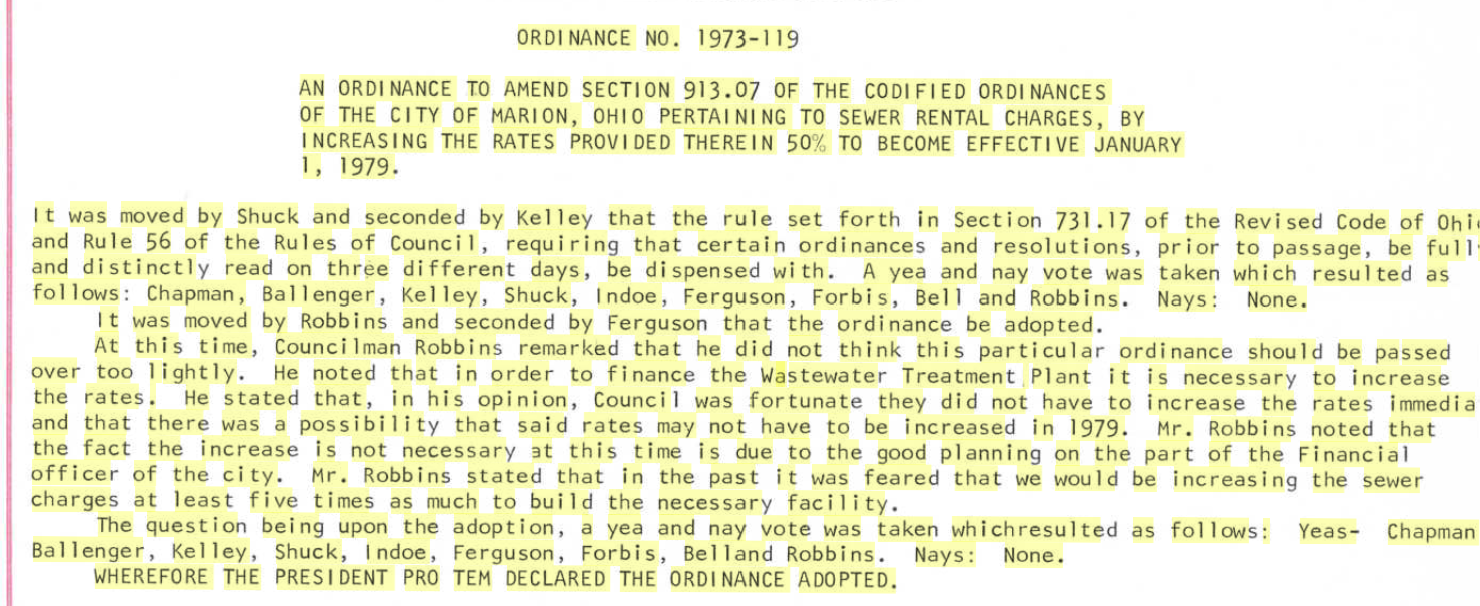
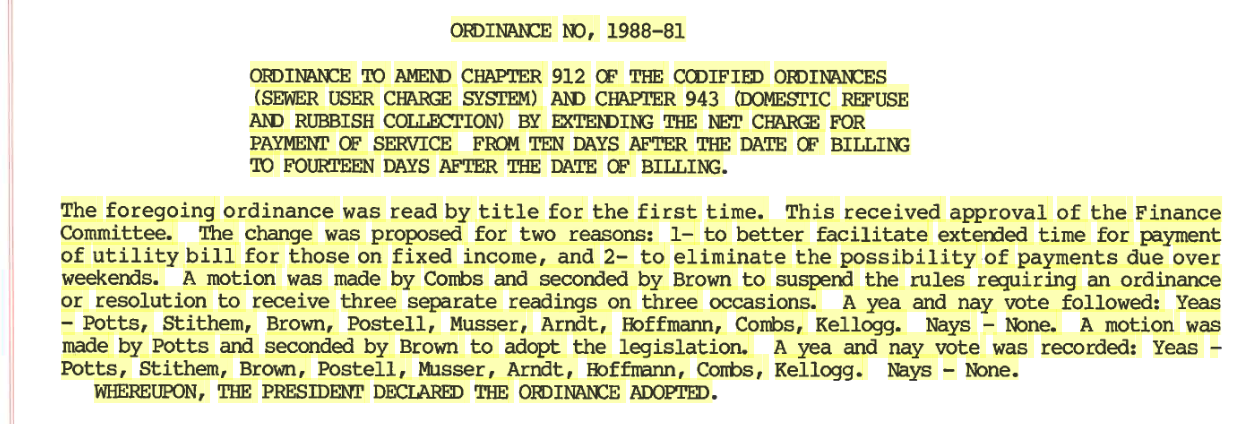
● Sewer Rental Charge & Periodic Rate Adjustment Mandates (Ordinance No. 1973-119 Amending Section 913.07 & Ordinance No. 1988-81 Amending Chapters 912 & 943): These foundational ordinances established Marion’s baseline sewer rental charges, domestic refuse collection terms, and mandatory periodic rate adjustment schedules to ensure self-sustaining fee collection.
● How the Former Regime Broke It (Sewer Debt Coverage): Because the former administration refused to adjust user rates to cover debt service, Sewer Capital Debt payments ($2,387,716 in 2021) exceeded net utility receipts by $589,241, cannibalizing the city’s capital reserves.
● Capital Loan & Debt Service Recovery Regulations (OWDA Covenants & Municipal Debt Law): Ohio Water Development Authority (OWDA) loan covenants and state municipal debt regulations strictly require utility user rates to generate sufficient net revenue to service capital bonds and loan principal without diverting capital funds to cover daily operating deficits.
● How the Former Regime Broke It (Raiding Capital Loans): The previous administration repeatedly misallocated long-term capital loan and bond proceeds to pay for non-capitalized daily operating expenses—burning $2,883,615 in OWDA sewer loans in 2012 and another $2,655,194 in bond and loan proceeds in 2021. By 2021, annual debt payments ($2.39 million for sewer and $1.03 million for stormwater) exceeded net utility receipts, depleting capital loan reserves and creating a staggering $8,693,199.56 enterprise deficit across Sewer, Sanitation, and Stormwater accounts between 2017 and 2024.
THE BOTTOM LINE: THEY LIT THE FUSE AND HANDED OVER THE DYNAMITE
The social media spin attempting to blame the Collins administration for paused economic development salaries and overdue utility rate corrections is a calculated diversion.
The previous regime spent sixteen years operating a compromised software system with the safety switches turned off, ignored mandatory utility rate reviews for over a decade, raided long-term infrastructure loans for daily expenses, and went on a multi-million-dollar lame-duck spending spree in late 2023—pushing the first payments past January 1, 2024.
They passed along a series of ticking financial time bombs, fully aware that they would not be sitting in the Mayor’s chair when those bombs detonated.
The citizens of Marion are now paying the price for sixteen years of governance failures, and they deserve to know exactly who racked up the bill.
Marion Watch has the audits, the council minutes, the contracts, and the receipts—and we will use them relentlessly to dismantle every lie told by those who broke this city.