
 Written by

THE REAL STORY OF MARION’S FINANCIAL COLLAPSE.

Every symptom-based forensic IT warning published by Marion Watch since 2019 has been vindicated by the city and state of Ohio’s own records.
Half-measures and political deflections will no longer suffice.
This is why we have dedicated years of research, using our nationwide network to expose this preventable catastrophe, and why we will not allow it to be swept under the rug.
If local and state officials will not do what every single IT and financial professional who have actually read the Silent Sabotage study knows needs to be done, we will escalate higher.
Marion is a textbook case study in what NOT to do in enterprise-grade IT and finance.
It proves why manual workarounds are strictly forbidden, why rule-based access controls are non-negotiable, why undocumented tribal knowledge is an existential threat to governance, and why ignoring foundational architecture guarantees catastrophic failure—truths known by qualified IT professionals globally.
When leadership treats enterprise software as a political prop rather than an instrument of statutory compliance, accountability evaporates. Bypassing budgetary hard-stops, leaving paid controls dormant, and tolerating unrestrained “God Mode” permissions does not modernize government; it engineers a digital vault designed to operate in the dark.
For nearly two decades, the illusion of balanced books was sustained by unverified ledger plugs, non-capitalized debt borrowing, and off-book shadow systems. A system corrupted at its foundation cannot heal itself. Migrating to a new platform without purging seventeen years of bad data will simply automate the next generation of fiscal ruin.
A comprehensive, independent forensic IT and financial audit from installation forward, backed by state and federal law enforcement oversight, is the only way to sanitize the ledgers.
The hidden logs must be unsealed, the full chain of custody exposed, and this multi-million-dollar “Magic Black Box” of institutional negligence blown wide open!
In enterprise information technology and municipal finance, software architecture does not lie. When a Tier-1 municipal Enterprise Resource Planning (ERP) platform suffers a terminal mathematical collapse, culminating in a state-mandated Fiscal Emergency and Modified/Qualified Audit Opinions across 11 of 14 opinion units, the failure is never the product of a sudden, overnight software glitch. Under established IT governance frameworks (including ISACA COBIT and COSO internal control standards), catastrophic ledger corruption is the terminal detonation of technical debt and latent control collapse accumulated over more than a decade.
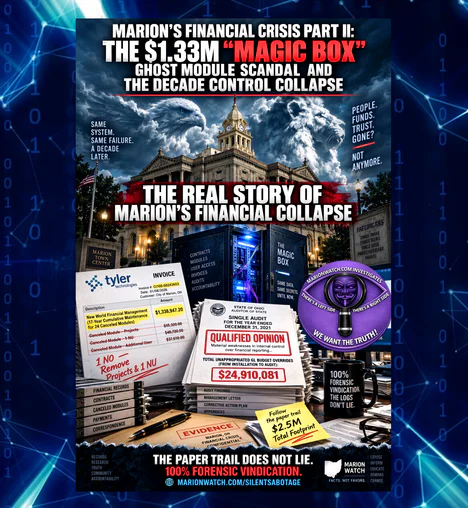
In our first installment, MARION’S FINANCIAL CRISIS PART I: THE $2.5M PRICE TAG AND THE BIRTH OF MARION’S ULTIMATE “MAGIC BOX”, we exposed the financial and contractual traps buried inside the original October 30, 2008 New World Systems agreement.
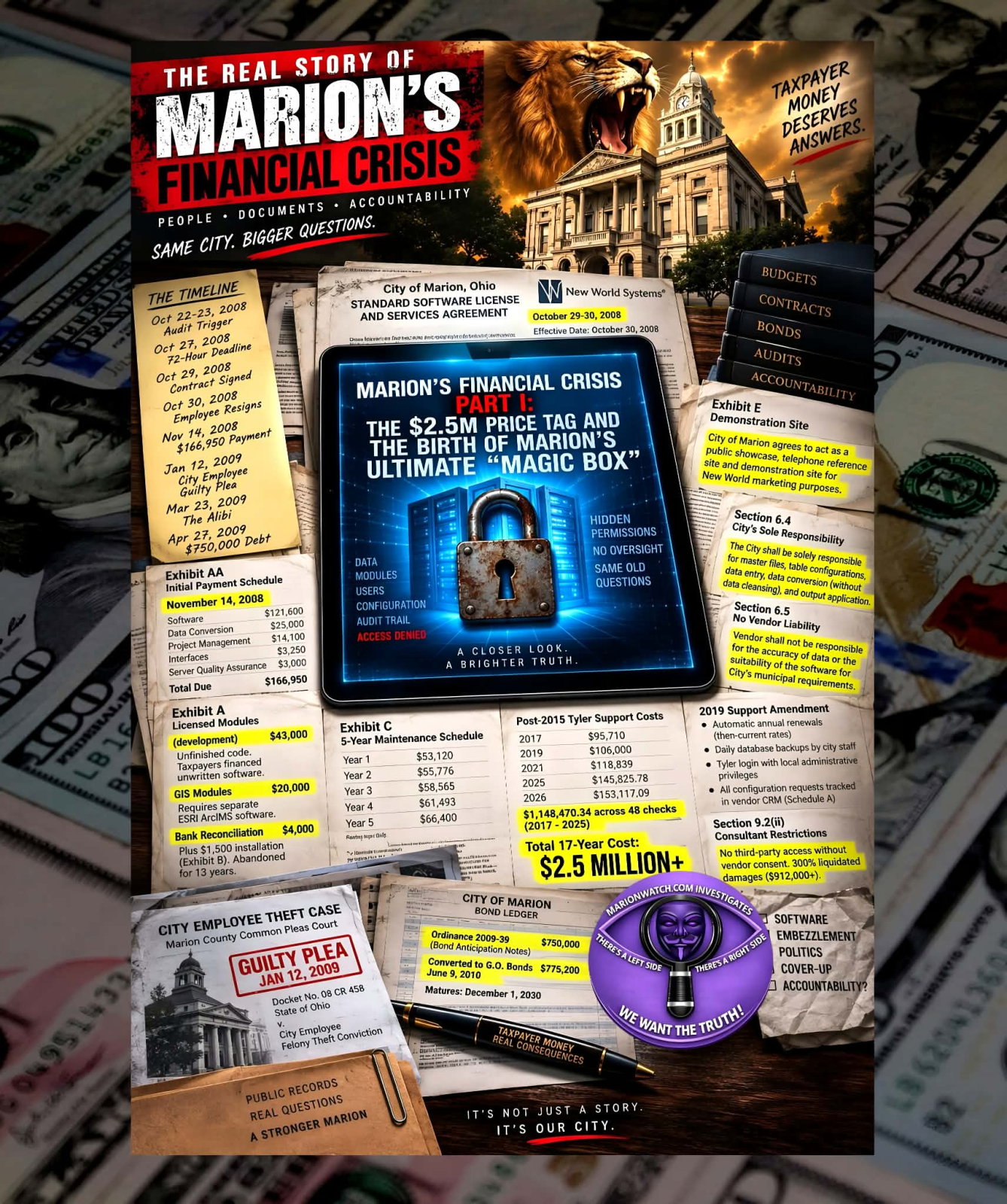
PART I AT A GLANCE: THE BIRTH OF THE “MAGIC BOX” AND SUSPICIOUS ORIGINS
○ The Fiscal Crisis & Dormant Governance: Between 2006 and early 2009, while draining carryover reserves, accumulating $4.5 million in unfunded leave liabilities, passing a 90-day temporary budget (Ordinance 2008-1), and freezing non-bargaining employee wages by 2.6% to stave off layoffs, the former administration bypassed the city’s Information Systems Committee, a structural “Ghost Committee” that sat dormant without a single meeting for 19 years.
○ The 24-Hour Embezzlement Alibi Collision: Following an October 22 to 23, 2008 internal audit in the Zoning and Engineering office that caught a 22-year city veteran (who began her career in Utility Billing) pocketing excavation bonds and permit fees via photocopied receipts, New World Systems drafted a 24-page contract on October 27 with an artificial 72-hour deadline. On October 29, 2008, the employee was placed on leave and Mayor Scott Schertzer and Auditor Kelly Carr signed the $649,500 contract certifying “all the necessary formalities have been met”. On October 30, 2008, the employee resigned and New World President Larry D. Leinweber countersigned the contract.
○ The Five-Month Cover-Up & Vanished Surplus: Just 15 days later, on November 14, 2008, Exhibit AA required Marion to wire $166,950 in upfront cash, five months before City Council was briefed. Although the employee pleaded guilty to felony theft on January 12, 2009, the administration kept Council in the dark until March 23, 2009, when Auditor Carr weaponized the conviction to defend the software purchase, claiming the office previously operated on “paper, pencil, and very little computer technology” and promising New World would eliminate “the human factor”. On April 27, 2009, leadership rammed through Ordinance 2009-39 issuing $750,000 in notes (leaving an immediate $100,500 unallocated financing surplus over the $649,500 contract price), which rolled into $775,200 of 20-year General Obligation Bonds on June 9, 2010, maturing December 1, 2030.
○ Compounding Rate Hikes & The $2.5M+ Footprint: Following Tyler Technologies’ November 2015 merger with New World, Kelly Carr signed a January 30, 2019 Support Amendment locking in automatic renewals at uncapped “then-current rates” and granting Tyler a dedicated login with local administrative privileges. Rubber-stamped 5% compounding hikes drove annual support bills from $53,120 in Year One to $95,710 (2017), $106,000 (2019), $118,839 (2021), $145,825.78 (2025), and $153,117.09 (2026), with $1,148,470.34 paid to Tyler across 48 checks and EFTs between January 2017 and March 2025 alone.
○ The Ten Contract Red Flags & 100% City Liability: The 2008 contract billed taxpayers $43,000 for seven unwritten (development) modules, $20,000 for two GIS packages without required third-party ESRI ArcIMS software (Endnote 5), and twice for Bank Reconciliation ($4,000 license in Exhibit A plus $1,500 installation in Exhibit B), while starting the warranty/billing clock automatically 30 days after delivery (Definition 9). Worse, the city accepted a discount to serve as a marketing “Demonstration Site” and phone reference (Exhibit E), agreed to zero vendor data cleansing during conversion (Exhibit F), accepted a third-party consultant gag order carrying 300% liquidated damages of $912,000+ (Section 9.2(ii) & Exhibit D), agreed to secret arbitration in Troy, Michigan and a one-year defect lawsuit limit (Sections 14.0 & 18.4), and assumed 100% contractual responsibility for master files, table configurations, data entry, and output (Sections 4.2, 6.4, and 6.5).

THE ESCALATION TIMELINE: HOW MARION WATCH FORCED THE ESCALATIONS
While Part I documented how the 2008 contract was engineered, newly released internal billing audits, vendor discontinuance contracts, and handwritten invoice worksheets obtained by Marion Watch prove what happened over the next 17 years: while taxpayers paid over $2.5 million, the administration left 70% to 80% of the software’s modules sitting dormant on the shelf, while systematically stripping the remaining core modules of their backend guardrails, hard stops, and segregation of duties.
The exposure of this multi-million-dollar software waste did not happen by chance; it was the direct result of a relentless, chronological escalation by Marion Watch that forced city leadership to audit its own invoices. Nobody was talking about this little secret until we ruined the fun.
○ Late 2024 to Early March 2025 (The Relaunch and Symptom-Based Diagnosis): After returning online in late 2024 to finish the investigative work begun between 2016 and 2019, Marion Watch meets in early March 2025 with 3rd Ward Councilman and IT Oversight Committee Chairman Ralph Smith, who served in information technology during the Vietnam era with high-level security clearance. We present our symptom-based forensic IT diagnosis demonstrating that decades of audit anomalies pointed directly to dormant New World modules, disabled hard stops, and compromised user permissions.
○ July 21, 2025 (The Council Floor Address): Following months of verification, Marion Watch formally addresses Marion City Council on the public record during a committee meeting, exposing disabled error-prevention switches, coerced employee password sharing, and internal evidence of unimpeded “God Mode” administrative access retained across department lines.
○ July 25 to September 29, 2025 (Escalation to the State Special Audit Task Force): On July 25, 2025, at 5:06 AM, Marion Watch submits a formal forensic threat assessment to the Ohio Auditor of State’s Special Investigations Unit (SIU), detailing the disabling of software safeguards, ongoing “permissions wars,” disappearing records, and fear of retaliation among city staff, while warning that a standard IT General Controls (ITGC) spot-check would be wholly insufficient. On September 25, 2025, the SIU confirms receipt (Case 2025-INTK-000015712) and transfers the file to the Auditor of State’s Special Audit Task Force. On September 29, 2025, at 5:45 AM, Marion Watch submits supplemental evidence including circa-1983 and 1997-1998 archival audit assessments, eyewitness New World screenshots proving inappropriate administrative access by a former Deputy Auditor in March 2021, and reports that the municipal server room was being used as a storage unit and general office.
○ October 15 to November 13, 2025 (The 2021 Audit Detonation and Override Lockdown): On October 15, 2025, the Ohio Auditor of State signs the long-delayed 2021 Single Audit (filed April 4, 2025, over three years past its March 1, 2022 statutory deadline, and certified November 13, 2025). The state issues Modified/Qualified Opinions across 11 of the city’s 14 opinion units and officially strips Marion of its federal “Low-Risk Auditee” designation. Crucially, in the Corrective Action Plan for Findings 2021-005 and 2021-006, Auditor Miranda Meginness confesses that universal permissions to override budgets were finally removed from all New World users (except the City Auditor) on October 27, 2025, directly validating the exact vulnerability Marion Watch had escalated months prior.
○ December 14, 2025 (The Public Records Catalyst): At 6:13 PM, Marion Watch submits a formal public records request to Mayor Bill Collins and Treasurer Twila Laing demanding the Original Purchase Manifest, Comprehensive User Permissions List, and Tyler Technologies Help Desk Logs. Our request explicitly states on the record: “This data will be used to investigate several theories, including the potential purchase of unused modules, which could constitute an unjustified use of public funds”.
○ December 15 to December 22, 2025 (The 19-Hour Internal Scramble): Less than 19 hours after receiving our records request, on December 15, 2025, at 12:36 PM, Mayor Bill Collins emails Deputy Auditor Marden Watts and Auditor Miranda Meginness asking: “Can you advise how much we are paying for New World for maintenance contract every year?”. After Watts forwards the contract and the 2025 detailed invoice on December 16 ($145,825.78 on Invoice 045-496026, paid via EFT #16654 on March 6, 2025, and split across the Auditor, Safety/Service, Engineering, and Utility Billing budgets), Mayor Collins emails the itemized bill to 13 department heads and officials on December 17, 2025, at 11:31 AM, writing: “I see several just from looking that are likely not being used and may have never been used, yet we are still paying for them”. On December 22, 2025, at 10:30 AM, City Engineer Jeff Shetler replies with a devastating written confirmation: “None of the items shown for Engineering are currently being used and I don’t believe any of these ever have been used”.
○ January 5 to January 16, 2026 (The 80% Written Confession and Webcast Validation): On January 5, 2026, at 1:03 PM, Mayor Collins emails Deputy Auditor Marden Watts (copying Auditor Meginness, Law Director Mark Russell, Treasurer Twila Laing, and Councilmen Ralph Smith and Aaron Rollins) ordering a halt on the 2026 renewal bill: “I found that we do not use 80% or more of the modules listed on the bill and feel that we should not be paying for these items… We certainly should not be paying for things now or for the past I don’t know how many years that we don’t even use”. Watts replies on January 6 at 10:14 AM confirming he will hold the bill. Ten days later, on January 16, 2026, Treasurer Twila Laing appears on The Watchmen’s Report, confirming on the record that New World “was not set up correctly to begin with,” automated safety switches were deliberately turned off, and she was personally threatened with disciplinary write-ups to surrender her system password.
○ April 11 to July 6, 2026 (The Follow-Up Demand and IT Log Denial): On April 11, 2026, at 6:41 PM, Marion Watch sends a formal seven-point follow-up request to IT Oversight Chairman Ralph Smith pressing for the unfulfilled Software Procurement Costs, Module Utility and Abandonment Report, Historical User Permissions, Physical Security Access Logs, Vendor Remediation records, and GL Override Configuration records. On July 6, 2026, at 3:01 PM, IT Supervisor Jacob Boldin emails Councilman Smith to block the release of the permission logs, writing: “Just as a heads up user accounts and permissions are not public record and are exempt for security reasons and should not be given to the public” (which Smith forwards to Marion Watch on July 8, 2026).
○ July 7 to August 17, 2026 (The 24-Module “Don’t Use” Discontinuance and $78,761.60 Credit): On July 7, 2026, the exact morning after Boldin’s email, Mayor Collins contacts Tyler Technologies representative Charles Hallick requesting a line-by-line billing audit of pending 2026 Invoice CI100-00243653 ($153,117.09). Following a July 14 Microsoft Teams meeting, Hallick sends a color-coded module list (“Red means drop, Green means keep and yellow needs more research”). On July 17, 2026, at 9:46 AM, Mayor Collins replies: “All items marked in yellow can be changed to red, we do not use them”. On July 22, 2026 (signed by Mayor Collins on July 28, 2026, effective January 31, 2026), the city executes Tyler’s official Discontinuance of Maintenance on Licensed Software Acknowledgement Document, terminating 24 applications and checking the mandatory vendor box: “Don’t use”. On August 17, 2026, Tyler issues revised Invoice CI100-00243653a, applying Credit Memo SN100-00038108 for $78,761.60 and reducing the city’s net annual bill to $74,355.49, which Mayor Collins submits for payment at 1:10 PM.
○ August to October 19, 2026 (The AOS Flip-Flop and Finance 77 Resolution): Despite advising Mayor Collins in November 2025 on how to engage an independent forensic IT firm, the Ohio Auditor of State abruptly reverses course in August and September 2026 council meetings, claiming a forensic IT audit is unnecessary. In response, on October 19, 2026, City Council introduces the Finance 77 Special Investigation Committee Resolution to pair three voting council members with two citizen IT and financial professionals if the state refuses to conduct a forensic audit.
THE 24 CANCELED APPLICATIONS AND THE HANDWRITTEN INVOICE RECEIPTS
The physical proof of Marion’s 17-year software abandonment is written in ink across the city’s internal review copies of Tyler Technologies Invoice CI100-00243653 ($153,117.09 across 43 line items for the February 1, 2026 to January 31, 2027 cycle) and Invoice 045-496026 ($145,825.78 for the 2025 cycle).
In the top right corner of Invoice CI100-00243653, a city official hand-tallied the audit results: “43 Total, 24 Removed, 19 Remaining, 153,117.09 Total, 78,761.60 Credit, 74,355.49 Net”. Across the individual line items, officials scribbled candid admissions of non-use:
- Beside Project Accounting ($2,504.27/yr), an official wrote: “Projects & 1 NU” (Never Used).
- Down the center column next to 17 separate applications, including Fixed Assets, Requisitions, Inventory, Work Orders, GASB Reporting, eEmployee, eParcels, ePermits, eTimesheets, Business Licensing, Code Enforcement, Request for Services Tracking, Employee Event Tracking, Personnel Action Processing, Cobra Billing Administration, HR Analytics, CD Analytics, and eRequests, officials wrote: “1 NO”.
- Beside myInspections ($656.28/yr) and GIS Integration – Community Development ($6,262.92/yr), officials wrote “Remove”, while marking “My Inspection Yellow” beside myMobility Server Software ($3,278.38/yr).
- Beside GIS Integration – UB ($2,088.15/yr), one review sheet says “Remove BH” while another notes “no they use / yellow” before it was ultimately axed on the July 22 discontinuance form.
- Beside Misc. Billing & Receivables ($2,504.27/yr), officials wrote “Auditor 1 ?” on one sheet and “Chelsea” on another.
- On the 2025 invoice worksheet next to Auto Meter Interface ($1,988.71/yr), a handwritten note states: “Jacob is not sure”.
Here is the complete manifest of the 24 applications officially terminated on July 22, 2026, for the explicit reason “Don’t use,” along with their 2026 annual maintenance rates:
○ eEmployee: $6,679.06/yr
○ GIS Integration – Community Development: $6,262.92/yr
○ Work Orders: $5,427.66/yr
○ Request for Services Tracking: $4,592.42/yr
○ Inventory: $4,592.42/yr
○ GASB Reporting: $4,592.42/yr
○ Business Licensing: $3,757.15/yr
○ HR Analytics: $3,757.15/yr
○ Code Enforcement: $3,440.94/yr
○ eTimesheets: $3,339.55/yr
○ myMobility Server Software: $3,278.38/yr
○ Project Accounting: $2,504.27/yr
○ Personnel Action Processing: $2,504.27/yr
○ eParcels: $2,504.27/yr
○ Employee Event Tracking: $2,504.27/yr
○ ePermits: $2,504.27/yr
○ Misc. Billing & Receivables: $2,504.27/yr
○ Requisitions: $2,504.27/yr
○ Fixed Assets: $2,504.27/yr
○ eRequests: $2,504.27/yr
○ GIS Integration – UB: $2,088.15/yr
○ Cobra Billing Administration: $2,088.15/yr
○ CD Analytics: $1,670.52/yr
○ myInspections: $656.28/yr
At $78,761.60 per year, paying for these 24 dormant modules over 17 years equates to approximately $1,338,947.20 in wasted support fees alone.
Furthermore, cross-referencing Exhibit A of the 2008 contract reveals the city paid $158,000 in upfront licensing fees just to acquire these 24 unused tools ($6,000 for Asset Management/Fixed Assets, $6,000 for Project Accounting, $6,000 for Misc. Billing & Receivables, $11,000 for GASB Reporting, $6,000 for Requisition Processing, $11,000 for Inventory Management, $6,000 for Employee Event Tracking, $6,000 for Personnel Action Processing, $5,000 for COBRA Billing, $9,000 for HR Business Analytics, $9,000 for Business Licensing, $11,000 for Requests for Services Tracking, $4,000 for CD Business Analytics, $15,000 for Community Development GIS Integration, $5,000 for Utility Billing GIS Integration, $8,000 for ePersonal/eEmployee, $8,000 for ePayroll, $8,000 for eTimesheets, $6,000 for eParcels, $6,000 for eRequest, and $6,000 for ePermits), five of which were marked (development) in 2008 because New World had not even finished writing the code!
DIRECT CORRELATION: HOW DORMANT MODULES CAUSED A DECADE OF AUDIT CITATIONS
In municipal administration, ERP modules are engineered to enforce statutory guardrails. Leaving those 24 paid applications inactive directly generated recurring state and federal audit findings from 2009 through 2021:
- Project Accounting ($2,504.27/yr, Marked “1 NU” / Never Used): This module is built to isolate grant cost centers, enforce allowable cost tables, and automate federal drawdown timers. Because it sat unused on the shelf, the city commingled seven separate federal CDBG grants inside five funds (Findings 2010-010, 2010-017, 2011-010, and 2012-009), forcing staff to inject manual “ghost data” adjustments across grant ledgers and causing reporting variances on every status report submitted to the state in 2010, 2011, and 2012. Without automated drawdown alerts, Marion repeatedly violated the strict 15-day federal cash disbursement rule, holding CDBG funds for up to 144 days in 2009 (Finding 2009-009), 222 days in 2010 (Finding 2010-018), 127 days in 2011 (Finding 2011-011), and 195 days in 2012 (Finding 2012-010), plus holding Airport Improvement Grant funds for up to 136 days (Finding 2012-011).
- July 2011, council minutes revealed that the Ohio Department of Transportation (ODOT) stopped monthly Rural Transit grant: Payments in February 2011, and city leadership did not notice the missing half-million-dollar funding stream for six months, with Auditor Carr admitting on the record: “we really did not know there was a problem… When you start reviewing it that is when it was found”. Because the grant module was never configured for accrual reporting, the city filed improper cash-basis reports with ODOT that over-transferred $19,187 from the General Fund in 2010 (Finding 2010-014), shorted the local match by $25,448 in 2011 (Finding 2011-007), and led the administration to install off-the-shelf “Shadow QuickBooks” software running parallel to New World in 2012, which still miscalculated the math and illegally drained $77,108 in excess matching funds from the General Fund (Finding 2012-007). The city also incurred $41,892 (2010), $19,500 (2011), and $18,000 (2012) in federal questioned costs for billing unapproved $1,500/month bus storage fees (Findings 2010-015, 2011-008, and 2012-008), failed to provide its 5% local match ($15,858) for an Airport taxiway grant (Finding 2012-012), omitted $33,952 in Police Helmets grants from the 2020 SEFA (2021 Audit Note F), and omitted $634,680 in OPWC infrastructure grants ($400,000 Sewer; $234,680 Storm Water) in 2021 (Finding 2021-003).
- Fixed Assets ($2,504.27/yr) & Inventory ($4,592.42/yr, Both Marked “1 NO”): Leaving both asset tracking modules dormant forced a prior-period restatement in Note 3 of the 2011 financial statements because “the City did not accurately report capital assets and accumulated depreciation in the prior year”. By 2018 and 2019, this neglect triggered back-to-back Federal Material Weaknesses (Findings 2018-001 and 2019-001) after state auditors discovered Marion had not conducted a physical inventory of its capital assets in over two years and failed to track federal grant participation in the Fixed Asset System, warning that the failure invited “loss, misappropriation, theft, or diversion of assets”.
- Requisitions ($2,504.27/yr) & eRequests ($2,504.27/yr, Both Marked “1 NO”): Disabling electronic requisition and approval routing gutted purchasing oversight. In 2009, 23% of tested expenditures lacked supervisor approval on purchase orders (Findings 2009-007 and 2009-012). In 2010, 22% of general purchase orders (Finding 2010-006), 30% of CDBG purchase orders (Finding 2010-020), and 80% of Rural Transit purchase orders (Finding 2010-016) bypassed department head approval, with the administration formally confessing in Finding 2010-006 that staff bypassed electronic approvals in favor of “verbal” authorizations to avoid late fees. In 2017, the city was hit with another Federal Material Weakness (Finding 2017-001) when 14% of tested CDBG expenditures bypassed small purchase procurement procedures.
- GASB Reporting ($4,592.42/yr, Marked “1 NO”): Although taxpayers paid thousands annually for automated GASB statement compilation, the chart of accounts was configured for cash-basis reporting in 2009, causing late annual report and Single Audit filings in 2009, 2010, and 2011 (Findings 2009-003, 2010-011, and 2011-005). By 2021, the hybrid database was so fractured that the city abandoned Generally Accepted Accounting Principles (GAAP) entirely (Finding 2021-001, violating ORC 117.38 and OAC 117-2-03(B)) and filed its 2021 report on April 4, 2025, more than three years late. Retreating to cash-basis statements wiped $140,261,602 in asset accruals ($65,742,456 Governmental; $74,519,146 Business-Type) and $117,794,601 in liability accruals ($54,611,597 Governmental; $63,183,004 Business-Type) off the primary balance sheets (Note 3), alongside removing $31,742,843 in Net Pension Liabilities (Note 10), $3,611,959 in Net OPEB Liabilities (Note 11), and $57,534,407 in total long-term debt obligations (Note 13) from the face of the statements. This GAAP surrender disqualified Marion from the EPA Local Government Financial Test for its $680,818 Landfill postclosure liability (40 CFR Part 258) and prompted Standard & Poor’s to downgrade the city from A to BBB in June 2022 before withdrawing Marion’s bond rating entirely in April 2023 (Note 20).
- Misc. Billing & Receivables ($2,504.27/yr, Marked “Auditor 1 ?”): Bypassing automated cash receipting controls led directly to four years of Transit farebox reconciliation citations (Findings 2010-007, 2010-013, 2011-006, and 2013-003). When the city opened its $3.5 million Lincoln Park Aquatics Center in 2012 without point-of-sale or duplicate receipt controls, staff aggregated cash admissions and memberships under single receipt numbers and failed to deposit 40 of 58 tested receipts timely (Findings 2012-005 and 2012-006), forcing the State Auditor to issue a Qualified Audit Opinion on the Aquatics Center Fund’s $271,288 in service charges.
- eTimesheets ($3,339.55/yr) & Personnel Action Processing ($2,504.27/yr, Both Marked “1 NO”): Leaving electronic timekeeping and HR action workflows dormant explains why 97% of tested Rural Transit payroll expenditures in 2009 (Finding 2009-010) and 100% of tested timecards in 2010 (Finding 2010-016) lacked employee and supervisor signatures, resulting in $309,559 in federal questioned costs, while leaving the payroll system vulnerable to inactive “ghost employees” and unexplained nights-and-weekends logins later detailed in employee depositions.
THE OTHER HALF OF THE SABOTAGE: THE 19 RETAINED MODULES
While canceling 24 unused applications stops $78,761.60 in annual waste, a forensic audit requires examining the 19 items kept on the 2026 invoice ($74,355.49/yr). Keeping a module on the bill does not mean it operated properly; the most destructive financial damage occurred inside retained core modules whose backend controls and security permissions were deliberately crippled:
- Bank Reconciliation ($1,670.52/yr on the 2026 invoice; $1,590.97 in 2025): Marked “1 yes” on the 2026 review sheet only because the Auditor’s office finally began attempting to initialize it in June 2022. Immediately after New World went live in July 2009, the city entered a six-month reconciliation blackout (Finding 2009-002), and for the next 13 years, nine different cash and investment bank accounts were aggregated into a single General Ledger account code in New World, making automated reconciliation impossible. To force the Comprehensive Annual Financial Reports (CAFRs) to balance at year-end without reconciling to the bank, the administration injected massive, undocumented “Unrecorded Activity” plugs into the budgetary footnotes: $160,237 in 2014; $73,839 (General) and -$111,325 (Police/Fire) in 2015; $158,476 (General), $1,289,260 (Street), and -$302,387 (Police/Fire) in 2016; $42,427 in 2017; -$3,299 in 2018; and -$210,072 across three major funds in 2019 (-$82,374 General, -$8,873 Street, and -$118,825 Police/Fire). By 2020 and 2021, monthly reconciliations ceased entirely, leaving a $314,347 variance in 2020 (Finding 2020-001), an unsupported $543,079 bank-to-book discrepancy at year-end 2021, 96 stale court warrants totaling $15,729, and an off-the-books “Cashless Evidence Room” bank account that Police Chief Jay McDonald admitted “doesn’t go into New World” (Finding 2021-002).
- Accounting/General Ledger ($14,618.45/yr) & Purchase Orders ($4,592.42/yr): Retained on the invoice, but configured with budgetary hard-stops disabled in favor of a simple “Soft Stop” pop-up warning (confirmed by Auditor Meginness on March 25, 2024) and universal budget override permissions assigned across departments. This 16-year control bypass, which was not locked down until October 27, 2025 (Findings 2021-005 and 2021-006 CAP), allowed departments to click past negative-balance warnings and process $24,910,081 in illegal, unappropriated expenditures from 2009 through 2021 (violating ORC 5705.41(B)): $628,032 in 2009 (Finding 2009-008); $16,062,830 in 2010 (Finding 2010-004); $2,685,574 in 2011 (Finding 2011-003); $176,550 in 2012 (Finding 2012-003); $107,222 in 2013 (Finding 2013-002 & Note 4); $241,670 in 2015; $30,000 in 2017; $5,127 in 2018; $13,181 in 2019; $1,293,911+ in 2020 plus the unappropriated $1,184,754 February 2021 IRS wire (Finding 2020-003); and $2,481,230 in 2021 across six major accounts ($1,150,886 General Fund Transfers Out, $625,738 Fire, $567,688 Police, $71,291 Street Maintenance, $44,905 Judicial, and $20,722 Leisure Time). Simultaneously, deactivated cash-deficit stops allowed five funds to end 2021 with negative cash balances totaling -$316,749 (-$138,266 Police, -$106,176 Storm Water, -$48,213 Fire, -$23,375 Parks, and -$719 Landfill, Finding 2021-006) even after $6,436,000 in General Fund bailout transfers.
- Utility Billing Water/Sewer Base ($10,437.72/yr): Retained on the invoice, yet configured in 2008/2009 on a contradictory hybrid cash/accrual basis that automatically posted unpaid utility bills, NSF returned checks, overpayments, and account credits directly into cash accounts rather than accounts receivable. According to Veritas and city officials, only one person understood how this flawed architecture functioned from beginning to end, demonstrating a dangerous reliance on undocumented tribal knowledge that left the city completely blind once that personnel departed. On November 8, 2021, State Auditor GAAP team member Belinda Miller confessed to City Council that state auditors had known about this hybrid flaw for “10-12 years” (since 2009 to 2011), but collaborated on a narrow year-end workaround (“a consistent path”) that shattered when reports were not pulled during a tiny window on December 31, 2020. This flaw generated millions in phantom “ghost revenue,” caused a $137,000 report swing when toggling a single system setting checkbox (confirmed by Veritas on October 23, 2023), produced a $177,600,000 debit/credit cross-fund report glitch ending in $15.69 in July 2021, and created a $2.4 million to $2.5 million cross-fund vs. cash report discrepancy in 2021. In addition, deactivated approval workflows and missing input masks in Utility Billing enabled Supervisor Brenda Nwosu to embezzle $34,276 between 2011 and 2014 by manually wiping 71 customer bills and redirecting 25 Sheriff’s sale checks without triggering an alarm (Finding 2015-001), while the administration masked enterprise insolvency through unverified sanitation bad debt purges ($1,191,803 wiped in 2012 and $305,600 in 2013, which abruptly halted to -$7,071 in 2014 under the Hawthorne Effect when criminal investigators arrived).
- Payroll/HR ($10,020.09/yr): Marked “Needed – 1 yes” on the 2026 invoice worksheet and paid by taxpayers, even though Auditor Meginness officially declared in the Finding 2021-004 Corrective Action Plan that “The City has started the process of converting to ADP payroll systems to process payroll”! Because IT staff left audit logging disabled and vendor validation masks unconfigured in Payroll and the Magic-Wrighter ACH interface (confirmed in the sworn deposition of former Auditor employee Kimberly Hutchison), the city misrouted $1,184,754 in 3rd and 4th quarter 2020 federal payroll taxes to the State of Ohio for seven months, wired the $1,184,754 to the IRS on February 9, 2021 without council appropriation until November 8, 2021, and racked up $465,694.97 in multi-year tax and pension penalties and interest ($22,500 Finding for Recovery against Kelly Carr in 2020-006; $154,399 Finding for Recovery against Robert Landon III in 2020-004; $40,488.79 in 2021 late penalties across the IRS, ODJFS, OPERS, Ohio Dept. of Taxation, and OP&F; plus $279,036.80 in prior/subsequent penalties and $146,169.38 abated in Finding 2021-004).
- Unimpeded “God Mode” Access, The 106 Veritas Excel Plugs & The Pre-2020 Firewall: Internal New World screenshots dated March 8, 2021, prove that former Deputy Auditor Cathy Chaffin retained active, citywide “full” administrator permissions (flagged as “User specific” and “Template overridden”) across all New World modules for 14 months after transferring out of the Auditor’s office in January 2020 to become Service Director. When forensic accountants from Veritas Solutions Group reviewed over 600,000 cash transactions, drafted 72 to 90 journal entries totaling over $20 million in gross adjustments, and uncovered $600,000+ report variances extending back into 2019, City Council members and the state barred Veritas from adjusting the closed 2019 baseline (confirmed by Councilman Ratliff on February 12, 2024) and voted down Ordinance 2023-088 ($38,000) and Ordinance 2024-064 ($43,000) to block a forensic deep-dive into Utility Billing. During that June 24, 2024 debate, Finance Chair (now Treasurer) Twila Laing testified on the public record that state auditors called Marion’s books “the most illogical bookkeeping and accounting they had ever seen in their 30 years of doing audits,” and admitted the state sent advance audit tip-offs so staff could “make that pristine by moving money where it does not need to be”. After Veritas walked away without turning over their working papers, the City Auditor blindly imported Veritas’s Excel file of 54 adjusting entries for 2020 and 52 adjusting entries for 2021 into New World with zero supporting documentation (while state auditors had to post 65 additional adjustments, including restoring $1,473,947 in omitted ESID, State Patrol Fines, and Rotary Custodial funds and fixing unposted 2020 LGS adjustments), triggering the 11 Qualified Opinions in 2021 ($635,348 in unsupported beginning cash variances) and ending five consecutive years (2016 to 2020) of illegal “Low-Risk Auditee” designations under 2 CFR § 200.520.
CONCLUSION: THE CRITICAL OPERATIONAL QUESTION FOR MARION
Over 17 years, Marion taxpayers were forced to spend over $2.5 million on an enterprise ERP suite where 24 applications ($1,338,947.20 in estimated 17-year maintenance) sat completely unused on the shelf while the remaining 19 modules were stripped of their statutory safety controls. As established in Part I, an ERP database is a mirror of administrative governance: exporting 17 years of un-reconciled cash ledgers, phantom utility revenue, $24.91 million in budget overrides, 106 undocumented Excel adjustments, and millions in non-capitalized bond spending ($4.58 million in 2012, $3.39 million in 2018, $2.98 million in 2019, and $2,655,194 in 2021 per Note 13) into a brand-new software platform without a forensic audit is textbook Garbage In, Garbage Out. Porting corrupted data into a new system will simply poison Marion’s next digital foundation while permanently burying the digital audit trail of past wrongdoing.
While Mayor Bill Collins’ July 2026 cancellation of those 24 dormant modules stops $78,761.60 in annual billing waste, it raises an immediate, unavoidable operational question for City Council, the Financial Planning and Supervision Commission, and state regulators:
If the City of Marion just terminated software maintenance on Fixed Assets, Inventory, Project Accounting, Requisitions, Misc. Billing & Receivables, Work Orders, and GASB Reporting because city departments checked the box admitting they “Don’t use” them, how is the city tracking these legally mandated financial metrics right now?
In the official Corrective Action Plan for Finding 2021-001 (signed in late 2025), City Auditor Miranda Meginness pledged to the Ohio Auditor of State that after outside firm Clark Schaefer Hackett completes the 2022, 2023, 2024, and 2025 audits on a cash basis, the City of Marion will return to full GAAP-basis financial reporting for FY 2026 (with a proposed deadline of June 30, 2027).
How does a municipality in state-declared Fiscal Emergency compile full GAAP accrual financial statements, track tens of millions of dollars in physical capital assets and depreciation schedules, monitor federal grant drawdowns, and enforce departmental requisition approvals when it just canceled the exact software modules engineered to perform those functions? Without those modules active, and while paying $10,020.09 for New World Payroll/HR maintenance while simultaneously converting payroll to ADP, is the City of Marion right back to tracking public tax dollars on manual, off-book spreadsheets and the very “paper and pencil” that leadership claimed to replace in 2009?