

 Written by

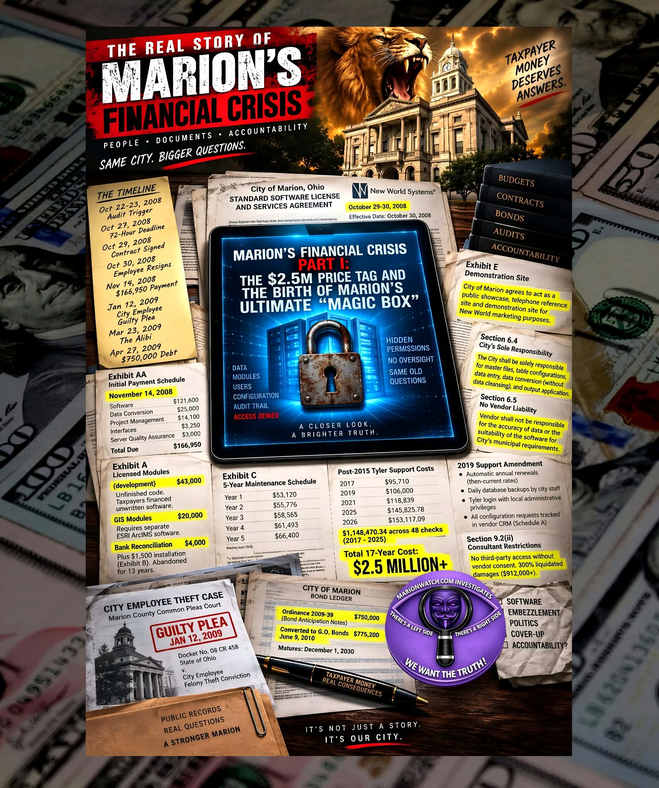
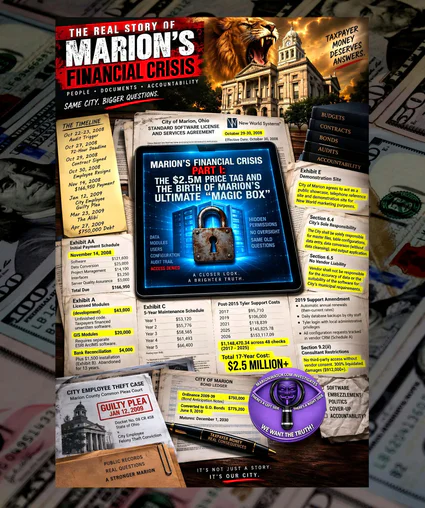
Between 2006 and early 2009, the City of Marion was trapped in a deepening fiscal crisis characterized by chronic revenue shortfalls and structural budget deficits.
Facing relentless economic pressure, the administration routinely drained municipal carryover reserves just to balance the annual operating budgets.
Marion also faced the growing addiction, overdose, and lack of treatment option crisis, and was one of the hardest hit nationwide.
During municipal sewer rate debates in March 2006, Councilman Dr. Gilsdorf warned that with $4.2 million in long-term debt backed by only $2 million in cash reserves, “technically the city is bankrupt”.
By January 2, 2007, an additional $856,752 was stripped from carryover, and council was explicitly warned that $2.5 million was urgently needed to cover unfunded long-term obligations.
By December 26, 2007, those recurring fiscal warnings escalated into alarming public statements.
Dr. Gilsdorf cautioned citizens that Marion had accumulated $4.5 million in unfunded sick and vacation leave liabilities against a meager $2 million in available cash, testifying on the public record: “It’s like a credit card… bond it out, over 20 years plus interest, your children and grandchildren for the money that’s going to paid out right now… Would you steal money from your children and grandchildren?”
When Mayor Scott Schertzer and Auditor Kelly Carr took office in January 2008, the administration acknowledged the instability by passing Ordinance 2008-1 as a temporary 90-day operating budget through March 31, 2008, admitting they needed time to locate the city’s true carryover funds.
By January 12, 2009, cash depletion became so acute that City Council was forced to freeze 2.6% wage increases for non-bargaining employees to stave off imminent layoffs.
Against this backdrop of acute austerity, committing nearly three-quarters of a million dollars to a new municipal computer system was fiercely contentious. To neutralize budget hawks, the former administration deployed a dual strategy: manufacturing an artificial “emergency” software transition timeline while orchestrating the disclosure of an internal embezzlement scandal to serve as an unassailable political alibi.
In enterprise information technology, surprise software expirations do not exist. Commercial ERP vendors publish end-of-life and support termination roadmaps years in advance to protect clients and ensure orderly transitions. Bypassing standard municipal procurement and technical governance, the administration chose to completely ignore the city’s Information Systems Committee—a structural “Ghost Committee” that had sat dormant without holding a single meeting for 19 years.
Instead, leadership orchestrated a tight, behind-the-scenes contract execution that collided down to the exact 24-hour window with the discovery of the Zoning and Engineering department theft:
- October 22 to 23, 2008 (Internal Audit Trigger): The Auditor’s office flags an irregular disbursement voucher in the Zoning and Engineering office. An internal review uncovers that a 41-year-old administrative assistant—a 22-year city veteran who began her career in Utility Billing—had been systematically pocketing excavation bond deposits and driveway/sidewalk permit fees throughout 2007 and 2008, hiding her tracks by substituting photocopied receipts for original cash entries.
- October 27, 2008 (The 72-Hour Pressure Deadline): New World Systems drafts the 24-page Standard Software License and Services Agreement, embedding an artificial 72-hour expiration clause demanding execution by October 30, 2008, to lock in a $28,000 eSuite discount and a 200-user site license.
- October 29, 2008 (Suspension and Initial Execution): Service Director Jay Shoup places the employee on administrative leave. On that exact same day, Auditor Kelly Carr and Mayor Scott Schertzer sign the $649,500 New World contract, formally certifying under their signatures that “all the necessary formalities have been met”.
- October 30, 2008 (Resignation and Counter-Execution): The department employee responsible for the theft and used to justify the New World purchase submits her resignation. On that exact same day, New World President Larry D. Leinweber countersigns the agreement, establishing October 30, 2008, as the official legal “Effective Date”.
- November 14, 2008 (The First Multi-Thousand-Dollar Bill): Just 15 days after contract execution, Exhibit AA requires Marion to wire $166,950.00 in upfront cash installments ($121,600 for software, $25,000 for data conversion, $14,100 for project management, $3,250 for interfaces, and $3,000 for server quality assurance)—months before City Council is ever briefed on the software or asked to authorize financing.
- January 12, 2009 (Guilty Plea and Continued Silence): The employee pleads guilty to felony theft in Marion Common Pleas Court. City Council remains entirely unnotified. That same night, Councilman Ratliff challenges the administration’s spending priorities, attacking the approval of a “$700,000.00 computer system for City Hall” while employees are denied cost-of-living adjustments.
- March 23, 2009 (Weaponizing the Theft): Five months after the internal audit, Safety Director Tom Robbins finally briefs City Council on the employee’s conviction. When Councilman Ratliff excoriates the administration for the five-month cover-up, Auditor Kelly Carr immediately seizes the moment to defend the New World contract, testifying on the public record that the office previously operated on “paper, pencil, and very little computer technology” and claiming the new software would eliminate “the human factor” by enforcing automated internal controls.
- April 27, 2009 (Pushing Through the Emergency Debt): Having successfully leveraged the specter of employee theft to disarm fiscal critics, the administration introduces Ordinance 2009-39. Over Councilman Ratliff’s sole dissenting vote, the measure is rammed through under emergency suspension, issuing $750,000 in bond anticipation notes to fund the acquisition. This short-term debt was subsequently rolled into $775,200 of 20-year unvoted General Obligation Bonds on June 9, 2010, permanently encumbering taxpayers through December 1, 2030.
READ MORE OF THE FULL AND OVERVIEW SILENT SABOTAGE SERIES:

FINANCIAL ANATOMY: THE TRUE COST OF THE 2008 AGREEMENT
A granular review of Exhibit AA, Exhibit A, and municipal bonding ledgers reveals the exact financial mechanisms used to obligate the city.
The project was launched with $750,000 in short-term notes under Ordinance 2009-39, which were later converted into $775,200 of 20-year General Obligation Bonds issued on June 9, 2010.
This left an immediate $100,500 financing surplus against the $649,500 upfront New World contract price, which vanished into unallocated capital accounts.
The upfront capital cost breakdown specified in Exhibit AA included $304,000 net for standard software licenses ($332,000 list price across 15 packages and 42 modules minus the $28,000 eSuite deadline discount), $197,600 for 1,520 implementation and training hours billed at $130 per hour, $50,000 for data file conversion assistance across 7 legacy databases, $47,000 for 18 months of project management, $38,400 for estimated travel expenses across 48 trips, $6,500 for interface installations (Bank Reconciliation and AMR), and $6,000 for server quality assurance.
The financial hemorrhage, however, did not stop at the capital acquisition.
Exhibit C established an introductory 5-year maintenance schedule starting at $53,120 in Year One and stepping up to $66,400 in Year Five.
But following Tyler Technologies’ merger with New World in November 2015, Auditor Kelly Carr signed a January 30, 2019 Support Amendment committing the city to uncapped annual renewals billed at Tyler’s “then-current rates”.
Because the administration rubber-stamped automatic 5% compounding annual rate increases year after year without auditing active module utility, support costs skyrocketed from $95,710 in 2017 to $106,000 in 2019, $118,839 in 2021, $145,825.78 in 2025, and $153,117.09 by 2026.
Documented vendor inquiries show Marion paid Tyler Technologies $1,148,470.34 across 48 separate checks and EFT disbursements between January 2017 and March 2025 alone, driving the total 17-year taxpayer expenditure for New World well past $2.5 million.
TEN RED FLAGS BURIED IN THE CONTRACT TEXT Legal and technical analysis of the New World agreement contract, and the 2019 Support Amendment exposes ten high-risk structural anomalies that financial watchdogs should never have permitted:
- Purchasing Unfinished “Development” Software (Definition 1 & Exhibit A): The contract explicitly licensed seven modules totaling $43,000 marked (development) because New World had not even finished programming them. Taxpayers financed unwritten code.
- The “Demonstration Site” Compromise (Exhibit E): Marion accepted a financial discount to act as a public showcase and telephone reference site for prospective New World customers, marketing software that leadership ultimately failed to configure.
- The 30-Day Automatic Installation Clock (Definition 9 & Exhibit C): Software was legally deemed “installed” 30 days after delivery regardless of server deployment, triggering the 90-day warranty and recurring maintenance billing automatically.
- Un-supported GIS Modules (Exhibit A, Endnote 5): The city paid $20,000 upfront plus annual maintenance for two GIS integration packages while Endnote 5 buried the requirement that third-party ESRI ArcIMS software had to be purchased and installed separately.
- Paying Twice for Bank Reconciliation (Exhibit A & Exhibit B, Section 3a): Marion paid $4,000 to license Bank Reconciliation in Exhibit A plus a $1,500 installation fee in Exhibit B, yet abandoned the module for 13 years while running manual spreadsheets.
- The “No Data Cleansing” Conversion Loophole (Exhibit F): Exhibit F barred New World from cleansing or editing legacy data, refused tables under 500 records, and terminated conversion warranty support after 30 days, guaranteeing that messy historical data would corrupt the database on day one.
- Violating Internal Access Restrictions (Section 6.0 & Section 9.2): Section 9.2(i) mandated restricting software access strictly to employees requiring it for operational processing, directly contradicting the unmanaged password sharing and unchecked “God Mode” access later uncovered.
- Consultant Gag Orders and 300% Liquidated Damages (Section 9.2(ii) & Exhibit D): The contract barred third-party consultants or auditors from accessing software files without New World’s written consent, attaching punitive liquidated damages of three times current license fees ($912,000+) for unauthorized inspection.
- Secret Michigan Arbitration and the One-Year Sue Limit (Sections 14.0 & 18.4): Disputes were forced into confidential arbitration after mandatory meetings in Troy, Michigan, while the city’s window to sue for software defects was slashed to one year (while New World retained two years to sue for non-payment).
- The 2019 Support Amendment Backdoor (Exhibit 1): Signed by Kelly Carr in January 2019, this amendment locked in automatic annual renewals, mandated daily database backups by city staff, and forced the city to grant Tyler Technologies a dedicated login with local administrative privileges.
THE VENDOR REALITY AND THE MIGRATION TRAP As the failure of New World becomes impossible to hide, officials have periodically floated software migration. However, municipal governance standards issue a severe warning: Do not migrate to a new platform without a comprehensive forensic IT audit.
The 2008 contract proves the vendor is not at fault for Marion’s collapse:
- 100% City Liability (Section 6.0 & Section 4.2): Section 6.4 places total responsibility on the city for master files, table configurations, data entry, and file control. Section 4.2 disclaims any warranty that features will suit municipal requirements.
- Configured by Client Instruction: State Auditor Belinda Miller confirmed on November 8, 2021, that the hybrid cash/accrual flaw was created in 2008 based entirely on internal personal preference and local office policy.
- Operating as Designed: Veritas managing director Greg Blate confirmed on January 22, 2024, that New World operated exactly as designed, warning council on July 24, 2023, against jumping to a new vendor before fixing internal workflows.
- Vendor CRM Audit Trails: Schedule A of the 2019 Support Amendment proves every configuration request is permanently recorded in Tyler Technologies’ CRM system with a unique incident number.
Exporting 17 years of corrupted ledgers, phantom utility revenue, and manual plugs into a new platform without a forensic audit is textbook Garbage In, Garbage Out.
CONCLUSION: COMPROMISED BY DESIGN
When you strip away the political spin, the manufactured software emergency, and the polished veneer of the 2008 contract documents, the hard evidence points to an inescapable conclusion: the City of Marion’s financial management software was compromised by design from the very day it was installed.
This was never a simple administrative oversight, nor was it a sudden technical glitch born in 2020. The structural absence of basic internal controls, the deliberate abandonment of automated safety modules, the active sheltering of super-user “God Mode” permissions, and the rubber-stamping of automatic rate hikes on empty shelfware reveal an enterprise environment engineered to operate without oversight.
A system that has been hollowed out from the inside cannot fix itself, and a digital vault intentionally left unlocked cannot produce trustworthy numbers. When a multi-million-dollar financial engine is built on unwritten code, shifting liabilities, and locked doors, accountability is the first casualty.
This is precisely why a comprehensive, independent forensic IT audit from installation forward is no longer optional—it is the absolute duty of anyone who claims to serve the public trust. The citizens of Marion did not just finance a software package; they bought a black box of institutional failure. Now, it is time to pry it open.