


 Written by

How Did Crawford County’s Political Circus Land on Marion’s Doorstep?
Why is Marion Watch again crossing Crawford County lines to look closer?
Because when a small-town municipal circus gets so toxic that its legal fallout overflows county lines, it becomes our business. Beyond the legal jurisdiction, this is personal. We have several members of our investigative network who hail from Bucyrus—some of whom have been known to the Marion Watch Core Team since childhood.
Bucyrus, Ohio, is a historically tight-knit statutory county seat currently struggling under demographic stagnation and a declining tax base. Yet, its local government has managed to produce enough theatrical drama, targeted lawfare, and operational scandals to rival a prime-time soap opera.
At the absolute center of this political storm is former Council President Kurt Fankhauser. Prosecuted after a series of high-stakes verbal altercations and political turf wars at public meetings, Fankhauser didn’t just fight Crawford County’s established legal machinery—he fought it pro se and won. In a stunning blow to the local establishment, Fankhauser successfully forced the total conflict-of-interest recusal of both the Bucyrus Law Director’s and the Crawford County Prosecutor’s offices.
Because of his pro se courtroom victory, attorneys from our own Marion, Ohio government have supposedly been appointed to step in, acting as the special prosecution on behalf of the State of Ohio in the criminal case against him. Yes, Marion County taxpayers: according to inside sources our legal clean-up crews have officially been drafted to play referee in our neighbor’s sandbox brawl. Although we cannot find confirmation of this yet, the specific sources are solid and have shown our investigative team a few documents that suggest this is factual. Sources have told Marion Watch that Fankhauser was criminally charged days after an alleged incident, which is the basis for the recusals.
But Fankhauser’s prosecution is merely the tip of a massive municipal iceberg. Marion Watch has uncovered a staggering web of administrative dysfunction, backroom real estate schemes, and runaway spending that has left Bucyrus citizens bruised, broke, and bewildered.
Consider the jaw-dropping $1.26 million automated garbage truck purchase. Shoved through on a highly controversial, narrow tie-breaking vote by Council President Kevin Myers, this massive loan binds local taxpayers to a million-dollar debt over the fierce, emotional objections of residents.
During the heated debates, mothers and fathers pleaded with council members about the physical safety of their tight-knit neighborhoods, warning that giant mechanical arms navigating narrow alleys and low-hanging utility lines could clip active power grids. One resident spoke through tears, warning that a sudden outage could kill his special-needs child, who relies on continuous electrical service for life-saving medical equipment. Council’s response? A tie-breaker vote and a lecture on long-term labor attrition.
And then there is the backdoor YMCA roller skating rink deal. While citizens were publicly assured that the city was merely “considering” the real estate purchase, investigative records show that Mayor Bruce Truka had already signed a binding purchase agreement weeks in advance, completely bypassing the legislative body. The legal review of that highly irregular contract? Put on ice because the city’s then-Law Director was booked on an OVI charge just forty-eight hours before the committee met to authorize the deal.
The administrative rot doesn’t stop there. We have tracked everything from the dramatic shutdown of a “donated” public park surveillance system—amid fears that a private citizen was accessing the cameras to spy on political rivals and local bar patrons—to an administrative collapse so severe that a double clerk resignation left up to 100 committee meetings completely unrecorded.
It got so bad that Police Chief Jon Dorsey had to threaten the entire chamber—elected officials and spectators alike—with physical arrest under Ohio Revised Code § 2917.12 (Disturbing a Lawful Meeting) just to keep the peace.
Crawford County politicians want to keep this mess quiet, but with the Marion legal system officially holding the clipboard on their prosecution, Marion Watch is turning on the high-beams. Welcome to Bucyrus, Ohio: where the meetings require a police guard, the clerks run for the hills, and Marion is stuck cleaning up the mess.
Let’s look closer at the last two years of Bucyrus history, and learn about this charming town with a lot of similarities to Marion—which Marion Watch Investigates has been involved in—and Galion, which we first began covering back in January 2026.
Get ready, Bucyrus. Marion Watch consists of seasoned investigators with the technology, skills, and historical understanding to lay it all bare.
Municipal Foundations and the Wastewater Infrastructure Milestone
The administrative trajectory of Bucyrus, Ohio, during the 2024–2026 period is anchored in routine legislative actions that gradually gave way to systemic institutional paralysis and public controversies.
This progression is illustrated by a key 2024 city council session that focused on Resolution 21-2024, an emergency measure amending and supplementing Resolution 223-2023.
This resolution authorized the mayor and the public service-safety director to contract with Arcadis US Inc. for preconstruction tasks related to the renovation of the municipal wastewater treatment plant, with expenditures capped at $58,500. While this session reflected the typical operational focus expected of a county seat, it also marked the baseline from which the city’s governance apparatus would deteriorate over the next two years.
To understand how such standard municipal functions became entangled in severe gridlock and multi-layered scandals, one must examine the deep-seated historical and socioeconomic background of Bucyrus.
Historically, the administrative structure of Bucyrus is rooted in the early settlement of northern Ohio. The political division of Crawford County dates back to February 20, 1820, when the Maumee Valley was opened to settlement and subsequently divided into counties for judicial and governmental purposes.
Named in honor of Colonel William Crawford, a soldier who died in 1782, the county seat was officially established at Bucyrus in 1830. The earliest judicial operations in the county commenced in July 1826 at the home of Lewis Cary, located on the south bank of the Sandusky River, under the leadership of Judge Ebenezer Lane. Over nearly two centuries, the city developed into a statutory municipality managed by an elected mayor and a legislative city council, serving a stable population that reached 11,684 in the 2020 census.
Socioeconomic Baseline and Demographic Stagnation
In the modern era, Bucyrus operates under significant socioeconomic and demographic constraints that influence its legislative priorities and municipal capacity. The city has experienced gradual population contraction, estimated at a rate of 0.33% annually, bringing the population down to approximately 11,593 by 2026.
This stagnation is accompanied by an aging populace and median household income levels that fall below both state and national benchmarks, leaving the local tax base vulnerable to economic shifts.
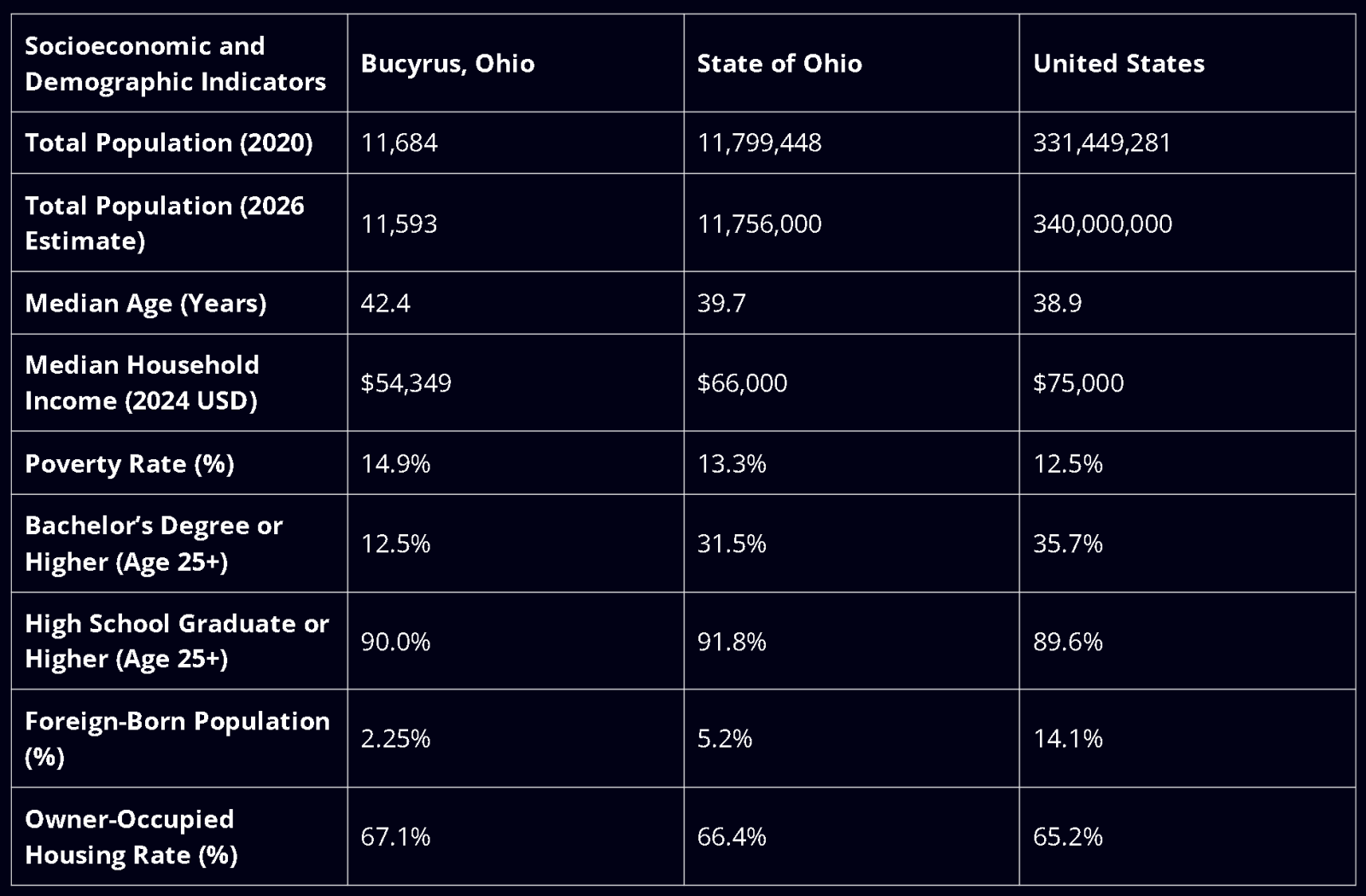
The economic landscape of Bucyrus is shaped by a high percentage of residents who completed high school (90.0%) but a low percentage who attained a bachelor’s degree or higher (12.5%), which is roughly one-third of the national average. The local population is predominantly white (94.33%), with minor representations of multiracial (2.31%), Asian (1.81%), and Black or African American (1.47%) communities. Additionally, the municipality has a notable veteran population, with 842 civilian veterans. This group includes a large cohort of Vietnam-era servicemen, representing a population density 1.6 times greater than any other conflict.
The geographic mobility of the city is low, with 85.3% of residents living in the same house year-over-year. These figures paint a picture of a tight-knit community that is economically dependent on local manufacturing and municipal services, making it highly sensitive to political instability and fiscal battles within its local government.
Electoral Shifts and the Restructuring of Council Power
The legislative branch underwent a significant transition between 2024 and 2026.
This transition was marked by competitive primary and general elections in 2025 that reshaped the composition of the council. The administrative friction of the previous term was a major focus of these campaigns, leading to an almost complete turnover in key council leadership roles.
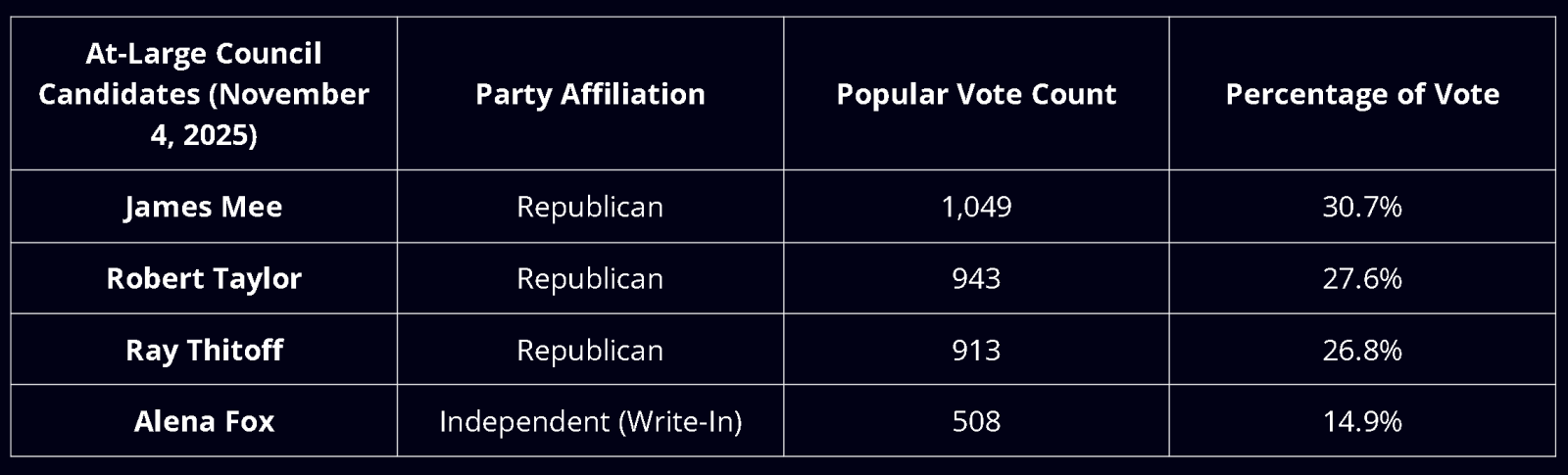
The general election results led to the swearing-in of a restructured city council on December 22, 2025, which officially took office on January 1, 2026. State Representative Riordan McClain administered the oaths of office, establishing a new administrative lineup intended to reset municipal operations.

This transition was designed to move the city past the governance bottlenecks of the 2024–2025 term, during which Council President Kurt Fankhauser frequently clashed with executive administrative departments and other members of council.
The incoming leadership, headed by Council President Kevin Myers, immediately faced the challenge of resolving a large administrative backlog and restoring order to public meetings.
The $1.26 Million Automated Garbage Truck Purchase Controversy (June 2026)
One of the most explosive operational and fiscal scandals of the current administration came to a head in mid-2026 over a massive capital expenditure for waste management. On June 16, 2026, the Bucyrus City Council approved Resolution 229-2026, authorizing the Safety Service Director to contract with Lease Servicing Center / NCL Government Capital to purchase two McNeilus ZR automated side-load garbage trucks and standard roll-out carts for an amount not to exceed $1,264,667.44.
Tie-Breaking Vote and Legislative Divisions
The purchase generated division within the council, culminating in a 3-3 tie on the roll-call vote. At-large Councilman James Mee, 1st Ward Councilman Chris Mauritz, and 3rd Ward Councilman Terry Spiegel voted in favor of the emergency acquisition. Opposition was led by Allison LeClair, Cody Scott, and Ray Thitoff, who voted against the measure. Under council rules, the tie-breaking vote was cast by Council President Kevin Myers, allowing the measure to pass. (Though some meeting portals mistakenly reported that a “Mayor Croghan” cast the deciding vote, local journalistic records confirm that Council President Myers broke the tie to push the million-dollar expenditure through).
Public Backlash and Safety Concerns
Bucyrus residents reacted with anger during the meeting’s public participation portion, accusing the administration of keeping them in the dark about the details of the purchase. Longtime transparency advocate Greg White submitted a formal written complaint regarding the lack of public notice and clarity.
Citizens raised physical safety concerns regarding the giant automated side-load trucks navigating the city’s narrow alleys, commercial routes, and low-hanging utility lines.
One resident spoke emotionally about the potential danger of the automated mechanical arms striking power lines, explaining that his special-needs child relied on continuous, regulated electrical service for medical equipment.
Labor Reductions and the “Geriatric” Fleet
To justify the $1.26 million loan, the administration and City Auditor Kali Lewis distributed financial projections to the council. The spreadsheets compared the current three-person manual collection crew against an automated one-operator-per-truck system.
While Lewis insisted the city was not planning immediate layoffs, the long-term survival of the Solid Waste Fund relied on eliminating positions through attrition, retirement, and reassignments, projecting a $26,000 annual contractual service savings. Lewis warned that if the city did not modernize, maintaining its “geriatric (older) vehicles” and high labor costs would drive the Solid Waste Fund into a permanent deficit by 2035, forcing aggressive utility rate increases.
This controversy was preceded by a separate scandal in the Service Committee, where Chairman Chris Mauritz and Safety Service Director Tommy Starner proposed a blanket $3.00 solid waste rate hike across the board for all water customers, citing escalating landfill costs.
However, local inquiries revealed that the Crawford County Sanitary Landfill had only raised fees by $2.00 per ton on out-of-county material, while in-county disposal fees remained completely unchanged. Resident Bill Stuckert vocally attacked the proposal at the podium, accusing the council of trying to “bail out” bad math on the backs of seniors and disabled citizens on fixed incomes.
The YMCA Skating Rink Transaction as an Administrative Flashpoint
Before the 2025 elections, the relationship between the legislative and executive branches reached a critical breaking point over real estate transactions. The key dispute involved the potential purchase of the former YMCA roller skating rink property next to the fire station on East Mansfield Street. This acquisition was presented to the public as a strategic opportunity to expand municipal facilities, but the transaction was quickly overshadowed by questions about the legality and transparency of the process.
During public participation sessions, residents—including Angela Fishpaw and future council candidate Ray Thitoff—accused Council President Fankhauser and the city administration of misleading the community. An investigation by local media revealed that the purchase agreement had been signed on July 24, 2024, bearing only the signatures of Mayor Bruce Truka and the seller. This signed document was executed weeks before the Public Lands and Buildings Committee met on August 12, 2024, to discuss the acquisition.
During that committee session, members Zyan Hickman and Aaron Sharrock voted to draft legislative authorization for the purchase, but both appeared surprised to learn that a binding agreement had already been signed.
The controversy was deepened by significant irregularities in the purchase contract, which included uninitialed alterations to the transaction’s closing date, raising concerns about the document’s legal validity.
Complicating matters further, Law Director Brian Gernert was arrested on August 10, 2024—just two days before the committee meeting—on suspicion of Operating a Vehicle Impaired (OVI).
His arrest rendered him unable to fulfill his duties, leaving the city legal department temporarily incapacitated and unable to review the contract or guide council through the real estate transaction.
The Legislative Clerk Crisis and Administrative Backlog
The administrative friction between legislative leaders and executive staff culminated in a complete collapse of the council’s recording apparatus. This operational failure resulted from the resignations of Council Clerk Miranda Wise and Clerk Pro-Tem Vicki Dishon.
The vacancies left the council unable to perform basic statutory duties, leading to a massive administrative backlog.

Under Ohio’s Open Meetings Act and public records laws, municipal legislative bodies are strictly required to produce and approve meeting minutes in a timely fashion. The loss of both the clerk and the clerk pro-tem paralyzed this process.
By December 2025, Fankhauser warned that nearly 100 committee meetings and several regular council sessions lacked completed or approved minutes. Some records had been backlogged for a full year, exposing the city to significant legal vulnerability and public records lawsuits.
This lack of clerical support had a direct impact on legislative progress. Key ordinances and resolutions—including a major expansion project by Avita Health System and funding for the municipal swimming pool—stalled on the legislative calendar. This gridlock occurred because council members Aaron Sharrock, Clarissa Slater, and Vicki Dishon demanded extensive edits to pending documents, but there was no clerk available to process the revisions.
Fankhauser had warned the administration as early as 2021 that the Clerk’s office required additional part-time support, but no action was taken. When the office collapsed in 2025, Fankhauser refused to assume clerical duties himself, arguing that Ohio law did not require the Council President to act as clerk during a vacancy, which further stalled the city’s legislative process.
Fankhauser’s Legal Battles and Administrative Controversies
The systemic breakdown of the city’s legislative body between 2024 and 2026 is heavily tied to the personal, political, and criminal legal proceedings surrounding former Council President Kurt Fankhauser.
The Criminal Altercation Case and Special Marion Prosecution?
The personal feuds between Fankhauser and other city officials reached their peak when Fankhauser was criminally charged following a physical and verbal altercation at a municipal meeting. However, he was not immediately charged. Acording to citizen network sources familiar with Bucyrus, Fankhauser was not charged immediately, but days later leaving many residents to term the criminal charges as “lawfare”.
During his prosecution, Fankhauser chose to represent himself pro se. Exercising his procedural rights, he successfully filed a motion to recuse the entire Bucyrus Law Director’s and Crawford County Prosecutor’s offices due to conflicts of interest and personal bias stemming from his public disputes with Law Director Brandon Gobrecht.
Fankhauser won the motion, resulting in the appointment of independent attorneys reportedly from the Marion, Ohio governmental offices to step in and act as the special prosecuting authority on behalf of the State of Ohio in the case against him.
Civil Defamation Case (Case No. 25CV0183)
On July 22, 2025, Fankhauser filed a pro se civil lawsuit in the Crawford County Court of Common Pleas against the City of Bucyrus, Law Director Gobrecht, Councilwoman Clarissa Slater, Auditor Kali Lewis, and Deputy Auditor Kim Felkey.
The lawsuit arose from a payroll dispute over Miranda Wise’s unapproved personal leave timesheet. Fankhauser sought an injunction to block the payout, arguing it violated city policy.
He also demanded $75,000 in defamation damages from both Gobrecht and Slater individually.
The lawsuit cited a July 18, 2025, press release issued by Slater accusing Fankhauser of creating a hostile, retaliatory environment where he allegedly yelled at Wise, slammed a chair, and stormed out of City Hall.
Municipal security footage obtained by local media showed a routine exchange in the clerk’s office where the “slammed chair” was actually Mayor Truka accidentally tipping a chair while repositioning it.
Slater accepted accountability for misinterpreting the video but maintained that the toxic environment was real. Due to the close relationships between the parties, Crawford County Common Pleas Judge Sean Leuthold recused himself from the civil case, and the Ohio Supreme Court reassigned it to retired Morrow County Judge Howard E. Hall.
The Voter Registration Residency Challenge
In June 2025, Fankhauser filed a formal challenge with the Crawford County Board of Elections, arguing that Gobrecht should be removed from the city’s voting rolls.
Fankhauser alleged Gobrecht did not live at his registered address on East Southern Avenue in Bucyrus, but resided with Slater at a home on State Route 4, outside municipal boundaries.
Fankhauser extracted internal water department records showing Gobrecht had shut off his water service on East Southern Avenue as proof of non-residency. Gobrecht and Slater’s father, Randy Scheffler, testified that the water shutoff was a routine precaution during home renovations. The Board dismissed the challenge, and Gobrecht characterized Fankhauser’s filing as “dirty politics.”
Fankhauser himself was simultaneously targeted by residency challenges.
Citizens Angie Rayborn and Gary Miller filed complaints alleging Fankhauser improperly used a dilapidated, uninhabitable property at 616 Prospect Street to meet candidacy requirements while living on Michigan Avenue.
To avoid a contentious hearing, Fankhauser changed his address to Michigan Avenue and resigned from the Republican Central Committee (RCC) in January 2025, rendering the residency challenge moot.
Body-Worn Camera Public Records Overcharging Case (2026-Ohio-2340)
On January 9, 2026, Fankhauser submitted a public records request to the Bucyrus Police Department for the case file, reports, and bodycam footage of Carolyn Shireman’s October 2024 telephone harassment incident.
The Police Department invoiced Fankhauser $701.21 for the footage, which Fankhauser paid under protest before filing a lawsuit in the Court of Claims of Ohio (Case No. 2026-00110PQ).
On appeal, the Court of Claims found that the Police Department violated the Public Records Act, ruling that local law enforcement may charge for footage but cannot exceed statutory limits. The court ordered the police department to reimburse Fankhauser’s filing fees and bear the cost of the litigation.
Decorum Collapse, Criminality, and Law Enforcement Intervention
As the administrative and legal battles intensified, the breakdown of order began to affect the safety and decorum of council meetings.
The Shireman-Slater Feud and Criminal Conviction
The friction within the council was further highlighted by a long-running dispute between Councilwoman Carolyn Shireman and Clarissa Slater.
In 2024, Shireman filed a civil protection order against Slater, accusing her of online harassment and linking her to a break-in at her home. Slater countered that Shireman had used her official position to contact Slater’s university and employer to make false and retaliatory accusations.
The council ultimately voted against Shireman’s request to attend via Zoom, and she was removed from the council’s rules committee.
This political dispute was soon followed by a major legal crisis.
Shireman was indicted on a second-degree felony theft charge for misusing the personal funds of a developmentally disabled individual for whom she served as a caretaker.
Shireman was subsequently convicted and sentenced to 18 months in prison. In June 2026, the Crawford County Common Pleas Court denied her petition for early judicial release, with the judge rejecting her complaints about prison food and emphasizing that she needed to complete her sentence.
The Resignation of Councilman Robert Taylor
The combative environment within the Bucyrus government eventually began to drive out other elected officials.
On June 2, 2026, At-Large Councilman Robert Taylor abruptly resigned during a council meeting. Taylor stepped down from his seat to address the chamber as a private citizen, stating that his resignation was due to the emotional toll of threats from local bloggers targeting his family. He specifically called out online commentators who presented themselves as news outlets while engaging in persistent character attacks.
Law Enforcement Intervention in Council Chambers
By October 2025, the breakdown of order during public meetings led to direct police intervention. Police Chief Jon Dorsey issued a formal warning, announcing that he or a designated officer would attend all future council and committee meetings to maintain order. Dorsey cited Ohio Revised Code § 2917.12 (Disturbing a Lawful Meeting) and warned that anyone engaging in disruptive outbursts or continuous interruptions would be arrested and charged with a fourth-degree misdemeanor.
Dorsey expressed frustration that his short-staffed department had to divert officers from active road patrols to police “sophomoric behavior” at city hall.
The Invocation and Religious Disputes
The ideological division of the council was put on display during high-conflict debates surrounding the inclusion of a Christian invocation.
Fankhauser consistently led Christian prayers heavily laden with biblical references.
Councilwoman Aaron Sharrock protested, stating that using a governmental seat to push personal religious beliefs was unacceptable.
The friction peaked during a meeting when Councilwoman Vicki Dishon expressed her disgust at Fankhauser leading the prayer, telling him, “The invocation is fine… but not from you! I feel like I’m listening to the devil!” Fankhauser responded by placing a physical figurine of Jesus on the table before him, which Dishon laughed off as “laughable, it’s unreal.” The council subsequently voted 4-2 to remove the invocation from the meeting agenda, prompting Fankhauser to declare that the council had “removed God from the meeting.”
Economic Resilience and Technological Modernization
Despite the ongoing administrative and legal conflicts, the city of Bucyrus managed to secure several economic and technological improvements during the 2025–2026 period.
Technological Modernization
In his January 2026 State of the City address, Mayor Truka outlined a major upgrade to the city’s technological infrastructure.
Effective January 1, 2026, all municipal departments transitioned to a secure, unified network provided by Spectrum, with standardized cybersecurity and data backup protocols managed by IT partner KOSI.
This transition successfully replaced the city’s previous network agreement with Wavelinc, Fankhauser’s internet service provider. The mayor thanked Fankhauser for his cooperation during the transition, which saved the city over $30,000 in implementation costs.
To improve administrative efficiency, the City Auditor’s office worked with the Income Tax Department to implement Mits software, enabling residents to file their municipal taxes online. Additionally, the administration re-launched the Bucyrus Access Channel as a primary hub for streaming public programming and broadcasting official city updates.
Capital Projects and Industrial Growth
Several key capital projects and economic developments advanced during this period:
- The General Obligation Bond: On April 16, 2025, the city closed a $1,050,000 general obligation bond, depositing the funds into its depository account to secure the city’s long-term financing.
- State Capital Budget Funding: The municipality secured significant funding through the state capital budget, including $500,000 for the Maple Crest Community Center, $432,000 for the Bucyrus Aumiller Recreation Trail, and $200,000 for Bicentennial Park, along with an extension on a previous $175,000 allocation.
- South Sandusky Sewer Separation Project: In July 2026, the Ohio EPA issued a Limited Environmental Review approving a $3.5 million WPCLF loan (out of a total $5 million project cost) to separate storm and sanitary sewers along Sandusky Avenue and East Kilbourne Drive, reducing CSOs and saving the city over $964,000 in market-rate interest.
- Industrial Expansion: Automotive supplier IB Tech announced a major facility expansion projected to create 170 new manufacturing jobs, balancing out the sudden closure of Diamond Wipes in 2025. Advanced Fiber Technology also announced a substantial $5.5 million capital expansion.
On March 31, 2025, the City of Bucyrus received the Certificate of Achievement for Excellence in Financial Reporting from the Government Finance Officers Association for its annual comprehensive financial report. This award, overseen by Auditor Kali Lewis, highlighted the work of the city’s professional finance staff, who maintained high standards of fiscal transparency and accounting accuracy even as the legislative body was dealing with personal lawsuits, criminal trials, and clerical gridlock.
Analytical Synthesis and Structural Implications
The municipal history of Bucyrus from 2024 to 2026 highlights the unique vulnerabilities of micro-municipal governance in statutory frameworks.
In cities of this scale, where the boundaries between public service, private business, and personal relationships are often blurred, minor administrative disputes can easily escalate into systemic gridlock.
The structural weakness of this system was clearly illustrated when a disagreement over a single clerk’s final timesheet escalated into a pro se lawsuit that named almost the entire executive administration. This dispute delayed key legislative decisions, including an expansion project by Avita Health System and funding for the municipal swimming pool, showing how easily personal friction can disrupt broader community projects.
Furthermore, the co-opting of municipal data—such as using water department utility logs to file voter residency challenges—demonstrates how administrative tools can be repurposed for political conflict.
This tactical approach to local politics, combined with aggressive commentary from local bloggers, has significantly increased the personal cost of public service. This environment has driven out more moderate officials, leaving local government increasingly dominated by highly polarized figures.
The experience of Bucyrus during this period shows that while professional staff can continue to manage day-to-day services, complete sewer projects, and secure capital funding, the legislative body remains highly vulnerable to personality-driven conflict.
To build long-term stability, the city must work to professionalize its administrative processes, provide permanent support for the Council Clerk’s office, and adopt clear standards for public meeting decorum.
Securing these administrative functions is essential to ensure that personal conflicts do not disrupt the delivery of public services or undermine the community’s trust in its local government.
WORKS CITED (CLICK HERE)
- Wikipedia: Bucyrus, Ohio / Last updated 2026 / Provides basic history, geographic data, and statutory governmental structure of the city of Bucyrus, Crawford County.
- World Population Review: Bucyrus, Ohio Demographic Profile / 2026 Estimate / Contains demographic data, population contraction rates (-0.33%), median household income ($54,349), and racial composition details.
- Bucyrus Historical Society: Bucyrus Area History / Historical archive / Traces the history of Crawford County’s organization (1820), Colonel William Crawford, and the establishment of Lewis Cary’s home court in 1826.
- U.S. Census Bureau: Bucyrus City, Ohio QuickFacts / July 2025 Estimates / Source for baseline population, homeownership rates (67.1%), geographic stability (85.3%), and educational attainment.
- Census Reporter: Profile Profile for Bucyrus, OH / ACS 2024 5-year estimate / Compares local demographic figures (e.g., median age of 42.4 years) against Ohio’s median age (39.7 years) and lists wartime service vectors for veterans.
- Data USA: Socioeconomic Profile of Bucyrus, Ohio / ACS 2024 data / Documents veteran populations, healthcare coverage rates, and the density of local Vietnam-era military servicemen.
- Crawford County Now: “Bucyrus City Councilman Robert Taylor resigns, citing community challenges…” / June 2, 2026 / Chronicles the sudden resignation of At-Large Councilman Robert Taylor due to personal harassment and threats from local bloggers.
- Crawford County Now: “Bucyrus Police Chief issues warnings to council and visitors…” / October 15, 2025 / Outlines Police Chief Jon Dorsey’s warnings to enforce Ohio Revised Code § 2917.12 to restore decorum in council chambers.
- Crawford County Now: “Council President seeks injunction and damages against two colleagues” / July 30, 2025 / Details the $75,000 slander and defamation lawsuit filed by Kurt Fankhauser against Brandon Gobrecht and Clarissa Slater over Miranda Wise’s timesheet.
- Crawford County Now: “Council President raises alarm over nearly 100 outstanding committee meeting minutes” / December 9, 2025 / Details the massive clerical backlog and potential Open Meetings Act vulnerabilities caused by the vacancy of the Council Clerk.
- Civic IQ: Bucyrus City Auditor online tax reporting contract / 2026 / Outlines the implementation of Mits software in the Income Tax Department to allow online tax filings.
- Ballotpedia: Alena T. Fox (Bucyrus City Council At-large, Ohio, candidate 2025) / November 4, 2025 / Outlines the exact vote counts and results from the November 2025 at-large general election.
- Crawford County Board of Elections: 2025 Elected Officials Directory / April 28, 2025 / Provides statutory commencement dates, address information, and party designations for active city officials.
- Crawford County Now: “State Representative Riordan McClain swears in new Bucyrus City Council and officials” / December 23, 2025 / Details the swearing-in ceremony and names of the newly elected city council members taking office on January 1, 2026.
- Crawford County Now: “Bucyrus Mayor outlines 2026 vision: new tech infrastructure…” / January 19, 2026 / Mayor Bruce Truka’s State of the City address detailing the IT Spectrum/KOSI transition, Wavelinc termination, and industrial expansions.
- Richland Source: Advanced Fiber Technology announces $5.5M expansion / 2025 / Details capital projects and industrial growth in Crawford County.
- Crawford County Now: “Mayor Truka issues statement regarding Council behavior” / July 30, 2025 / Focuses on escalating council tensions and committee assignments.
- Crawford County Now: “Controversy surrounds Bucyrus City’s skating rink purchase…” / August 2024 / Outlines the East Mansfield Street transaction and the municipal legal paralysis following the arrest of Law Director Gernert.
- Crawford County Board of Elections: Gobrecht Voter Residency Challenge Determination / June 16, 2025 / Official record of the public hearing and dismissal of Kurt Fankhauser’s residency challenge against Law Director Brandon Gobrecht.
- Court of Common Pleas of Crawford County: Complaint Case No. 25CV0183 (Fankhauser v. City of Bucyrus et al.) / July 22, 2025 / Verified pro se filing details regarding the payroll timesheet injunction request and personal defamation claims.
- YouTube: Bucyrus City Council Meeting (Resolution 21-2024 Preconstruction Contract) / 2024 / Video record of the council session discussing the wastewater treatment preconstruction contract with Arcadis US Inc.
- YouTube: Crawford Partnership Annual Economic Address / 2024 / Outlines state capital budget projects, including Maple Crest Community Center and Bicentennial Park funding.
- YouTube: Bucyrus City Council Meeting (April/May 2025 Bond Closure) / 2025 / Record of the city auditor confirming the closure of the $1,050,000 general obligation bond.
- Crawford County Now: “From the Desk of Councilwoman Clarissa Slater…” / July 18, 2025 / Clarissa Slater’s press release on Miranda Wise’s timesheet, Fankhauser’s conduct, and gender-based discrimination concerns.
- FreeWire Magazine: “Hostile Work Environment Confirmed by City Officials…” / July 2025 / Elaborates on Slater’s response to Fankhauser’s civil case and the chair-slamming incident details.
- Crawford County Now: “Bucyrus City Council faces legislative uncertainty…” / July 17, 2025 / Documents the legislative gridlock and delays resulting from the abrupt resignations of Council Clerk Miranda Wise and Pro-Tem Vicki Dishon.
- The Advocate / Muck Rack: “Carolyn Shireman denied early release from prison” / June 26, 2026 / Covers Carolyn Shireman’s caretakers theft felony sentence of 18 months and the denial of her judicial early release request.
- FreeWire Magazine: “Gobrecht’s Remarks Spark Criticism Amid Shireman Allegations…” / January 2025 / Focuses on Carolyn Shireman’s indictment and the removal of park cameras.
- Court of Claims of Ohio: Case No. 2026-00110PQ (Fankhauser v. Bucyrus Police Dept.) / 2026-Ohio-2340 / June 2026 / Official ruling and recommendation finding the police department violated the Public Records Act by overcharging Fankhauser $701.21 for bodycam footage of Carolyn Shireman’s harassment case.
- Crawford County Now: “Council President seeks injunction and damages…” / July 30, 2025 / Outlines the re-assignment of Case No. 25CV0183 by the Supreme Court to retired Morrow County Judge Howard E. Hall.
- Crawford County Now: “Bucyrus City Councilwoman calls for formal censure of Council President” / September 19, 2025 / Clarifies C. Aaron Sharrock’s push to censure Kurt Fankhauser for personal attacks and religious disputes.
- Crawford County Now: “Bucyrus Council approves purchase of automated garbage trucks…” / June 18, 2026 / Details the controversial 3-3 tie-breaking vote to approve Resolution 229-2026 for the $1.26 million automated garbage truck purchase.
- Citizen Portal AI: “Bucyrus council approves $1.26 million purchase of two automated trash trucks…” / June 15, 2026 / Summarizes the contract details with McNeilus ZR / Lease Servicing Center and Greg White’s written complaints.
- Crawford County Now: “Auditor clarifies mission of Garbage Truck purchases… staff reductions…” / June 2026 / Evaluates Auditor Kali Lewis’s projections regarding long-term Solid Waste Fund labor cost savings and vehicle replacement issues.
- Crawford County Now: “Prayer and tribute: Bucyrus City Council debates agenda items…” / September 21, 2025 / Highlights the volatile invocation removal debate, the Jesus figurine incident, and Vicki Dishon’s “devil” comments.
- Ohio Environmental Protection Agency: South Sandusky Sewer Separation Limited Environmental Review / July 6, 2026 / Documents the approval of the $3.5 million WPCLF below-market interest rate loan for municipal sewer separation along Sandusky Avenue and East Kilbourne Drive.
- FreeWire Magazine: “Council President Kurt Fankhauser Changes Address and Resigns…” / January 21, 2025 / Details Fankhauser’s residency challenges (616 Prospect Street) and his subsequent resignation from the Republican Central Committee.