 Written by
Recent developments in Galion’s municipal water and wastewater management have brought sudden personnel changes, multi-million dollar infrastructure bonds, and a troubling push away from public discourse.
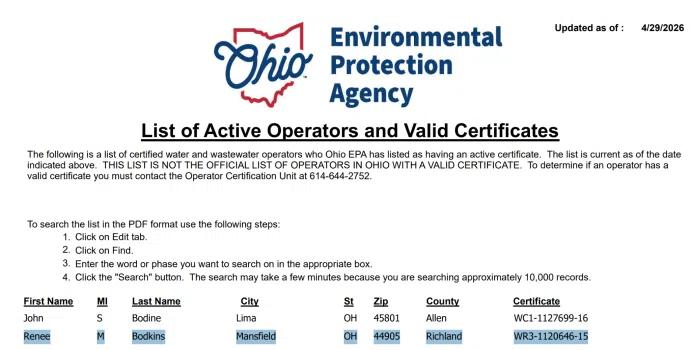
During the most recent Galion City Council meeting on May 12, 2026, officials announced the hiring of Renee Bodkins as the new Wastewater Treatment Plant Superintendent. The administration also noted they are in the second round of interviews and hope to pull an Assistant Superintendent from the same applicant pool.
While filling essential municipal utility roles is standard procedure, the administrative posturing surrounding these updates raises immediate transparency concerns.
During the meeting, Mayor Brian Satterfield explicitly directed the council to route their questions privately to him or Safety Service Director Nikki Ward.
“I guess the last thing I’m going to say is if you have a question ask me or ask Nikki. That’s all I’m going to say about that,” the Mayor stated from the dais, acknowledging that there was a “lot of stuff floating around out there” and that “there’s always two sides to a story”. He then abruptly shut down any potential public inquiry on the matter: “Nope, not today. Call me and talk to me, I will. It’s getting extremely frustrating to be in my office right now”.
The Problem with “Call Me” Governance
When a public official acknowledges that critical municipal information is circulating, claims there is another side to the story, and then immediately suffocates public discussion, it is highly suspicious.
In municipal oversight, a primary tactic used to avoid accountability is shifting conversations from the public square—where there are transcripts, meeting minutes, and a verifiable paper trail—into unrecorded, closed-door phone calls. True accountability requires providing receipts and primary sources for every claim. By directing council members to “call me and talk to me,” the administration is effectively isolating inquiries and preventing the public from hearing the questions being asked or the justifications being offered.
This defensive posture becomes even more concerning given the context of what the city is currently navigating. During that same May 12 meeting, the Mayor confirmed the EPA had been on-site that very day conducting a tour of the water treatment plant, reservoirs, and pump houses in relation to highly publicized notices of violation. While the Mayor claimed the EPA found “no smoking gun” and was pleased with the city’s progress, keeping the details of that progress off the public record prevents citizens from verifying those claims.
Working Backwards: The $3.7 Million Mandate (April 28, 2026)
The tension at the May 12 meeting directly follows massive financial moves made just two weeks prior. On April 28, 2026, the Galion City Council authorized roughly $3.7 million in bond anticipation notes specifically to address EPA mandates and failing infrastructure.
The financial legislation passed included:
- $1.14 million (Refinancing/Rollover): A renewal of existing notes for the sewer treatment plant. This covers projects completed three or four years ago—specifically the acquisition of screw pump equipment and the construction of a lift station along State Route 61—rather than funding new, current issues..
- $1.2 million for the water treatment plant, targeting clear well tank mixing, aeration, ventilation, control panels, sluice gates, and sediment removal.
- $1.4 million to demolish and replace the existing structures, raw water pumps, and deteriorated electrical components at the Amann reservoir.
City officials noted during the April 28 meeting that these multi-million dollar investments are not optional; they are required mandates to stay on schedule with EPA findings.
A Regional Pattern of Water Infrastructure Strain
The infrastructure degradation and the subsequent battles over public transparency in Galion are not isolated incidents. They represent a broader, regional failure in municipal utility governance that requires vigilant oversight.
Similar battles for clear communication, verifiable testing procedures, and infrastructure accountability have been extensively documented on MarionWatch.com in partnership with Galion City Watch. Recent coverage of regional water and wastewater issues—including the scrutiny surrounding figures like Patrick Hickman and the ongoing analysis of utility management practices—demonstrates a consistent pattern. When local governments face mounting environmental mandates and failing systems, the initial administrative reflex is often to restrict the flow of information.
Public infrastructure requires public scrutiny. When millions of taxpayer dollars are deployed to fix EPA violations, “call me” is never an acceptable substitute for on-the-record answers.