 Written by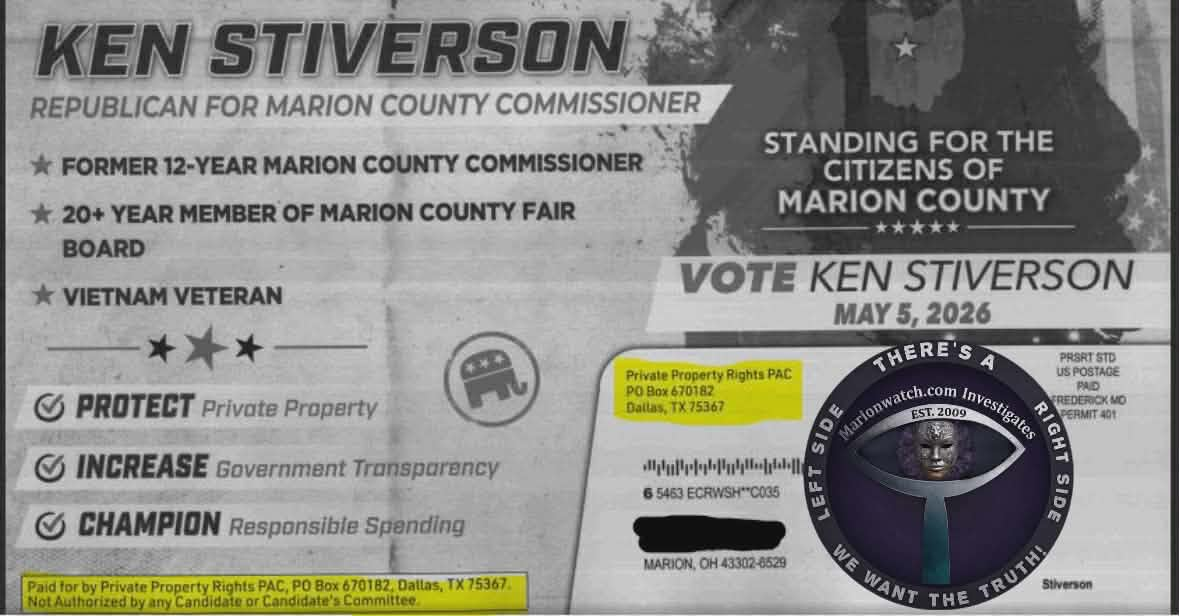
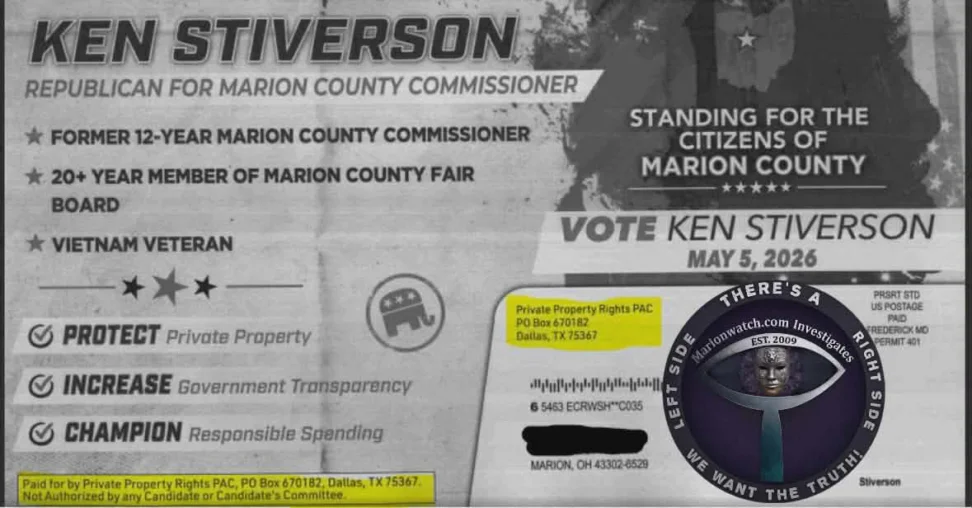
With the May 5th primary just days away, a flood of high-production mailers has landed in the mailboxes of Marion County voters, urging them to elect Ken Stiverson for County Commissioner. But the most important detail on the mailer isn’t the candidate’s name. It is the tiny yellow disclaimer at the bottom: Paid for by Private Property Rights PAC, Dallas, TX.
Why is a political action committee with a Dallas, Texas P.O. Box dropping cash into a municipal race in north-central Ohio? When out-of-state money suddenly floods a local county zoning authority, it almost always points to a massive corporate footprint expecting a return on its investment.
The Mercenary Bookkeeper and The “Dark Money” Machine
A dive into the Federal Election Commission (FEC) database reveals that the “Private Property Rights PAC” is a million-dollar operation managed not by Texas locals, but by a Washington D.C.-based compliance consultant named Cabell Hobbs.
Hobbs isn’t a grassroots organizer; he is a mercenary bookkeeper for the GOP elite. Over his career, he has served as treasurer for massive national operations, including the John Bolton Super PAC, the Ted Cruz Victory Fund, and Ron DeSantis’s Never Back Down PAC.
But Hobbs’ operation brings serious baggage and a paper trail of shady election maneuvers. Hobbs has been repeatedly named in federal complaints (FEC Matters Under Review, including MURs 7351, 7867, and 7732). The allegations against his managed PACs are severe:
- Dark Money Coordination: In MUR 7732, Hobbs and a Senate campaign were accused of using bulk payroll vendors to hide campaign staff and cover up illegal coordination with a 501(c)(4) “dark money” organization.
- Foreign National Involvement: Complaints tied to the John Bolton PAC investigated allegations of illegal coordination involving Cambridge Analytica, a foreign entity.
- Illegal Donations & Fines: Hobbs has had to admit to the FEC that a major Senate campaign he managed accepted illegal donations. In 2022, another PAC he managed paid a $14,000 civil penalty to the FEC to settle violations for failing to put legally required disclaimers on multi-state attack ads.
When a PAC run by a D.C. operative with a history of dark-money allegations parachutes into a local race, it is a professionally managed astroturf operation designed to bypass local campaign finance limits while maintaining total legal deniability for the candidate.
The “Private Property” Code and the Solar Invasion
If a D.C. operative using a Texas P.O. Box doesn’t care about Marion County’s potholes or municipal budget, what do they care about? The answer lies in the PAC’s name: Private Property Rights.
In Ohio, the phrase “private property rights” has been heavily weaponized by out-of-state energy conglomerates and utility-scale developers. Under Ohio law (SB 52), County Commissioners hold the ultimate veto power over large-scale wind and solar projects. They can establish restricted zones and completely block multi-million-dollar energy and data center developments.
Marion County is currently ground zero for this fight, and the landscape is already changing. In November 2021, the Ohio Power Siting Board (OPSB) formally approved the Marion County Solar Project—a massive 100-megawatt, $208 million facility developed by Savion (a subsidiary of the multinational energy giant Shell) and backed by Ohio Air Quality Development Authority bond financing. It is occupying 724 acres within a nearly 1,000-acre project footprint in Marion Township.
But while that project slipped through, the out-of-state energy industry recently suffered a devastating local defeat that forced them to change their playbook.
Why Chestnut Solar Failed
In 2024, an out-of-state developer attempted to push through the Chestnut Solar Project, which would have blanketed over 400 acres of Pleasant Township in solar panels.
This time, the community fought back. Grassroots groups like the Concerned Citizens of Pleasant Township organized massive resistance, citing the destruction of prime agricultural farmland, potential chemical leaks, water contamination, and severe property devaluation.
The opposition was so fierce and highly organized that the government was forced to listen. In April 2024, the OPSB staff officially recommended rejecting the project, issuing a devastating report that stated: “Staff believes that any benefits to the local community are outweighed by the overwhelming documented public opposition.” Crucially, local elected officials—including the Marion County Commissioners—voted to officially oppose the facility.
Seeing the writing on the wall, the developers officially withdrew their application on May 16, 2024, just days before an adjudicatory hearing in Columbus.
The Opposition: The Other Side of the Coin
The corporate push for these developments is not happening in a vacuum. The fight against Chestnut Solar proved that a fierce, highly organized coalition of grassroots, environmental interests can actually win.
Organizations like the Buckeye Environmental Network, the Sierra Club’s Ohio Chapter, and various local citizens’ alliances are pushing back against the narrative that industrializing rural Ohio is a conservative ideal. They argue that wrapping corporate energy development in the flag of “private property rights” ignores the devastating impact on neighboring landowners and local ecosystems. For these grassroots organizations, a massive solar farm isn’t a “property right” for one farmer; it is an environmental and aesthetic burden forced upon an entire community without their consent.
What Do They Expect in Return?
The failure of Chestnut Solar sent a shockwave through the energy sector. Out-of-state developers realized that local township trustees and county commissioners are no longer guaranteed rubber stamps for corporate land leases. If local officials listen to their constituents, multi-million-dollar projects die.
To combat this grassroots resistance, special interests have launched a massive financial counter-offensive. By funneling money through dark-money-adjacent PACs managed by D.C. compliance fixers, corporate developers are attempting to aggressively shape local zoning boards. They want commissioners who will prioritize a single landowner’s “right” to sign a lucrative solar lease over the organized objections of their neighbors, environmental groups, and the broader community.
To be absolutely clear, the Private Property Rights PAC has disbursed over $819,500 this cycle, spreading that money across multiple municipal and county races wherever land-use and zoning battles are happening. Dropping this specific mailer in Marion is a calculated attempt to install a voting bloc friendly to out-of-state energy and infrastructure leases.
Stiverson can look voters in the eye and legally claim he has no idea who is paying for the mailers.
But make no mistake: million-dollar D.C. PACs do not spend money in north-central Ohio out of the goodness of their hearts. They are buying the boardroom. They are making sure the next “Chestnut Solar” doesn’t get voted down. And when the next multinational developer comes looking for 500 acres of Marion County farmland, the out-of-state money that paid for these mailers will expect its return on investment.
Works Cited (Click Here)
1. PAC Registration & Financial Disbursements
- Source: Federal Election Commission (FEC) Public Database
- Entity: Private Property Rights PAC (Committee ID: C00882480)
- Relevancy: This is the primary federal ledger. It proves the PAC is based at the Dallas P.O. Box, lists Cabell Hobbs as the Treasurer, defines it as an Independent Expenditure-Only Committee (Super PAC), and shows their total receipts ($1.14M) and total nationwide disbursements (~$819,500) for the current cycle.
- URL: https://www.fec.gov/data/committee/C00882480/
2. Cabell Hobbs & Associated Campaign Finance Violations
- Source: FEC Matters Under Review (MUR) Enforcement Database
- Relevancy: Proves Hobbs’ history as a mercenary compliance officer for national campaigns and documents the specific legal troubles his managed PACs have faced.
- MUR 7382: Details the complaints regarding the John Bolton Super PAC and alleged illegal coordination/foreign national involvement (Cambridge Analytica).
- URL: https://www.fec.gov/files/legal/murs/7382/7382_33.pdf
- MUR 7672 / 7732: Details allegations of dark money coordination and using bulk payroll vendors to hide campaign staff.
- URL: https://www.fec.gov/data/legal/matter-under-review/7672/
- MUR 7867: Details the specific FEC violations regarding excessive in-kind contributions and failure to include required disclaimers on attack ads, resulting in civil penalties.
- URL: https://www.fec.gov/files/legal/murs/7867/7867_18.pdf
3. The Marion County Solar Project
- Source: Ohio Power Siting Board (OPSB) Case Docket
- Case Number: 21-0036-EL-BGN
- Relevancy: This is the official state docket that proves the existence, scope, and approval of the existing solar farm in Marion. It verifies the 100-megawatt capacity, the developer (Savion/Shell), the 724-acre footprint in Marion Township, and the official approval date.
- URL: https://opsb.ohio.gov/cases/21-0036-el-bgn
4. The Defeat of Chestnut Solar
- Source: Ohio Power Siting Board (OPSB) Case Docket
- Case Number: 22-0988-EL-BGN
- Relevancy: This docket contains the entire legal battle over the Chestnut Solar project in Pleasant Township. It contains the official “Staff Report of Investigation” (filed April 2024) where OPSB staff explicitly recommended rejecting the project due to overwhelming public opposition, and the official withdrawal motion filed by the developer on May 16, 2024.
- URL: https://opsb.ohio.gov/cases/22-0988-el-bgn
5. Ohio County Commissioner Authority (SB 52)
- Source: Ohio Revised Code (R.C. 303.58) / Ohio Legislative Service Commission
- Relevancy: This is the specific state law that grants county commissioners the power to designate “restricted areas” to block utility-scale wind and solar facilities, or to prohibit specific projects entirely. This proves the legal motive for why an energy-backed PAC would invest heavily in a local county commissioner race.
- URL: https://www.lsc.ohio.gov/assets/organizations/legislative-service-commission/files/wind-and-solar-energy-regulations.pdf