


 Written by
 Modern public health faces new challenges from the unchecked growth of hyper-scaled industrial infrastructure. In the past, environmental hazards were usually visible, such as factory pipe pollution or smog. Today, communities face less obvious, systemic threats that easily bypass standard government regulations. This report examines the severe public health and environmental crises triggered by the rapid expansion of hyperscale data centers. By analyzing the mechanisms of their ecological impact—specifically the contamination of local water supplies and the profound physiological damage caused by constant low-frequency noise—this report illustrates how regulatory gaps allow massive technological operations to pass severe, long-term health risks directly onto local, unsuspecting communities.
More concerningly, Governor Candidate Vivek Ramaswamy and other powerful political and business figures are promoting this along with the EPA who is proposing allowing water quality standards to be lowered to accommodate the data centers.
Part I: Hyperscale Infrastructure and Aquifer Contamination
As the demand for cloud computing and artificial intelligence grows, technology companies are aggressively building massive data centers. While often marketed as clean, frictionless technology, these facilities require immense amounts of water and power, rivaling heavy manufacturing in their environmental impact and resource consumption.

The Oregon Contamination and Political Fallout
Recent media reports and political campaigns have highlighted the severe environmental risks of data centers. On March 25, 2026, at 6:08 AM, the science and technology publication Futurism (@futurism) posted a tweet on X.com that garnered 306K views at the time we composed this article. It featured a color-shifted, thermal-style graphic of Amazon founder Jeff Bezos superimposed over endless rows of glowing server racks. The headline read: “AMAZON DATA CENTER LINKED TO CLUSTER OF RARE CANCERS.” The post included the damning subtext, “And they’re still making money with it,” along with the link trib.al/aZuHo6S.
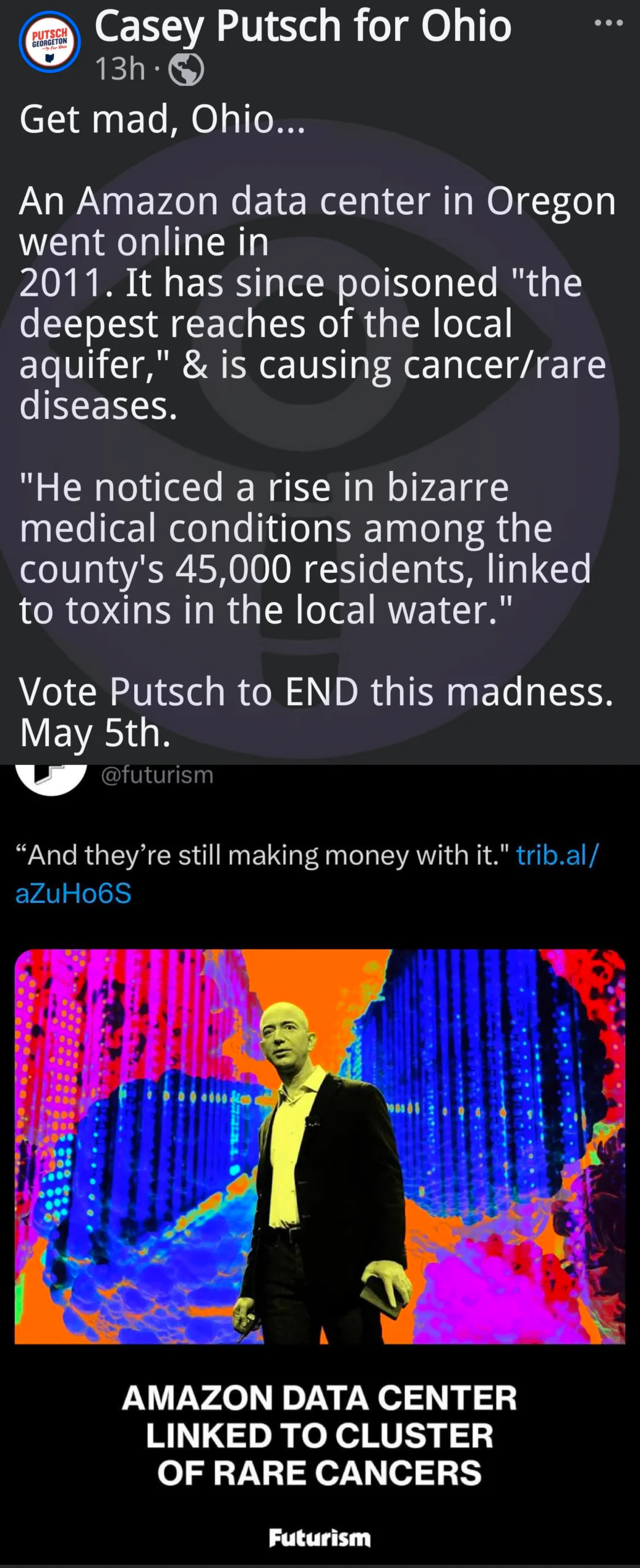
This environmental disaster was quickly utilized in local politics to mobilize voters. A Facebook post from Ohio Primary Governor Candidate Casey Putsch shared the Futurism graphic to sound the alarm for local residents. The post stated: “Get mad, Ohio… An Amazon data center in Oregon went online in 2011. It has since poisoned ‘the deepest reaches of the local aquifer,’ & is causing cancer/rare diseases.”
The post also quoted a local doctor who “noticed a rise in bizarre medical conditions among the county’s 45,000 residents, linked to toxins in the local water.” The political messaging concluded with an urgent, direct call to action: “Vote Putsch to END this madness. May 5th.”

As seen in the provided images, the severe health and environmental threats posed by Amazon data centers have become a central political flashpoint, with campaign messaging explicitly utilizing the Oregon contamination crisis to urge citizens to “Vote Putsch to END this madness” in the upcoming May 5th election. In stark contrast to candidate Casey Putsch’s strong opposition, leading Republican gubernatorial candidate Vivek Ramaswamy is heavily advocating for the expansion of these facilities, publicly pledging to transform the Ohio River Valley into the next “Silicon Valley”. State leaders have aggressively encouraged this corporate buildout by offering tech giants massive, multi-year tax abatements and sales tax exemptions on construction materials. However, this state-sponsored tech boom directly impacts everyday citizens, who are ultimately forced to subsidize the expansion through soaring utility costs. Because a single hyperscale data center can consume as much electricity as 100,000 homes, their presence places enormous, unprecedented stress on regional power grids. This explosive energy demand directly drives up monthly electric bills for residential customers, leaving the local population to bear the heavy financial burden and environmental risks of the industry’s growth.
How Data Centers Contaminate Water
The claim that a data center could poison an aquifer and cause rare diseases is tied directly to the physical requirements of keeping servers running. Contamination generally happens through three primary vectors:
- Cooling Water Chemicals: Data centers use millions of gallons of water daily through evaporative cooling towers. This water is heavily treated with polyacrylamide anti-scaling agents, potent biocides, chlorine, bromine, and anti-corrosive heavy metals to prevent bacteria and rust. The leftover wastewater, called “blowdown,” can seep through unlined retention ponds or failed injection wells, eventually percolating down to reach the deep aquifers that communities use for drinking water. This exposure leads to gastrointestinal disorders and rare carcinomas.
- Diesel Fuel Leaks: To ensure uninterrupted power, data centers keep millions of gallons of diesel fuel in underground storage tanks (USTs) to run massive backup generators. Over time, these tanks and their complex piping networks degrade, leaking BTEX compounds (benzene, toluene, ethylbenzene, and xylene) into the groundwater. Benzene is a highly potent carcinogen directly linked to leukemia and non-Hodgkin’s lymphoma.
- Fire Suppression Systems (PFAS): Data centers use specialized fire suppression foams (AFFF) to protect their expensive electronics. These foams contain high levels of PFAS, commonly known as “forever chemicals.” Because these chemicals feature unbreakable carbon-fluorine bonds, they do not break down in the environment. Routine testing or accidental discharges cause PFAS to run off into the soil and water supply, driving elevated risks of kidney cancer, testicular cancer, and thyroid disease.
The timeline mentioned in the political post—a facility opening in 2011 and causing cancer clusters by 2026—perfectly aligns with the latency period required for industrial chemicals to seep into deep groundwater and for chronic toxic exposure to result in rare diseases.
Part II: The Invisible Hazard of Low-Frequency Noise and Infrasound
Beyond the poisoning of local aquifers, data centers introduce a pervasive, invisible public health hazard to their surrounding communities: severe noise pollution. The mechanical requirements of hyperscale data centers—which include massive rooftop cooling towers, thousands of internal server fans, large air-handling units (HVAC), and regularly tested backup diesel generators—generate a continuous, inescapable hum that runs 24 hours a day, 7 days a week.
While the heavy equipment used to construct the facilities is loud, the operational noise levels can easily exceed 90 decibels, well above the 85-decibel threshold known to cause hearing damage. However, the most insidious threat is not the sheer volume, but the specific frequencies of the sound being emitted.

Infrasound and Neurological Disruption
Data centers are notorious for emitting high levels of low-frequency noise and infrasound. Infrasound refers to sound waves below 20 Hertz (Hz). While humans typically cannot consciously “hear” these extremely low frequencies, the human body and brain can still feel and process the acoustic energy.
Because low-frequency noise travels great distances and easily penetrates the walls of residential homes, it forces the brains of nearby residents to constantly process the noise around the clock. Medical research indicates that prolonged exposure to this industrial infrasound leads to severe physical and psychological symptoms, including:
- Chronic sleep disturbances and insomnia.
- Intense headaches and sensations of pressure or vibration within the head and body.
- Cognitive impairment and difficulty concentrating.
- Severe irritability, chronic fatigue, and elevated anxiety.
- An increased long-term risk of developing cardiovascular disease due to persistent physical stress.
Local governments are beginning to recognize these impacts. In Prince William County, Virginia, where massive data center buildouts are underway, compiled research has shown that the persistent hum of data processors and rooftop chillers near residential areas and schools leads to stress-related illnesses, hypertension, and learning impairments in children.

Vibroacoustic Disease (VAD)
The most severe consequence of chronic exposure to low-frequency noise and infrasound is a systemic medical condition known as Vibroacoustic Disease (VAD). First identified in professionals exposed to heavy aeronautical and industrial noise, VAD is a whole-body pathology caused specifically by the acoustic stressor of low-frequency vibrations.
Unlike traditional acoustic damage that merely affects the ears, VAD fundamentally alters human tissue. It is characterized by the abnormal growth and proliferation of extra-cellular matrices—specifically collagen and elastin—without any underlying inflammatory process.
The hallmark of Vibroacoustic Disease is the severe thickening of cardiovascular structures, such as pericardial thickening, which compromises the heart without presenting traditional signs of disease. Beyond physical tissue changes, VAD has severe neurological and psychological manifestations, causing patients to suffer from severe depression, increased aggressiveness, a tendency toward isolation, and decreased cognitive skills. Alarmingly, research indicates that low-frequency noise acts as a genotoxic agent, meaning it can cause cellular mutations, which correlates with the development of malignancies in those exposed to prolonged acoustic stress.
Conclusion
The trajectory of public health threats in the modern era is defined by the dangerous gap between rapid industrial innovation and regulatory response. The environmental and physiological footprints of hyperscale data centers clearly demonstrate this crisis. Whether examining a facility quietly leaching industrial biocides, PFAS, and benzene into a deep community aquifer over a decade, or subjecting thousands of nearby residents to 24/7 low-frequency noise that induces Vibroacoustic Disease, the underlying pathology remains identical.
Massive corporate profit motives intersect with profound regulatory loopholes, transferring extreme toxicological and physiological risks directly onto vulnerable local populations. The political mobilization seen in Ohio regarding the Amazon data center in Oregon highlights a growing civic desperation. Protecting the public requires environmental and health agencies to evolve from a reactive posture to an anticipatory stance, ensuring that the unchecked expansion of the digital economy does not come at the cost of the fundamental health and ecological safety of local communities.
Works Cited (Click Here)
- Title: Futurism X (Twitter) Post: Amazon Data Center Linked to Cluster of Rare Cancers
URL: https://x.com/futurism (Image provided in conversation; link referenced in image: trib.al/aZuHo6S)
Relevancy: This image served as the foundational catalyst for the investigation. A careful analysis of the image provided the specific publication date (March 25, 2026), the publication source (Futurism), the striking visual of Jeff Bezos over server racks, and the core allegation linking hyperscale Amazon data centers to rare cancer clusters while still generating profit. - Title: “Ohio” Facebook Political Action Post
URL: https://www.facebook.com (Image provided in conversation)
Relevancy: This image demonstrated how the environmental crisis is being actively weaponized in local Ohio politics. Analysis of the text within the image provided the specific timeline of the Oregon facility (going online in 2011), the mechanism of contamination (“poisoned the deepest reaches of the local aquifer”), the scope of the affected population (45,000 residents), and the direct political call to action to “Vote Putsch” by May 5th to end the data center expansion. - Title: United States: Investigation links Amazon data centers to worsening nitrate crisis in Oregon
URL: https://www.business-humanrights.org/en/latest-news/united-states-investigation-links-amazon-data-centers-to-worsening-nitrate-crisis-in-oregon-incl-company-comments/
Relevancy: This source provided the real-world epidemiological and environmental context behind the social media posts, detailing how water used to cool Amazon data centers in Morrow County, Oregon, concentrates agricultural pollutants and contaminates the local aquifer that tens of thousands of residents rely on for drinking water. - Title: Closed-Loop Cooling: Water Saver or Chemical Time Bomb?
URL: https://ketos.co/closed-loop-cooling-water-saver-or-chemical-time-bomb
Relevancy: This technical source outlined the specific chemical vectors of water contamination from data center cooling systems, identifying the toxic cocktail of biocides, corrosion inhibitors, and anti-scaling agents that are prone to seeping into groundwater. - Title: The Dangers of Data Centers
URL: https://www.environmentalhealthproject.org/post/the-dangers-of-data-centers
Relevancy: This source provided critical data on the severe noise pollution generated by data center infrastructure, specifically noting that the combination of heavy HVAC systems, cooling towers, and diesel generators generates constant noise levels exceeding 90 decibels, which easily penetrates residential areas. - Title: What Research Says About the Public Health Dangers of Noise Pollution
URL: https://www.pwcva.gov/assets/2025-05/DCOAG%20White%20Paper%20-%20What%20Research%20Says%20About%20the%20Public%20Health%20Dangers%20of%20Noise%20Pollution%2020250507.pdf
Relevancy: Compiled for Prince William County, Virginia, this white paper detailed the public health impacts of data center noise pollution, highlighting how the constant low-frequency hums from rooftop chillers and server fans cause chronic sleep deprivation, cognitive impairment, and cardiovascular stress. - Title: Vibroacoustic Disease Summary (State of New York Department of Public Service)
URL: https://documents.dps.ny.gov/public/Common/ViewDoc.aspx?DocRefId={D1D0F959-7673-4B4A-A6E1-32D492ADAAB8}
Relevancy: This document served as the primary medical reference for Vibroacoustic Disease (VAD), explaining the pathology of how prolonged, systemic exposure to low-frequency noise (LFN) causes abnormal tissue proliferation, cellular mutations, and pericardial thickening without traditional inflammatory responses. - Title: Meet the GOP candidate challenging Vivek Ramaswamy for Ohio governor
URL: https://www.newsfromthestates.com/article/who-casey-putsch-meet-gop-candidate-challenging-vivek-ramaswamy-ohio-governor
Relevancy: This source provided the political background for the gubernatorial race referenced in the images, specifically detailing candidate Casey Putsch’s strong opposition to data center expansion, massive tax abatements, and aquifer contamination, which contextualized the Facebook post’s demand to “Vote Putsch”.