

 Written by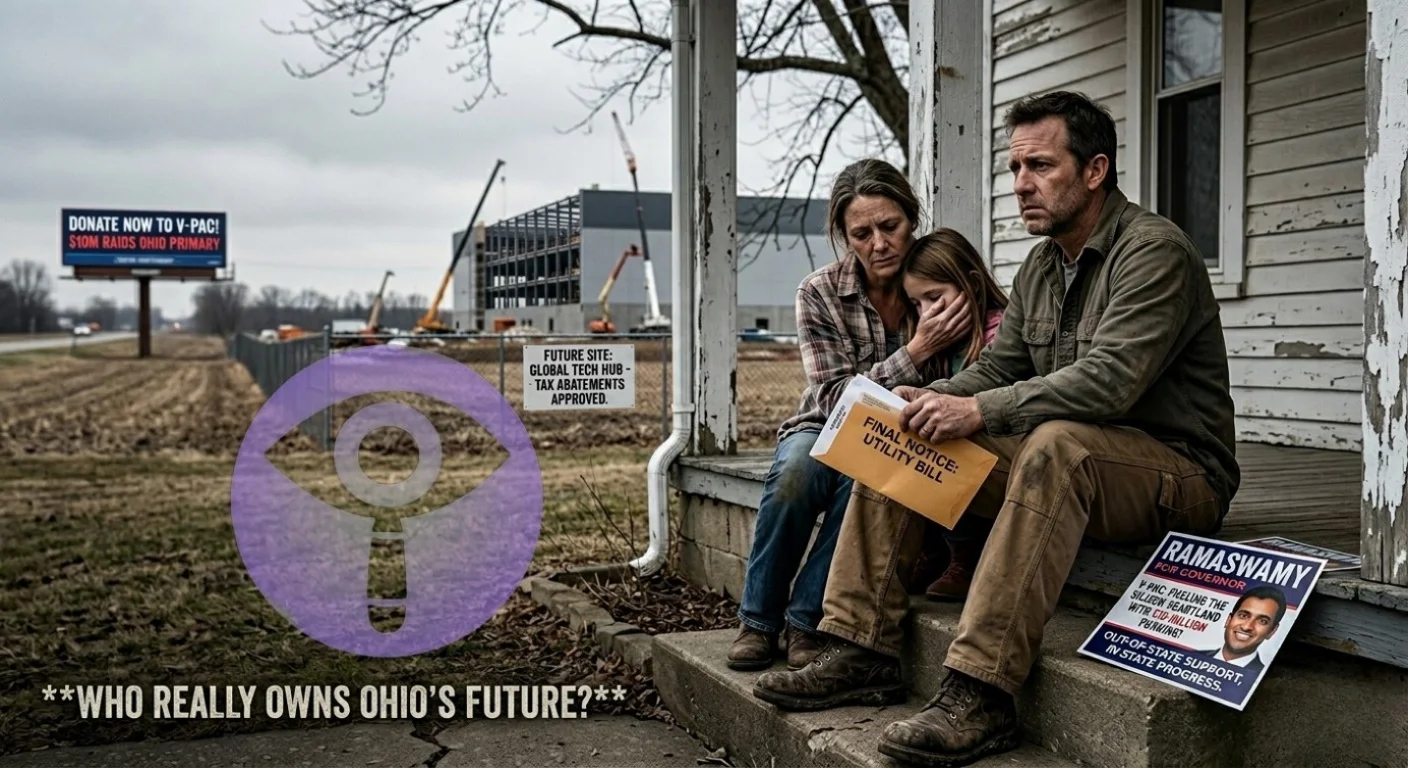
The Republican primary race for Ohio Governor is intensifying as frontrunner Vivek Ramaswamy faces a coordinated wave of attacks from multiple (opposing) opponents.
Just weeks ahead of the May 5th election, rival grassroots campaigns have zeroed in on two major controversies: unprecedented out-of-state Super PAC contributions and highly scrutinized campaign spending habits.
The race to succeed term-limited Governor Mike DeWine has become heavily defined by immense financial disparities. While Ramaswamy’s official state campaign apparatus raised a record-shattering $19.5 million in 2025 alone, the focus has recently shifted to the millions flowing in from out-of-state billionaires, controversial donors, and how those funds are being actively utilized.
Hill Demands Exit Over $10,000 Travel Controversy
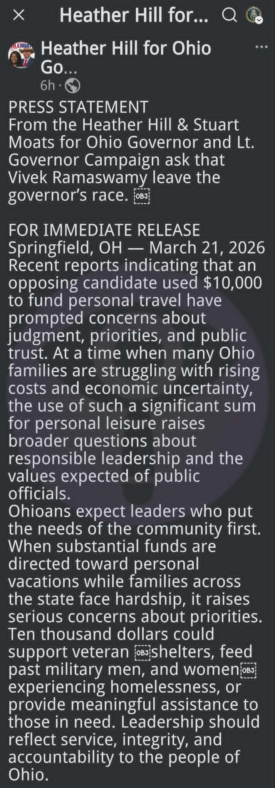
On Saturday, March 21, gubernatorial candidate Heather Hill issued a scathing press release demanding that Ramaswamy exit the race entirely over alleged lavish spending.
The statement from the Hill and Stuart Moats campaign seized upon recent reports indicating that an estimated $10,000 was used to fund personal travel and leisure.
Hill, an Appalachian entrepreneur running as a political outsider, framed the expenditure as a severe lapse in judgment and a betrayal of public trust.
“At a time when many Ohio families are struggling with rising costs and economic uncertainty, the use of such a significant sum for personal leisure raises broader questions about responsible leadership,” the official press statement posted to Hill’s Facebook page read.
Hill highlighted a stark contrast in priorities, arguing that the $10,000 spent on personal vacations could have been actively utilized within local communities to support veteran shelters, feed former military personnel experiencing homelessness, or provide meaningful assistance to Ohioans in immediate need.
This latest travel allegation compounds previous scrutiny regarding Ramaswamy’s extensive use of private aviation. Investigative reporting by Signal Ohio previously revealed that the candidate heavily utilizes a 2011 Cessna 750 Citation X private jet to campaign across Ohio’s 88 counties. State campaign finance records indicate the campaign has been spending roughly $80,000 a month to lease the jet from V Leasing, a corporate entity personally owned by Ramaswamy.
Georgeton Blasts $10 Million Billionaire Super PAC Haul
Simultaneously, Ramaswamy is facing heavy fire over the origins of his campaign’s massive war chest. Opposing candidate Kim Georgeton, running for Lieutenant Governor on the ticket with automotive entrepreneur Casey Putsch, publicly called out the frontrunner over the weekend for relying on massive donor funds to drown out competitors.
Because Ohio campaign finance laws limit direct individual contributions to a candidate to roughly $16,600, massive financial injections are being routed through affiliated Super PACs. The primary vehicle for this funding is V-PAC: Victors Not Victims, a federal Super PAC formed specifically to back Ramaswamy’s gubernatorial bid. By mid-2025, V-PAC had already raised nearly $16.8 million. The PAC was further seeded by a $116,816 transfer from the American Exceptionalism PAC, a now-dissolved committee originally created to support Ramaswamy’s 2024 presidential run.

Georgeton specifically targeted a recently disclosed $10 million contribution made to V-PAC by Pennsylvania billionaire and tech investor Jeff Yass. Yass, a prominent investor with a history of funneling tens of millions into conservative political action committees, has become a focal point for critics. Georgeton argued that relying on such astronomical Super PAC funding from out-of-state billionaires undermines the integrity of the state’s primary process and drowns out the voices of local voters.
Scrutiny Over Controversial Contributions
Beyond the sheer volume of outside money, V-PAC and the official campaign’s donor lists have faced intense pushback from across the political spectrum and the citizenry due to the origins of certain high-dollar contributions:
- Ross Stevens (New York): A New York City-based financier and CEO of Stone Ridge Asset Management, Stevens contributed $5 million to the Super PAC during the first half of the election cycle.
- IT Serve Alliance: In late 2025, V-PAC accepted $275,000 across two donations from IT Serve Alliance, an IT organization. The contribution sparked immediate backlash from conservative circles concerned about the outsourcing of American jobs, forcing V-PAC to refund the entire $275,000 in December 2025.
- Ties to Jeffrey Epstein: V-PAC came under heavy fire for accepting $100,000 from Glenn Dubin, a New York billionaire hedge fund manager with known past ties to Jeffrey Epstein. The PAC promised to refund the money following public pressure. Additionally, Les Wexner, the Ohio-based billionaire founder of L Brands who also has highly publicized past ties to Epstein, donated $5,000 to the campaign of Ramaswamy’s running mate, Ohio Senate President Rob McColley.
- Refunded Extremist Donation: Ramaswamy’s official state campaign was recently attacked by the state Democratic Party for accepting a $500 donation from an individual identified as a “Nazi reenactor.” The campaign was subsequently pressured to return the funds.

The Fight for Ohio’s Future: Outside Wealth and the Data Center Dilemma
Ohio is not a boardroom to be bought, nor is it a server rack to be powered at the expense of its people. Across the heartland, families are feeling the suffocating grip of rising costs—staring down monthly utility bills that climb higher even as wages stagnate. Yet, while working-class Ohioans are forced to make agonizing choices between keeping the lights on and putting food on the table, a different kind of power broker is quietly purchasing influence in the 2026 governor’s race.
The staggering influx of tens of millions of dollars from out-of-state billionaires and corporate tech interests has ignited a fierce, emotional backlash across the state, raising a profound and unsettling question: Who really owns Ohio’s future?
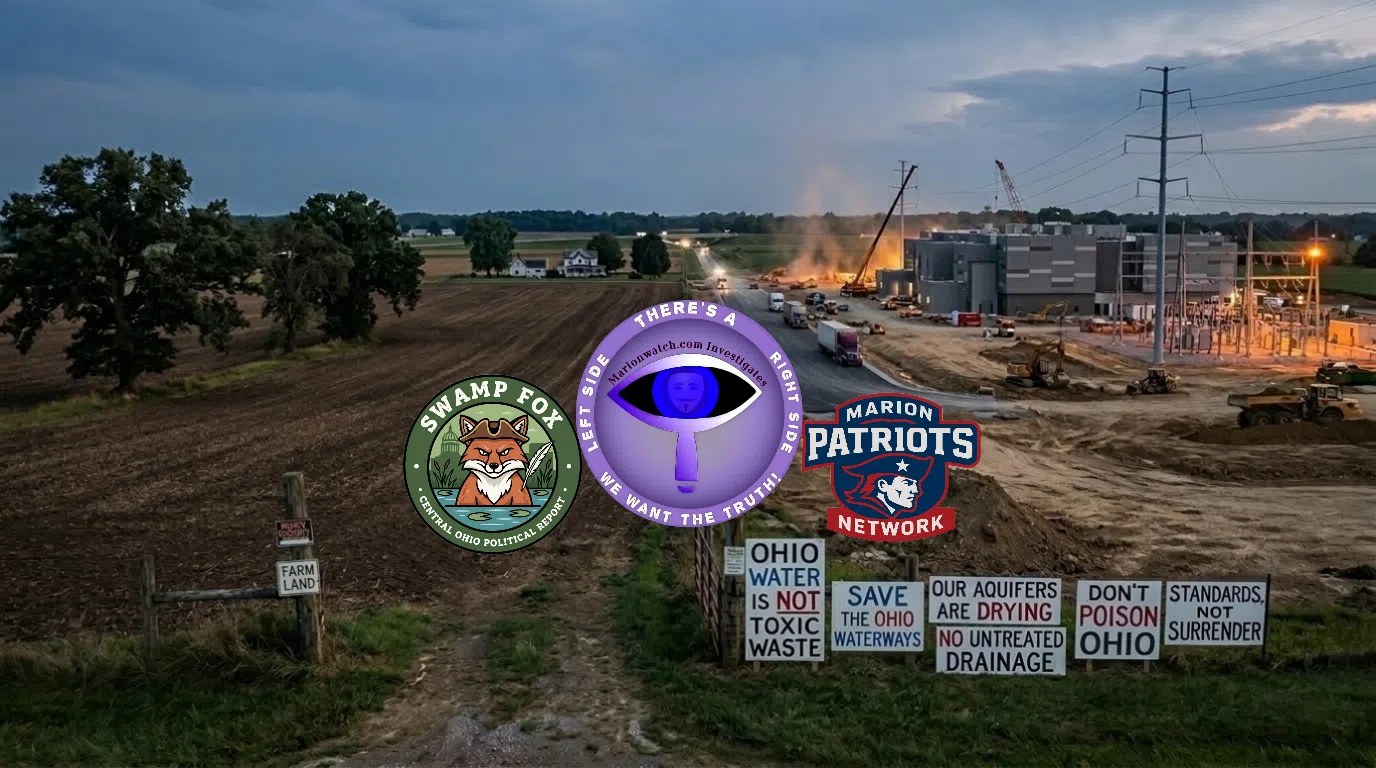
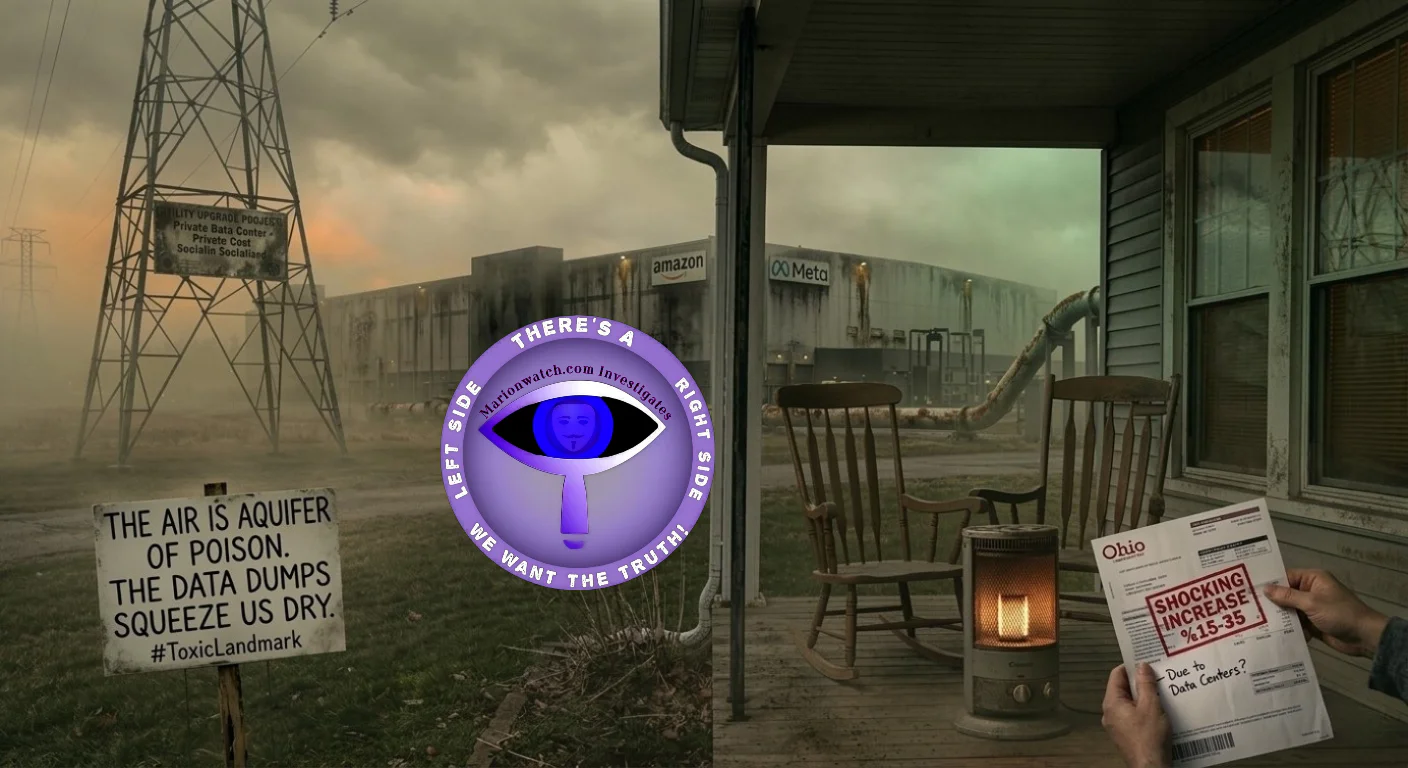
This influx of outside money—much of it tied to tech investors and billionaire financiers—has collided painfully with a growing, tangible crisis right in Ohio’s backyard: the explosive growth of data centers. As artificial intelligence and tech companies rapidly expand, Ohio has become fertile ground for massive data center construction. However, these facilities have become a highly contentious political issue, actively protested by citizens and local watchdog groups due to the severe strain they place on local communities:
- Skyrocketing Utility Bills: Data centers require colossal amounts of electricity to power and cool their servers. Utilities are struggling to keep up with the demand, which threatens to drive up energy prices and strain the electric grid for everyday Ohioans who are already financially stretched.
- Corporate Tax Breaks: While local residents bear the brunt of potential rate hikes and infrastructure strain, many of these tech-driven data centers benefit from massive sales and property tax exemptions—costing the state millions in revenue that could otherwise support schools, first responders, and local services.
- The Glaring Disconnect: Critics assert there is a severe disconnect when political campaigns are heavily insulated by out-of-state tech wealth, while local citizens are left paying the literal and figurative price for that industry’s heavy, resource-draining footprint in their state.
The mounting outrage over Super PAC funding and tech-aligned donors is more than just a procedural debate over campaign finance; it is a battle over who gets to dictate the priorities of the state. As the primary approaches, the backlash serves as a clear warning from voters who refuse to see their communities treated as an extraction zone for outside wealth. For many Ohioans, the central issue is no longer just who has the largest war chest, but whether a political apparatus fueled by out-of-state billionaires can ever truly serve the people left paying the bills.
Works Cited (Click Here)
- “Heather Hill for Ohio Governor” Official Facebook Page. Press Statement released March 21, 2026. Source for the allegations regarding the $10,000 personal travel expenditure and the criticism of campaign priorities.
- Federal Election Commission (FEC) & Ohio Secretary of State. Campaign Finance Disclosures (2025–2026 cycle). Source for the $19.5 million state campaign fundraising total, the transfer of funds from the “American Exceptionalism PAC,” and the financial filings for “V-PAC: Victors Not Victims.”
- V-PAC Campaign Finance Receipts. Source for the specific donor contributions, including Jeff Yass ($10 million), Ross Stevens ($5 million), Glenn Dubin ($100,000), Les Wexner ($5,000 to Rob McColley), and the IT Serve Alliance ($275,000 refund).
- Ohio Democratic Party. Public statements and press releases (2025–2026). Source for the scrutiny and subsequent refund of the $500 donation from an identified extremist.
- Signal Ohio. Investigative political reporting (2025). Source for the details regarding the $80,000 monthly lease of the 2011 Cessna 750 Citation X private jet through V Leasing.