

 Written by
 There’s been some folks who have been commenting about the pay of city workers, so the Ole Swamp Fox decided to do some digging into the salary and benefits data of the city of Marion over the past few years.
According to the Federal Reserve, the national average increase in employment cost (salaries & benefits) for state and local government workers between January 2023 and January 2026 was 11.98%.
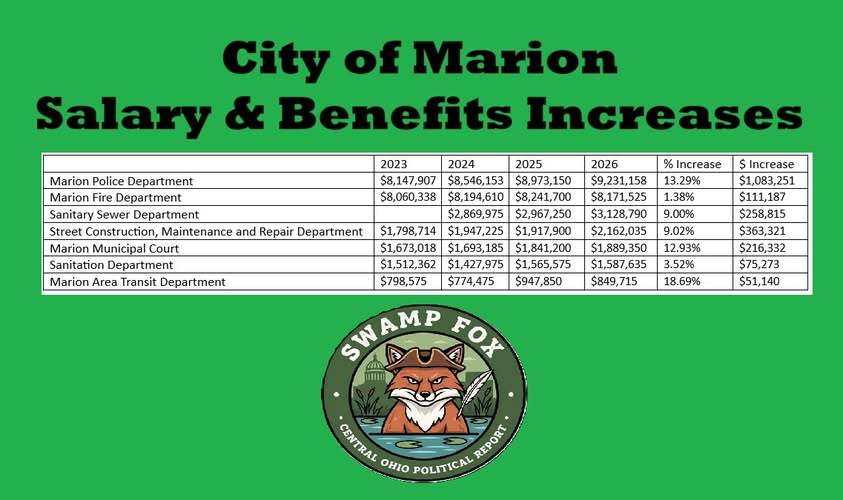
As such, any increase at that level or below would be presumed to be acceptable and fiscally responsible. We have, after all, experienced one of the worst periods of inflation–if not the worst–in our nation’s history over the past six years.
Out of the most expensive departments, Marion Area Transit, the Marion Police Department and the Marion Municipal Court have seen increases above the rate of wage inflation. This is indicative of additional hiring and/or excessive pay increases for employees.
Marion Area Transit’s increase between 2024 and 2025 is likely due to the city’s implementation of the Night Moves Party Bus program, which was an expansion of the city’s normal transit operations into the evening that provided transportation from area hotels to downtown bars, restaurants and other venues.
Or, at least, that’s what it started out as.
Fortunately, due to the city’s fiscal distress, that questionable program has been eliminated.
With Marion Area Transit constantly running a deficit and needing to be bailed out by the city’s taxpayer-supported General Fund, perhaps city leaders will come to the realization that Marion Area Transit needs to be scaled back substantially–if not eliminated.
According to the most recent published data, the entire fleet of transit vehicles averages only six riders per hour. Six riders per hour for the entire fleet!
For each mile that a Marion Area Transit bus travels, it costs the city about $10.
As a business-like activity, Marion Area Transit is supposed to operate at a break-even point, using grant funds and service fees to balance its budget.
Unfortunately, that hasn’t happened. It regularly operates at a deficit.
Police expenses can and should be reviewed for additional efficiencies. However, with the Fraternal Order of Police negotiating fat contracts with the city, it’s unlikely that we’ll see any voluntary reductions from that department.
The same can be said for the city’s Municipal Court.
In the past, City Council has attempted to reign in the Municipal Court’s spending, but the Court threatened legal action to compel City Council to appropriate the funds requested by the court in their entirety, so prior councils caved.
It’s clear that Marion’s leadership needs to be resolute and willing to fight these fights with both the public sector unions representing city workers and the heads of the various city departments in order to trim the fat.
They won’t do it on their own.
Note: All data was obtained from budget reports published by the city of Marion.
Police is fund 260.100. Fire is fund 270.1002. Sanitary Sewer is fund 502.5003. SCMR is fund 202.2006. Municipal Court is fund 1019. Sanitation is fund 503.5005. Transit is fund 501.500.
Data for 2026 is based on budget projections listed in the city’s most recent budget proposal.