


 Written by
 As 2026 begins, a high-stakes legal battle is unfolding over the sanctity of the American home. A series of whistleblower disclosures has revealed a secretive policy shift within U.S. Immigration and Customs Enforcement (ICE) that critics argue effectively bypasses the Fourth Amendment. At the heart of this controversy is a May 12, 2025, memorandum that grants agents unprecedented authority to enter private residences without the traditional approval of a judge.

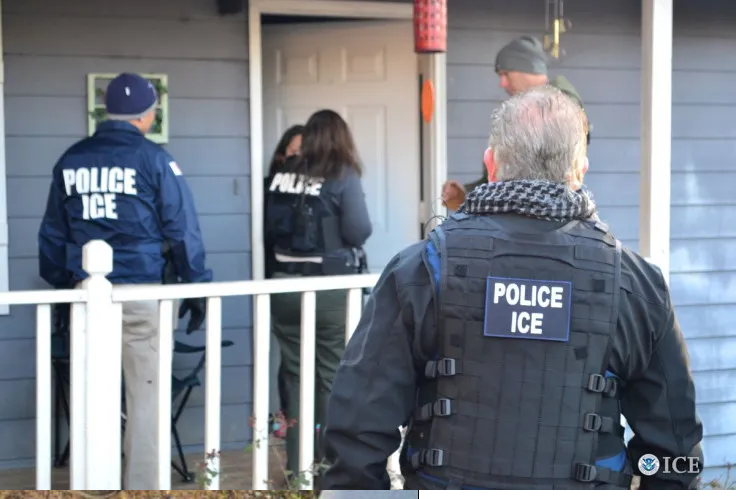
The Legal Shift: Force Over Consent
For decades, the standard for federal immigration agents remained clear: unless there was an emergency, agents needed a resident’s voluntary consent or a warrant signed by a judge to enter a private home. This standard was rooted in the Fourth Amendment’s protection against “unreasonable searches and seizures,” which courts have historically interpreted as requiring a neutral judicial officer to review any request to enter a private dwelling.
However, the “secret” May 2025 memo from Acting ICE Director Todd Lyons reverses this historical reliance on consent. The directive asserts that administrative warrants—internal agency documents known as Form I-205—are sufficient to justify a forced entry. According to the memo, if a resident refuses to open the door, agents are authorized to use a “necessary and reasonable amount of force” to enter. This change is based on a new, non-public legal determination by the DHS Office of General Counsel claiming that neither the Constitution nor federal law prohibits this practice.

Judicial vs. Administrative: Why the Signature Matters
The debate hinges on a fundamental legal distinction between two types of documents:
- Judicial Warrants: These are court orders signed by a neutral and detached judge. To obtain one, law enforcement must provide evidence of “probable cause” that a crime has been committed.
- Administrative Warrants (Form I-205): These are civil documents signed by immigration officials, not judges. They are used to carry out final orders of removal for civil immigration violations.
Historically, because administrative warrants do not come from the judicial branch, they were considered insufficient for home entry. Critics, including Senator Richard Blumenthal, argue that by allowing executive officials to sign their own “entry” papers, the administration is removing the primary check on government overreach.

Training Under the Radar
Whistleblowers have raised additional alarms regarding how these new rules are being taught. Allegations from the Federal Law Enforcement Training Centers (FLETC) suggest a “two-track” training system. While official written materials—such as the 2021 ERO Training Handbook—still state that a warrant of removal “does NOT alone authorize a 4th Amendment search,” instructors are reportedly being told to verbally instruct recruits to ignore those written rules.
This “verbal-only” instruction has led to concerns that newly hired agents are being deployed with an unconstitutional understanding of their authority. This is further complicated by recent reports of an AI hiring error that may have sent undertrained recruits into the field during an accelerated hiring push.
This news report provides additional context on the “AI hiring error” mentioned in the article, explaining how hundreds of recruits may have been deployed without the full legal training usually required for ICE agents.
The Human Cost of “Operation Metro Surge”
The impact of this policy shift is already being felt in communities across the country. In Minnesota, where “Operation Metro Surge” has seen thousands of agents deployed, a federal judge recently ruled that agents violated the Fourth Amendment by forcibly entering the home of a Liberian citizen without a judicial warrant. In that instance, the resident, who was in the country legally and met regularly with authorities, was reportedly removed from his home at gunpoint while still in his underwear.
Other incidents include:
- Oklahoma (April 2025): Agents mistakenly raided the home of U.S. citizens while looking for a previous resident.
- Indiana (Oct 2025): DHS officials allegedly forced entry into a residence and detained three U.S. citizens alongside the intended target.
- South Dakota (May 2025): A couple returned from work to find their front doors left open after an erroneous raid by ICE agents looking for someone else.
Works Cited (Click Here)
- Memorandum from Acting ICE Director Todd Lyons on Utilizing Form I-205, Warrant of Removal
- Date: May 12, 2025
- Relevance: The primary internal memo authorizing forced home entries using administrative warrants.
- URL: N/A (Internal Agency Memorandum)
- Anonymous Whistleblower Disclosure
- Date: January 7, 2026
- Relevance: Allegations of secretive, unconstitutional training at FLETC regarding home entries.
- URL: N/A (Enclosure to Congressional Correspondence)
- Letter from Senator Richard Blumenthal to Director Benjamin C. Huffman
- Date: January 21, 2026
- Relevance: Formal Senate inquiry into “secretly” directed verbal training that contradicts written manuals.
- URL: https://www.hsgac.senate.gov/wp-content/uploads/2026-01-21-Letter-from-Blumenthal-to-FLETC.pdf
- Federal Law Enforcement Training Centers (FLETC) Legal Training Handbook
- Date: 2025
- Relevance: Official manual stating home entry generally requires a judicial warrant or consent.
- URL: https://www.fletc.gov/sites/default/files/25_0106-LEG-LegalTrainingHandbook.pdf
- Legal scholars raise concerns about internal ICE policy (CBS Minnesota)
- Date: January 23, 2026
- Relevance: Detailed report on the Minnesota forced entry case involving Garrison Gibson.
- URL: https://www.cbsnews.com/minnesota/news/legal-scholars-concerns-ice-policy-homes-warrants/
- Immigration Arrests in the Interior of the United States: A Primer (Congressional Research Service)
- Date: June 13, 2025
- Relevance: Analysis highlighting that ICE warrants are administrative and lack judicial approval for search/entry.
- URL: https://www.congress.gov/crs-product/LSB10362
- ICE Administrative Removal Warrants Recorded Discussion (FLETC)
- Date: Accessed November 21, 2025
- Relevance: Audio transcript where a legal instructor explains that Form I-205 does not authorize home entry without consent.
- URL: https://www.fletc.gov/ice-administrative-removal-warrants-mp3