


 Written by
 You’ve likely heard it said that “there’s no such thing as a free lunch,” but it could also be said, when it comes to Marion Area Transit, there’s no such thing as a free ride.
Everything comes at a cost.
But just how costly is Marion’s public transportation system?
How much of a service does it offer? Is that service worth the cost?
How efficient is it at providing those services?
Given the city of Marion’s current budget woes, and Marion Area Transit’s longstanding deficits, our leaders should be asking these questions and seeking solutions.
Plans to establish a taxpayer subsidized transit system in Marion began in 1979, largely as a reaction to the 1979 Oil Crisis. Although there wasn’t a great need for transit in Marion, as most people owned their own vehicles or utilized one of Marion’s privately owned and operated taxicab services, public transit proponents pushed forward, nonetheless.
It took some doing, with most people in Marion opposing it at the time, but under the Democratic mayorship of Ron Malone and supported by funding from the state of Ohio and the federal government, Marion Area Transit eventually came into being, holding its grand opening on the 20th of December 1982.
When it first opened under the management of Iola Mahaffey, an adult could ride for $0.50, while seniors, students, and the disabled received a reduced fare of $0.25.
Now let’s compare that with the fares of 2025.
An adult can ride for $1.25. Seniors, the disabled and students get a discounted rate of $0.60 per ride.
Fares have not changed—not even through periodic inflation adjustments—since 2004.
Former transit director, Julie Welch, wisely floated the idea of an increase to transit fares at the regular meeting of city council held on the 23rd of June 2025. Ms. Welch advocated increasing adult fares from $1.25 to $2.00 and those receiving reduced fares from $0.60 to $1.00.
“We have 20 years of raises, increased gas, and repair costs that we just cannot cover,” Welch said. She further explained, seconded by former Budget Director Tacy Courtright, that by increasing fares and generating more funds, Marion Area Transit would be eligible to receive an increase in grant funds from state and federal sources.
Welch’s proposal, however, did not go over well with several longtime members of council.
Ayers Ratliff (D-2nd Ward), despite the city’s well-known financial constraints, stated that he would rather increase transit’s budget than increase transit fares.
Jason Schaber (R-3rd Ward) concurred with Ratliff, asking why the transit director was seeking to put this burden on the riders and not the city. He went on to suggest that council increase its 2026 budget for transit, so as to avoid a fare increase.
In the end, the fares remained unchanged. And transit’s budget woes were left unaddressed.
So what is Marion Area Transit’s service impact and cost?
For the year of 2023, which is the last data that I could locate, Marion Area Transit consisted of 12 transit vehicles (buses) and had a total ridership of 91,867. Total service hours (actual hours that the transit buses were in operation) was 15,188 and total service miles (actual mileage driven by the buses while in operation) was 137,678.
If we break those figures down (rounding up or down):
- There were 7,656 riders per bus per year;
- There were 6 riders per total service hour of the entire fleet in operation;
- The fleet averaged 9.06 miles driven per hour of operation.
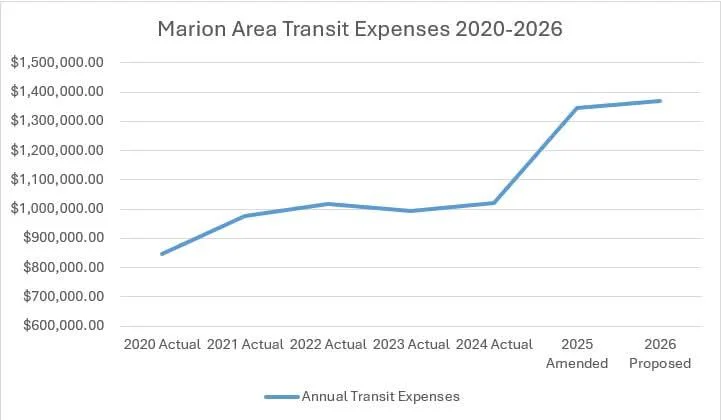
In 2023, Marion Area Transit had a total of $994,645.25 in expenses.
Under the 2026 proposed budget for transit, that figure has been increased to $1,370,765.56.
If you compare 2020’s transit expenses with 2026’s proposed expenses, there’s been a 62.07% increase!
Assuming that ridership and total service miles are similar between 2023 and 2026, Marion Area Transit spends $9.96 PER MILE DRIVEN!
Even if we only look at 2023’s data, transit spent $7.22 PER MILE DRIVEN.
The average taxicab fare per mile in the US is between $1.50 and $3.50, depending on the city. In addition, the IRS standard mileage rate is currently $0.70 per mile.
That just goes to show you just how costly Marion’s public transit is compared to alternatives in the private sector.
Marion Area Transit may provide valuable services to a small sector of our population. However, it does not appear to be a fiscally responsible or efficient enterprise, taxpayer funded grants aside.
Significant operational revisions are more than warranted. Now that the city is facing a fiscal crisis, perhaps its leaders will revisit this issue and make the necessary operational adjustments.