


 Written by
 Defining Marion’s Governance Future

Marion, Ohio, stands at a pivotal juncture, contemplating a shift from its long-standing status as a statutory city to adopting a home rule charter. This potential transition represents more than a mere administrative change; it is a fundamental redefinition of how Marion governs itself, impacting everything from daily operations to long-term strategic planning.
The Marion City Council’s agenda for July 7, 2025, prominently features a “Charter Discussion,” signaling the immediacy and significance of this debate for the community.1 The inclusion of this item on a recent City Council agenda, alongside numerous charter-related documents, indicates that this is not a theoretical exercise but an active, near-term consideration for Marion, making an investigative examination particularly pertinent.
This report delves into the intricacies of this proposed change, dissecting the inherent advantages and potential drawbacks, scrutinizing concerns around transparency and accountability, and contrasting the proposed charter model with Marion’s current governance framework. Furthermore, it will examine key past events in Marion’s history, exploring how a charter city structure might have influenced their outcomes, thereby providing a concrete illustration of the stakes involved.
Marion Watch has reached out to several officials, and received some replies. We notice that the majority of citizens do not understand the differences in the structure of government that a charter would provide. We heard back from City Councilor Twila Laing.
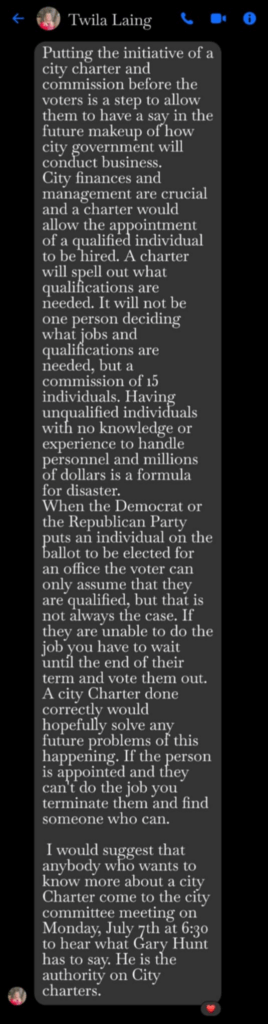
City Councilor Twila Laing is advocating for a city charter and commission, emphasizing it as a crucial step to ensure qualified individuals are at the helm of city government. In a recent statement, Laing highlighted that a charter would meticulously define the necessary qualifications for city positions and outline specific job requirements.
Laing stressed the importance of moving towards a system with a commission of 15 individuals, instead of one person deciding if an applicant is qualified. She echoed concerns we have observed over the years with the current practices in hiring individuals potentially lacking relevant expertise, makes critical hiring decisions. She warned that “having unqualified individuals with no knowledge or experience to handle personnel and millions of dollars is a formula for disaster.”
The councilor also touched upon the electoral process, noting that voters often assume candidates put forth by the Democratic or Republican parties are qualified. However, she cautioned, “that is not always the case.” Laing believes a well-crafted city charter could proactively address such issues, allowing for the termination of underperforming individuals and their replacement with more suitable candidates.
Laing encourages residents interested in learning more about a city charter to attend the city committee meeting on Monday, July 7th at 6:30 PM. She specifically mentioned that Gary Hunt, who “has the authority on City charters,” will be present to share insights.
Councilor Rollins also showed support for the initiative and simply stated that he has been a long time champion/ fighter for the charter initiatives. Due to the holiday, we did not receive many replies but Marion Watch plans on being in attendance this evening.
Statutory vs. Charter: Understanding Ohio’s Municipal Governance
Marion’s Current Framework: The Statutory City Model
Currently, Marion, Ohio, operates as a “statutory city regulated by the Ohio Revised Code”.2 This means its powers and governmental structure are explicitly defined and limited by state statutes. As a “General Law” city, a term often used interchangeably with statutory city, Marion is restricted to actions that state statutes specifically direct or permit.3 If the Ohio Revised Code (ORC) does not grant express or implied power for a particular action, the city cannot undertake it.3
Under the ORC, the legislative power of a city like Marion is vested in a legislative authority, typically the City Council. This body is composed of a specified number of members, generally not fewer than seven, with four elected by wards and three at-large, up to a total of seventeen.4 The powers of this legislative authority are “legislative only,” meaning it performs no administrative duties and cannot appoint or confirm most city officers or employees, except those of its own body.5 The Mayor, as the chief executive, supervises administration, enforces laws, manages the budget, and possesses veto power over ordinances.7 Marion’s current status as a statutory city means its governance structure is largely pre-defined by the state, limiting its ability to innovate or adapt its internal operations without state legislative changes. Any desire to change how its council is structured, how departments are managed, or specific procedural aspects is bound by the Ohio Revised Code unless the Code itself provides alternatives.
The Home Rule Concept: A Local Constitution
In contrast, a “Home Rule” city, typically with a population over 5,000 (a threshold Marion likely meets), adopts a “home rule charter”—essentially its own municipal constitution.3 This charter defines the structure, powers, duties, and authority of the local government based on local preferences and desires.3 Rather than looking to state statutes for what they may do, Home Rule cities look to their local Charters.3
The Ohio Constitution, specifically Article XVIII, grants municipal corporations “home rule” powers. These include the power of local self-government and the ability to adopt and enforce local regulations that are not in conflict with general state laws.11 This means a Home Rule city “may generally take any action that is not prohibited by the Ohio Constitution or statutes as long as the authority is granted in the Charter of the city”.3
Key Differences in Authority and Flexibility
The core distinction between these two models lies in the source of authority: statutory cities operate under delegated state power, while charter cities exercise inherent constitutional home rule powers.10 This grants charter cities significant flexibility and autonomy to tailor their governance to local needs.9 For instance, a charter can define the form of government (e.g., strong mayor, council-manager, commission) 9, establish controls over city finances, and define limitations on governmental powers.3 Cleveland, for example, has a mayor-council charter, while Mentor operates under a city manager-council system.13
Crucially, a chartered municipal corporation “may vary from state law on both procedural and substantive matters of local self-government,” whereas a non-chartered city “must follow the procedure prescribed by state statutes in matters of local self-government, but may enact ordinances that vary from state law regarding substantive matters of local self-government”.11 This distinction is a subtle but critical point for Marion. While a statutory city can vary on substantive local self-government issues (e.g., setting local tax rates within state limits), it is bound by state procedures. A charter city gains freedom in both. This means a charter could streamline internal processes, decision-making, and even administrative appointments, which are currently dictated by the Ohio Revised Code. This procedural flexibility is a significant advantage, allowing a charter city to design its own competitive bidding processes or civil service regulations, for instance, in a way that best suits local conditions.
Table 1: Statutory vs. Charter City Governance: A Comparative Overview
| Criterion | Statutory City (Current Marion) | Charter City (Proposed Marion) |
| Source of Authority | Ohio Revised Code (delegated state power) | Local Charter (municipal constitution) under Ohio Constitution (inherent home rule powers) |
| Scope of Powers | Limited to state-permitted actions; “General Law” | Broad powers of local self-government, unless prohibited by state/federal law; “Home Rule” |
| Form of Government | State-defined (e.g., Mayor-Council with ORC rules) | Locally defined (e.g., strong mayor, council-manager, commission) |
| Legislative Authority | ORC-defined (e.g., 7-17 members, ward/at-large, legislative only) | Charter-defined (flexible number/election method, potentially broader powers) |
| Executive Authority | ORC-defined powers (e.g., chief executive, veto) | Charter-defined powers (can be strong mayor, or vested in city manager) |
| Citizen Direct Democracy | Limited (no initiative/referendum/recall unless state law specifically provides for it) | Enhanced (Initiative, Referendum, Recall available as inherent powers) |
| Financial Autonomy | ORC-defined tax/debt powers (e.g., specific tax levies) | Charter-defined tax/debt powers (within state/federal limits), greater flexibility in financial controls |
| Flexibility in Procedures | Must follow state procedures for local self-government matters | Can vary from state procedures on both procedural and substantive matters |
| Amendment Process | State-defined (via state legislature, or limited local options within ORC framework) | Locally defined (voter approval, often via charter review commissions or council/citizen petition) |
The Promise of Self-Governance: Advantages of a Charter City for Marion
Tailored Local Control and Structure
A primary advantage of a charter is the ability to customize the city’s governmental structure to best suit Marion’s specific needs and preferences.9 This includes choosing the form of government, such as a strong mayor system, a council-manager system, or a commission.9 This contrasts with the current statutory model, which dictates a more rigid structure.5 For example, Cleveland has a mayor-council charter, while Mentor has a city manager-council system.13 This flexibility allows Marion to design a system that optimizes efficiency, responsiveness, and accountability for its unique community. The ability to tailor the form of government directly impacts the balance of power between the executive and legislative branches, which could profoundly affect decision-making speed and accountability in Marion. A council-manager system, for instance, typically vests executive power in a professional manager appointed by the council, potentially reducing political influence in day-to-day administration but perhaps diffusing accountability. A strong mayor system concentrates executive power in the elected mayor, offering clearer lines of accountability but potentially less council oversight. This choice is a strategic decision for Marion’s future governance style.
Enhanced Legislative and Fiscal Autonomy
Charter cities gain “a great deal of autonomy in how the municipality is organized and the procedures it follows, from the form of government… to its tax and debt powers”.9 This means Marion could potentially have greater flexibility in local lawmaking, setting tax rates (within constitutional limits), incurring debt, and issuing bonds.12 This could be particularly beneficial for a city that has faced “financial hardship” and “cuts made to local government funding by the State” in the past.14 The 2012 income tax increase 14 demonstrates Marion’s past reliance on local measures to address financial shortfalls; a charter could provide more diverse and flexible fiscal tools. The explicit mention of “tax and debt powers” 9 as an advantage for charter cities, combined with Marion’s historical financial struggles 14, suggests that a charter could empower Marion to develop more sophisticated and locally-controlled financial strategies, potentially reducing reliance on state funding changes or single-issue tax levies. Marion previously passed a 0.25% income tax increase in 2012 to offset state funding cuts.14 While this was a specific, voter-approved measure within the statutory framework, a charter, by granting broader tax and debt powers, could allow Marion to explore a wider range of revenue streams or financing mechanisms that are not explicitly detailed in the Ohio Revised Code for statutory cities. This could provide greater fiscal resilience and flexibility in long-term financial planning, moving beyond reactive measures.
Direct Citizen Empowerment: Initiative, Referendum, and Recall
One of the most significant democratic enhancements offered by a home rule charter is the direct involvement of citizens through “Initiative, Referendum and Recall” powers.3 These are “three separate facets of direct democracy reserved for exclusive use by local voters that provide direct remedies in unusual situations” and are “unique to Home Rule Cities and not available to voters at any other level of government”.3
- Initiative: This power allows citizens to propose new ordinances or resolutions by petition, such as the requirement of signatures from 10% of electors in North Ridgeville’s charter.15
- Referendum: This enables citizens to challenge recently enacted ordinances or resolutions by petition, forcing a public vote. For instance, North Ridgeville’s charter requires 10% of electors for a referendum, or 20% for a special election.15
- Recall: This allows citizens to remove an elected official from office through a petition and subsequent election. North Ridgeville’s charter requires 25% of electors for a recall petition, while the ORC 705.92 for statutory cities under a specific plan requires 15%.15 While the ORC does provide for recall in some statutory plans 16, the charter explicitly enshrines and defines these powers for all elected officials, providing a more direct and comprehensive mechanism for voter accountability.
Adaptability and Innovation
As communities grow and face increasingly complex issues, a charter provides the necessary “flexibility in addressing those issues”.3 It allows for a “local response to the form of government desired by citizens”.3 This adaptability is crucial for a city like Marion, which has experienced industrial decline (the Marion Power Shovel plant closed in 1997) and is working on revitalization through “community initiatives and incremental improvements that build momentum”.17 A charter could facilitate more agile responses to economic shifts, public health challenges, or infrastructure needs by removing state-imposed procedural hurdles.
The Perils of Power: Potential Disadvantages and Risks
Complexity and Cost of Transition
Drafting and adopting a home rule charter is a significant undertaking. It requires the formation of a charter commission 1, extensive public engagement, and a voter approval process.3 This process can be complex, time-consuming, and potentially costly, involving legal consultation, public education campaigns, and election administration. Maintaining the charter also requires regular review, often through mandated charter review commissions 9, which adds an ongoing administrative burden. For example, Cuyahoga Falls reviews its charter every five years.9
Potential for Unintended Consequences and Power Imbalances
While a charter offers flexibility, a poorly drafted or ambiguous charter can lead to unforeseen governance issues, power struggles, or a lack of clear lines of authority. For example, if the charter does not clearly define the roles and responsibilities of the mayor, council, and administrative departments, it could create inefficiencies or conflicts. The Dublin charter, for instance, explicitly states that “Neither Council nor any of its members shall in any manner direct or demand the hiring or termination of any City employee whom the City Manager is empowered to hire” 19, illustrating the need for clear separation of powers to prevent overreach. The risk of a poorly drafted charter leading to power imbalances or unintended consequences is particularly salient given Marion’s recent history of executive-legislative tensions, such as the mayoral vetoes of salary increases.20 If a charter is drafted without careful consideration of checks and balances, it could exacerbate existing friction or create new avenues for conflict.
Navigating State Law Conflicts and Judicial Interpretation
While home rule grants broad powers, it is not absolute. Charter provisions and local ordinances “must not conflict with state or federal laws” or the Ohio Constitution.9 Courts play a significant role in determining the validity of municipal ordinances under the Home Rule Amendment.11 This means that even with a charter, Marion may face legal challenges if its local laws are deemed to conflict with “general laws” of the state.11 The Ohio Supreme Court’s analytical framework for determining validity can be complex and lead to “varying outcomes” 21, creating legal uncertainty. The reliance on judicial interpretation for home rule validity 11 introduces an element of unpredictability that could undermine the very flexibility and autonomy a charter aims to provide. This suggests that Marion would need robust legal counsel during the drafting phase and for ongoing operations to navigate potential legal challenges and ensure the charter’s provisions withstand judicial scrutiny.
Transparency and Accountability: A Deep Dive into Governance Oversight
Current Accountability in Statutory Marion
As a statutory city, Marion’s government is subject to Ohio’s public records and open meetings laws.22 The Marion City Council’s mission explicitly states a commitment to “provide the public with the most information day or night” and believes “government should be accessible to all citizens”.2 The council also makes “Summary of Proceedings, Ordinances, as well as meeting dates, times, and agendas” publicly available.2 The Marion Police Department has a formal complaint process, accepting anonymous and third-party complaints, with investigations typically completed within 35 days.24 Public health complaints are also accepted and investigated.25
However, the recent controversy surrounding City Auditor Miranda Meginness 26, with allegations of “lack of urgency,” “failure to provide satisfactory answers to questions,” and significant financial penalties due to “misfeasance and malfeasance,” raises questions about the effectiveness of current oversight mechanisms. The Mayor’s vetoes of salary increases, citing this “lack of accountability from the current Auditor” 20, further underscore these concerns. These events reveal a potential vulnerability in Marion’s current statutory oversight framework. Under the statutory system, the process for addressing issues like the auditor’s alleged misfeasance might be slow or rely heavily on political will, as evidenced by the initiative to remove the auditor spearheaded by the Mayor and councilmen.26
Charter City Opportunities for Enhanced Oversight
A charter can serve as a powerful tool to embed stronger transparency and accountability measures tailored to Marion’s specific needs.9 It can mandate regular “charter review commissions” 9, typically composed of volunteers, to periodically review the entire charter and recommend changes (e.g., Cuyahoga Falls reviews every five years).9 This institutionalizes a mechanism for continuous governmental self-assessment and public input.
Charters can also define specific public access provisions, ethics rules, and clear processes for citizen engagement beyond state minimums. The powers of Initiative, Referendum, and Recall 3 provide direct citizen remedies for perceived government failures or unpopular decisions, enhancing accountability. Voters can also “impose additional restrictions on the local government’s powers” through the charter.9 While the current statutory framework offers public records and open meetings 2, the ability of a charter to mandate a “charter review commission” 9 represents a proactive, institutionalized mechanism for continuous accountability and adaptation that is absent in the statutory model. This built-in feedback loop compels regular, public examination of the city’s foundational document and its governance effectiveness, moving beyond merely reactive responses to problems.
Potential for Reduced Oversight
Conversely, a poorly designed charter could inadvertently limit public access or accountability. For example, if a charter is not carefully written, it might allow for less transparency in certain administrative functions or make it harder for citizens to access information compared to state statutory requirements. An example cited in the research is a charter requiring “all public bodies conduct all meetings in person” 21, which could limit “greater access to local government, greater transparency, and more flexibility” offered by virtual or hybrid meetings, especially in a post-pandemic environment. While this is an example of an archaic charter provision, it highlights the critical need for foresight and careful consideration in drafting to ensure that the charter promotes, rather than hinders, public oversight.
Marion’s Past as Prologue: How a Charter Might Have Changed History
The Auditor’s Office Controversy (Late 2023)
In late 2023, Marion City Auditor Miranda Meginness faced an initiative for her removal, driven by allegations of “lack of urgency,” “failure to provide satisfactory answers,” and significant financial errors.26 These included untimely payments to pension funds, non-compliance with IRS regulations leading to potential fines of nearly $400,000, actual late payment fees of over $84,000, and false statements regarding a fire truck lease resulting in $54,000 in unnecessary interest.26 This follows a previous IRS fine of $153,000 under the former auditor.26 The Mayor cited this “lack of accountability” as a reason for vetoing salary increases.20
The recurring financial mismanagement issues in the Auditor’s office suggest a systemic weakness in Marion’s statutory financial oversight that a charter could directly address. The fact that both the current and former auditors faced significant financial penalties points to more than just individual error; it indicates a gap in the existing statutory framework for financial controls, reporting, or accountability. A well-crafted charter could establish a more robust system of financial checks and balances. For example, the Dublin charter allows for “an independent audit of the accounts and records of the City, which may be in addition to audits by State offices and agencies”.19 Such a provision could have identified the financial irregularities and non-compliance issues earlier, potentially mitigating the large fines and unnecessary interest.26 Furthermore, a charter could define specific performance metrics or clearer, more expedited processes for addressing financial malfeasance or incompetence, potentially bypassing the political impasses seen with the Mayor’s vetoes.20 It could also define the auditor’s role and reporting structure more precisely, ensuring timely answers and transparency. The ability for citizens to initiate a recall 3 could also provide a direct path for voters to remove an official perceived as failing in their duties, offering a more direct accountability mechanism than currently available.
Mayoral Vetoes and Council Dynamics (Late 2023)
Mayor Scott Schertzer vetoed three ordinances that would have raised salaries for the city auditor, law director, and mayor, citing the city’s “dire financial distress” and the auditor’s “lack of accountability”.20 The City Council failed to override these vetoes because four of its nine seats were empty, preventing the necessary votes.20 This situation led to accusations of “playing politics”.20
The failure to override mayoral vetoes due to council vacancies 20 highlights a procedural vulnerability in Marion’s current statutory governance that could be rectified by a charter’s ability to define its own legislative procedures and council composition rules. Under the current statutory rules, the council’s inability to act due to “four empty seats” represents a procedural failure. A charter, as a “municipal constitution,” can explicitly define how vacancies are filled, what constitutes a quorum, or what majority is needed for various actions, including veto overrides. This is a direct application of the flexibility granted by home rule in “procedural matters of local self-government” 11, allowing Marion to design a more resilient legislative process. A charter could also alter the number of council members, their election method (all at-large, all ward, or mixed), or their terms.4 Such changes could influence council dynamics, quorum requirements, and the ability to act, potentially preventing a situation where empty seats paralyze legislative action. Furthermore, a charter could grant the council (or a city manager accountable to the council) more direct administrative oversight or appointment powers, potentially reducing friction points with the mayor over issues like salaries.
Historical Financial Challenges and Recovery
Marion faced significant financial issues due to national economic conditions and state funding cuts, leading to layoffs and concessions in city departments. In response, voters approved a 0.25% income tax increase in November 2012, which, along with changes to income tax guidelines, generated approximately $1.4 million annually.14 This revenue was used to rehire police, staff the fire department, and fund street improvements.14 More recently, Marion County (which includes Marion City) received $67.5 million in American Rescue Plan Act (ARPA) funds, much of which was allocated to public infrastructure after consultation with local municipalities.27 Despite these efforts, some residents perceive the city as “falling apart” and lacking investment.28
Marion’s past reliance on a specific income tax increase 14 and external federal funds (ARPA) 27 to address financial shortfalls suggests a reactive approach to fiscal challenges under the statutory model. The 2012 tax increase was a direct response to state cuts, and while successful, it represents a limited tool. The ARPA funds are also external and temporary. A charter could provide Marion with greater flexibility in developing diverse revenue streams beyond traditional income or property taxes, or allow for different debt financing mechanisms.9 This could reduce the city’s vulnerability to state funding cuts and provide more stable, predictable funding for essential services and infrastructure. By granting broader “tax and debt powers” 9 and allowing local control over “city finances” 3, a charter could empower Marion to proactively develop a more comprehensive and resilient fiscal framework, including potentially new local taxes, fees, or bond structures, or more flexible budgeting rules that are not tied to Ohio Revised Code specifics. This shifts from state-dependent solutions to locally-driven fiscal innovation. While Marion is currently developing a five-year funding priorities plan 17, a charter could embed requirements for long-term fiscal planning, reserve policies, or capital improvement programs, making financial management more proactive and less reactive to crises. The complaints about lack of investment in parks and public spaces 28 and the ongoing efforts to revitalize downtown and industrial areas 17 highlight a need for sustained strategic investment. A charter could enable a government structure that is more agile in pursuing economic development initiatives, forming public-private partnerships, or allocating funds to community projects without being rigidly tied to state-mandated processes.
Major Public Works and Environmental Issues (e.g., Marion Engineer Depot Cleanup)
The former Marion Engineer Depot (MED) was the site of a 14-year environmental cleanup, costing $15 million (paid by Congress for school relocation) due to concerns over leukemia cases and the presence of radium and buried chemicals.30 This extensive remediation, which involved relocating schools and removing thousands of tons of contaminated soil, ultimately led to the land being rezoned for industrial purposes and contributing to the Marion Commerce Center.30 This was a major, long-term public health and infrastructure challenge.
The 14-year environmental cleanup at the Marion Engineer Depot 30 highlights the long-term impact of historical industrial activity and the critical need for proactive environmental governance. The MED cleanup was a massive, federally-led remediation effort. While successful, it was reactive to a crisis (leukemia concerns). A charter could grant Marion more explicit and proactive powers related to local environmental protection, public health, and land use planning, potentially allowing for earlier intervention or stronger local regulatory frameworks to prevent future contamination issues. The charter could empower specific departments or commissions with broader authority in these areas, beyond what is explicitly outlined in the Ohio Revised Code. By granting broader “police powers” 12 for health, safety, and welfare, a charter could allow Marion to create its own, more stringent environmental protection ordinances, land use regulations, or industrial oversight mechanisms that go beyond state minimums, thereby proactively preventing similar future contamination issues. This shifts from being a recipient of federal cleanup to being a local leader in environmental stewardship. A charter could also define clearer processes for large-scale public works projects and inter-governmental agreements. While the MED cleanup involved federal and state agencies, a charter could enable Marion to more effectively coordinate with external partners or to lead such initiatives if they fall within local jurisdiction. The “Restoration Advisory Board (RAB)” played a role in providing citizen input during the MED cleanup.30 A charter could formalize and strengthen mechanisms for citizen participation in major public works or environmental decisions, ensuring community concerns are systematically integrated into planning and execution, potentially preventing or mitigating controversies.
The Path Forward: Informed Decisions for Marion’s Future
The decision for Marion to become a charter city is a profound one, offering a significant increase in local autonomy and the ability to tailor its governance to its unique character and evolving needs. This includes greater flexibility in structuring government, managing finances, and empowering citizens through direct democracy.3
However, this increased flexibility comes with inherent risks, including the complexities of drafting a comprehensive charter, the potential for unintended consequences if not carefully planned, and the ongoing need to navigate the boundaries of state and federal law.21
Marion’s recent history, marked by financial accountability issues 26, inter-branch political impasses 20, and ongoing efforts to revitalize its economy and infrastructure 17, provides a compelling backdrop for this discussion. A charter could offer new tools and frameworks to address these challenges more effectively, but its success hinges on thoughtful design and active citizen engagement.
The importance of citizen engagement cannot be overstated. The charter is “written by the citizens adopted by the citizens and defines the local government”.3 Informed voting and active participation in the drafting and review processes are paramount to ensure the charter truly reflects the community’s values and priorities, and establishes a transparent and accountable government for the future.
Conclusion: Shaping Marion’s Destiny
Marion, Ohio, stands at a defining moment. The move to become a charter city is not merely a bureaucratic adjustment but a fundamental act of self-determination, offering the promise of greater local control and responsiveness. It provides an opportunity to craft a governance model uniquely suited to Marion’s aspirations, potentially streamlining operations, enhancing fiscal resilience, and deepening democratic participation.
Yet, the path to home rule is fraught with complexities. The success of a charter city rests not just on the adoption of a document, but on its careful design, its capacity to anticipate and mitigate potential power imbalances, and its commitment to robust mechanisms for transparency and accountability.
Ultimately, the future of Marion’s governance lies in the hands of its citizens. An informed and engaged populace, understanding both the profound opportunities and the significant responsibilities that come with self-governance, will be key to shaping a charter that truly serves Marion’s destiny.
Works Cited:
- Marion City Council | The City of Marion, Ohio, https://www.marionohio.us/citycouncil
- Home Rule Charter-Frequently Asked Questions – City of Van Wert, https://vanwert.org/wp-content/uploads/2020/02/CHARTER-CITY-FAQS.pdf
- Section 731.01 | Members of legislative authority. – Ohio Laws, https://codes.ohio.gov/ohio-revised-code/section-731.01
- Chapter 731 – Ohio Revised Code, https://codes.ohio.gov/ohio-revised-code/chapter-731
- Legislation and Codes – City of Marion, https://marionohio.us/sites/default/files/files/citycouncil/Committee%20Packets/20200218%20LEGISLATION%20AND%20CODES.pdf
- SECTION 3.03 DUTIES AND POWERS OF THE MAYOR. – American Legal Publishing, https://codelibrary.amlegal.com/codes/brookpark/latest/brookpark_oh/0-0-0-25355
- Section 705.79 – Ohio Revised Code, https://codes.ohio.gov/ohio-revised-code/section-705.79
- You live in a charter city, what does that mean? – Signal Akron, https://signalakron.org/you-live-in-a-charter-city-what-does-that-mean-akron-cuyahoga-falls/
- 14.7 Home Rule Charters & State Laws – An Ohioan’s Guide to State & Local Government – Pressbooks@MSL, https://pressbooks.ulib.csuohio.edu/statelocalgov/chapter/14-7/
- Municipal Home Rule | Ohio Legislative Service Commission – Members Brief, https://www.lsc.ohio.gov/assets/organizations/legislative-service-commission/files/municipal-home-rule.pdf
- municipal government in ohio, https://search-prod.lis.state.oh.us/api/v2/general_assembly_136/committees/cmte_h_local_govt_1/meetings/cmte_h_local_govt_1_2025-02-26-0900_134/submissions/oml.pdf
- 23.6 Home Rule Charters – An Ohioan’s Guide to State & Local Government, https://pressbooks.ulib.csuohio.edu/statelocalgov/chapter/23-6/
- CITY OF MARION, OHIO – Ohio Auditor of State, https://ohioauditor.gov/auditsearch/Reports/2014/City_of_Marion_13-Marion.pdf
- ARTICLE XIII. – INITIATIVE, REFERENDUM, RECALL | Codified Ordinances | North Ridgeville, OH | Municode Library, https://library.municode.com/oh/north_ridgeville/codes/codified_ordinances?nodeId=CH_ARTXIIIINRERE_S13.2RE
- Section 705.92 | Procedure for removal of elective officer by recall. – Ohio Laws, https://codes.ohio.gov/ohio-revised-code/section-705.92
- On Development: Marion finds strength in collaboration – Matter News, https://matternews.org/voices/on-development-marion-finds-strength-in-collaboration/
- City Charter | Norton, OH, https://www.cityofnorton.org/183/City-Charter
- dublin-ohio-revised-charter.pdf, https://dublinohiousa.gov/alpha/wp-content/uploads/2020/07/dublin-ohio-revised-charter.pdf
- Marion City Council fails in attempt to override mayor’s vetoes of …, https://marioncountynow.com/news/277772-marion-city-council-fails-in-attempt-to-override-mayors-vetoes-of-salary-increases/
- municipal-home-rule-and-charters-lbm.docx – City of Columbus, Ohio, https://www.columbus.gov/files/sharedassets/city/v/1/city-council/documents/charter-review-commission-2022/municipal-home-rule-and-charters-lbm.docx
- Government Accountability: Brought to You by You. – ACLU of Ohio, https://www.acluohio.org/news/government-accountability-brought-you-you/
- Council Ordinances Archive – The City of Marion, Ohio, https://www.marionohio.us/citycouncil/archives
- Compliments and Complaints – Marion Police Department, https://marionohiopolice.com/compliments-complaints/
- Public Health Complaints – Marion Public Health, https://marionpublichealth.org/nuisances/
- Controversy surrounds Marion City Auditor, initiative to remove her …, https://marioncountynow.com/news/277772-controversy-surrounds-marion-city-auditor-initiative-to-remove-her-from-office-underway/
- MARION COUNTY RECOVERY PLAN PERFORMANCE REPORT, https://www.co.marion.or.us/BOC/Documents/State%20and%20Local%20Fiscal%20Recovery%20Funds/MC_SLFRF%20Recovery%20Plan%20Performance%20Report%206-30-24%20-%20Final.pdf
- Marion, Ohio Assignment – Sundown Town Concerns? : r/Columbus – Reddit, https://www.reddit.com/r/Columbus/comments/1l3cqek/marion_ohio_assignment_sundown_town_concerns/
- Marion, OH Reviews – Niche, https://www.niche.com/places-to-live/marion-marion-oh/reviews/
- Corps completes 14-year environmental cleanup at Marion Engineer Depot, https://www.usace.army.mil/Media/News-Archive/Story-Article-View/Article/477954/corps-completes-14-year-environmental-cleanup-at-marion-engineer-depot/