

 Written by

When the entity running a utility and the entity regulating that utility are both political organizations, the outcome is often political preservation and administrative shielding rather than strict environmental enforcement.
Why exactly did the Ohio EPA quietly modify the permit of a municipality that has a long, highly documented record of severe environmental violations and infrastructure collapse?
Through months of exclusive reporting, Marion Watch Investigates and Galion City Watch have exposed the systemic breakdown of the City of Galion’s utility infrastructure.
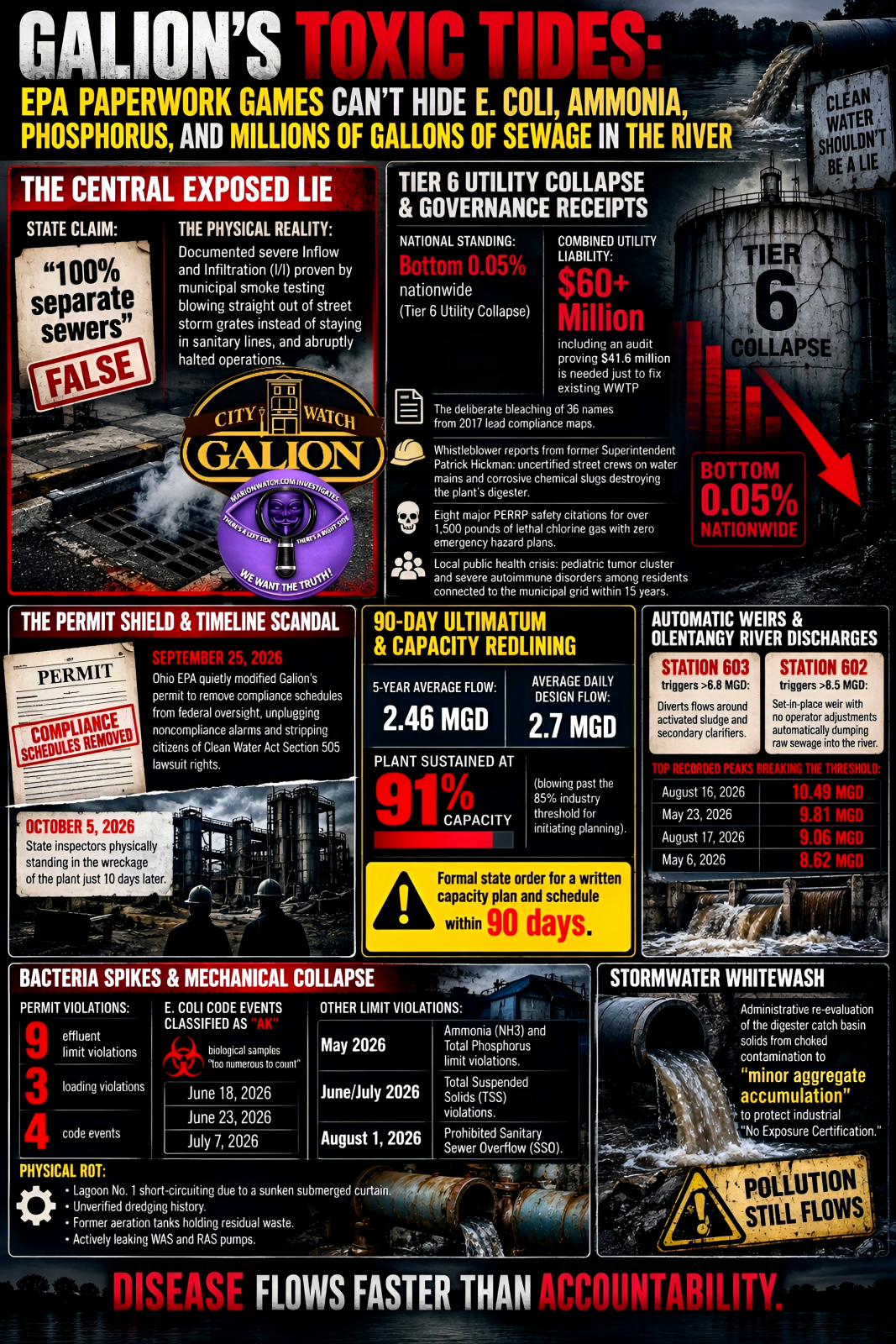
As we recently benchmarked against 66,000 municipalities nationwide, Galion currently suffers from a Tier 6 utility collapse—placing the city’s failing grid in the bottom 0.05 percent of the country.
The historical receipts prove a catastrophic failure of municipal governance:
● A $60+ million combined utility liability, including an engineering audit proving $41.6 million is required just to fix existing equipment at the Wastewater Treatment Plant.
● The deliberate bleaching of 36 names from the city’s 2017 lead compliance maps to protect insiders and mathematically dilute failure rates.
● Explosive whistleblower disclosures from former Superintendent Patrick Hickman, who documented the use of uncertified street crews on water mains and the dumping of corrosive chemical slugs that destroyed the plant’s digester.
● Eight major PERRP safety citations for storing over 1,500 pounds of lethal chlorine gas with zero emergency hazard plans.
● A localized public health crisis featuring a pediatric tumor cluster and clusters of severe autoimmune disorder symptom increases, specifically among residents who relocated to the city within the last 15 years and connected to the municipal grid.
Despite this undeniable catalog of failure, on September 25, 2026, the Ohio EPA modified Galion’s permit to remove compliance schedules from federal oversight.
This maneuver successfully unplugged the federal noncompliance alarms and effectively stripped downstream citizens of their Clean Water Act lawsuit rights.
But the state cannot fix broken pipes with a pen.
Two newly obtained Ohio EPA documents, both dated October 28, 2026, prove exactly what was happening at the physical plant while the state was busy sanitizing the paperwork.
THE TIMELINE SCANDAL
The timeline itself is the scandal.
The Ohio EPA signed off on Galion’s regulatory shield on September 25, 2026.
Exactly ten days later, on October 5, state inspectors were physically standing inside the Galion plant, staring at leaking pumps, raw sewage records, and a sunken lagoon.
The state handed Galion a legal pass while physically standing in the wreckage of a Tier 6 utility collapse.
To understand the true scale of Galion’s failure, the public must understand the specific environmental events documented in these new EPA reports.

A 90-DAY ULTIMATUM: REDLINING AT 91 PERCENT CAPACITY
While state regulators and local officials point to laundered compliance dashboards to claim everything is fine, a separate EPA Capacity Evaluation letter issued on October 28 proves the physical iron of the Galion grid is permanently overburdened.
● Over a five-year review period from September 2021 through August 2026, the Galion plant discharged an average flow of 2.46 million gallons per day (MGD).
● Against an Average Daily Design Flow (ADDF) of 2.7 MGD, this means the plant has been sustaining operations at a staggering 91 percent of its approved design capacity.
● Industry and regulatory standards require initiating planning and design for capacity improvements when sustained flows exceed 85 percent of the ADDF.
● Because Galion has blown past this safety threshold for multiple consecutive years, the EPA has formally ordered the city to submit a written plan and schedule within 90 days outlining how it will address future capacity needs. Any future expansion will require strict Permit to Install (PTI) approval.
This 90-day ultimatum wasn’t just sent into the bureaucratic void.
The state’s mandate was addressed directly to Mayor Brian Saterfield, Safety-Service Director Nicole Ward, and WWTP Superintendent Renee Bodkins.
They hold the letter.
They know the grid is redlining.
They can not plead ignorance.
THE “100% SEPARATED” LIE AND HALTED SMOKE TESTING
Even more alarming than the daily averages are the rain-triggered surges.
The state has previously claimed Galion has “100% separate sewers,” meaning rainwater and raw sewage travel in entirely different, unconnected pipes. The physical flow data completely destroys this claim.
Massive amounts of stormwater are illegally infiltrating the sanitary lines.
This severe Inflow and Infiltration (I/I) was recently proven visually when municipal smoke testing blew thick smoke straight out of street storm grates instead of staying contained within the sanitary lines.
The October 28 EPA inspection report notes that the city has completed this smoke testing, but states the final report is “currently being prepared”.
The next sections prove, beyond a doubt, that inflow and infiltration is indeed still occurring despite the claim on the EPA paperwork that it is not.
This is literally a lie written directly into state and federal regulatory documents—proving for the second time definitively that the administrative paperwork games continue while the environment pays the price.
DEFINING THE DISCHARGES: BYPASSES VS. OVERFLOWS
When stormwater floods the broken sanitary sewer grid, the water has to go somewhere.
The EPA report documents two distinct types of failures that result in raw or under-treated sewage entering the environment: Plant Bypasses and Sanitary Sewer Overflows.
Both of these mechanisms directly contradict the official administrative claim that Galion operates a “100% separate sewer system”.
In a truly separate system, rainfall stays in storm drains and never impacts the sanitary plant or collection grid.
The sheer existence of both plant bypasses and street-level overflows proves that millions of gallons of stormwater are pouring into the sanitary pipes, completely destroying the state’s clean-paper narrative.
Plant Bypasses (Flushing Sewage into the River): A bypass happens inside the treatment plant. When the sheer volume of water is too massive for the biological treatment tanks to process, automatic weirs physically divert the excess flow around the treatment phases and discharge it directly into the Olentangy River.
This massive volumetric surge inside the plant is direct physical proof of massive Inflow and Infiltration (I/I); if the sewers were truly “100% separate,” rainwater would never reach the plant to trigger these weirs.
● Station 603 triggers when flows exceed 6.8 MGD, diverting millions of gallons around the activated sludge system and secondary clarifiers.
● Station 602 is triggered when flows exceed 8.5 MGD, bypassing both primary and secondary treatment entirely. The EPA notes this is controlled by a “set-in-place weir with no operator adjustments,” meaning it automatically dumps raw sewage into the river the moment it hits that level.
The flow data recorded by the EPA during the summer of 2026 confirms these bypass weirs were triggered repeatedly.
On four separate occasions, the plant blew far past the absolute peak 8.5 MGD trigger, making it a mathematical certainty that millions of gallons of sewage were flushed over the weirs and into the river.
The Top 10 flows recorded by the EPA during this period were:
● August 16, 2026: 10.49 MGD (Catastrophic weir bypass)
● May 23, 2026: 9.81 MGD (Catastrophic weir bypass)
● August 17, 2026: 9.06 MGD (Catastrophic weir bypass)
● May 6, 2026: 8.62 MGD (Catastrophic weir bypass)
● May 25, 2026: 6.85 MGD (Secondary treatment bypass)
● August 11, 2026: 6.73 MGD
● May 24, 2026: 6.44 MGD
● August 18, 2026: 4.48 MGD
● May 20, 2026: 4.30 MGD
● May 9, 2026: 4.20 MGD
Sanitary Sewer Overflows (Street-Level Sewage Eruptions): While bypasses happen at the plant, a Sanitary Sewer Overflow (SSO) happens out in the city streets, providing yet another undeniable contradiction to the state’s claim of “100% separate sewers”.
An SSO occurs when underground sanitary pipes become so completely flooded with stormwater infiltration that raw, untreated sewage backs up and erupts out of manholes, floods basements, or runs off into local ditches before it can even reach the treatment plant.
In a separated system, stormwater runoff never enters the sanitary pipes; the occurrence of a storm-driven SSO physically invalidates the paper claim that storm and sanitary flows are isolated.
● The EPA documented a prohibited SSO raw sewage discharge on August 1, 2026.
● Under the Clean Water Act, SSOs are strictly illegal under all circumstances.
State inspectors explicitly noted in bold text: “All sanitary sewer overflows are prohibited”.
BACTERIA SPIKES AND EQUIPMENT COLLAPSE
During the exact same months the city administration was securing its regulatory shield in Columbus, the plant was actively violating environmental laws in Galion.
Since their previous inspection on June 3, 2026, the EPA logged nine permit effluent limit violations, three loading violations, and four code events.
● E. Coli Spikes: The plant logged code events on June 18, June 23, and July 7, 2026, where E. coli bacteria levels were classified as “AK”. The EPA defines this code as a biological sample that is “too numerous to count”.
● Ammonia, Phosphorus & TSS Violations: May 2026 saw multiple limit violations for Ammonia and Total Phosphorus, and June and July saw limit violations for Total Suspended Solids (TSS).
The new report also documents a facility struggling to hold itself together mechanically:
● Lagoon No. 1 is currently “short-circuiting” because a submerged curtain sank, and the city cannot even confirm the last time the lagoon was dredged.
● The former aeration tanks are sitting offline but still contain unresolved residual material.
● Photographs taken by state inspectors show vital WAS and RAS pumps actively leaking and awaiting replacement.
THE STORMWATER WHITEWASH
Most concerning is what appears to be an administrative pivot by the Ohio EPA to protect Galion’s industrial stormwater “No Exposure Certification”.
● In a previous inspection, the EPA noted a stormwater catch basin south of the digesters was choked with accumulated solids.
● In this new October report, the EPA suddenly re-evaluated the basin, declaring the solids to be “minor aggregate accumulation” and ruling the structure is now magically “functioning as intended”.
● This administrative whitewash conveniently aligns with the city’s recent legal certification swearing that zero industrial waste touches its stormwater.
GALION’S COLLAPSE: BY THE NUMBERS
● 91%: The capacity the plant has sustained over a five-year average.
● 10.49 MGD: The catastrophic flow peak on August 16, bypassing primary and secondary treatment directly into the river.
● $41.6 Million: The engineering estimate required just to fix the plant’s existing equipment.
● 0.05%: Galion’s utility rank nationwide (Tier 6 Collapse).
THE VERDICT
The October 28 EPA documents provide yet more definitive proof.
While state regulators and local officials attempt to engineer compliance on paper, the physical iron of the Galion grid is failing.
The automatic weirs are triggering.
The bacteria counts are off the charts.
The raw sewage is hitting the Olentangy River.
When E. coli is “too numerous to count” and millions of gallons of raw sewage are surging over automatic weirs into the local environment, it stops being an engineering problem and becomes a localized public health crisis.
You cannot separate a failing municipal grid from a potential public health crisis.
The Ohio EPA is protecting the permit, but who is protecting the citizens?
It is time for an intervention.