
 Written by
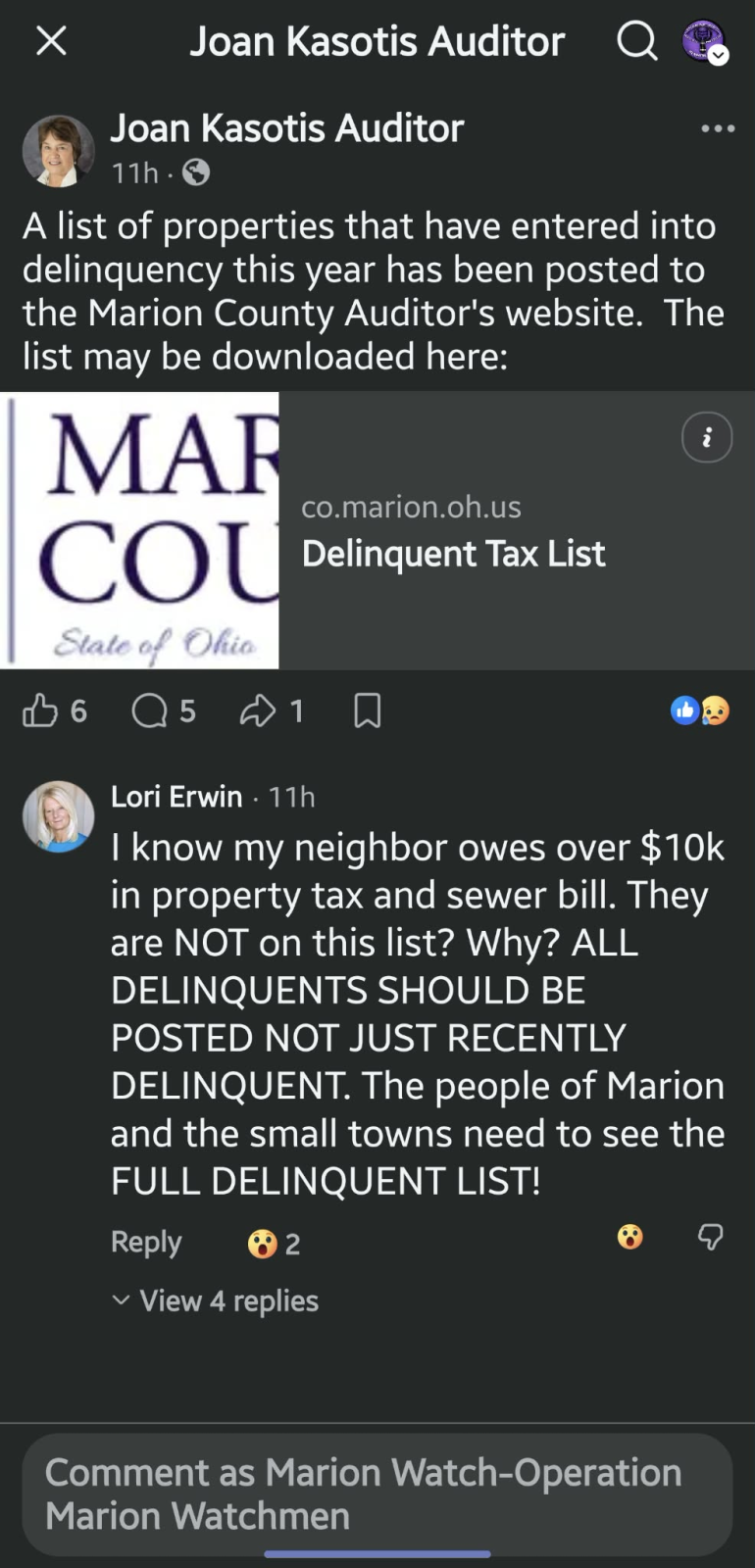
A routine social media post by Marion County Auditor Joan Kasotis was ostensibly intended to provide transparency regarding unpaid property taxes. Instead, it inadvertently exposed a multi-million-dollar blind spot in the county’s collection system—and a calculated data blackout designed to mask a decade of systemic administrative negligence.
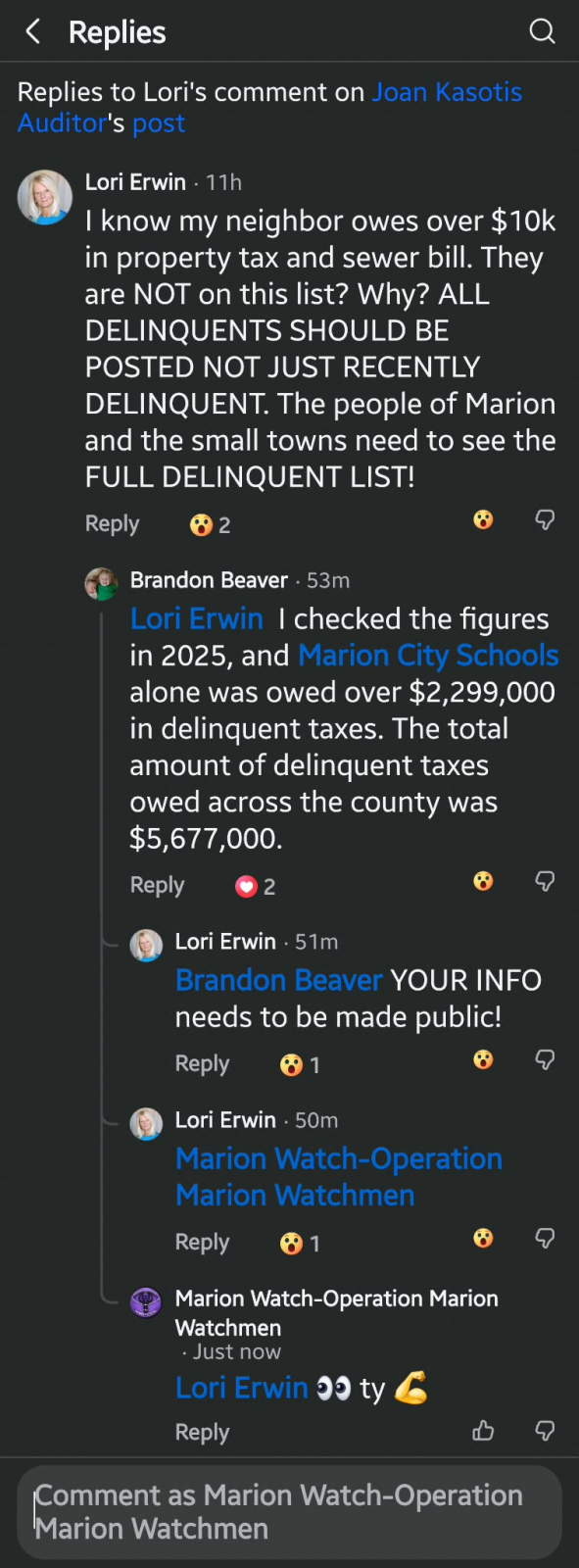
When the Auditor’s office published a link to the county’s delinquent tax list, local resident Lori Erwin immediately spotted a glaring omission: a neighboring property owing over $10,000 in combined property taxes and sewer bills was entirely absent from the registry.
The omission was no accident. It was the direct result of restrictive reporting parameters designed to conceal the macro-level crisis: the published list exclusively featured properties that “have entered into delinquency this year,” sanitizing the public record by erasing cumulative, multi-year defaults.

The Data Behind the Decade-Long Delinquency
To understand how a single property racks up five figures in uncollected debt without consequence, you have to examine the county’s historical enforcement data. When property taxes and certified city sewer liens go unpaid, the County Treasurer’s primary statutory enforcement mechanism under Ohio Revised Code Section 323.25 is filing a tax lien foreclosure.
According to public court records compiled by the Ohio tax database AxOHTax, Marion County’s collection enforcement has systematically collapsed over the last decade:
- 2015–2017 (Consistent Enforcement): The county maintained baseline accountability, averaging 150 tax lien foreclosures filed per year (153 in 2015; 155 in 2016; 141 in 2017).
- 2018–2019 (The Fluctuation): Filings dipped to 111 in 2018 before a temporary surge to 198 in 2019.
- 2020–2021 (The Collapse): Enforcement fell off a cliff, plummeting to just 39 foreclosures in 2020 and hitting a decade-low of 21 in 2021.
- 2022–2025 (The Stagnation): Filings never recovered, averaging a depressed 87 per year (94 in 2022; 78 in 2023; 80 in 2024; and 98 in 2025).
Overall, tax lien foreclosure enforcement in Marion County has plummeted by 36% since 2015. By refusing to utilize available legal tools, the county effectively grants a de facto immunity agreement to out-of-town LLCs and absentee corporate landlords who milk local rental properties for cash flow while completely abandoning their tax obligations.
Under Ohio Revised Code Section 5721.03, county auditors are mandated to compile and publish delinquent tax lists. By deliberately filtering this database to show only newly initiated defaults, the county shields chronic deadbeats and out-of-state portfolios from public scrutiny.
Erwin exposed this shell game, demanding the full, cumulative ledger be brought to light.
The Financial Drain on Local Schools: A Managed Crisis
The downstream destruction of this compounding debt was exposed by citizen researcher Brandon Beaver, who calculated that the cumulative amount of delinquent property taxes owed across Marion County sits at a staggering $5,677,000.
When cross-referenced against independent state audits and investigations conducted by Marion Watch and The Swamp Fox, this uncollected revenue directly exacerbates the manufactured financial crisis inside the Marion City School District (MCSD).
Dividing the school district’s estimated deficit share (2,299,000)by the county’s total claimed delinquency (5,677,000) yields a direct correlation of 40.49%—mirroring Ohio’s statutory tax distribution framework, where local school districts capture between 40% and 45% of total property tax revenue.
The School Board’s Shell Game: $10 Million in Pay Hikes While Crying Poverty
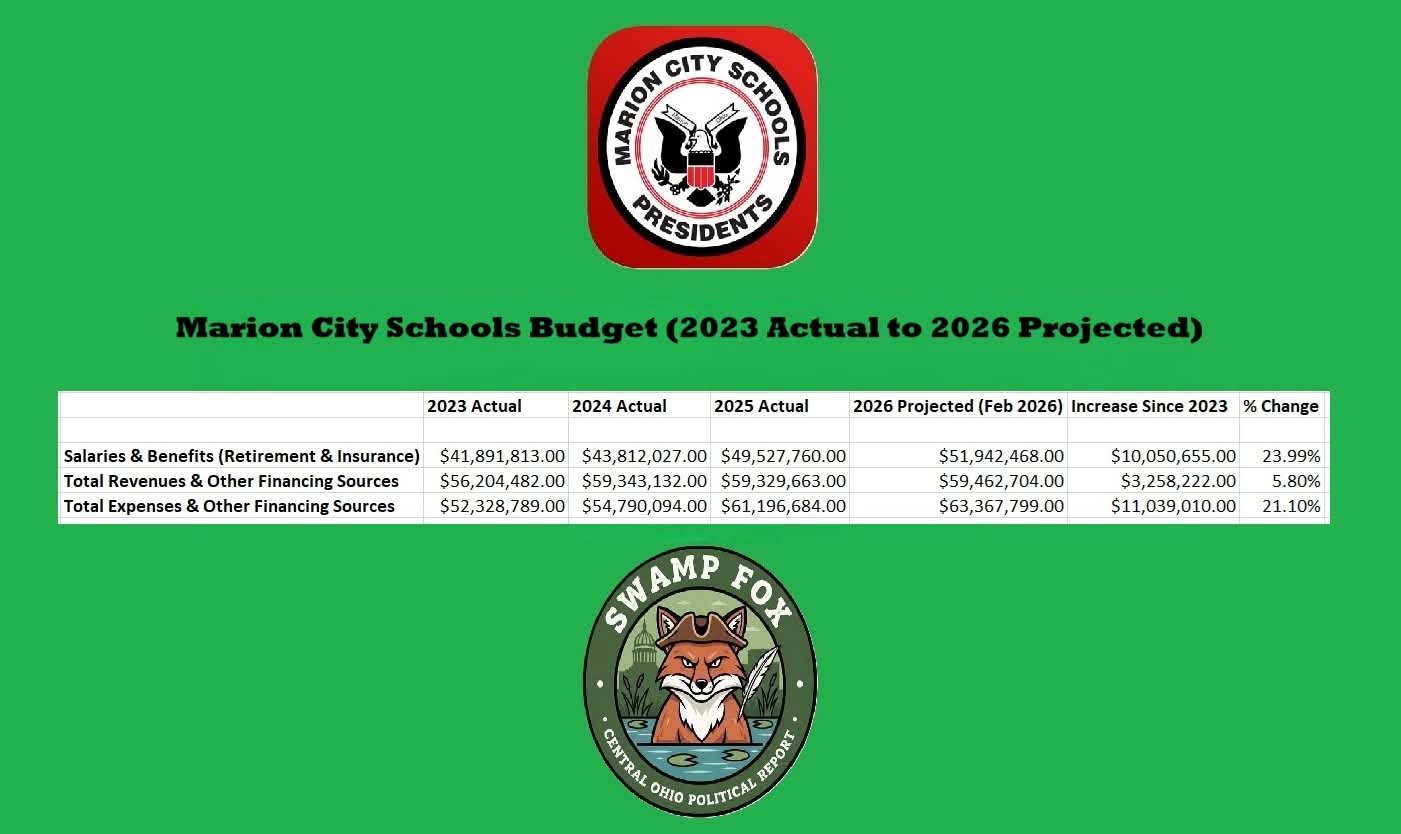
While the county protects tax delinquents through non-enforcement, MCSD leadership has spent years engineering its own internal fiscal disaster. As Marion Watch previously exposed, MCSD projected a catastrophic $3,905,095 budget deficit for 2026, driven not by an unavoidable lack of funds, but by aggressive, top-heavy administrative expansion and skyrocketing payroll.
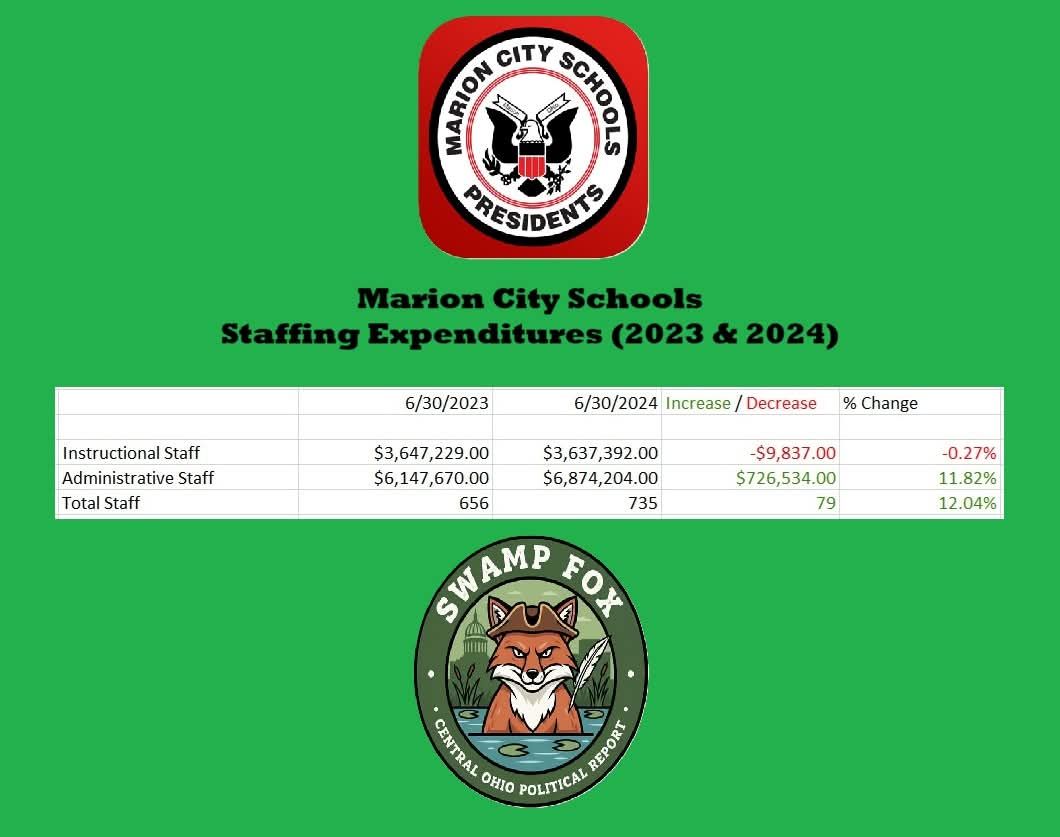
- The Hiring Spree: State audits prove that between 2023 and 2024, the district increased its staff headcount by 79 employees (from 656 to 735)—a massive 12.04% surge in a single year.
- Exploding Compensation: Driven by fat pay increases handed out in 2025, the district will spend over $10 million more on salaries and benefits in 2026 than it did in 2023 (a 23.99% jump), blowing past revenue growth entirely.
- The Administrator Discrepancy: While average teacher pay lags behind comparable districts and state averages, administrators pull in an average of $91,959, comfortably beating state benchmarks. Meanwhile, the district bleeds nearly 30% of its General Fund into outsourced “Purchased Services.”
- The Charter Cash Pipeline (Component Unit Shuffling): Underlying audits of the district’s discretely presented component units reveal a massive, opaque cash pipeline. In FY 2016 and FY 2017 alone, millions in related-party cash transfers flowed directly back from the Marion City Digital Academy ($678,705 in ’16; $658,162 in ’17) and Rushmore Academy ($1,569,493 in ’16; $2,210,446 in ’17) to the primary district under the guise of “administrative and support services”, propping up central office spending.
Institutional Secrecy: Hiding Behind “Modified Cash” Accounting
To keep the public in the dark about these structural failures, MCSD actively evades standard financial accountability. Ohio Administrative Code Section 117-2-03(B) legally mandates school districts to report using GAAP (Generally Accepted Accounting Principles), which provides full transparency on long-term debts, assets, and pension liabilities.
Instead, MCSD leadership and the Board of Education intentionally violate state code year after year, hiding behind a simplified “modified cash basis”. In official Corrective Action Plans, Treasurer Veronica Reinhart explicitly defended this evasion, stating the district refuses to convert to GAAP “In light of the higher costs, absence a material benefit, and financial constraints.” This intentional opacity has earned the district recurring Material Non-Compliance Findings in state audits spanning from 2016 through the present (including Findings 2016-001 and 2017-001).
The Bottom Line
Marion County has a $5.6 million collection crisis that officials refuse to aggressively pursue, and Marion City Schools has a self-inflicted $11 million spending spike masked by intentional violations of state transparency laws.
When the county lets corporate landlords squat on tax debt for a decade, and schools inflate administrative payrolls while shuffling millions through charter pipelines, the bill always lands on the responsible citizen. Unless the county seizes delinquent assets and the school board reins in executive bloat, the only “solution” management will offer is another tax levy to bail out their own systemic failure.
WORKS CITED (CLICK HERE)
- AxOHTax (Ohio Property Tax Database). Marion County Signing Locations: Tax Lien Foreclosure History 2015-2025. https://axohtax.com/counties/marion/
- Ohio Revised Code Section 5721.03: County auditor to compile delinquent tax list and delinquent vacant land tax list – publication. https://codes.ohio.gov/ohio-revised-code/section-5721.03
- Ohio Revised Code Section 323.25: Enforcement of tax lien. https://codes.ohio.gov/ohio-revised-code/section-323.25
- Ohio Auditor of State. Marion City School District Audits (Fiscal Years 2016–2024 Basic Financial Statements, including GAAP Non-Compliance Findings 2016-001 through 2024-001 and Related-Party Component Unit Notes). https://ohioauditor.gov/auditsearch/search.aspx
- Marion County Auditor: Delinquency Report Database. https://propertysearch.marioncountyohio.gov/DelinquencyReport
- Marion Watch Investigates. “Marion City School District Projects $3.9 Million Budget Deficit in 2026 after Increasing Salaries & Benefits Expenditures by Nearly 23% Since 2023” (March 15, 2026).
- Marion Watch Investigates. “The Financial State of Marion City Schools: The ‘Eight-Year Freeze’ Myth and the $10 Million Administrative Pay Hike” (March 19, 2026).
- State Employment Relations Board (SERB) Public Database: Marion Education Association Collective Bargaining Agreements (2015, 2019, 2022).