

 Written by
When military personnel, elected officials, and appointed government leaders enter public service, they swear a legally binding oath to “support and defend the Constitution of the United States against all enemies, foreign and domestic.” When this oath is broken—not merely through political corruption, but through the active betrayal of the nation via treason, espionage, or acts of war—it is universally recognized as the gravest crime in the American legal system.
The belief that those who use their trusted positions to prey upon or violently betray United States citizens should face the severest consequences is a foundational principle of U.S. national security law, supported by centuries of constitutional and military precedent.
The Legal Framework of the Ultimate Betrayal
To protect the republic, the framers of the U.S. Constitution carefully defined exactly what constitutes the ultimate betrayal. Aware of how European monarchs often used vague charges of “treason” to execute political rivals, they explicitly limited the definition in Article III, Section 3 to “levying War against them, or in adhering to their Enemies, giving them Aid and Comfort.”
The Uniform Code of Military Justice (UCMJ) is designed to deal harshly with oath-breakers in the armed forces. Under military law, the death penalty is authorized for specific, catastrophic betrayals: premeditated murder, mutiny, sedition, espionage, and desertion in the face of the enemy. The U.S. military has utilized executions since the Revolutionary War to maintain discipline and eliminate threats from within. During World War II, the military executed Private Eddie Slovik by firing squad for desertion—the last time a U.S. soldier was put to death for a strictly military offense.
Today, the death penalty is explicitly reserved for officials and soldiers whose actions directly endanger the lives of American citizens or the security of the state.
The Fort Hood Massacre: A Modern Betrayal
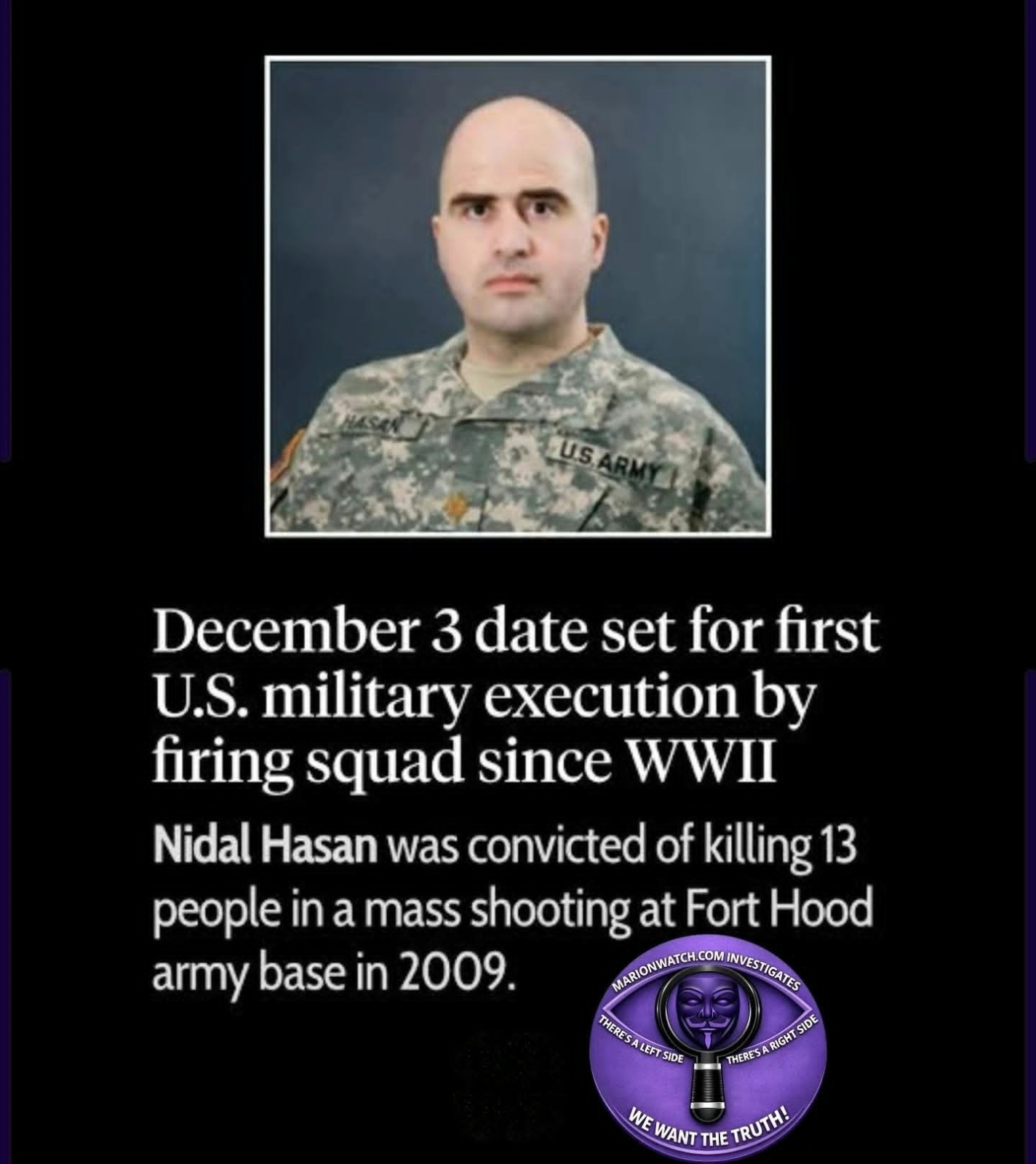
This legal reality was thrust back into the national spotlight in October 2026, when the U.S. government announced the impending military execution of Nidal Malik Hasan.
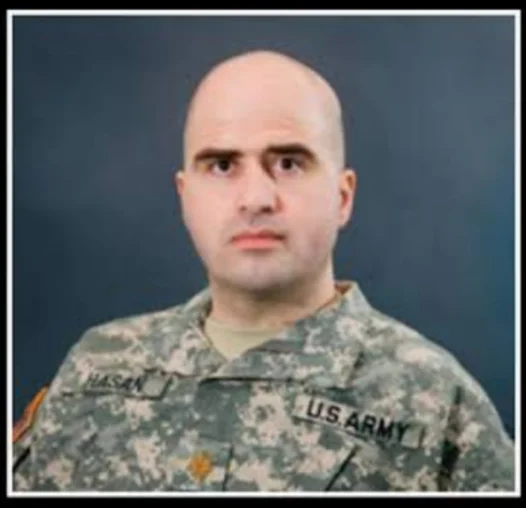
On November 5, 2009, Hasan, a 39-year-old U.S. Army Medical Corps psychiatrist, walked into the Soldier Readiness Processing Center at Fort Hood, Texas. The facility was crowded with unarmed military personnel preparing to deploy to combat zones. Armed with a semi-automatic pistol equipped with laser sights, Hasan shouted “Allahu Akbar” and opened fire.
He systematically targeted soldiers in uniform, bypassing civilians. In 10 minutes, he fired 214 rounds, murdering 13 people (12 soldiers and one civilian physician assistant) and wounding 32 others. The massacre ended when Department of the Army civilian police officers engaged him in a firefight. Hasan was shot several times, severing his spine and leaving him paralyzed.
The Case File:
Hasan’s actions were a violent betrayal of both his military oath as an officer and his medical oath as a doctor. An FBI investigation revealed he had been in electronic communication with Anwar al-Awlaki, a radical cleric and al-Qaeda recruiter. Hasan believed he had a religious obligation to kill American soldiers and later referred to himself as a “Soldier of Allah” fighting a jihad from within.
During his 2013 court-martial, Hasan dismissed his military-appointed defense attorneys and represented himself. He offered virtually no defense, called no witnesses, and openly admitted to the shooting in his opening statement. He was found guilty of 13 counts of premeditated murder and 32 counts of attempted premeditated murder, and sentenced to death.
The Execution: Firing Squad Protocols
The execution order, directed by Acting Secretary of the Army Adam Telle and approved by President Donald Trump, schedules Hasan’s death by firing squad for December 3, 2026, at 1:00 p.m. CST at Fort Hood. In a highly unusual move, the Pentagon announced that the execution will be publicly livestreamed.
The decision to utilize a firing squad represents a return to historical military justice, bypassing modern lethal injection bottlenecks.
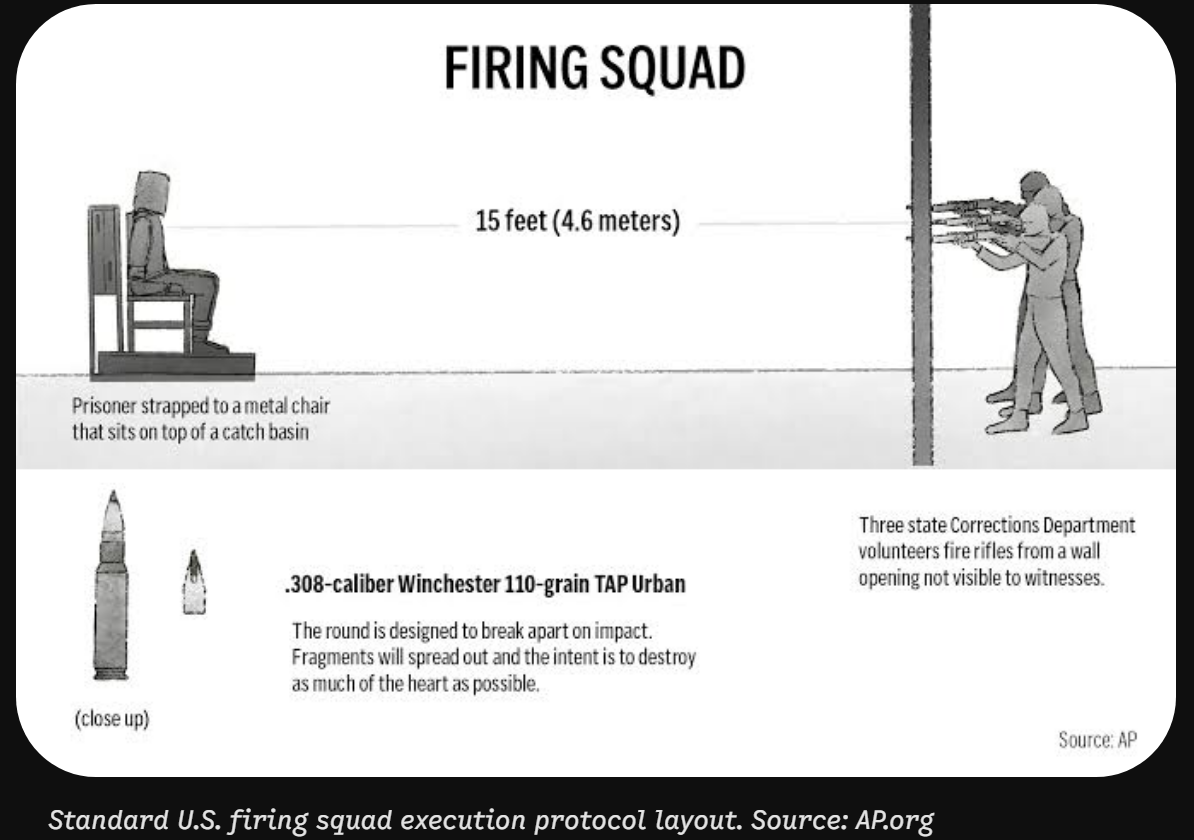
While civilian protocols (like those used recently in South Carolina or Utah) and military protocols vary slightly, a standard U.S. firing squad execution is conducted with strict precision:
- The Setup: The condemned is strapped into a specialized metal chair surrounded by sandbags or a catch-basin to absorb blood and bullet fragments. A dark hood is placed over their head, and a circular white cloth target is pinned directly over their heart.
- The Squad: Five volunteer shooters—typically law enforcement or military personnel—stand behind a wall roughly 15 to 20 feet away. They aim rifles through horizontal slots, remaining largely out of sight of witnesses.
- The Execution: The rifles are pre-loaded by a third party. Four rifles contain live rounds (often .308-caliber designed to break apart on impact to destroy the heart instantly). One rifle is loaded with a “dummy” or blank round. None of the shooters know who has the blank, a psychological mechanism meant to diffuse the burden of taking a life. On command, the shooters fire simultaneously.
Capital Espionage and Embedded Betrayals
Espionage is not merely a crime of theft or deception; under both U.S. federal law (18 U.S.C. § 794) and the Uniform Code of Military Justice (Article 106a), it is a capital offense. The government holds the explicit legal authority to execute anyone—whether a uniformed officer, a civilian government employee, or a foreign agent operating on American soil—who gathers or delivers national defense information to a foreign adversary. While some infamous spies have avoided the execution chamber through plea agreements or diplomatic prisoner swaps, the legal framework strictly classifies these betrayals as death penalty-eligible crimes.
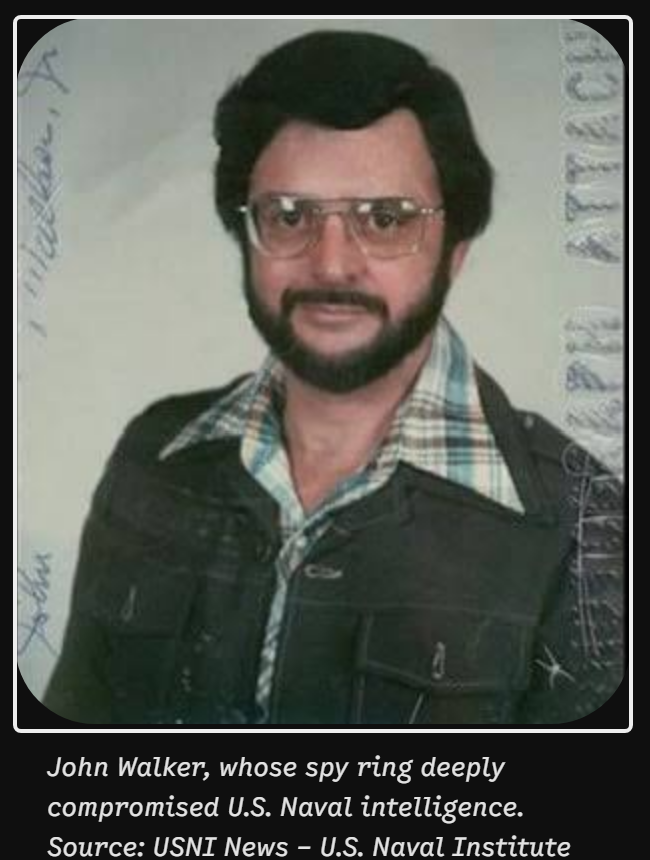
- The Walker Family Spy Ring (1980s): U.S. Navy warrant officer John Anthony Walker Jr. operated a spy ring that leaked highly classified naval cryptographic technology to the Soviet Union for nearly two decades. As a sworn military official compromising national defense, Walker was fully eligible for the death penalty. He only avoided a capital trial by brokering a plea deal, agreeing to a life sentence and full cooperation to secure a lighter sentence for his son, Michael, whom he had also recruited into the treasonous scheme.
- Cold War “Romeo” Spies (1950s–1990): Throughout the Cold War, East German intelligence deployed “Romeo” spies—male operatives specifically trained to seduce and embed themselves into the lives of female aides working within the West German government and NATO. The officials who broke their oaths by handing over top-secret defense strategies to these operatives engaged in capital espionage, compromising Western security at the highest levels.
- Russian “Illegals” Embedded Families (1990s–2010): The Russian “Illegals” program involved foreign agents assuming the stolen identities of dead Westerners, moving to U.S. suburbs, and living as ordinary American families. By infiltrating U.S. policymaking to siphon intelligence to Moscow, these embedded agents committed acts of espionage that carry the ultimate penalty under federal law, though this specific group was deported in a historic 2010 prisoner exchange to secure the release of Western intelligence assets.
Modern Capital Threats (2025–2026)
The threshold for capital espionage continues to apply to modern threats, where compromised insiders and foreign agents attempt to steal critical data or surveil targets on American soil.
- The Stuttgart Wireless Spy Ring (2025): An advanced Russian-linked spy ring was dismantled after targeting U.S. and Ukrainian military personnel at the Stuttgart Army Airfield. Operatives using advanced wireless surveillance technology to intercept military communications engaged in direct espionage against U.S. forces, placing them squarely within the crosshairs of capital offenses.
- The LAX Arrest (2026): In October 2026, the FBI arrested Wanying Zhang at Los Angeles International Airport. Operating as an unregistered agent for the PRC, Zhang was surveilling the U.S.-based family members of Taiwan’s president. Such coordinated intelligence gathering and operations on American soil represent the exact type of foreign infiltration that federal capital espionage statutes were designed to punish.
Whether it is a uniformed officer committing violence against their own, a naval family selling cryptographic keys, or foreign agents establishing embedded families in American suburbs, the betrayal of the nation requires relentless vigilance. For those who swear the oath of office and then actively cross the line into treason or espionage, the United States continues to hold the death penalty in reserve as the ultimate legal consequence.