

 Written by
There is a specific kind of municipal alchemy where failing infrastructure is repaired not with steel or concrete, but with ink. If the system is broken, you don’t fix the pipes—you simply rewrite the rules governing the pipes.
On August 6, 2026, this investigative network exposed the blueprint for this exact bureaucratic maneuver taking shape in Galion, Ohio. We warned that the Ohio EPA was actively coaching municipal leadership to weaponize administrative loopholes, paving over the severe physical collapse of the city’s wastewater infrastructure with a thick layer of regulatory paperwork.
Less than a month later, the prophecy has been fulfilled.
The “Regulatory Shield” is now fully operational, successfully blinding federal oversight and allowing the municipality to legally ignore a failing utility grid.
But internal emails reveal that this September maneuver was not an isolated incident. It is the culmination of a multi-year administrative shell game between Galion officials and the Ohio EPA—a quiet war against transparency characterized by missed deadlines, ignored mandates, and a staggering disconnect between the paper they sign and the reality they govern.
It appears to be a calculated effort to launder failing grades and keep the federal EPA off their backs.
2023: The Delusion of “Maintenance Issues”
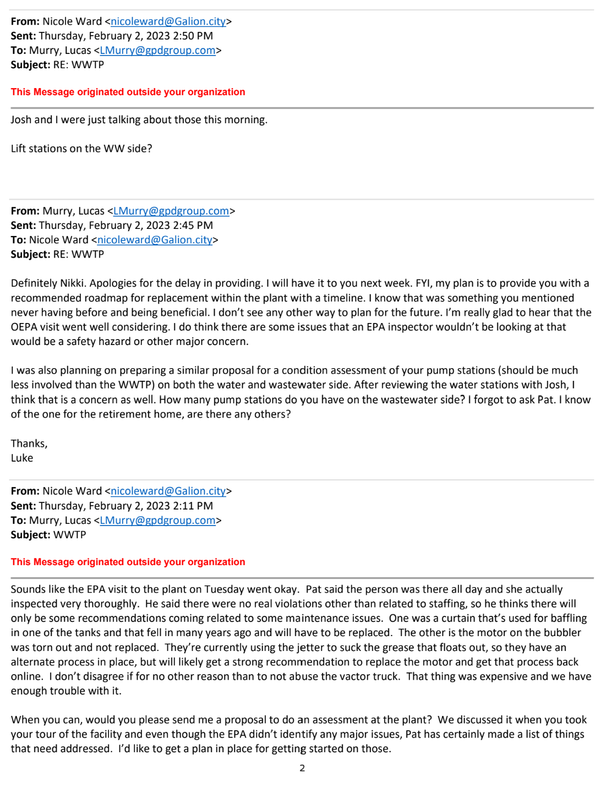
The internal disconnect regarding the severity of Galion’s infrastructure crisis is glaring. In a February 2, 2023 email to GPD Group engineer Lucas Murry, Safety-Service Director Nicole Ward discussed an Ohio EPA visit, stating: “Pat said the person was there all day and she actually inspected very thoroughly. He said there were no real violations other than related to staffing, so he thinks there will only be some recommendations coming related to some maintenance issues”.
To frame the plant’s condition as a mere “maintenance issue” was either a severe underestimation or willful ignorance. During this exact same timeframe, the plant was suffering from massive wet-weather bypasses, and an ensuing state investigation by the Public Employment Risk Reduction Program (PERRP) would soon issue eight major safety citations for lethal workplace conditions, including the catastrophic mishandling of over 1,500 pounds of chlorine gas and unpermitted confined space entries.
2024: The Ignored Mandate to Stop Bypasses
By 2024, the Ohio EPA was well aware that the Galion plant was routinely bypassing millions of gallons of raw, untreated sewage.
On April 15, 2024, Ohio EPA Environmental Specialist Mallorey Smith sent an email flagged with “High” importance to Nicole Ward and Superintendent Pat Hickman. The state demanded a past-due “Discharge Prevention Plan” which legally required the city to “conduct a comprehensive analysis of all feasible alternatives necessary to eliminate bypasses at the treatment plant and any overflows in the collection system”.
The following day, Ward responded that the city was working to get a new proposal from GPD Group to look at the bypass alternatives.
The mandate was clear: the city was legally required to figure out how to stop dumping raw sewage into the Olentangy River.
2026: The Stormwater Question and the Pivot to Evasion
Two years later, the bypasses were still occurring, and the reporting was still failing. In an April 21, 2026 email following the resignation of the WWTP Superintendent, the EPA’s Mallorey Smith again reprimanded the city, noting that “Previous reports were often not submitted within appropriate timelines”.
Crucially, in this same email, the state regulator asked a fundamental question regarding the plant’s industrial stormwater permitting (MSGP): “The stormwater catch basins at the wastewater treatment plant… where do those lead to? Do they discharge directly to stream or are they routed back to the headworks?”.
This email proves that in April 2026, the Ohio EPA did not even know where the plant’s stormwater drained. Yet, less than three months later, the EPA would advise the city to legally certify that the plant had absolutely no exposure to stormwater.
GALION WWTP BYPASS REPORTS
The Blueprint for the Cover-Up?
Instead of enforcing the 2024 mandate to physically eliminate the sewage bypasses, the Ohio EPA shifted its strategy to paperwork management.
In a July 1, 2026, inspection report, the state regulators handed Galion the precise instructions needed to erase its failing grades:
- Recommendation #2 (Erasing SNC Status): The EPA explicitly advised Galion to submit an NPDES permit modification application to remove overdue compliance milestones, coaching the city that, “Taking this step will help the facility resolve its current SNC status”.
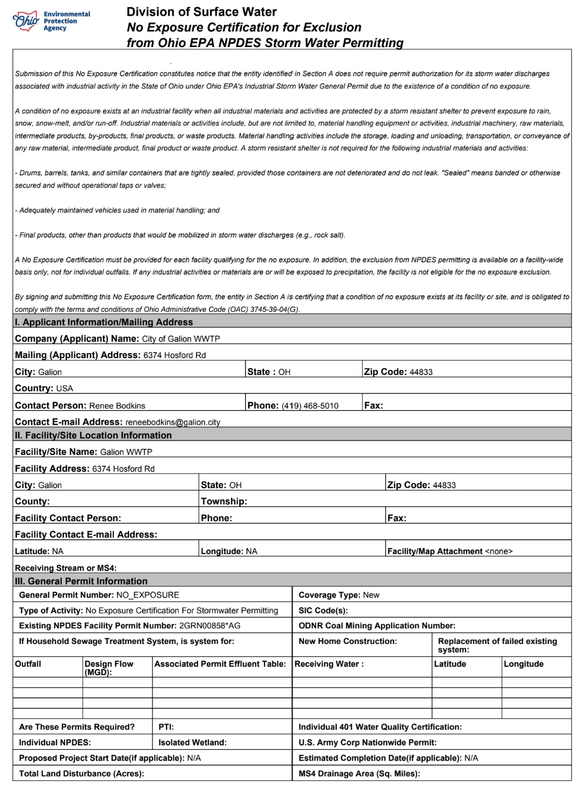
- Recommendation #4 (The Stormwater Exemption): Despite not knowing where the catch basins drained just months prior, the state instructed the city to submit a “No Exposure Certification” (NOE) to terminate the plant’s industrial stormwater permit entirely.
Why would state and local officials go to such lengths to shuffle this specific paperwork? To evade the federal dashboard. The U.S. EPA relies on national tracking systems to monitor facilities trapped in Significant Noncompliance (SNC). By stripping the missed deadlines out of the federal NPDES permit and shifting them into localized, state-level orders, the Ohio EPA effectively laundered Galion’s failing grades. The maneuver scrubs the city from the federal watchlist, ensuring Washington sees a compliant facility on paper while the local reality remains a catastrophe.
The Execution and the $41.6 Million Reality
Municipal leadership followed the EPA’s instructions to the letter. In their permit modification application, city officials explicitly admitted their motive, writing that they were “Requesting that the Schedule of Compliance be removed from the permit to keep Galion out of significant noncompliance.”
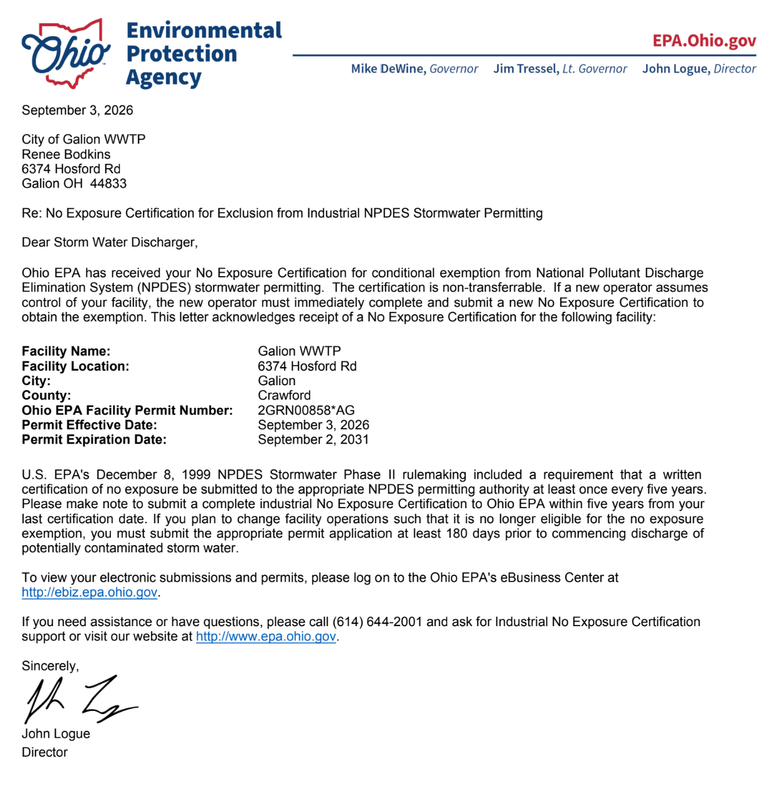
The final piece of the shield was locked into place on September 3, 2026. The wastewater superintendent filed the No Exposure Certification, legally swearing that zero industrial materials or waste products at the facility are exposed to precipitation. The Ohio EPA rubber-stamped the exemption on the exact same day.
This certification rests on a staggering semantic loophole. The Ohio EPA inspection report officially classifies Galion as having “100% separated sewers”. In a truly separated system, rainwater never enters the sanitary pipes. Yet, that exact same state report confirms wet-weather flows regularly shoot past the plant’s 8.5 million gallons per day peak capacity, triggering massive bypasses of untreated sewage.
The only way a separated sewer exceeds its capacity during a storm is through massive inflow and infiltration—meaning millions of gallons of rainwater are illegally flooding the decaying underground pipes and mixing directly with human waste.
This exposure is not just theoretical; the city has publicly admitted it. On June 3, 2026—exactly three months before signing a federal document swearing to “No Exposure”—the City of Galion posted an official notice on its website announcing citywide smoke testing. The city explicitly stated the testing was required to locate where “stormwater and groundwater enter sanitary sewer systems,” openly admitting that heavy rains introduce “millions of extra gallons” into their network.
Municipal leadership used surface-level technicalities to certify “No Exposure” to the rain, deliberately ignoring the fact that they were simultaneously pumping smoke through their own pipes to find all the places the rain was pouring in.
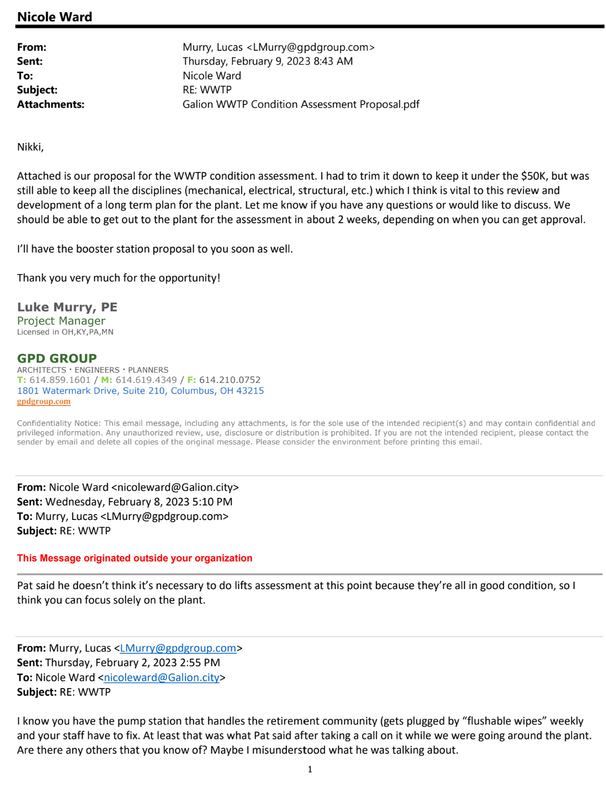
By securing this federal exemption, the city has built a regulatory fortress to hide an undeniable physical reality. An extensive facility assessment conducted by GPD Group confirmed that the Galion Wastewater Treatment Plant requires an estimated $41.6 million simply to maintain and rehabilitate its decaying infrastructure.
The Ohio EPA did not force Galion to fix the pipes, stop the bypasses, or secure the lethal chlorine gas. They simply coached the city on how to scrub its failures from federal compliance dashboards.
The paperwork looks clean, but the pipes are still broken.
How broken? We will find out soon!