


 Written by
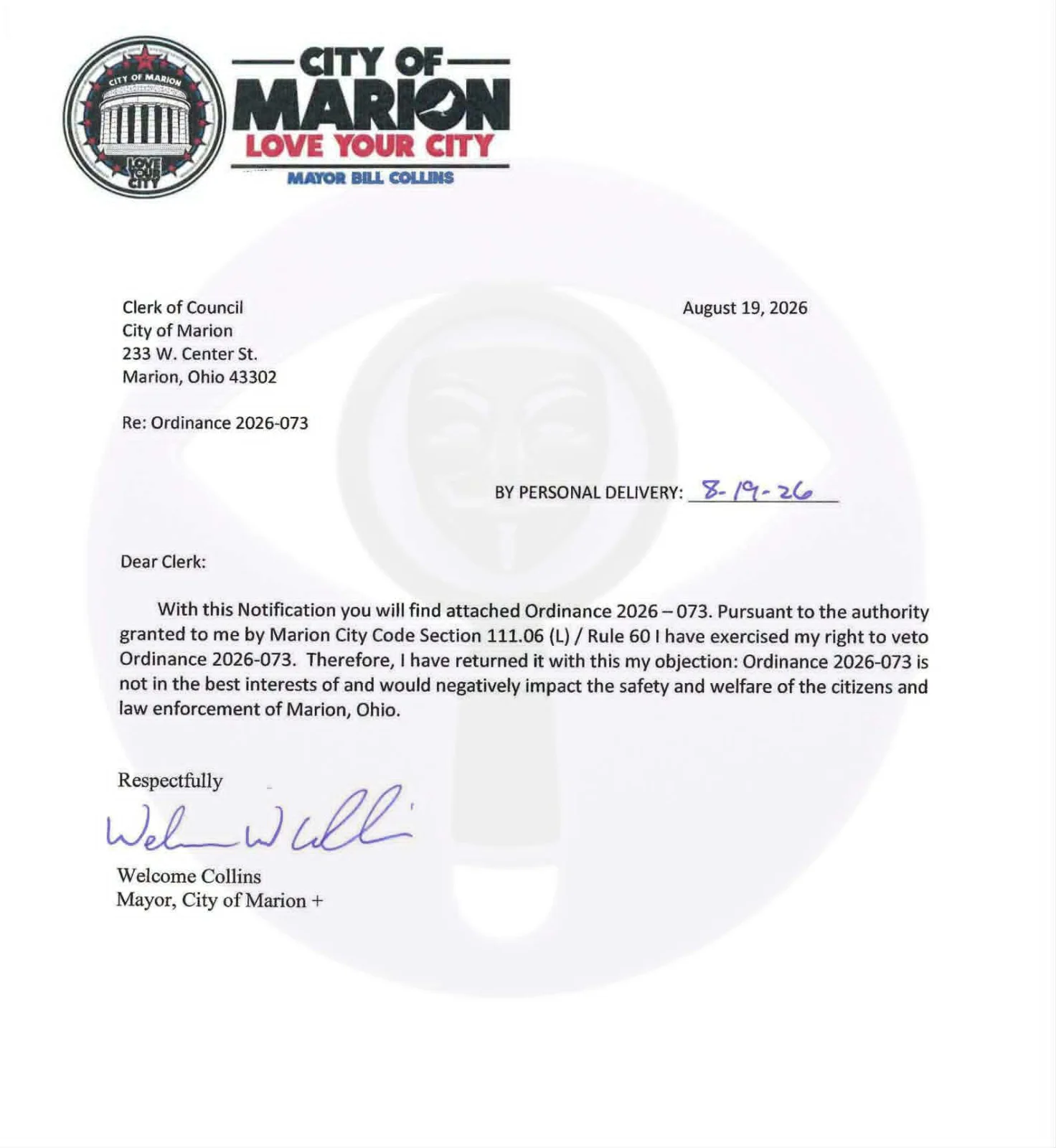
On Wednesday, Mayor Welcome “Bill” Collins issued a formal veto of Ordinance 2026‑073, striking down a narrow 5‑4 City Council decision to ban Flock Safety automated license plate readers (ALPRs) in Marion, Ohio. Drawing on his law enforcement background, the Mayor stated the ban “would negatively impact the safety and welfare” of the city.
Marion Watch’s document review confirms that Marion’s Flock system was installed during the Schertzer administration without formal City Council approval. The contract and deployment were executed through the executive branch, bypassing legislative involvement and leaving the system operating without direct council authorization.
A broader national review of municipal reporting, public records, and ALPR policy disputes found no widely documented instance of a U.S. mayor using an executive veto specifically to overturn a city council’s legislative ban on Flock technology. Other cities have fought over ALPRs, terminated contracts, or restricted deployments, but Marion’s combination of an executive‑installed system and a mayoral veto preserving it appears to be an outlier in the public record.
THE NATIONAL BACKLASH: TERMINATED CONTRACTS AND GRASSROOTS OPPOSITION
Across the country, the push to restrict or dismantle ALPR networks is accelerating as communities react to unauthorized data‑sharing, misuse, and the quiet expansion of surveillance infrastructure. In just the past week, several jurisdictions have moved decisively against Flock Safety:
SURPRISE, ARIZONA
On August 18, 2026, Surprise abruptly canceled its Flock Safety contract and ordered the immediate removal of all equipment. The decision followed an internal investigation in which a police officer was placed on leave for suspected misuse of the automated system. Local reporting describes the termination as a direct response to concerns about how the technology was being used inside the department.
EASTHAMPTON, MASSACHUSETTS
Earlier in 2026, Easthampton city councilors eliminated funding for Flock technology. With no budget support, the police chief terminated the contract and removed the cameras. Coverage by The Shoestring detailed how local ALPR data was being shared out‑of‑state, undermining local ordinances and fueling public anger over the lack of control and transparency.
INDEPENDENCE, KENTUCKY
On August 18, 2026, Independence held a special public meeting focused on Flock cameras. According to LINK nky, residents expressed “universal opposition” to the system, raising concerns about constitutionality, data security, and the creeping scope of the network. The meeting became a focal point for community resistance to ALPR expansion.
PRINCETON, NEW JERSEY
On August 16, 2026, residents in Princeton launched an aggressive campaign to preemptively ban ALPRs. As reported by The Cool Down, organizers are demanding strict public hearings and clear rules before any local infrastructure is absorbed into what they describe as a “nationwide surveillance network.” Their effort is aimed at stopping Flock‑style deployments before they become entrenched.
Taken together, these examples show a clear pattern: municipalities and residents are increasingly unwilling to accept opaque, vendor‑driven surveillance networks, especially when data flows and system controls are not fully understood or governed.
CORPORATE DAMAGE CONTROL: FLOCK’S RECENT SECURITY OVERHAUL
Facing mounting federal scrutiny, canceled municipal contracts, and audits that exposed severe breakdowns in configuration data, Flock Safety has moved into damage control.
On August 13, 2026, Flock CEO Garrett Langley announced a sweeping PR and security campaign aimed at tightening the platform’s heavily criticized internal controls. According to corporate statements and law enforcement trade coverage, the company is rolling out mandatory safeguards intended to reassure agencies and the public:
REDUCED DATA RETENTION
Flock is lowering its recommended default data retention threshold from 30 days to just 7 days, a change presented as a privacy‑oriented adjustment to limit how long plate data remains in the system.
MANDATORY CASE NUMBERS
By the end of the year, all law enforcement searches on the platform will be required to have an official case number. The stated goal is to curb unverified tracking and ensure that queries are tied to documented investigations.
SUSPICIOUS ACTIVITY LOCKOUTS
Flock is introducing automatic system lockouts triggered by predefined suspicious user behavior. When those triggers fire, access is cut off until an administrative review is completed, adding a layer of internal oversight over how the system is used.
TRANSPARENCY PORTAL
Through its own Flock Updates blog, the company is heavily promoting a “Transparency Portal” designed to let agencies publicly log their camera policies, retention rules, and data‑sharing partners. The portal is being marketed as a way for departments to demonstrate accountability to their communities.
These changes underscore the scale of the trust problem Flock now faces. They also highlight how dependent local agencies have become on vendor‑controlled mechanisms to police their own surveillance tools.
THE SINGULAR PRECEDENT IN MARION AND THE COUNCIL’S RESPONSE
Despite Flock’s attempts to harden its architecture and mitigate a nationwide PR crisis, the broader trend is clear: municipal consensus is turning against open, lightly governed ALPR networks. Where jurisdictions like Surprise and Easthampton are abandoning the technology altogether due to verified internal discrepancies and misuse, Marion’s executive branch is moving to ensure its system stays online.
The mayoral veto has not ended the legislative battle. Responding directly to Collins’ override of the 5‑4 council vote, Councilman Aaron Rollins issued a public statement urging citizens to apply pressure:
“Not happy at all. Our legislative actions have been nullified and the voices of concerned citizens have been ignored. I am committed to seeing this legislation through and will be taking actions as such! In the meantime it is critical that citizens contact their councilperson and express their opinions. We need to flip one ‘no’ vote to ‘yes’ to override the veto!”
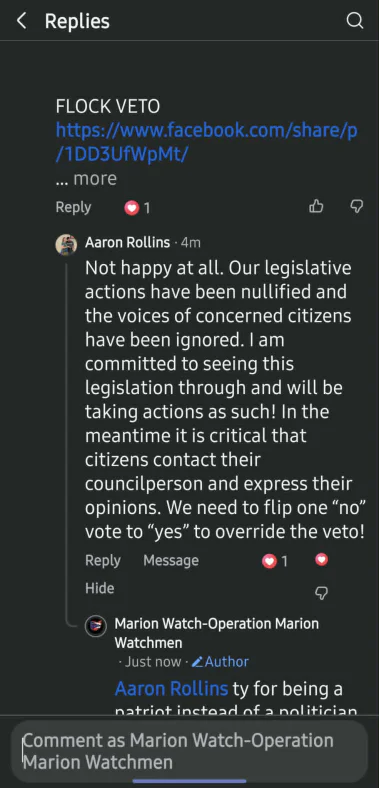
Under Marion’s circumstances, a single vote shift would give the council the numbers needed to attempt an override. That makes public engagement and constituent contact a decisive factor in whether the Flock ban ultimately stands or the mayor’s veto is sustained.
MARION AT THE CENTER OF THE DEBATE
With an ALPR system installed without formal council approval, a narrow legislative ban, and a mayoral veto preserving the network, Marion now sits at the center of the national debate over:
• Municipal governance and the limits of executive power
• Enterprise surveillance software integrity and vendor‑controlled safeguards
• The balance between public safety claims and mass data collection
Other cities are pulling back from Flock, terminating contracts, or demanding strict hearings before deployment. Marion’s executive branch, by contrast, has chosen to preserve the system over a documented council ban and a growing national backlash.
Whether the council can rally the single vote needed to override the veto will determine not just the fate of Flock in Marion, but how far a mayor can go to preserve contested surveillance infrastructure against legislative opposition.