

 Written by
 Recently hired Superintendent Renee Bodkins brings a proven track record to the table, having successfully navigated and rehabilitated catastrophic wastewater conditions in nearby Crestline.
There is genuine hope that she can apply that same expertise to rescue Galion’s failing grid.
However, the investigative stance of this network remains absolute: no permit modification can be allowed to proceed at this time.
The Ohio EPA’s July 1 inspection report is an objective train wreck of non-compliance.
For years, the City of Galion has operated its wastewater, water, and storm sewer infrastructure under a cloud of systemic dysfunction and regulatory leniency. Through our ongoing evaluation of raw municipal data and state files, a terrifying operational reality has emerged: the city’s public utilities are failing at several levels.
Yet, rather than facing the stringent, unyielding enforcement required to protect public health, the city is benefiting from a documented administrative sleight-of-hand orchestrated directly alongside state regulators.
We are calling this tactical evasion the “Regulatory Shield.” This shield has nationwide precedents, with drastically devastating outcomes.
While Part I of the newly named series on Galion’s wastewater and storm sewer systems exposes how this structural collapse was allowed to happen and how the state suggested a shield to help lessen the visibility, Part II will examine the true cost of this destruction—a price tag that is massive, significant, mostly hidden from the public view, and was entirely avoidable.
A review of recent city council summaries and local media coverage reveals exactly how this reality has been sanitized.
When the city enacted consecutive 20% sewer rate hikes in June 2024 and June 2025—paired with simultaneous water rate increases executed by the Safety Service Director, which legally bypassed council voting entirely—the financial burden was sold to residents as a standard necessity to cover basic “operating costs” and prevent draining the general fund.
Similarly, when Wessler Engineering presented catastrophic hydraulic overloading data, the resulting smoke-testing was framed publicly as routine “leak detection.”
Nowhere in the public discourse were citizens informed that their skyrocketing utility bills were actually funding a desperate response to lethal workplace safety citations, hundreds of millions of gallons of raw bypass events, and a calculated administrative effort to scrub the city’s active Significant Noncompliance status from federal dashboards.
These are not points drawn by Marion Watch, they are taken directly from official records, and in some cases insiders.
The “Regulatory Shield” and Documented EPA Complicity
In early 2026, the revolving door of accountability at the Galion Wastewater Treatment Plant (WWTP) spun once again. Official Ohio EPA Discharge Monitoring Reports (DMRs) from January and February 2026 were certified by long-time Superintendent Patrick Hickman.
By March 2026, certification duties had abruptly shifted to Safety-Service Director Nicole Ward. But by April and May 2026, the reports were being certified by Bodkins, who had just stepped into the chaos.
Upon certifying the data, Bodkins appended an explicit disclaimer to the official logs, noting she “did not start working for Galion until May 11th.”
As the sole licensed operator on staff at the time, Bodkins was legally required to sign off on these documents to ensure regulatory paperwork was submitted.
Her signature itself is not the issue.
Bodkins simply executed the administrative playbook handed to her by the state. The true issue is what the Ohio EPA engineered by suggestion.
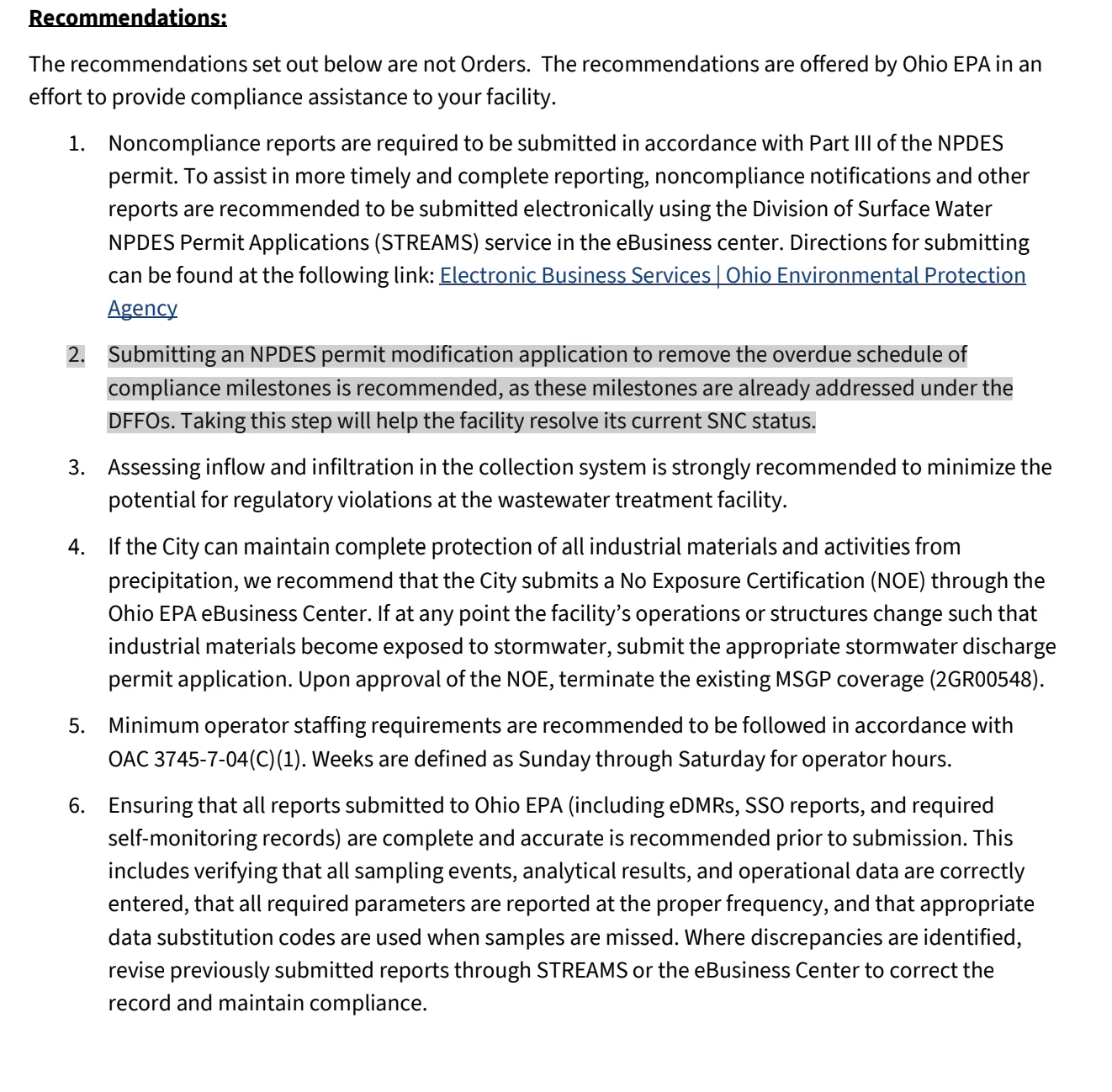
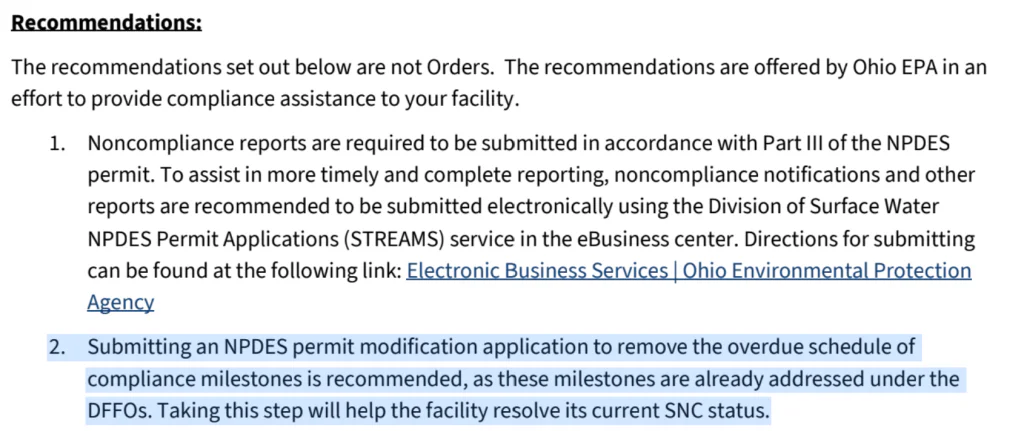
The state’s primary environmental regulator structured and permitted a procedural shielding maneuver, actively coaching the city on how to formally request modifications to its severe non-compliance status. In officcial documents, the agency explicitly directed this action under its official recommendations, advising the city to submit “an NPDES permit modification application to remove the overdue schedule of compliance milestones… as these milestones are already addressed under the DFFOs.” The EPA further stated, “Taking this step will help the facility resolve its current SNC status.”
(CLICK IMAGES TO ENLARGE)
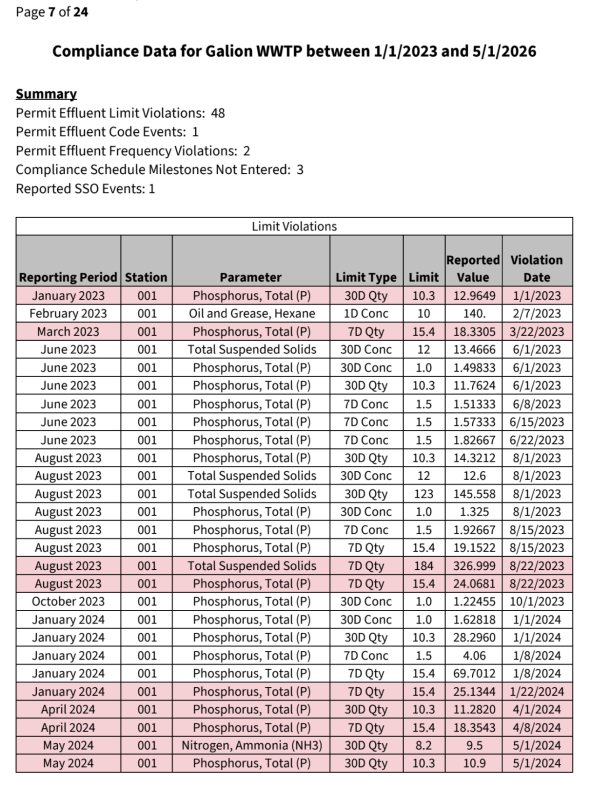
What makes this maneuver so deceptive is how the EPA framed the city’s failures. According to the EPA’s own inspection report, Galion had accumulated 48 effluent limit violations, 16 loading violations, and an unreported Sanitary Sewer Overflow (SSO) event.
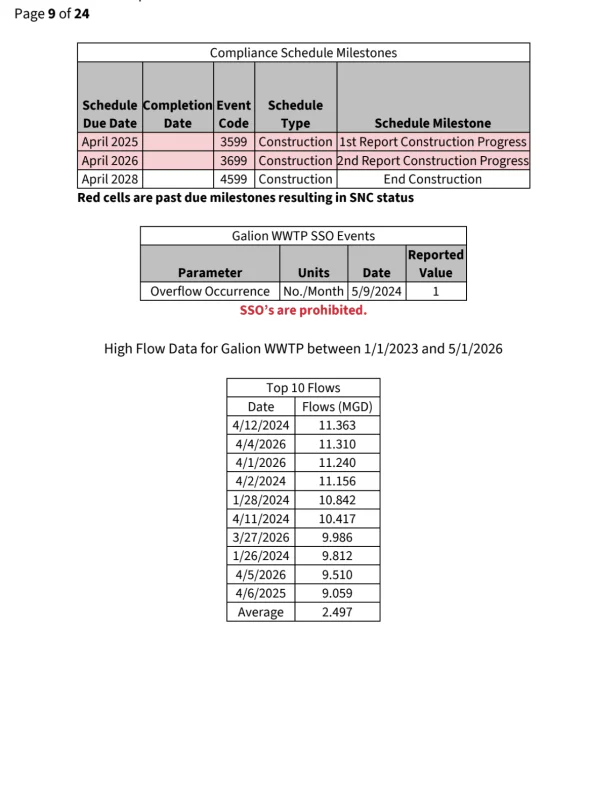
Yet, instead of anchoring the city’s Significant Noncompliance (SNC) status to this massive biological and structural collapse, the EPA officially attributed the SNC label to three overdue compliance milestones—specifically, missing the deadlines for the “1st Report Construction Progress” and “2nd Report Construction Progress.”
By officially reducing a massive environmental hazard down to a missed clerical report, the state created the perfect administrative loophole. Internal documentation reveals that Galion officials deliberately followed this guidance to remove the “Schedule of Compliance” language from their permit, a calculated effort to erase their SNC status while under active enforcement.
The permit modification application, documented in the file and submitted on behalf of the city, contained a stunning, written admission of this exact intent.
Because the EPA had conveniently blamed the SNC status on paperwork, the city was able to formally state in Section E of the application: “Required reporting for this Compliance Schedule was not completed which puts Galion in SNC status.” Furthermore, under Section G of the same document, the administration explicitly noted that the city was “Requesting that the Schedule of Compliance be removed from the permit to keep Galion out of significant noncompliance.”
“Required Reporting”: Only a Fraction of the Picture
To state that “Required reporting for this Compliance Schedule was not completed which puts Galion in SNC status” is, at best, a vast underrepresentation of reality.
Missing a construction progress report is only a microscopic fraction of the full picture.
Galion is not in trouble because it missed a deadline to submit a piece of paper. Galion is in trouble because its infrastructure is physically failing, its industrial users are operating without oversight, its rivers are being flooded with untreated biological waste, and the regulatory bodies tasked with stopping it are offering the city an eraser instead of a mandate to build.
Ultimately, the decision to approve this modification rests with the Director of the Ohio EPA.
But the fact that the EPA suggested a paperwork loophole to mask a physical infrastructure collapse is highly concerning to Galion residents, industry professionals, and the Marion Watch investigative network.
A Failing Report Card and a Forged Rubric
To understand the absurdity of the EPA’s suggestion, one must look at the July 1, 2026 inspection report not just as a regulatory document, but as a failing report card.
The inspector’s physical audit of the facility documented 18 specific violations and findings of structural failure. The state formally found that:
- Since January 31, 2023, the city accumulated 48 permit effluent limit violations, primarily for phosphorus, total suspended solids, and ammonia.
- Three compliance schedule milestones are overdue, officially plunging the City into Significant Noncompliance (SNC).
- The top ten flows recorded at the plant were all above the peak hydraulic capacity of 8.5 MGD.
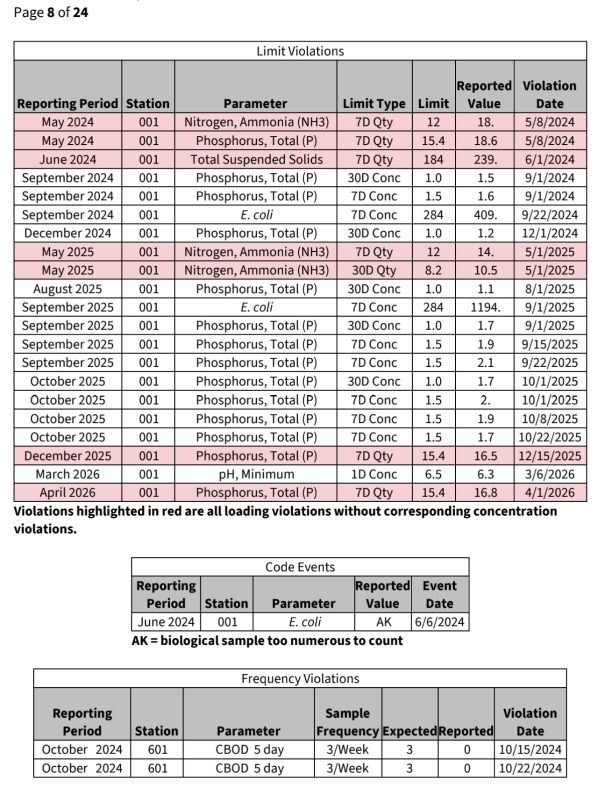
- The city committed 16 separate loading violations without corresponding concentration violations.
- An illicit Sanitary Sewer Overflow (SSO) event occurred on May 9, 2024, yet the city’s 2024 annual SSO report falsely claimed there were zero overflows for the entire year. A noncompliance report for this event was also never submitted.
- The city committed a code violation for missing CBOD samples in October 2024, alongside two frequency violations.
- Minimum operator staffing requirements for a Class III plant (5 days and a minimum of 40 hours) were explicitly violated during the week of July 14, 2025, when only 39.5 hours were logged.
- Equipment awaiting service was left actively leaking without the use of drip pans.
- The first pump for waste activated sludge (WAS) was observed visibly leaking.
- Despite previous warnings, a required Stormwater Pollution Prevention Plan (SWP3) still had not been developed.
- Critical compliance monitoring was compromised because a thermometer was entirely missing from the final composite effluent sampler.
- Former aeration tanks, which should be decommissioned, were observed improperly holding residual material.
- Filters on the plant’s aeration blowers were observed to be dirty, threatening the biological treatment process.
- Lagoon No. 1 is experiencing short-circuiting because a previously installed submerged curtain has sunk, and it is unknown when the lagoon was last dredged.
- A stormwater catch basin south of the digestors was choked with accumulated solids.
By every objective industry standard, this is a catastrophic operational failure.
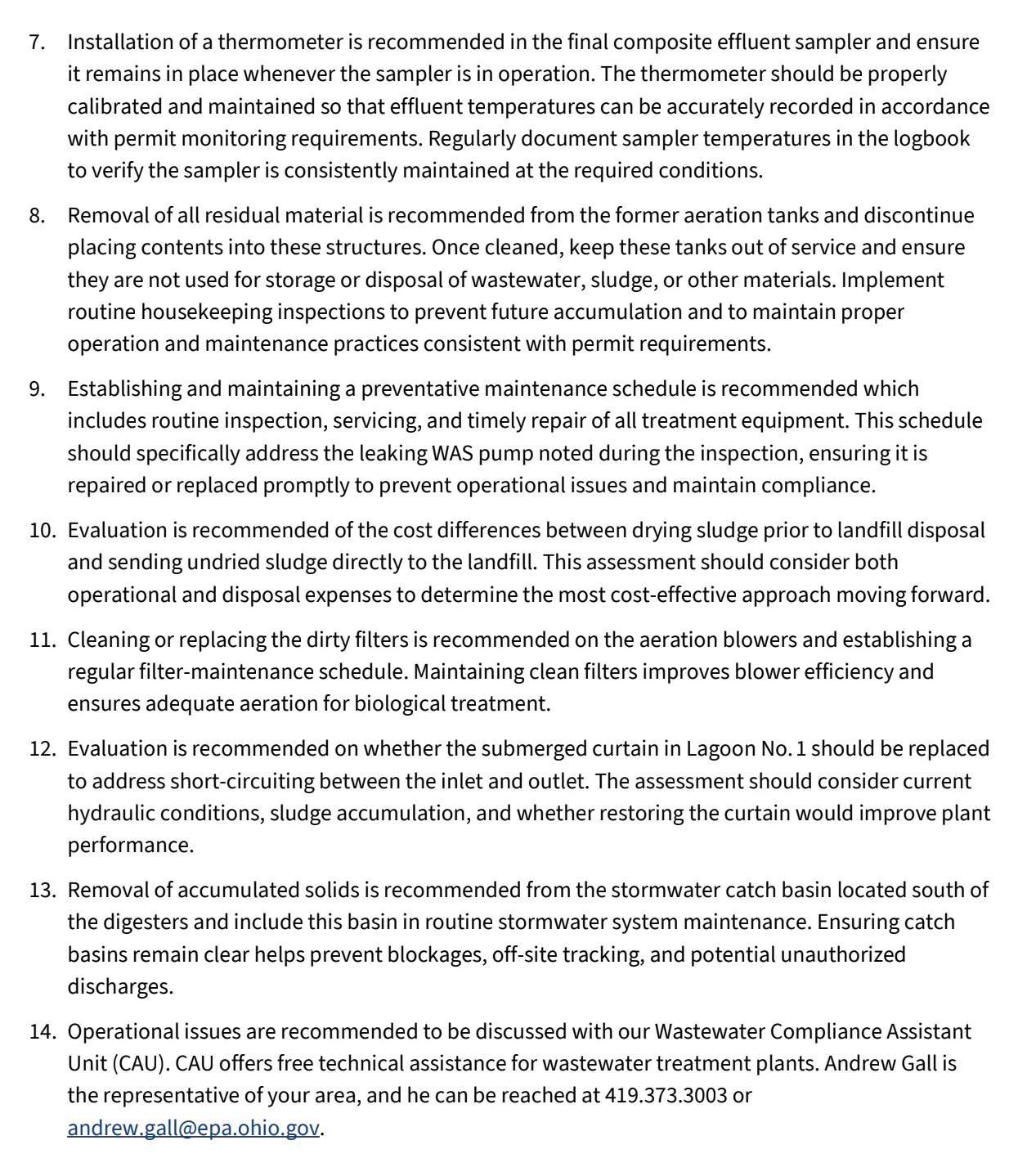
In response, the Ohio EPA issued 14 specific recommendations to the city, ranging from bureaucratic fixes to desperate infrastructure patches.
They advised Galion to submit noncompliance reports electronically, urgently assess inflow and infiltration, install missing thermometers, clean dirty filters, repair leaking pumps, and evaluate replacing sunken lagoon curtains.
Yet, buried among these demands for physical repairs was the EPA’s suggestion to submit the NPDES permit modification to erase the facility’s SNC status.
The agency essentially handed the city a failing report card while simultaneously providing the instructions to rewrite the grading rubric. Successfully dropping this high-level SNC designation would effectively scrub Galion from the plain view of federal compliance dashboards, deliberately crippling public transparency and making it significantly more difficult for citizens and investigative media to track the ongoing disaster.
EPA LETTER HIGHLIGHTS (CLICK IMAGE TO ENLARGE)

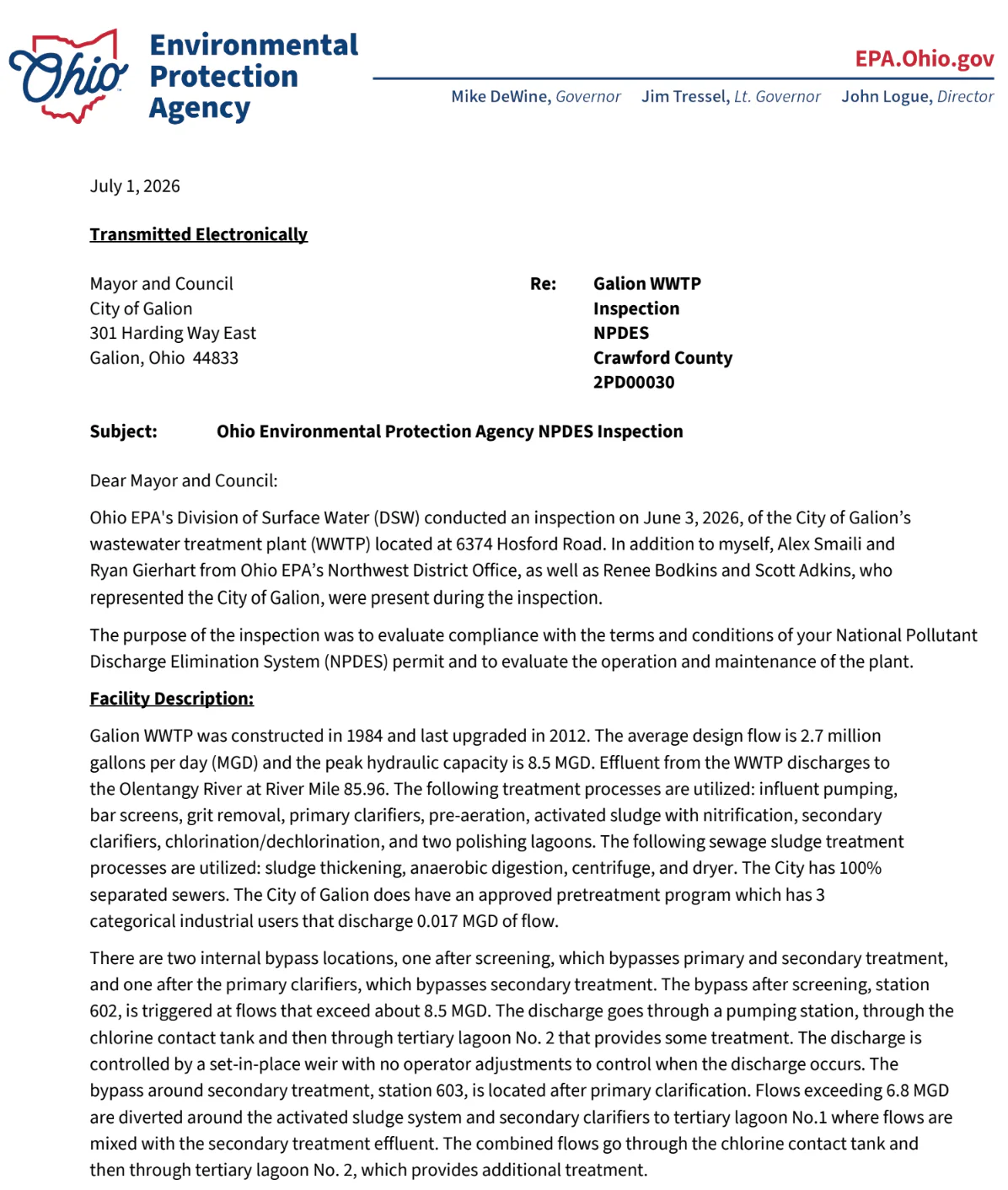
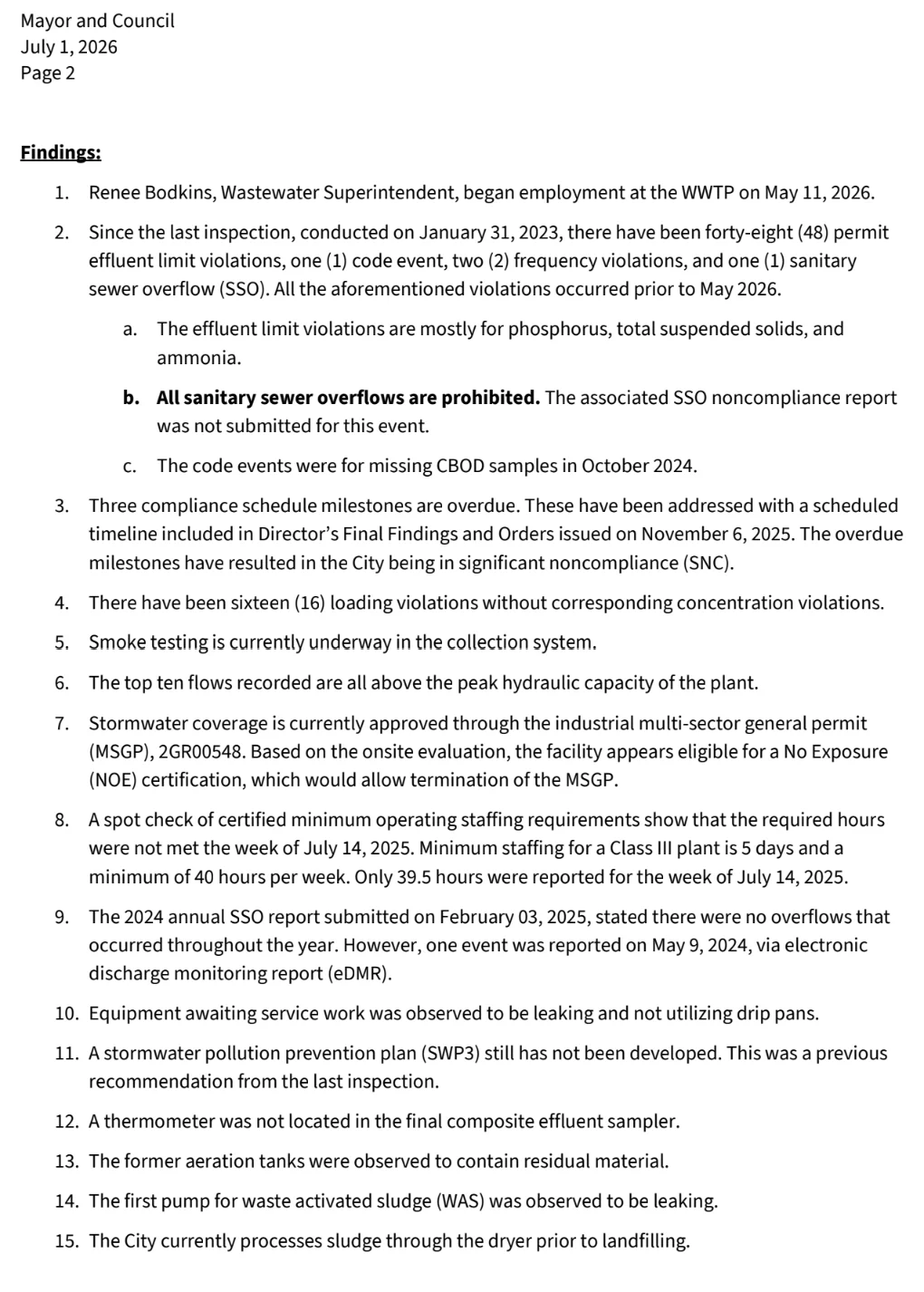
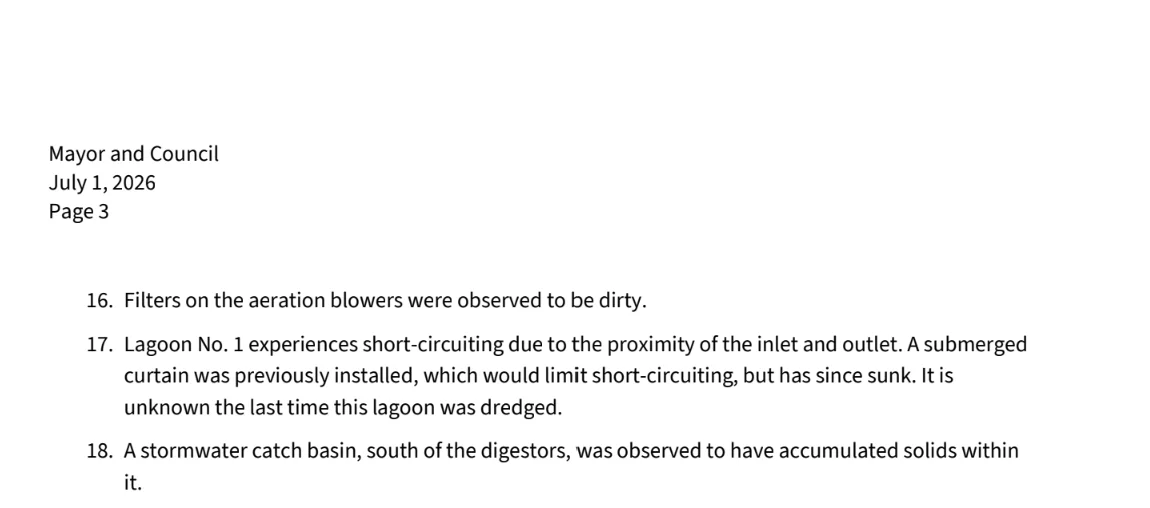
FULL EPA LETTER JULY 1, 2026
The Historical Precedent of the Regulatory Shield
The Ohio EPA’s willingness to suggest municipal leadership modify permit terms to bypass SNC status is not an anomaly—it is a well-worn, highly dangerous bureaucratic maneuver.
When environmental regulators prioritize paperwork manipulation over aggressive environmental enforcement, the physical decay does not stop; it simply continues out of the public eye until a catastrophe forces it back into view.
History provides a grim ledger of what happens when regulators use permit modifications and extended compliance schedules to shield failing facilities:
- Piney Point Phosphate Plant (Florida, 2021): Regulators knew wastewater stacks were nearing capacity but issued repeated administrative consent orders and permit modifications to extend compliance deadlines rather than forcing a shutdown. The result was a containment breach that forced the intentional pumping of 215 million gallons of toxic wastewater into Tampa Bay.
- The Elk River Chemical Spill (West Virginia, 2014): State regulators allowed a chemical facility to operate under an outdated, grandfathered permit, continually accepting weak administrative filings instead of placing the facility in a strict noncompliance category that would have mandated physical structural upgrades. A corroded tank eventually leaked, leaving 300,000 residents without safe drinking water.
- TVA Kingston Fossil Plant Spill (Tennessee, 2008): Regulators historically allowed coal ash ponds to operate under loosely defined, frequently modified wastewater permits rather than strict hazardous waste regulations. This administrative leniency ended when a containment dike failed, spilling 1.1 billion gallons of toxic slurry in the largest industrial spill in U.S. history.
These are just a few examples that show what happens when the paperwork looks clean, but the pipes still break.
BODKINS MODIFICATION REQUEST (CLICK IMAGES TO ENLARGE)
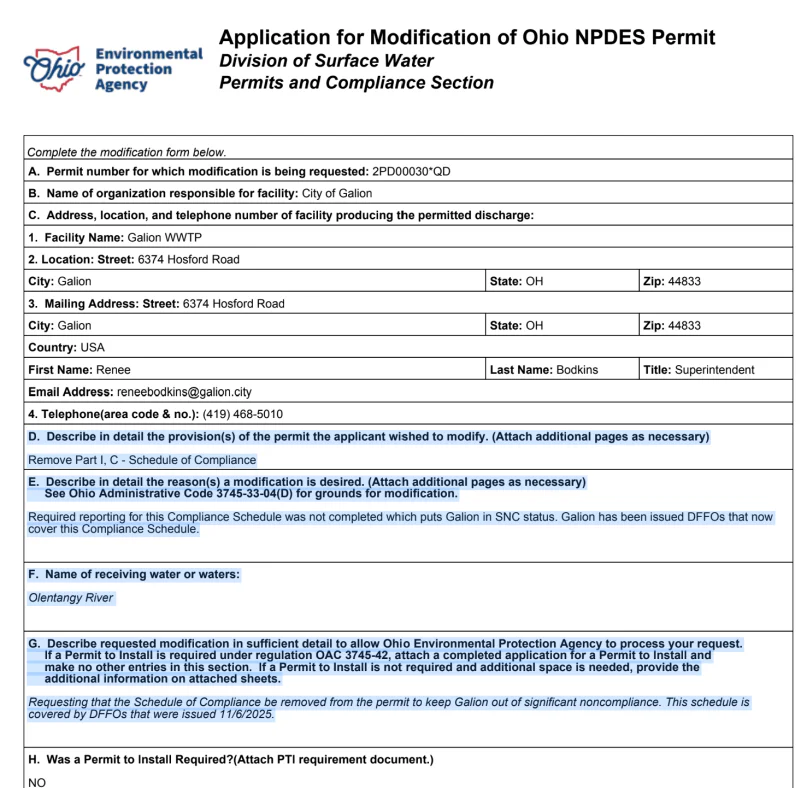
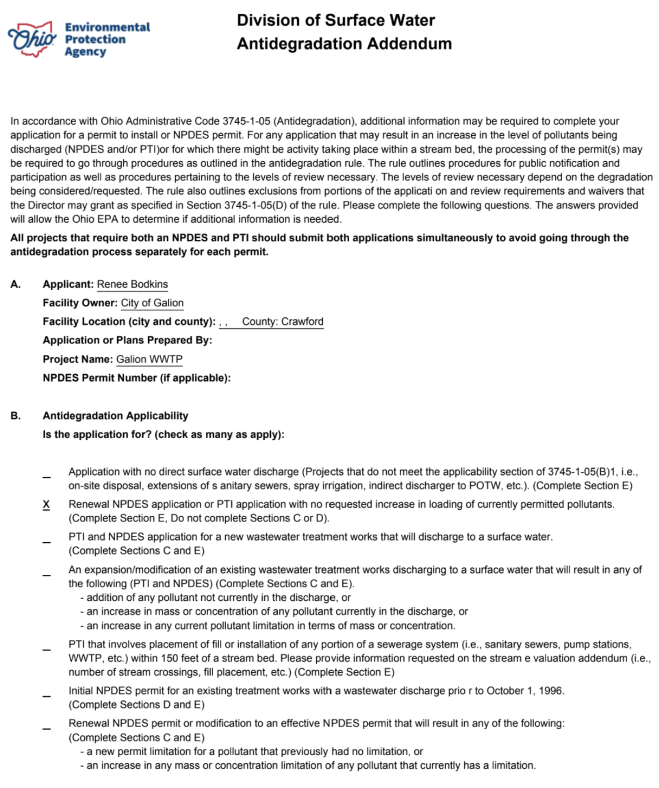
FULL MODIFICATION REQUEST
The Legal Impropriety of Permit Modification Under Ohio Law
Beyond the historical dangers, this maneuver represents a possible violation of administrative law and statutory mandate. As extensively documented in our ongoing series at marionwatch.com/galioncitywatch, the current crisis is not an isolated anomaly. It is the direct result of a decades-long pattern of lax enforcement, deferred maintenance, bad operational decisions, and regulatory blind eyes that have allowed the city’s infrastructure to rot from the inside out.
Under Ohio Revised Code (ORC) Chapter 6111 and federal Clean Water Act frameworks, a regulatory agency’s discretionary authority cannot be legally exercised in a manner that frustrates the core statutory purpose of pollution control. Specifically:
- Statutory Prohibition: ORC § 6111.07(A) and the express terms of Galion’s NPDES permit strictly prohibit unauthorized bypasses and permit violations—a catastrophic hazard that has never been eliminated in Galion, despite years of regulatory warnings.
- Abuse of Discretion: Administrative agencies possess no legal authority to issue permit modifications whose primary purpose is to sanitize an active record of chronic non-compliance or shield a municipal entity from the statutory consequences of its SNC status. Given the city’s ongoing, failing report cards and decades of documented structural decay, utilizing an administrative loophole to remove Galion from SNC status is both legally and morally unjustifiable.
- Public Trust Doctrine: The Ohio EPA is bound by a foundational legal duty to protect the waters of the state for the public benefit. Coaching a chronic violator on how to alter compliance schedules and holding civil penalties in abeyance (such as the $47,990 penalty suspended under the November 6, 2025 Director’s Final Findings and Orders) transforms enforcement discretion into arbitrary and capricious administrative sheltering.
The state cannot lawfully rewrite or modify compliance obligations to accommodate a municipality that continues to flood public waterways with untreated biological waste.
Procedural expediency and administrative self-preservation do not supersede the absolute legal duty to enforce environmental laws.
Headwaters Pollution: Public Health and Ecological Devastation
The environmental stakes in Galion are uniquely severe because the city sits directly at the headwaters of the Olentangy River, and the physical decay has been ongoing, building to the present state long before the signs and failures caused EPA intervention.
Every pollutant, pathogen, and toxic discharge entering the municipal utility grid is discharged at the very genesis of the watershed, dictating a poisoned baseline for the entire river basin downstream.
The city’s bypass events are massive environmental hazards that routinely shatter the 9.8 Million Gallon (MG) mark. When influent flows overwhelm the plant, wastewater spills over stationary overflow weirs at Station 602 and Station 603. While this wastewater passes through mechanical fine screening or primary clarifiers, it completely bypasses the critical secondary biological treatment stages before being pushed to the tertiary lagoons.
The documented volume of these events is staggering:
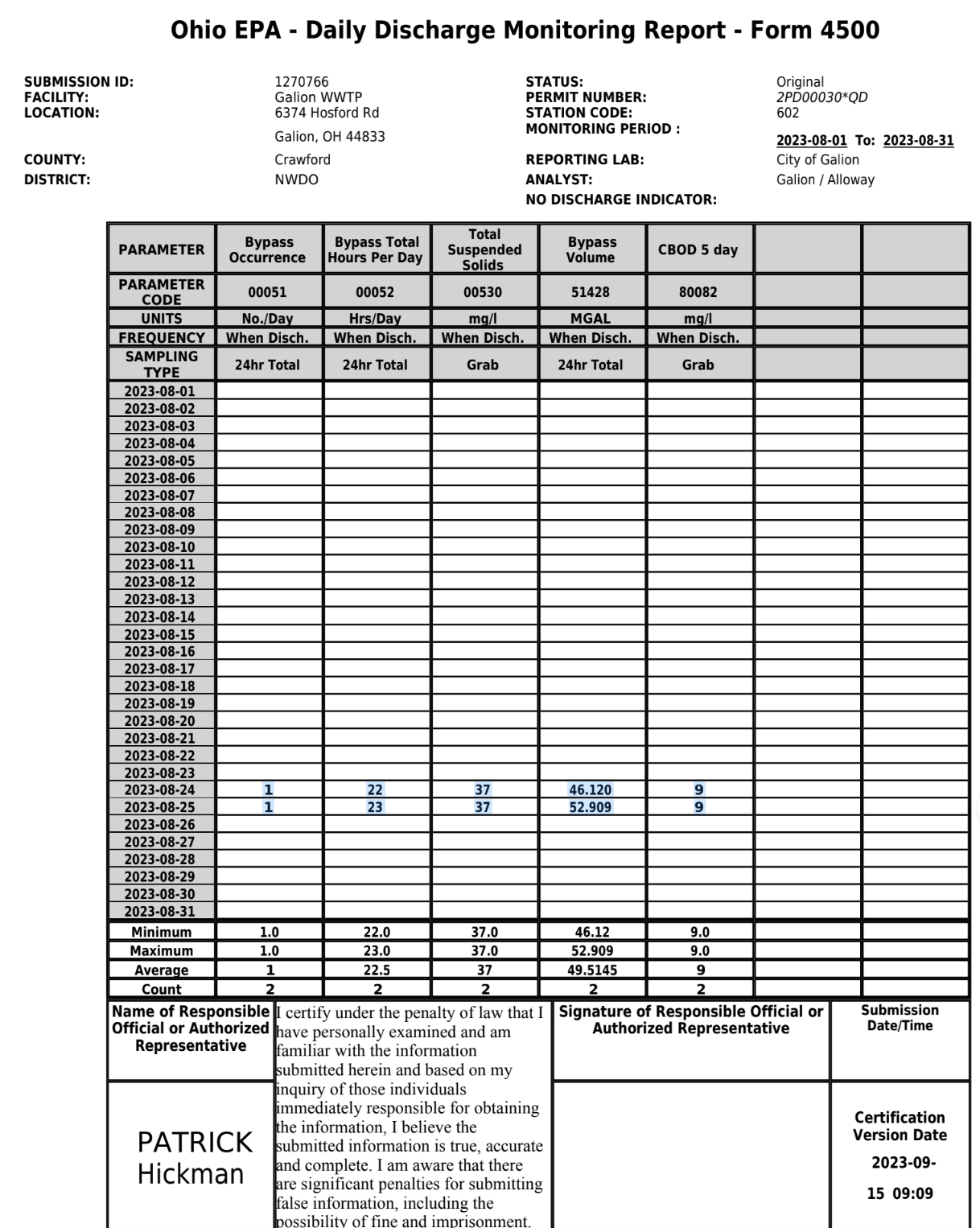
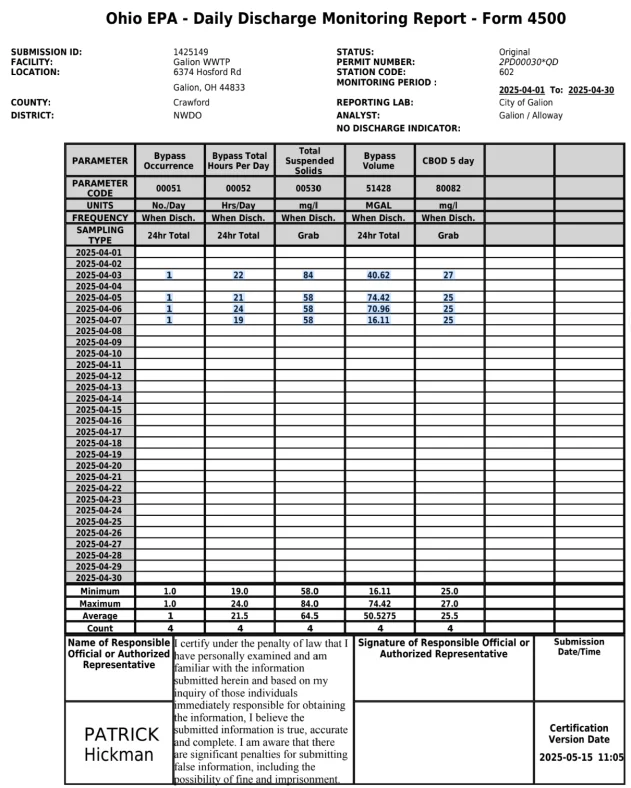
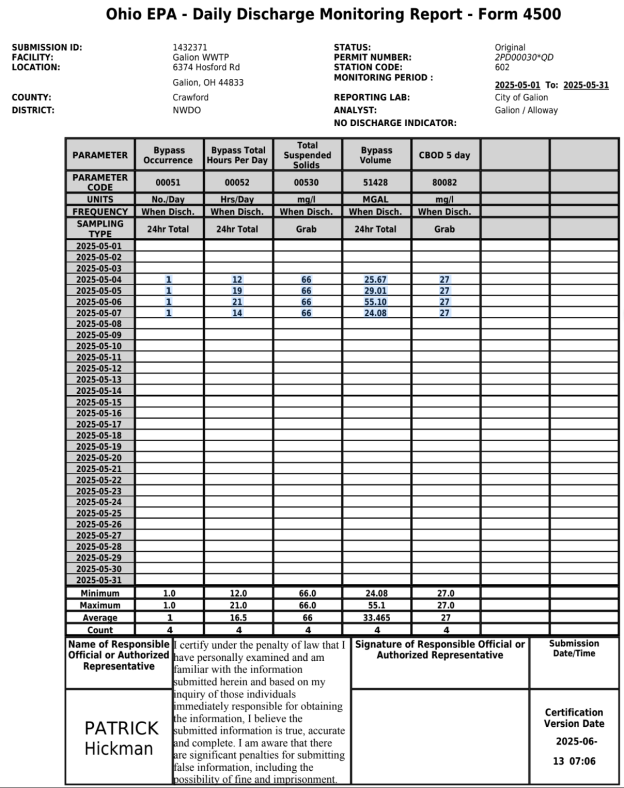
(CLICK TO ENLARGE IMAGES, FULL PDF BESIDE IMAGES).
- In August 2023, single-day bypasses hit 46.12 MG and 52.909 MG.
- In April 2025, the facility bypassed well over 200 million gallons of partially treated sewage, with daily discharges reaching 74.42 MG on April 5 and 70.96 MG on April 6.
- In May 2025, sustained overloading resulted in consecutive daily bypasses of 25.67 MG, 29.01 MG, 55.10 MG, and 24.08 MG.
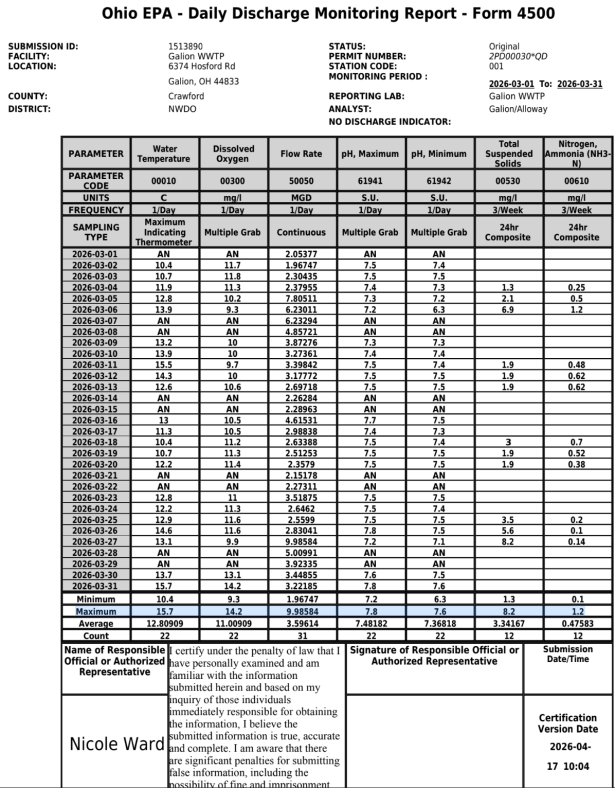
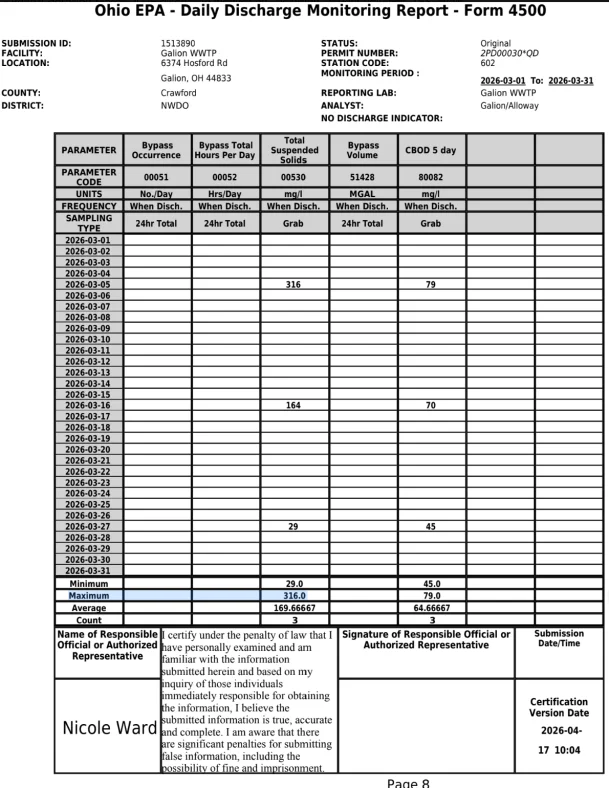
- In March 2026, effluent volumes reached 9.98 MGD, logging a Total Suspended Solids (TSS) bypass peak of 316 mg/L.
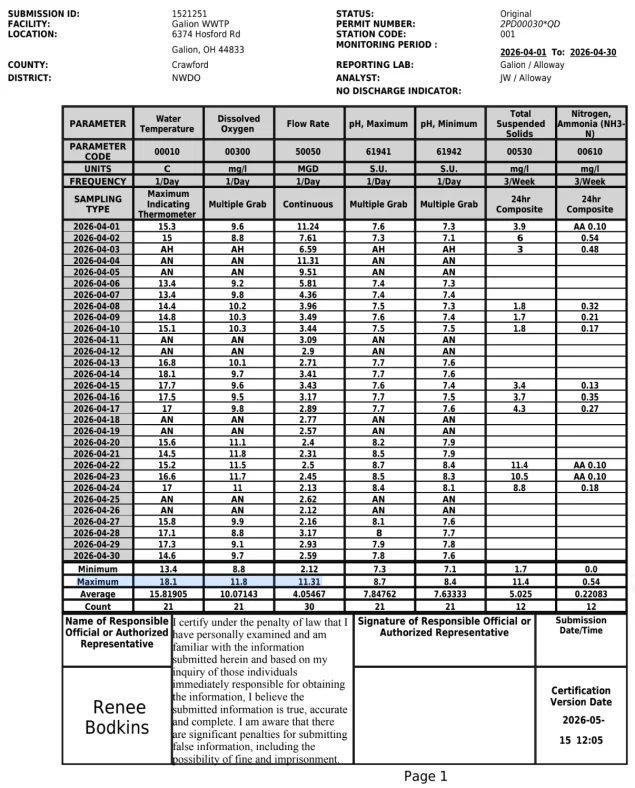
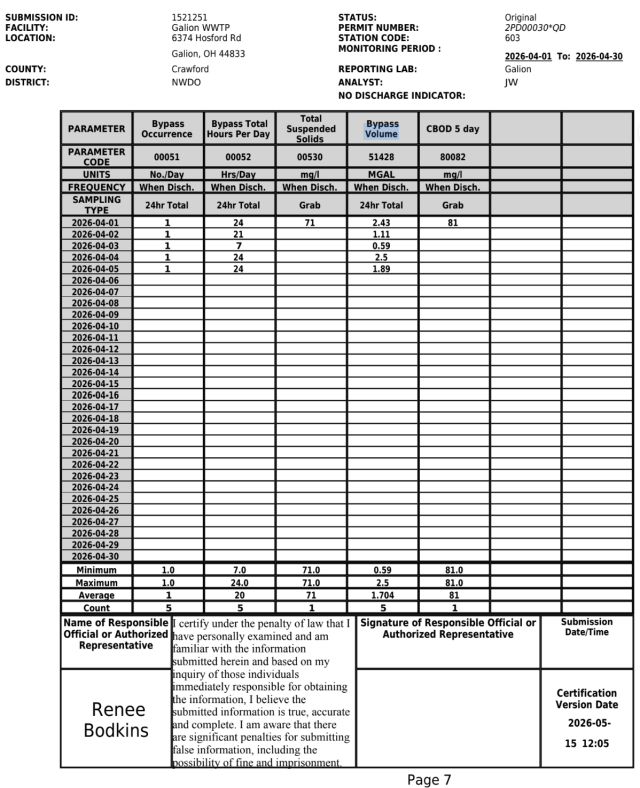
- In April 2026, the plant saw flows hit 11.31 MGD, resulting in millions of gallons bypassing the system over consecutive days.
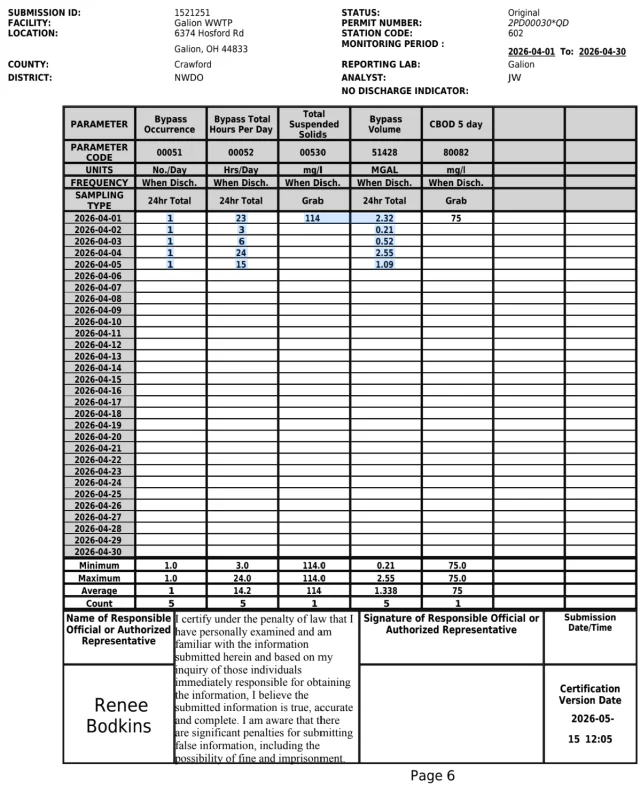
During major wet-weather events, millions of gallons of untreated biological waste are forced through the system. This severe hydraulic overloading—combined with the plant’s inability to fully process the extreme influx of suspended solids—saturates surrounding waterways with fecal bacteria and untreated sewage before secondary treatment can occur.
The sheer volume of these bypasses is strictly documented in the city’s monthly reports for August 2023, May 2024, and September 2025. Furthermore, the EPA’s own July 1, 2026, inspection report formally documents chronic pathogen spikes at the plant’s final outfall.
The state recorded E. coli limit violations in September 2024 and September 2025, with concentrations peaking at over four times the legal limit.
Even more alarming, an official E. coli code event was recorded on June 6, 2024, where the state noted the bacteria levels in the effluent were a “biological sample too numerous to count”.
This exposes downstream communities and residents interacting with the local watershed to severe risks of gastrointestinal illness, skin infections, and waterborne diseases.
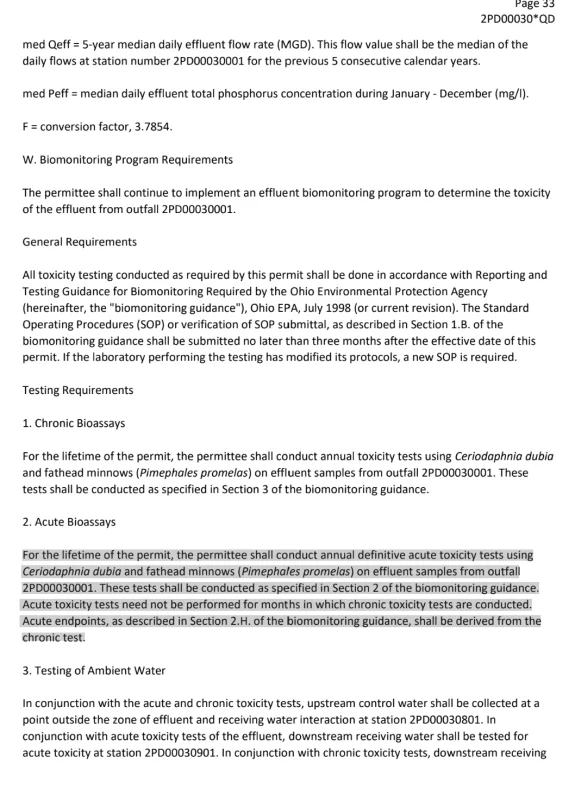
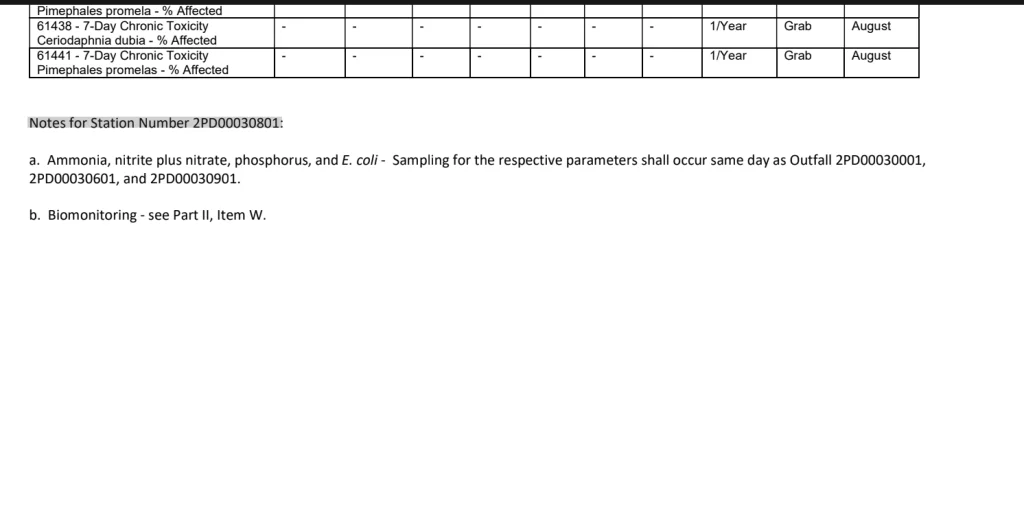
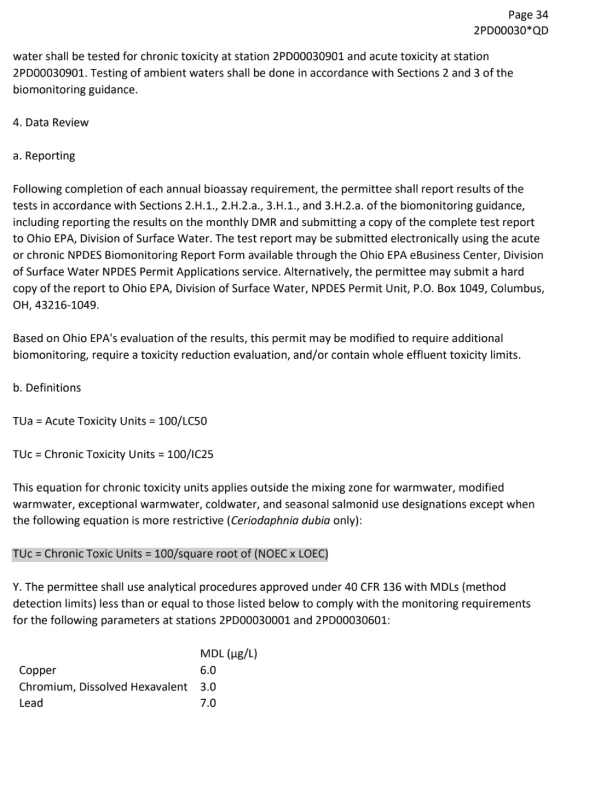
Furthermore, the toxicological impact of the facility’s discharge on the receiving waterway remains an acute ecological concern, particularly regarding annual monitoring protocols. Under the facility’s National Pollutant Discharge Elimination System (NPDES) permit, Ohio EPA mandates an annual effluent biomonitoring program designed to evaluate both acute and chronic toxicity at Outfall 001. This framework explicitly requires definitive bioassays utilizing Ceriodaphnia dubia (water fleas) and fathead minnows (Pimephales promelas) to calculate critical biological endpoints, such as Chronic Toxicity Units (TUc) based on a 25% reduction in organism growth or reproduction (IC25).
While these annual evaluations are legally required to verify that the plant avoids instream toxicity during critical low-flow conditions, the lack of available public documentation limits comprehensive oversight. The standard Daily Discharge Monitoring Reports (DMRs) do not contain raw toxicological narratives or biological indicators. Although the facility is required to submit complete bioassay laboratory results and bench sheets directly to the Ohio EPA Division of Surface Water following each annual test, the subsequent bioassay reports covering recent years have not yet been publicly reconciled. A formal public records request remains active with the City of Galion to secure records, chains of custody, and narrative evaluations necessary to verify compliance and fully gauge the historical effluent impact on Ceriodaphnia dubia population dynamics.
Uninspected Industry and Exploding Sewers
These bypass failures are driven by a collection system drowning in Inflow and Infiltration (I/I) and crippled by a total lack of municipal oversight.
A Phase 1A flow monitoring evaluation conducted by Wessler Engineering—executed under a $297,000 contract—established a normal dry-weather baseline flow of just 1.16 MGD. However, during wet-weather events, the system experiences catastrophic inundation, with flows peaking at 9.665 MGD. This represents a peaking factor of 8.33, nearly triple the standard design threshold of 2.94. As confirmed by the July 1 inspection, the top ten highest flows recorded were all utterly beyond the plant’s 8.5 MGD peak hydraulic capacity.
Wessler’s engineering estimates indicate that over 80% of residential properties in Galion have improper stormwater connections discharging directly into the sanitary sewer network.
Beyond residential downspouts, Galion’s industrial pretreatment program has fundamentally collapsed. State inspection findings prove that major industrial users—specifically Carter Machine Co., LLC, Galion LLC, and A&G Manufacturing—have been allowed to operate with expired permits and lapsed compliance timelines.
By failing to enforce its own pretreatment standards, the city has permitted unchecked, corrosive process wastewater and unmonitored toxic discharges to barrage a grid already on the brink of collapse. The Ohio EPA documented this failure, noting that the city’s inability to manage industrial pretreatment contributes directly to severe NPDES permit violations and physical infrastructure destruction.
The physical pipes cannot withstand this hydraulic and chemical pressure. Overloading in the Olentangy Trunk is so severe that manhole lids are forcefully dislodged during storm events. To prevent the complete physical destruction of the manhole structures, the city intentionally leaves castings unbolted, forcing municipal crews to routinely patrol the Olentangy River to recover blown-off lids. Additionally, severe direct infiltration occurs where the sanitary main crosses a ditch located in a 100-year flood hazard area, recording 48.4% more flow than anticipated and further inundating the treatment plant.
A Lethal Workplace
As millions of dollars in future repairs are debated—with Wessler projecting an estimated $200,000 for Level 1 field investigations and $995,000 for full CCTV cleaning—the lives of Galion’s municipal workers have been severely compromised by these exact same administrative failures.
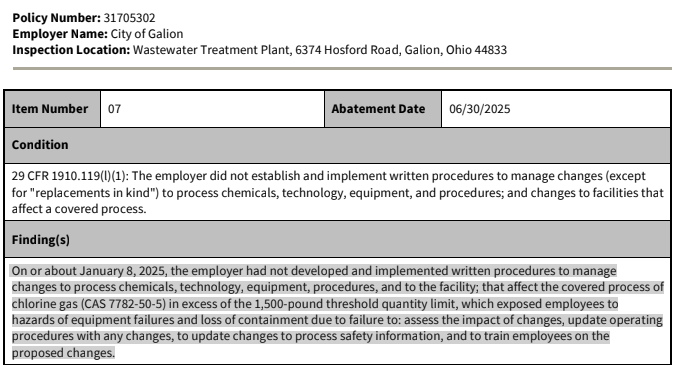
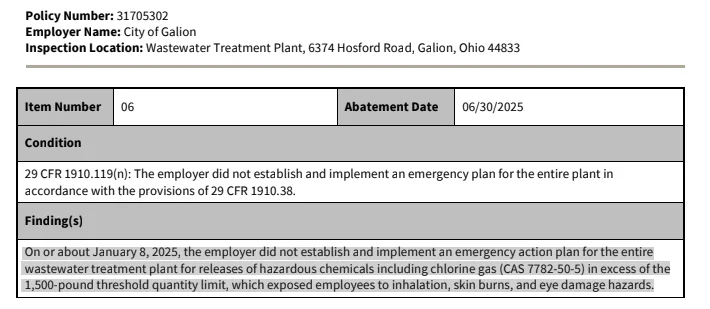
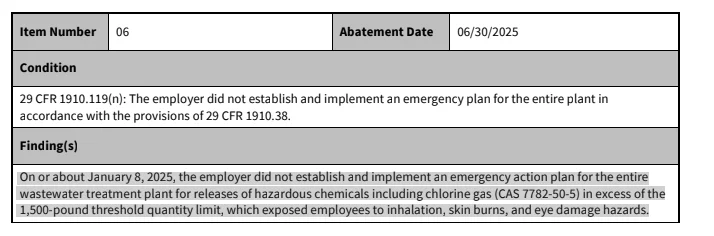
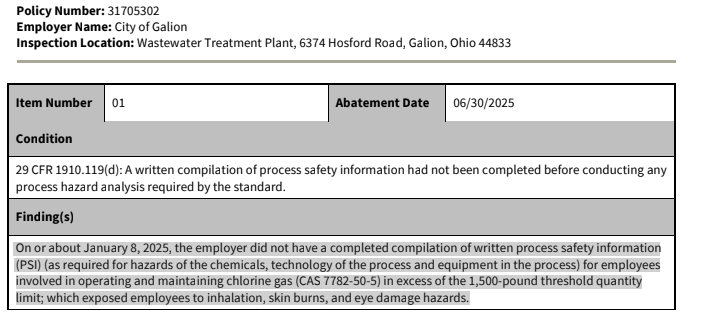
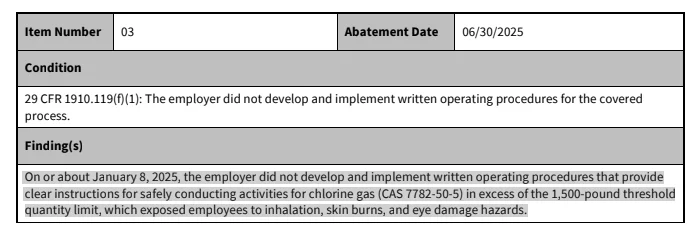
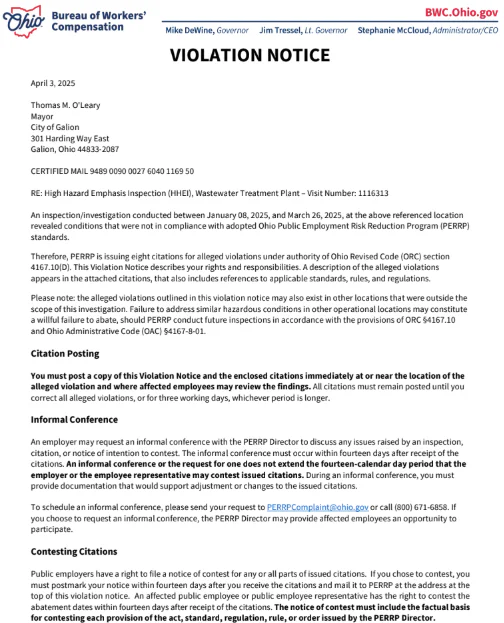
Between January 8 and March 26, 2025, the Ohio Bureau of Workers’ Compensation Public Employment Risk Reduction Program (PERRP) conducted a High Hazard Emphasis Inspection at the WWTP, resulting in an April 3, 2025, Violation Notice detailing eight major safety citations:
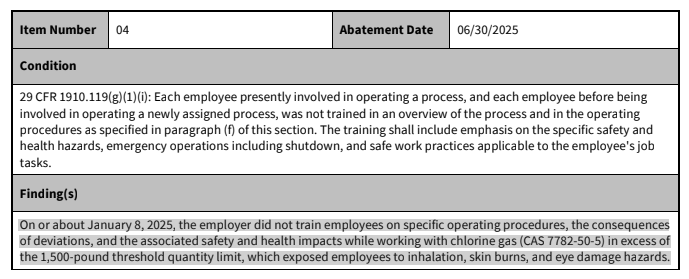
- Lethal Chemical Exposure: Seven citations were issued for the catastrophic mishandling of Chlorine gas (CAS 7782-50-5) stored in excess of the 1,500-pound threshold. The city failed to perform a process hazard analysis, develop written operating procedures, train its employees, maintain the integrity of process equipment, or implement a plant-wide emergency action plan. Employees were left completely exposed to severe inhalation, skin burn, and eye damage hazards.
- Confined Space Hazards: An eighth citation revealed that employees were ordered into Lift Station “A”, clarifier tanks, aeration tanks, and settling basins without a written permit-required confined space entry program. This exposed the workforce to imminent drowning, engulfment, atmospheric, and entrapment hazards.
A System Without Lids
The “Regulatory Shield” is not merely a bureaucratic loophole; it is the ultimate symbol of a broken accountability matrix and a catastrophic failure of public trust.
When the state’s environmental protector prioritizes paperwork manipulation over environmental enforcement—structuring and permitting a municipality to formally request modifications to mask its severe non-compliance and avoid SNC status—it may be directly violating its statutory obligations under Ohio environmental law.
The results of this complicity play out in real-time across the headwaters of the Olentangy River: sanitary sewers blow their lids into the local channel, the treatment plant bypasses hundreds of millions of gallons of partially treated wastewater into the upper basin, unregulated and corrosive industrial flows from expired-permit facilities destroy a compromised grid, and municipal workers are ordered into lethal chemical environments without basic federal safety protocols.
Galion’s infrastructure is failing visibly and violently.
Shielding the executives and administrators who oversaw this decay behind the legal paperwork that, if approved, will remove Galion from transparency, does not treat the E. coli, and does not make the workplace safe. The structural and financial fallout of this systemic negligence carries a cost that is both significant and entirely avoidable—a devastation whose full ledger we will begin to expose in Part II. Until the Ohio EPA abandons its unlawful procedural shielding and demands strict, unflinching accountability from municipal leadership, the systemic collapse in Galion will only accelerate.