


 Written by
Tomorrow, August 3, 2026, the Marion City Council convenes for the second reading of a proposed ban on Flock automated license plate readers (ALPRs). This isn’t just a vote on a piece of technology. It is a critical showdown forcing the city to confront exactly how a sprawling, 45-camera surveillance network was quietly entrenched in our backyards without legislative consent.

The July 20th Reality Check
For anyone who witnessed the marathon three-hour public comment session at the Legislative & Codes committee meeting on July 20th—chaired by Councilman Ralph Smith—the dividing line was clear.
On one side, law enforcement officials and select council members leaned heavily on the system’s utility. Defending the cameras, officials argued that the technology has been instrumental in solving serious local crimes, specifically citing homicides, kidnappings, and domestic violence charges. One law enforcement speaker highlighted a recent child abduction case where ALPR data directly led to an out-of-state arrest.
To wave away privacy concerns, council members and administration staff insisted that internal department policies, strict IT controls, and mandatory case-number entry requirements provide a sufficient firewall against misuse. However, this is the exact same reassurance regarding the city’s IT controls that has been repeated to Marion Watch since late 2018. It is also a defense that has now been proven absolutely incorrect through our investigation into the city’s legacy New World IT and financial controls—safeguards that were, in reality, completely non-existent.
The citizens of Marion brought the receipts, and they refused to accept internal promises in place of public oversight.
The emotional peak of the July 20th meeting came from a former dispatcher and Marion resident who shattered the illusion that these cameras are a flawless shield for the public. Referencing a tragic death that occurred locally on July 4th, the resident’s question cut through the bureaucratic talking points: “We failed her… Where were these Flock cameras for us, the citizens?”
While Mayor Bill Collins’ administration and Police Chief Jay McDonald’s department may tout internal policies, the public is demanding verifiable accountability. Technical experts and community members warned of systemic hacking risks, documented officer misuse in other jurisdictions, and the terrifying prospect of “mission creep” through AI-based tracking and unvetted “hot lists.” Residents demanded external audits and an independent citizen review board—safeguards that should have been legislated before a single camera was mounted.

The Paper Tiger: Ordinance 2023-033 and the Surrender of Oversight
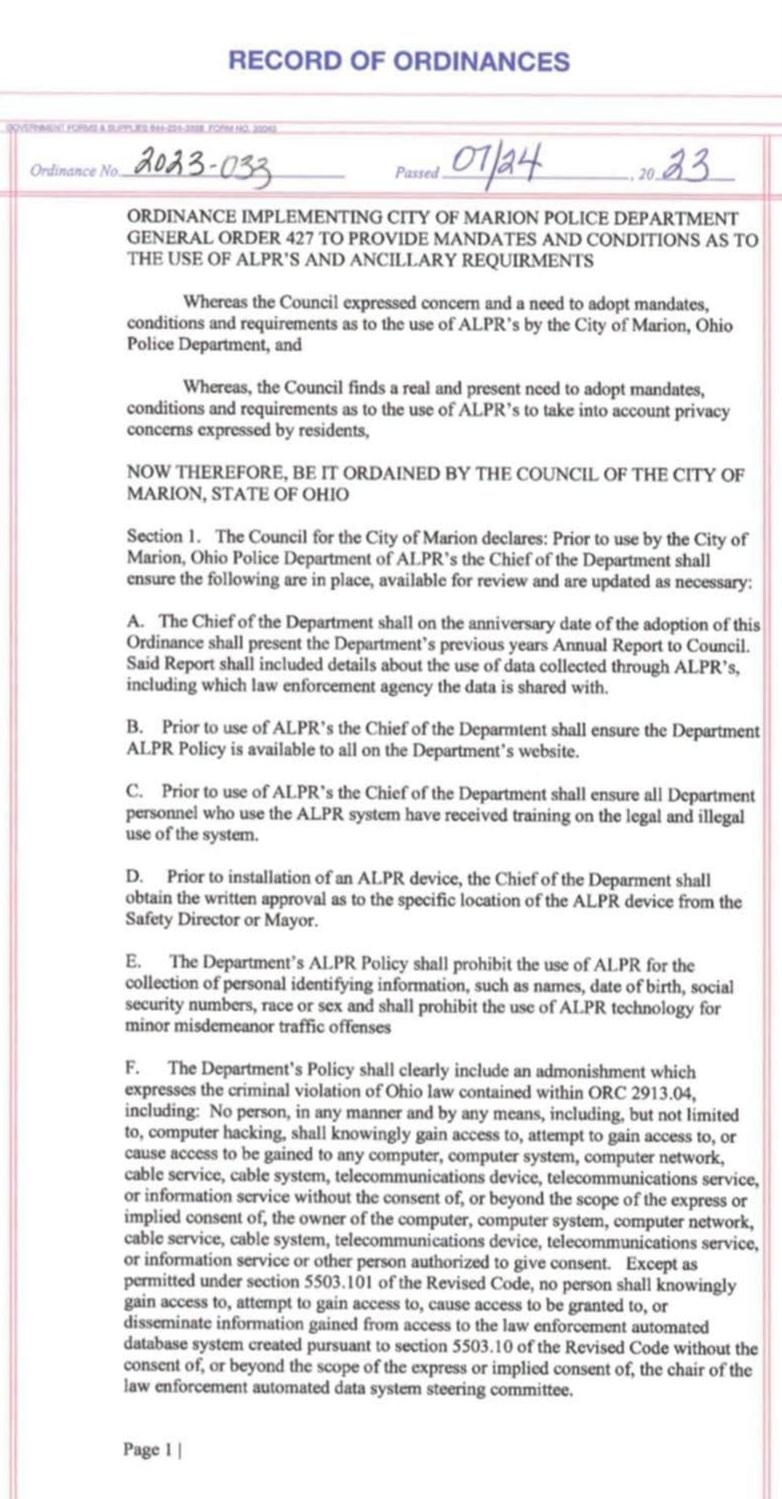
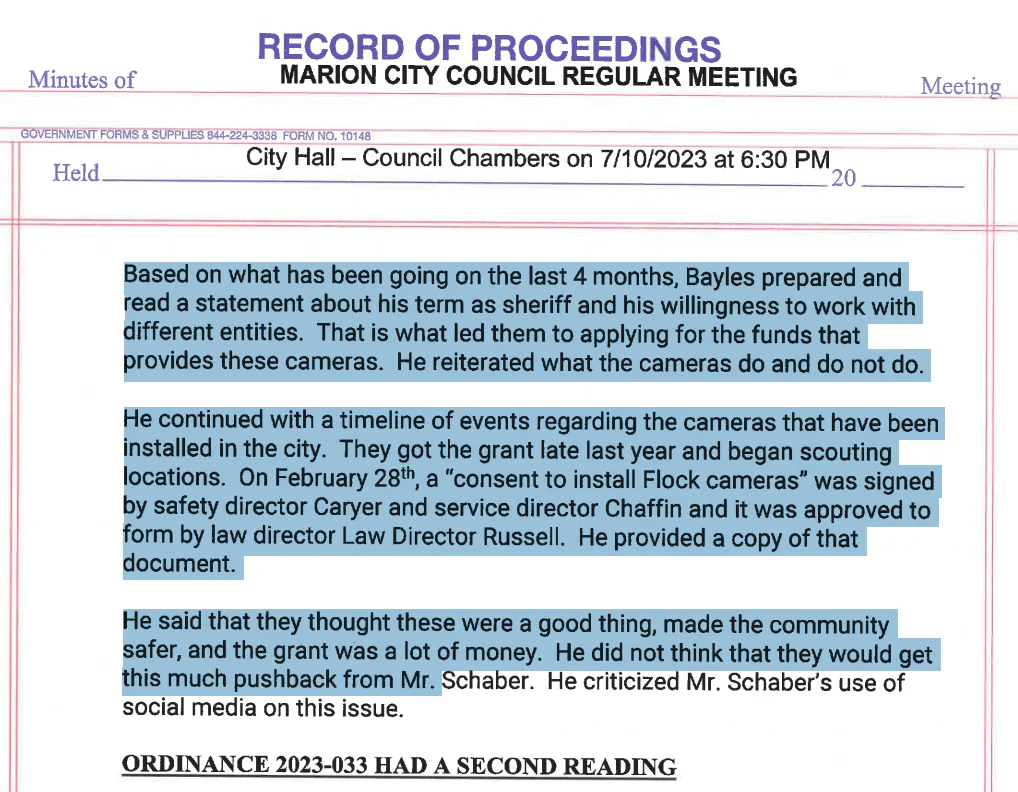
To defend the deployment, city officials point to Ordinance 2023-033, passed on July 24, 2023. They wave this document around as proof of oversight.
But in discussions with more than 400 residents since January 2025, the verdict on this legislation is unanimous: it is insufficient and weak.
Look directly at the text of Ordinance 2023-033, specifically Section 1(D). It reveals the ultimate betrayal of public trust. The ordinance does not require City Council approval to install a camera.
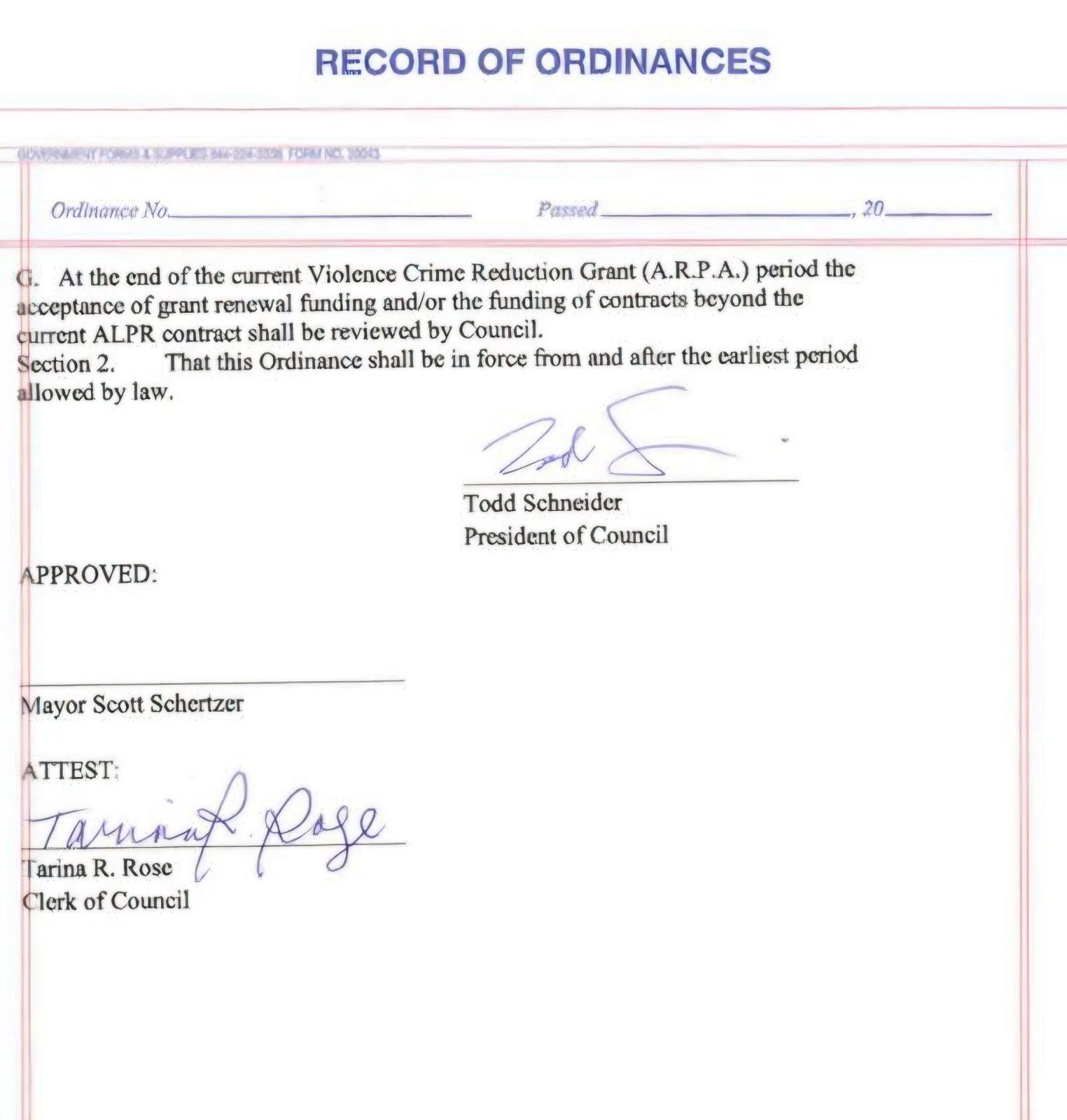
Instead, it explicitly states that prior to the installation of an ALPR device, the Police Chief only needs written approval as to the specific location of the ALPR device from the Safety Director or Mayor. The ordinance was signed into force under the previous administration, bearing the approvals of then-Mayor Scott Schertzer and Council President Todd Schneider.
The City Council effectively legislated their own irrelevance. They handed a blank check to the executive branch, allowing individual camera placements to be rubber-stamped behind closed doors by executive signature rather than debated in the open through Council votes. They surrendered the power to govern where and how citizens are surveilled.
Furthermore, Section 1(A) mandates the Police Chief present an annual report to Council detailing system usage and listing which law enforcement agencies the data is shared with. However, this self-reporting creates a fox-guarding-the-henhouse scenario, offering zero independent auditing, zero real-time enforcement mechanisms, and zero teeth to prevent local surveillance data from being funneled into broader networks. While Section 1(E) prohibits ALPR use for collecting personal identifying information like names, dates of birth, social security numbers, race, or sex, and prohibits its use for minor misdemeanor traffic offenses, these policies lack any external enforcement mechanism.
The Playbook: Circumventing Democracy
Because Ordinance 2023-033 completely stripped the Council of its installation approval power, the core issue with Marion’s current Flock network is how it arrived and expanded in the dark. These systems were never properly vetted through open public hearings before installation, nor were individual placements authorized by transparent legislative votes.
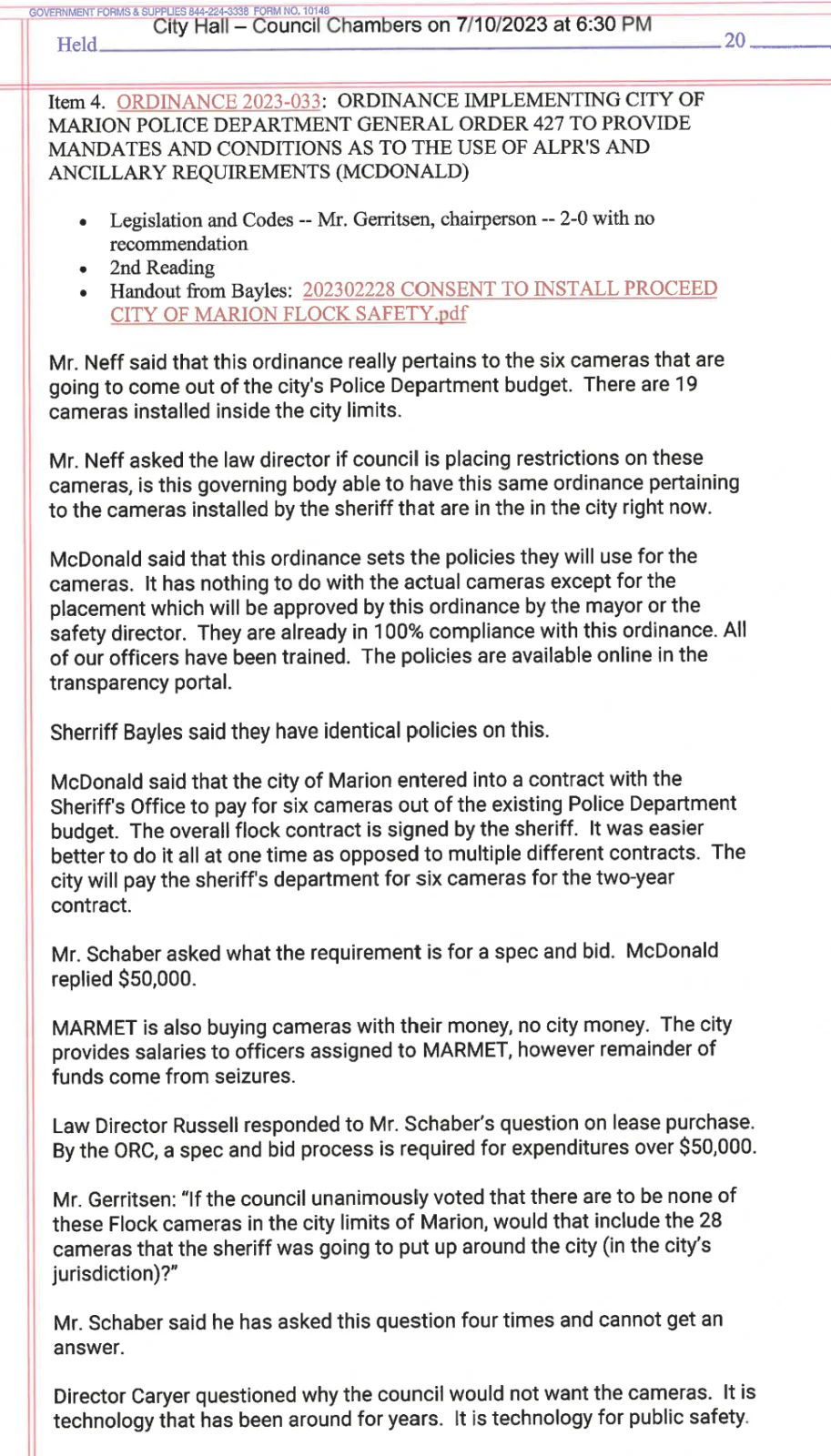
Instead, they were installed through administrative workarounds and county grants—a jurisdictional shell game designed to bypass normal checks and balances. During the July 20th meeting, this chaos was fully exposed. When officials couldn’t clearly establish the city’s authority over county-installed, grant-funded cameras operating within city limits, the committee had to summon Marion County Sheriff Matt Bayles and the County Prosecutor to answer for it at tomorrow’s session.
This isn’t an anomaly; it is Flock Safety’s meticulously designed business model. The company actively provides templates and strategies for municipalities to deploy these systems under the radar, leveraging private and grant funding to bypass the friction of public procurement processes. The result is a privatized mass-surveillance grid implemented with zero direct oversight from the elected body meant to govern it.

The 2,000-Agency Open Door
The sheer scale of the data collection happening on Marion’s streets is staggering:
- 11 Cameras operated by the Marion Police Department.
- 34 Cameras operated by the Marion County Sheriff’s Office.
- 30-Day data retention window for every vehicle logged.
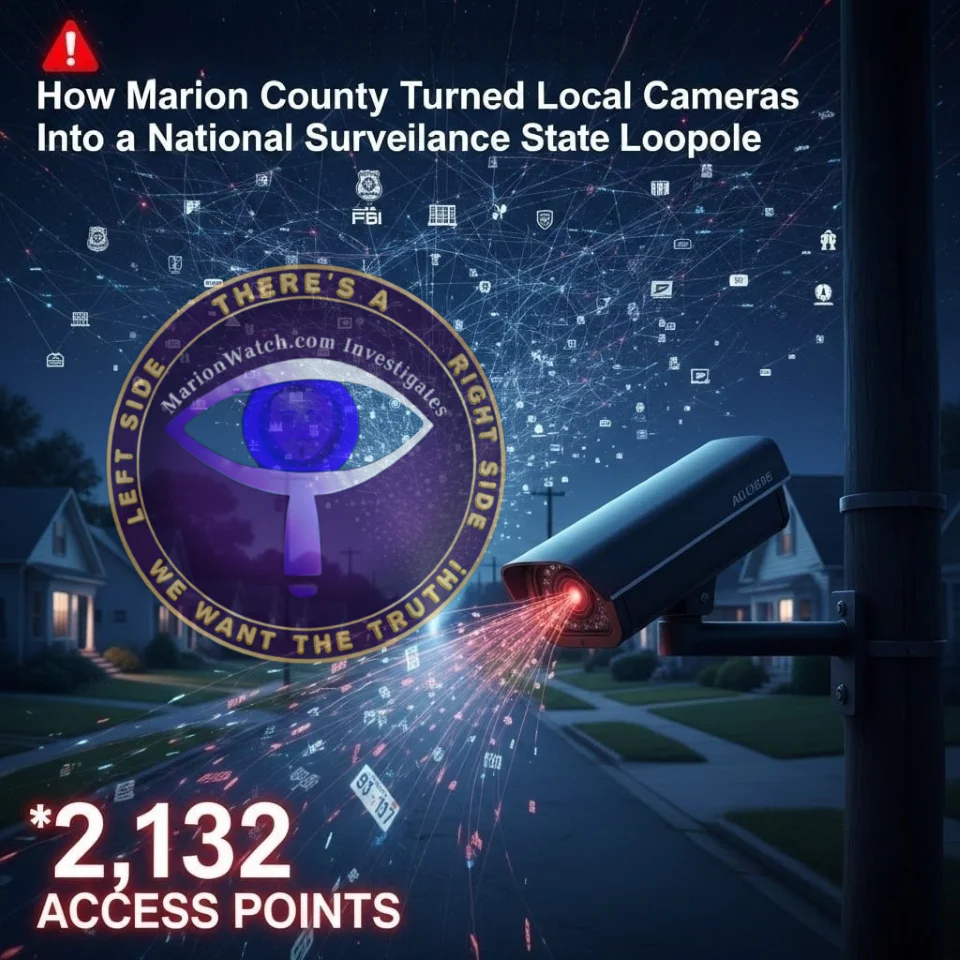
But the most dangerous aspect isn’t just local tracking—it’s the TALON (Tactical Awareness Law Enforcement Network) system.
When you drive to the grocery store in Marion, your vehicle’s make, model, color, and license plate aren’t just sitting on a local server. Because local agencies have opted into national sharing, your data becomes instantly searchable by over 2,000 other jurisdictions nationwide. Out-of-state agencies operating entirely outside the jurisdiction of the Marion City Council can query the daily movements of Marion residents. We have effectively outsourced the privacy of our citizens to a nationwide data pool with zero local accountability.
A Nationwide Revolt Against the Grid
Marion is not fighting this battle in a vacuum. A massive, nationwide backlash is already tearing down these surveillance networks piece by piece.
According to data tracked by privacy advocates, 82 Flock contracts were terminated across 28 states between August 2021 and May 2026. Almost half of those cancellations happened in the first five months of 2026 alone. From Austin, Texas to Cambridge, Massachusetts, city councils are voting to pull the plug on Flock.
We don’t even have to look out of state to see the turning tide. Dozens of cities, including Dayton, Ohio, have canceled or declined to renew their Flock contracts following massive citizen backlash over how the company shares local data with outside entities without the city’s knowledge. Just weeks ago, a Cleveland City Council committee voted aggressively against extending a $250,000 contract for their 100 Flock cameras, with council members blasting the technology for failing to deliver on its grand promises of safety while treating residents like products.
The illusion that municipalities must surrender their privacy for an automated dragnet is breaking down everywhere. Marion is just next in line.
Questions for the Record
If you plan to attend tomorrow’s session, these are the questions the administration must be forced to answer on the record:
- On the Surrender of Oversight (Section 1D): “Ordinance 2023-033 explicitly states that prior to the installation of an ALPR device, the Police Chief shall obtain written approval regarding the specific location from the Safety Director or Mayor, completely bypassing City Council votes. Why did this Council surrender its legislative authority over surveillance deployments, and how can you claim to represent the people when you have no vote on where these cameras go?”
- On Annual Reporting Enforcement: “Has the Police Department fully complied with the annual reporting requirements under Section 1(A) of Ordinance 2023-033, and why does that report lack independent, third-party verification of who accessed the data?”
- On Jurisdiction & Accountability: “If the Marion County Sheriff’s Office operates cameras within city limits that the City Council does not control, how can the Council fulfill its duty to protect the constitutional rights of city residents?”
- On Data Sharing (TALON): “Why was the public never informed that their daily vehicle movements would be shared with over 2,000 external agencies? What specific mechanism prevents an officer in another state from querying the movements of a Marion resident without a warrant?”
- On Grant Expiration: “With Section 1(G) of Ordinance 2023-033 requiring Council review before accepting grant renewal funding at the end of the current Violence Crime Reduction Grant (A.R.P.A.) period, why is the city attempting to maintain this network rather than terminating the contract as surrounding communities have done?”
The Coming Showdown
Tomorrow’s council session will test whether Marion’s elected officials are willing to reclaim legislative authority over the city’s streets. The proposed ordinance is uncompromising: ban the use of Flock systems citywide, terminate all current agreements, and mandate that any future surveillance technology face the hard light of City Council approval.
According to overwhelming citizenry statistics, it is time to stop the surveillance shell game. It is time to pass the ban.
