 Written by
 The July 28, 2026 Galion City Council meeting revealed mounting administrative pressure and fiscal strain across several core sectors of city government.
Since January 2026, when the local community invited MarionWatch to expand coverage into Crawford County operations, reporting in Galion has centered on recurring internal accounting weaknesses, procurement lapses, municipal utility challenges, and escalating liabilities tied to the Galion Port Authority. The late-July session provided new confirmations of these systemic friction points.
The Peace Lutheran Property and Port Authority Liabilities
The most inflammatory debate of the evening centered on the Galion Port Authority and its handling of the former Peace Lutheran Church property at 129 W. Walnut Street. The Port Authority originally took ownership of the 177-year-old structure with plans for community redevelopment, but severe storm damage subsequently compromised the building’s structural integrity.
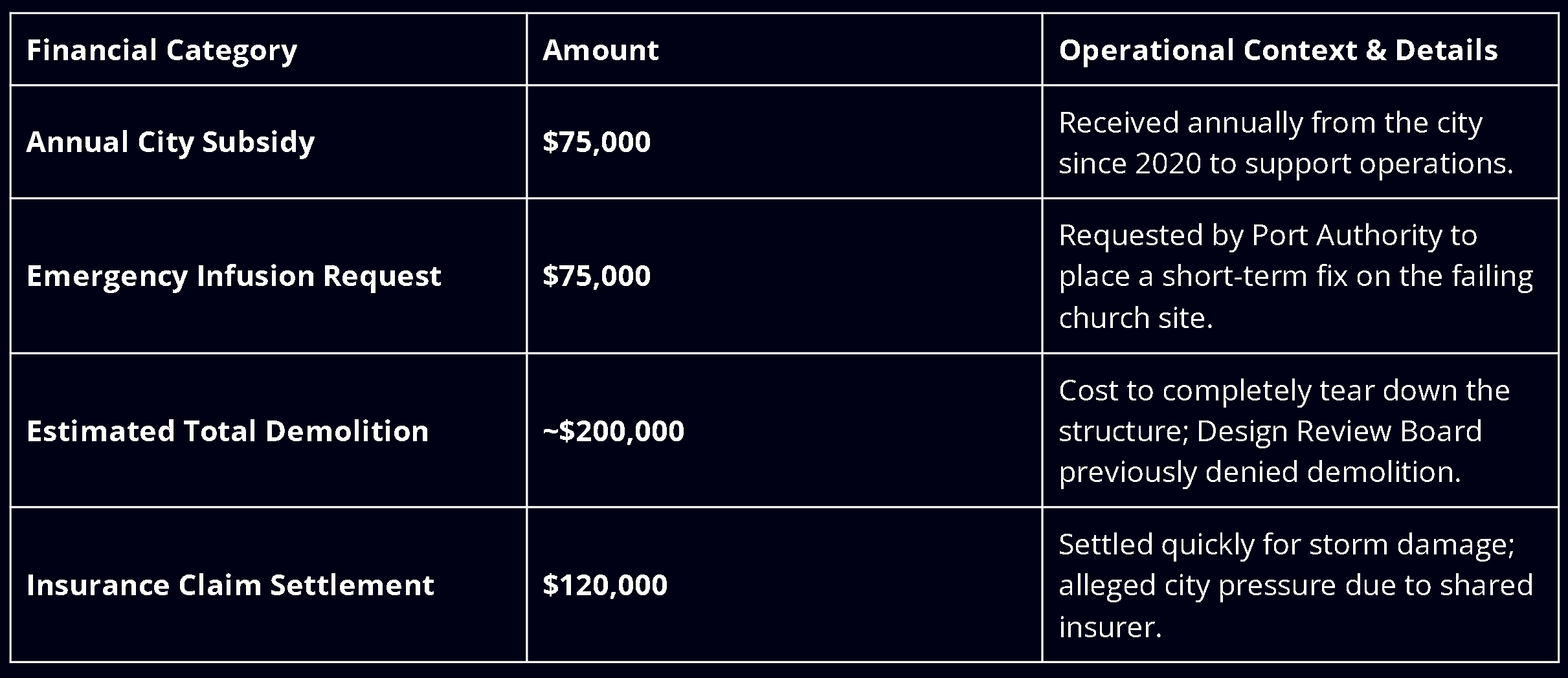
During council discussion, members verified that the Port Authority settled the storm damage insurance claim for $120,000.
However, a startling allegation was entered onto the public record: council members noted that an administrative figure inside city operations allegedly pressured the Port Authority to settle quickly and quietly because the property policy was written by the city’s own insurer and administration “didn’t want problems”.
Galion Port Authority Financial Pipeline
The financial position of the Port Authority has drawn sharp scrutiny from elected officials and citizens alike. Galion citizens told MarionWatch that the Walnut Street site resembles other local projects that ended up being “money pits,” noting that some didn’t even “get off the ground”. MarionWatch has been looking into this particular public allegation of failed projects and money pits and plans to publish a comprehensive investigative series on this subject in the near future.
Despite receiving a standard $75,000 annual municipal allotment, the entity claims it is out of operating funds and requested an additional $75,000 emergency infusion from the city to address the deteriorating church site. Council members pointed out that a complete structural tear-down would cost approximately $200,000—a process complicated by the local Design Review Board’s prior rejection of a demolition application for the sanctuary.
Frustration at the council table focused on the Port Authority’s reluctance to self-fund through asset sales. Members emphasized that the Port Authority holds other viable real estate, including parcels along State Route 598, which could be liquidated to cover operational deficits rather than treating municipal tax dollars as a funding buffer.
Sentiment is solidifying around forcing a formal floor vote to decide whether to transfer the property for $1, pursue aggressive structural demolition, or cut off Port Authority appropriations altogether.
State Auditor Warnings and Internal Control Fractures
Galion’s internal accounting workflow faced renewed scrutiny following communications from state oversight authorities. City Auditor E. Roberta Wade informed the council that she received formal correspondence from Jessica Wesler with the Ohio Auditor of State’s office regarding unreturned annual fraud questionnaires. Compliance records showed that only two elected officials—Council Members Eric Weber and Mike Richart—had submitted the mandatory forms.
State officials warned that failure to return the questionnaires would result in a formal “management letter comment” attached to Galion’s public audit record. Law Director Michael Bear contextualized the warning, noting that while a management comment reflects administrative compliance gaps, it is significantly less severe than a formal “finding for recovery”. However, Bear sparked debate by publicly characterizing the state requirement as “nitpicking”—despite the fact that returning these internal control questionnaires is explicitly mandated by the Ohio Auditor of State.
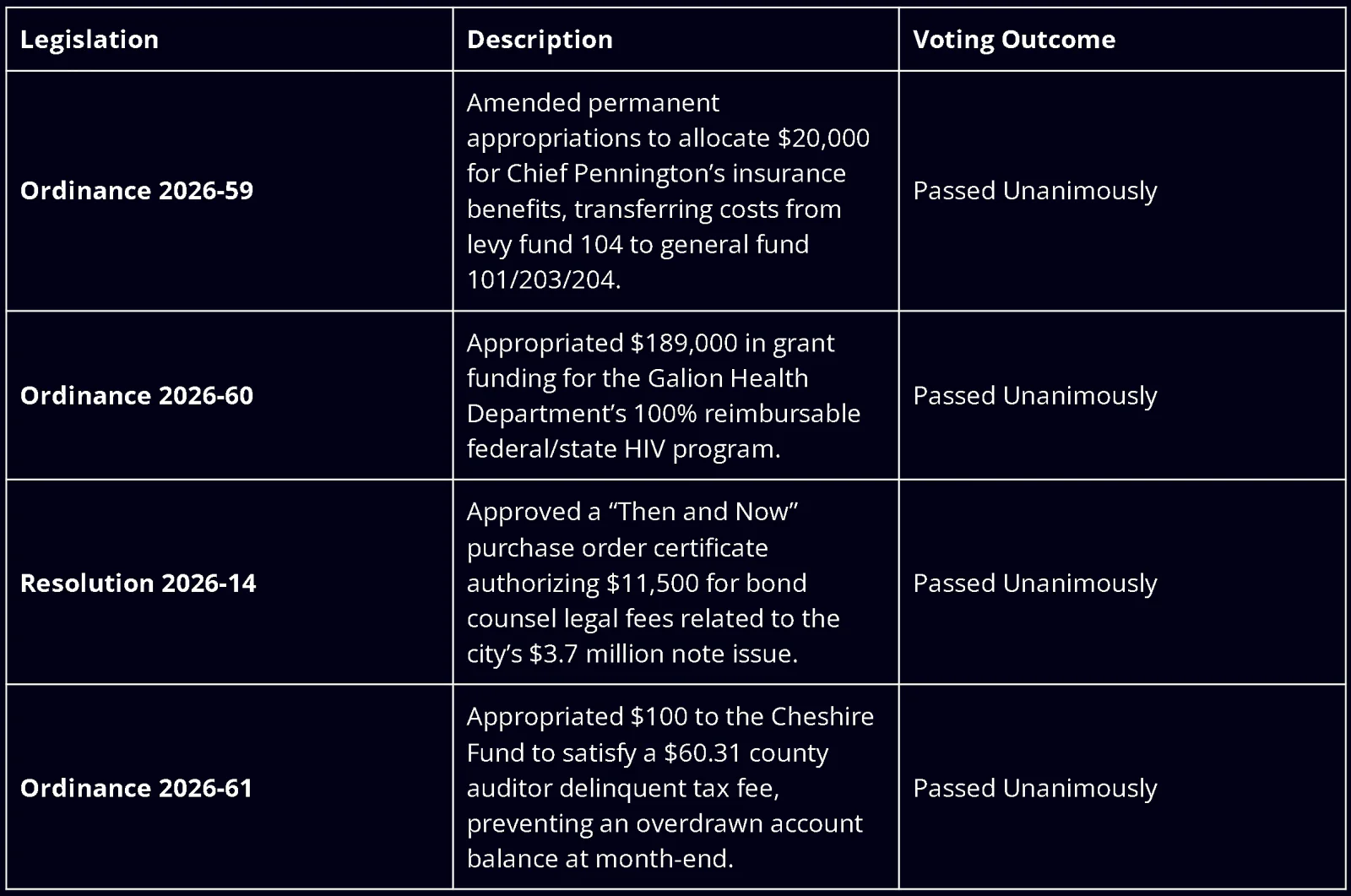
Audit & Procurement Flashpoint: Council was forced to pass Resolution 2026-14 authorizing an $11,500 “Then and Now” purchase order certificate for legal services rendered by bond counsel during the city’s $3.7 million note issue. Auditor Wade admitted the bill arrived before a purchase order was created. The reliance on retroactive expenditure approvals aligns with systemic procurement lapses documented by MarionWatch since January 2026, revealing a documented history of internal control issues.
Utility Oversight: Drinking Water Data & THM Management
Mayor Brian Saterfield delivered an administrative update regarding recent Environmental Protection Agency (EPA) test results for the municipal drinking water system. The report highlighted seasonal spikes in Trihalomethanes (THMs)—chemical byproducts generated when chlorine disinfectant reacts with naturally occurring organic matter in raw water sources. Elevated summer temperatures and higher organic loads accelerate this reaction.
Third-Quarter THM Testing Sites Exceeding 80 ppb
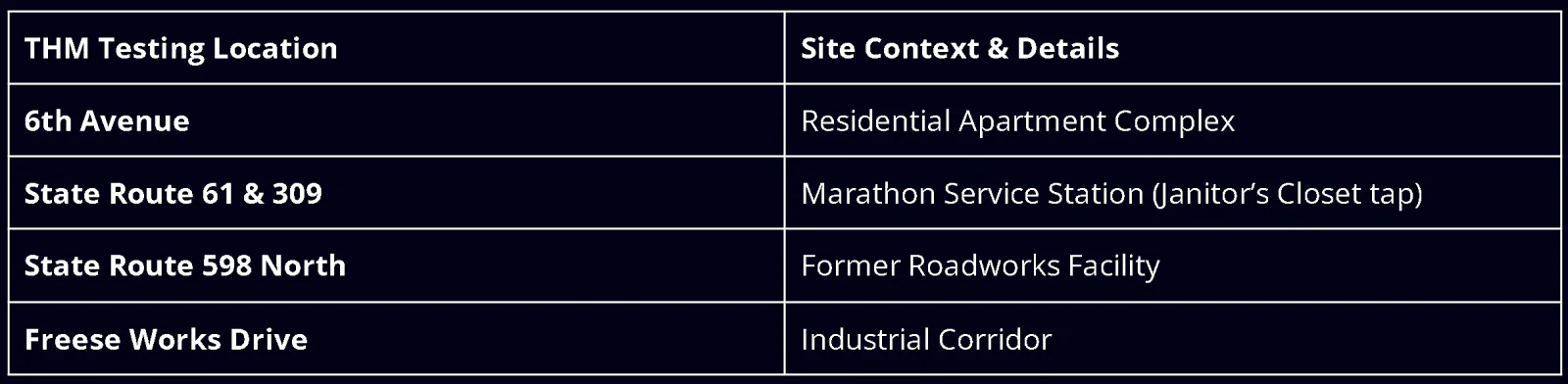
Single-sample test results registered above the 80 parts-per-billion (ppb) threshold at all four monitoring sites. However, Mayor Saterfield emphasized that federal drinking water compliance is governed by a Locational Running Annual Average (LRAA) evaluated across four consecutive quarters. Because Galion recorded low THM concentrations during the preceding three quarters, the city’s rolling annual average remains fully compliant with EPA standards, and tap water remains safe for public consumption.
To mitigate seasonal spikes and reduce overall water age in the system, municipal utility crews are actively flushing distribution mains. Additionally, the city is finalizing engineering plans for Ohio EPA review to install a submerged aeration system inside the 1.5-million-gallon underground clearwell storage tank located beneath the water treatment plant lawn. Aeration is an established, industry-standard engineering method that uses forced air bubbles to strip volatile organic compounds like THMs from disinfected water before distribution.
ONGOING INVESTIGATIONS: MARIONWATCH.COM/GALIONCITYWATCH
Beyond individual council sessions, MarionWatch.com / GalionCityWatch maintains active, multi-disciplinary investigative files into Galion’s municipal operations. Our investigative team focuses on core operational sectors to ensure public records and official statements align with ground realities. These include but are not limited to:
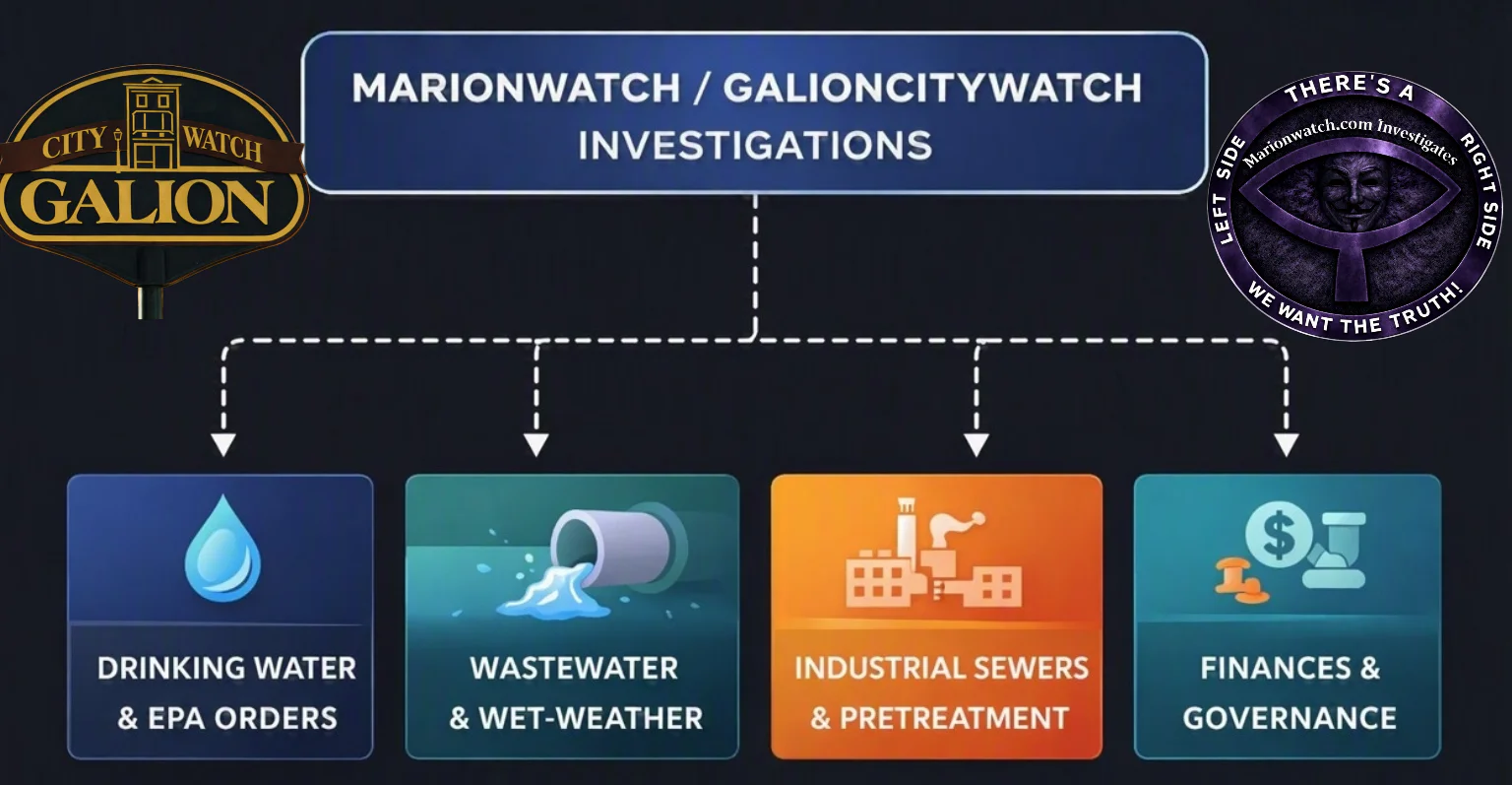
Municipal Drinking Water Infrastructure & EPA Orders
While routine municipal reports focus on quarterly compliance averages, MarionWatch tracks Galion’s long-term standing under official Ohio EPA Director’s Final Findings and Orders. Our ongoing inquiries monitor:
- Clearwell Aeration Engineering: Tracking state plan approvals and execution timelines for the West Railroad Street clearwell aeration system designed to eliminate volatile THM precursors.
- Lead Service Line Replacement Program: Auditing municipal identification protocols, mapping underground service line materials, and tracking federal funding allocations across local utility corridors.
Wastewater Treatment Plant (WWTP) Capacity & Wet-Weather Flow Dynamics
The Hosford Road Wastewater Treatment Plant operates at an average design capacity of 2.7 Million Gallons Per Day (MGD) and a peak hydraulic limit of 8.5 MGD. MarionWatch continues to evaluate:
- Inflow & Infiltration (I&I) Loading: Analyzing stormwater entering sanitary lines through degraded mains, aging manholes, and private sump pump hookups.
- Internal Facility Bypasses: Monitoring automated plant diversions during heavy rainfall events—specifically Bypass Station 603 (activated above 6.8 MGD to bypass secondary clarifiers into Lagoon #1) and Bypass Station 602 (activated above 8.5 MGD to bypass primary/secondary units into Lagoon #2).
Industrial Pretreatment Compliance & Storm Sewer Networks
Following citizen reports of chemical color shifts and unusual odor migration into residential basement sumps, MarionWatch expanded inquiries into municipal environmental oversight:
- Industrial User Permits: Reviewing Ohio EPA audit records concerning expired Categorical Industrial User (CIU) permits and missing monitoring reports for major commercial entities..
- Illicit Discharge & Smoke Testing: Tracking municipal smoke-testing schedules designed to locate unpermitted industrial tie-ins, cross-connections, and temporary discharge lines.
Municipal Governance, Accounting Workflow & Historical Audit Archiving
MarionWatch conducts systematic forensic document reviews covering City Hall’s financial operations:
- Procurement Integrity: Documenting reliance on retroactive “Then and Now” purchase order certificates and emergency rule suspensions.
- Historical Financial Archiving: Digitizing and analyzing state financial audits spanning 1984 to 1999 to evaluate multi-decade debt structures.
Community Operations and Infrastructure Highlights
Beyond fiscal and utility oversight, council addressed several public service and municipal infrastructure matters:
- Public Safety Leadership: Jeff Pennington, a 28-year veteran of the Galion Fire Department promoted to lieutenant in 2000, was formally sworn in as Fire Chief. Chief Pennington expressed appreciation for his family, department personnel, and visiting fire chiefs from Shelby and Springfield.
- School Schedule Safety: A resident voiced concern regarding unsupervised youth riding electric scooters without helmets on Mondays. The issue stems from Galion City Schools’ blended schedule. Council clarified that student meal programs remain operational on Mondays and urged patience as the community adapts.
- Street Paving Schedule: While city crews continue cold-patch maintenance, primary contractor Road Materials confirmed that major resurfacing operations are scheduled to begin by late August.
- Park Upgrades: Volunteers from St. Paul United Methodist Church were publicly recognized for collecting over 20 bags of weeds and trash at South Park. Furthermore, damaged green picnic tables at Heise Park were removed and replaced with new blue commercial tables.
Legislative Ledger: July 28, 2026
All legislative measures were enacted under a formal suspension of statutory rules:
LOOKING AHEAD
The July 28 session serves as a crucial piece of data for Galion’s municipal governance, distilling seven months of continuous watchdog reporting into three sharp, unavoidable realities:
- Procurement Standards Must Catch Up to Scale: The routine reliance on retroactive “Then and Now” certificates and emergency rule suspensions demonstrates an administrative structure operating on short-term fixes. As multi-million-dollar note issues and regional grant dollars pass through City Hall, establishing proactive purchase order controls is no longer optional—it is a baseline requirement to avoid state regulatory flags.
- The Port Authority Model Demands Real Reform: The Peace Lutheran Church debacle has laid bare the dangers of managing high-liability municipal real estate without an exit strategy. Expecting taxpayers to absorb emergency cash infusions while commercial land holdings sit idle on Route 598 is a model nearing its expiration date.
- An Increasingly Independent Council: The most significant shift since January 2026 is the growing willingness of City Council members to push back. Bypassing administrative rubber-stamping, demanding real estate liquidations, and insisting on floor votes signal an elected body preparing to hold quasi-governmental boards and administrative departments directly accountable to the public.
We encourage Galion officials to contact MarionWatch for assistance with transparency initiatives or any matters of public concern. We maintain an extensive network of professionals across technical, legal, financial, and environmental fields.
As Galion moves into late summer, MarionWatch.com Investigates will continue to monitor the State Auditor’s compliance letters, the EPA’s progress on the clearwell aeration project, other infrastructure projects, and the upcoming floor vote regarding the Port Authority.
Galion is a great example of a “small town USA” city, with genuinely caring, hard working, and dedicated people. It is the mission of MarionWatch to uncover, reveal, and educate the public—and at times officials—with the overall goal of fostering civic restoration.