


 Written by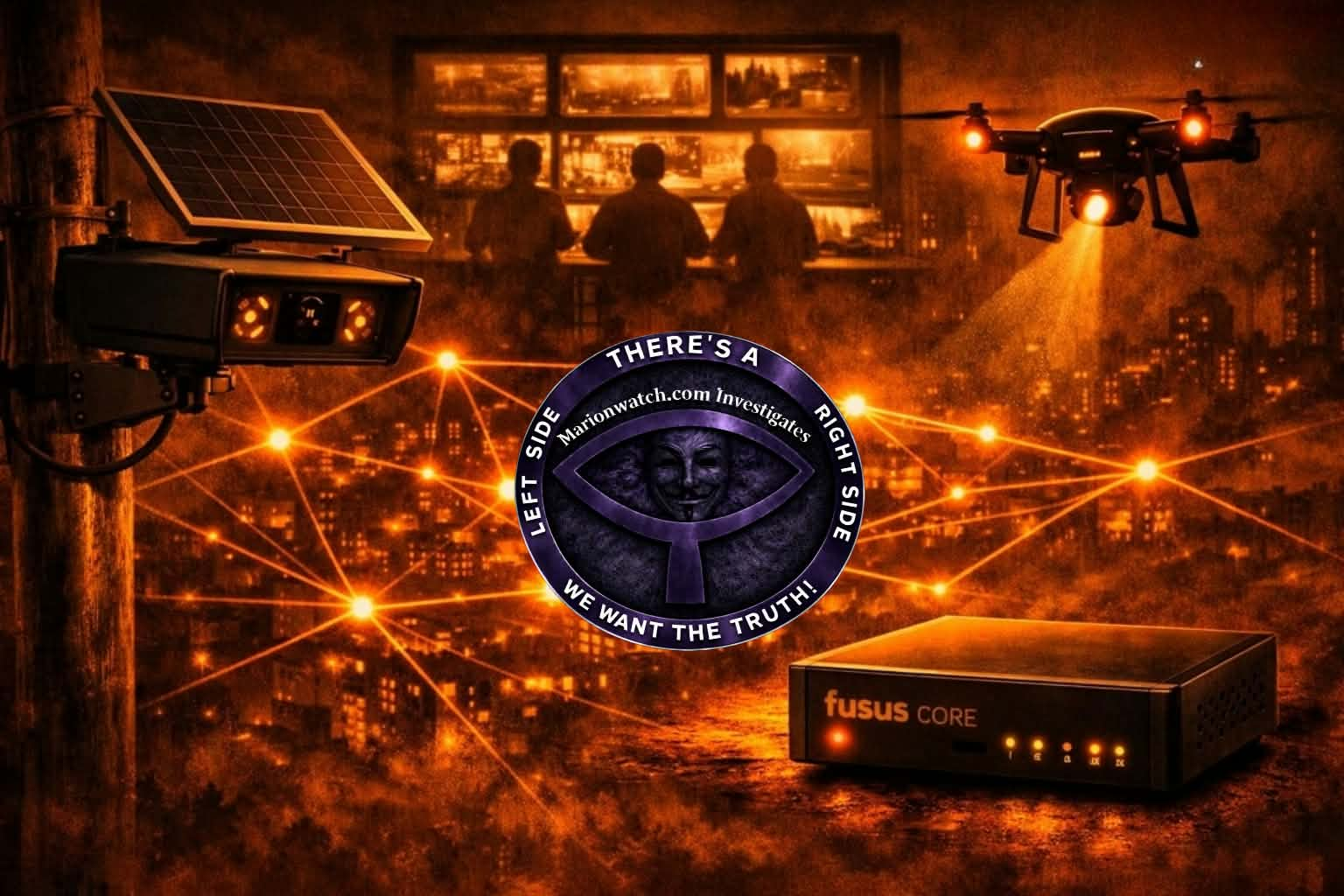
In recent months, as part of our tracking of municipal technology deployments in Marion and surrounding areas, we have documented a growing push by law enforcement to integrate private, commercial security camera systems into public safety infrastructure. This trend mirrors the adoption of other surveillance technologies, such as Flock Safety automated license plate reader systems, which use cloud connected networks to provide real time data to police. Flock was installed in Marion without city council approval. Later, a vote was taken on Flock oversight. This oversight ordinance is described as inadequate by a large majority of the citizenry.
At the center of this shift is the Axon Fusus CORE platform. While the technology is framed as a force multiplier for emergency response, understanding how it functions — and the privacy, retention, and corporate governance questions that come with it — is essential for business owners and citizens alike.

WHAT IS THE FUSUS CORE
The Fusus CORE is a small hardware appliance that acts as a bridge between an existing, independent camera system and a cloud based Real Time Crime Center. It plugs into a business’s internal network, locates the existing cameras, and creates a secure encrypted tunnel to upload that video feed to the police department’s centralized platform. Unlike traditional setups where police would have to physically arrive on site to request or download recorded footage, the Fusus platform allows them to view live or historical video feeds remotely and instantly from their own command centers.
FRAMING THE TECHNOLOGY: THE FLOCK CONTEXT
The adoption of Fusus follows a pattern similar to the implementation of Flock Safety cameras in local municipalities. Both systems share several core characteristics.
- Cloud Based Architecture: Just as Flock cameras rely on cellular networks to push license plate data to a central database, Fusus relies on specific firewall configurations and internet ports to maintain a constant link to Amazon AWS GovCloud servers.
- Voluntary Participation: In most jurisdictions, these programs rely on local businesses opting in to provide police with access to their property’s cameras.
- Emergency Integration: Similar to how Flock systems trigger alerts for wanted vehicles, Fusus is marketed to allow dispatchers and responding officers to see exactly what is happening at a business location before they arrive on the scene.
Flock Safety has also introduced an autonomous drone program in other cities.
These drones launch from rooftop docking stations, respond automatically to calls for service, and stream live video to police. However, there is no public documentation confirming that Flock drones are deployed in Marion, Ohio. Marion’s known involvement with Flock remains limited to fixed automated license plate reader cameras installed through county grant funding.
More detail is available through private camera integration, Flock ALPR operations, and Flock drone capabilities.
HOW THE FIREWALL AND NETWORK CONNECTION WORK
The Fusus CORE cannot operate unless the business’s firewall is configured to allow continuous communication with Axon’s cloud servers. The device requires outbound access to a specific list of internet hosts over port 443, along with a wide port range from 10000 to 19999 for cloud video streaming. These rules allow the CORE to maintain a permanent encrypted tunnel to where the Real Time Crime Center platform is hosted.
The device also needs access to DNS and NTP services so it can resolve domain names and maintain accurate time stamps. Without these permissions, the CORE cannot register itself, stream video, or receive remote updates.
Because the CORE sits inside the private network, these firewall rules create a standing pathway from the business’s internal environment to Axon’s cloud infrastructure. This makes network segmentation, logging, and access control essential. It ensures the CORE can only reach what it is supposed to reach and prevents it from interacting with unrelated internal devices, supposedly.
KEY TECHNICAL CONSIDERATIONS
For business owners, installing this hardware is not as simple as plugging it in. It requires deliberate network configuration, an understanding of outbound access rules, and awareness of how the device communicates with external servers. Because the connection is continuous, it represents a significant change in how a business manages internal network security. It effectively places a government monitored device inside the private network of a business, making it necessary to review access rights and data permissions to ensure the business retains control over when and how private video feeds are shared.
PRIVACY CONCERNS
The integration of private camera feeds into police Real Time Crime Centers raises multiple privacy issues that communities and business owners should consider:
- Scope Creep and Mission Creep: Systems introduced for emergency response can be repurposed for routine policing, investigations, or other uses not originally disclosed to participants. Once live access exists, it can be tempting for agencies to expand use beyond the original intent.
- Surveillance of the Public: Cameras on private property often capture public spaces (sidewalks, streets, parking lots). When those feeds are accessible to police in real time, the surveillance footprint over public life increases without the same public oversight that accompanies government-operated cameras.
- Access Controls and Auditability: Who within the police department can view live or recorded feeds? Are there role-based access controls, mandatory logging, and independent audits? Without strict controls and transparent auditing, access can be broad and unmonitored.
- Third-Party Access: The CORE creates a link to a vendor-hosted cloud. That raises questions about vendor employees, subcontractors, or cloud providers having any level of access to footage, metadata, or system logs. Contracts and data processing agreements should explicitly limit vendor access and require notification and oversight.
- Data Minimization and Purpose Limitation: Are feeds or derived data retained only as long as necessary for the stated public safety purpose? Are there policies to prevent the creation of long-term surveillance archives from continuous private feeds?
- Legal Process and Civil Liberties: How will law enforcement handle requests for footage in criminal investigations, civil litigation, or public records requests? Will businesses be notified when footage is accessed? What safeguards exist to protect sensitive footage (e.g., inside private areas, employee areas, or footage capturing minors)?
Business owners should ask local officials for written policies that address these points before opting in. Residents should request public hearings and clear, enforceable rules governing access, use, and oversight.
DATA RETENTION CONCERNS
Retention policies determine how long video and associated metadata are stored, who can delete it, and under what conditions it can be shared. Key retention concerns include:
- Default Retention Periods: Does the vendor or police agency set a default retention period for live and recorded video? If so, what is it, and is it aligned with the minimum necessary principle?
- Event-Based vs. Continuous Retention: Is footage retained only when flagged as relevant to an incident, or is continuous footage archived? Continuous archiving dramatically increases the amount of stored data and the risk of misuse.
- Metadata Retention: Even if raw video is deleted, metadata (timestamps, camera IDs, access logs, analytic outputs) can persist and be used to reconstruct patterns of movement or access.
- Deletion and Oversight: Who can delete footage? Is deletion logged and verifiable? Are there independent mechanisms to verify that deletion actually occurred?
- Legal Holds and Public Records: Retention policies must account for legal holds (e.g., when footage is relevant to litigation or an investigation) and public records laws that may require preservation. Clear rules are needed to reconcile routine deletion with legal obligations.
- Cross-Jurisdictional Storage: If footage is stored in cloud servers located in other states or countries, different retention and disclosure laws may apply. That can complicate requests for deletion or raise additional legal exposure.
Communities should demand transparent retention schedules, public reporting on access and retention, and technical controls that enforce deletion rather than relying solely on policy statements.
WHO OWNS AND CONTROLS THE DATA?
Ownership and control are often ambiguous in vendor-police-business arrangements. Important questions include:
- Contractual Ownership: Does the business retain ownership of the raw footage, or does the vendor or police agency claim rights to store, analyze, or share it?
- Access Rights: Under what circumstances can police access live feeds without a warrant? Are emergency exceptions narrowly defined?
- Business Protections: Can businesses restrict access to footage that captures private areas (e.g., employee-only zones) or require notification before footage is used for non-emergency purposes?
- Transparency: Are data-sharing agreements, memoranda of understanding (MOUs), and vendor contracts publicly available for review?
AXON, FUSUS CORE, AND CORPORATE BACKGROUND
Who is Axon?
Axon Enterprise, Inc. is the company that acquired Fusus and integrated the Fusus CORE technology into its product portfolio. Axon is a U.S.-based company known primarily for its law enforcement products, including body-worn cameras, TASER devices, and cloud-based evidence management systems. Axon’s corporate headquarters are in Scottsdale, Arizona, United States. The company is publicly traded and operates globally, selling hardware and cloud services to law enforcement agencies and other public safety organizations.
Fusus origins and acquisition:
Fusus began as an independent company offering software and appliances to aggregate and stream video from disparate camera systems into centralized monitoring platforms. Axon acquired Fusus to expand its real-time video and sensor integration capabilities and to offer a broader suite of public safety tools that connect cameras, sensors, and evidence management.
Corporate structure and affiliations:
- U.S. base and operations: Axon is headquartered in the United States and operates under U.S. corporate governance and securities regulations. Its primary cloud deployments for public safety customers often use U.S.-based cloud infrastructure (including AWS GovCloud for certain sensitive workloads), which is designed to meet government security and compliance requirements.
- Global footprint: Axon sells internationally and may have subsidiaries, partners, or service providers outside the U.S. that support sales, deployment, or maintenance. When vendors rely on international subcontractors or cloud regions, that can introduce additional legal and privacy considerations.
- Foreign affiliations: There is no public indication that Axon is foreign-owned; it is a U.S. public company. However, because cloud services, third-party analytics, or supply chain components can involve foreign vendors or data centers, communities should ask for a clear supply-chain and subcontractor disclosure in procurement documents.
Why corporate provenance matters:
- Jurisdictional law: Where a company is headquartered and where data is stored affects which laws govern access, disclosure, and government requests. U.S.-based companies are subject to U.S. law, but data stored or processed abroad may be subject to other jurisdictions’ laws.
- Vendor accountability: Publicly traded companies have investor reporting obligations and public records that can be reviewed for governance practices, but private subcontractors may not. Procurement contracts should require transparency about subcontractors, data flows, and cross-border transfers.
POLICY AND PROCUREMENT QUESTIONS FOR LOCAL OFFICIALS
Before any deployment or opt-in program expands, residents and business owners should press for:
- Publicly available MOUs and contracts that specify data ownership, retention schedules, access controls, and audit provisions.
- Clear, narrow definitions of emergency access and written policies limiting warrantless live access to narrowly defined exigent circumstances.
- Independent oversight and audit mechanisms to review access logs, retention compliance, and any analytic outputs derived from footage.
- Vendor transparency about where data is stored, which cloud providers and regions are used, and what subcontractors have access.
- Data minimization and deletion guarantees enforced by technical controls, not just policy statements.
- Notification and redress provisions for businesses and individuals whose footage is accessed or retained.
- Public reporting on the number of accesses, retention exceptions, and any law enforcement uses of the system beyond immediate emergency response.
WHY THIS MATTERS
As municipal governments continue to invest in these surveillance technologies, the line between private property surveillance and public safety monitoring continues to blur. For the investigative community, tracking these deployments is crucial for maintaining transparency regarding how much data is being shared, who has access to it, and what policies govern the use of these systems in our local communities.
WHAT WE DO NOT YET KNOW ABOUT MARION
At this time, it is not confirmed whether Axon Fusus CORE appliances or Flock drones have been deployed in Marion, or whether any formal plans exist to introduce them.
The possibility cannot be dismissed, however, because Flock technology was previously installed in the city without council approval or public disclosure.
That precedent means additional surveillance systems could already be operating, with their existence only becoming known after the fact.
The city and county currently use Flock automated license plate reader cameras, but no public procurement records, council minutes, or other official documentation indicate any local deployment of the Fusus CORE platform or Flock’s drone program.
This uncertainty is why investigators continue monitoring procurement records, grant filings, and network integration activity. Technical inquiries from regional operators show that the technology is circulating in the area, but confirmation of any local deployment will require further documentation and verification.