 Written by
Marion Watch frequently writes about the “echoes” that ripple through local communities—those historical whispers, local legends, and supposed myths that many dismiss as mere small-town folklore. Yet, seasoned investigators know that if you dig long enough beneath the official narratives, you are occasionally rewarded with “gifts” and hidden “treasures” that quietly confirm the reality of these mythical things. Embedded within the stark bureaucratic realities of this report lies one of those unmistakable local legends.
We will leave it to you, the reader, to spot it—but anyone who truly knows Galion, its history, and its community network will recognize the signpost immediately.
The actual relationship between the Galion City Council and the Galion Port Authority has officially reached a critical turning point. At the most recent City Council meeting, local officials leveled intense scrutiny at the Port Authority’s financial management, operational transparency, and growing liabilities that threaten to fall back on the city’s taxpayers.
At the center of the legislative floor debate was Ordinance 2026-50, a controversial funding request for $75,000 intended for structural repairs on the former Peace Lutheran Church property.
While the ordinance was presented, council members explicitly voiced deep concerns regarding the Port Authority’s long-term financial stability and a distinct lack of transparency regarding its internal revenues.
The Transparency Breakdown: Hidden Tax Reports and Property Sales
A major flashpoint during recent civic discussions involves the Port Authority’s resistance to direct municipal oversight. Specifically, the Port Authority reportedly refused to provide its filed tax reports directly to the city council for standard oversight review.
When independent, verified data was brought forward to challenge this secrecy, it revealed a stark contrast between gross real estate revenue and actual project net returns:
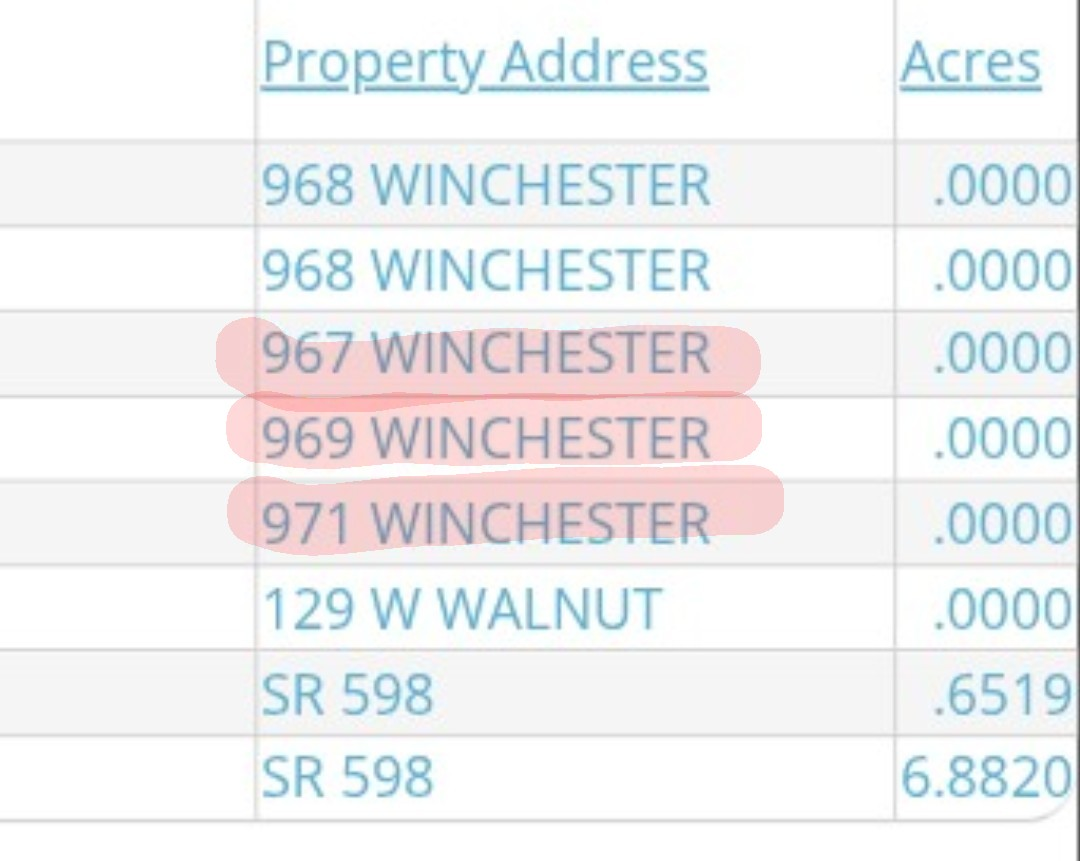
- The Renschville Discrepancy: The Port Authority sold three residential lots within the Renschville development project, bringing in a total gross revenue of $174,000.
- The Actual Profit: Despite these high-dollar real estate transactions, insider financial analysis shared with local oversight advocates revealed that the public entity walked away with a mere $15,000 in actual profit from the Renschville sale.
- Where the Money Went: Public accountability questions have intensified as records indicate the vast majority of these incoming real estate monies were instantly swallowed up to fund the executive director’s salary, which sits at $90,000 a year.
Council Confrontation and Context
During the legislative debate, the frustration among council members was palpable as they refused to act as an unvetted, blank check for an opaque entity. Multiple representatives noted that the city’s oversight parameters had been completely cut out of the loop.
“We are being asked to hand over $75,000 in taxpayer funds to a body that won’t even show us their basic tax reports,” one council member noted during floor discussions. “If they cannot demonstrate internal sustainability on a project as straightforward as Renschville, how can we trust them to manage massive structural assets without the city holding the bag?”
Council’s ultimate consensus underscored a hard line on accountability: the city will no longer absorb external project risks while the Port Authority operates under a veil of privacy.
Historical Audit Context vs. Modern Financial Strain
To understand how the Port Authority’s financial obligations have shifted, it is necessary to examine its state-level financial filings recorded by the Ohio Auditor of State over time.
The Baseline Years (2019–2020)
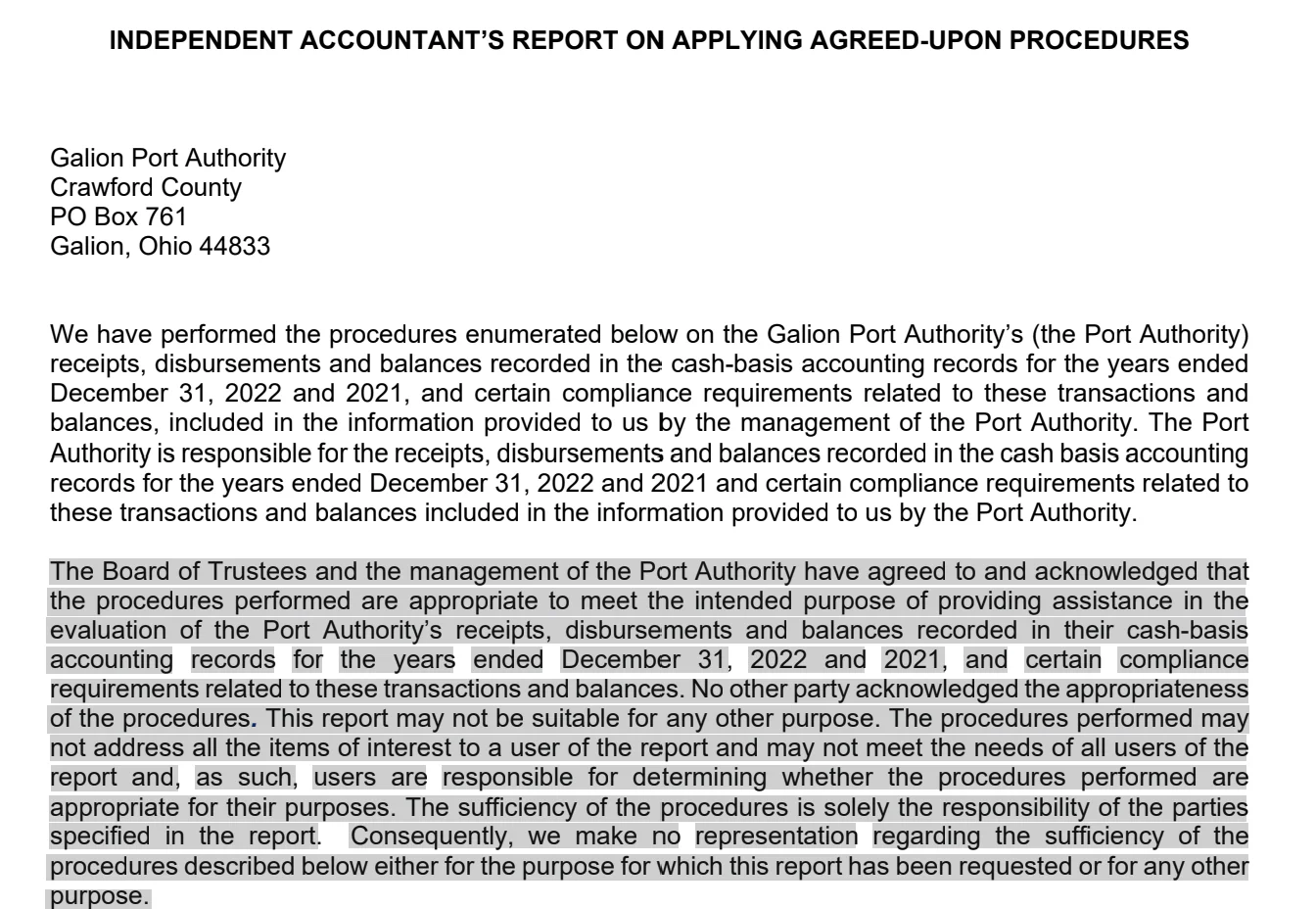
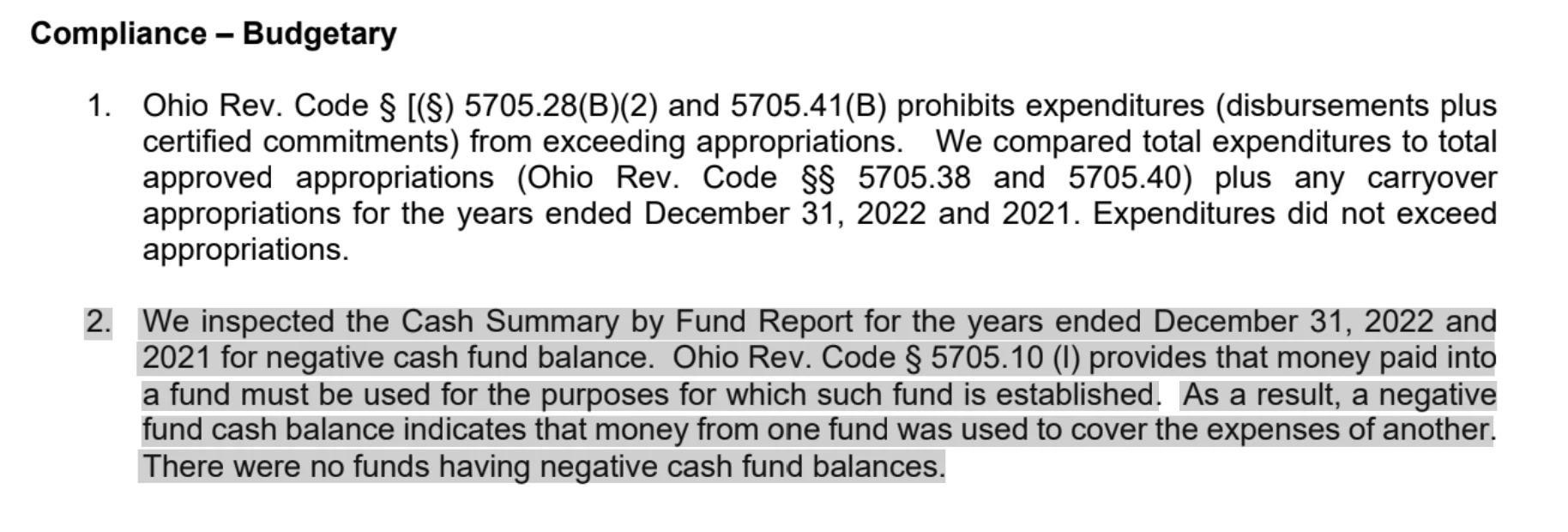
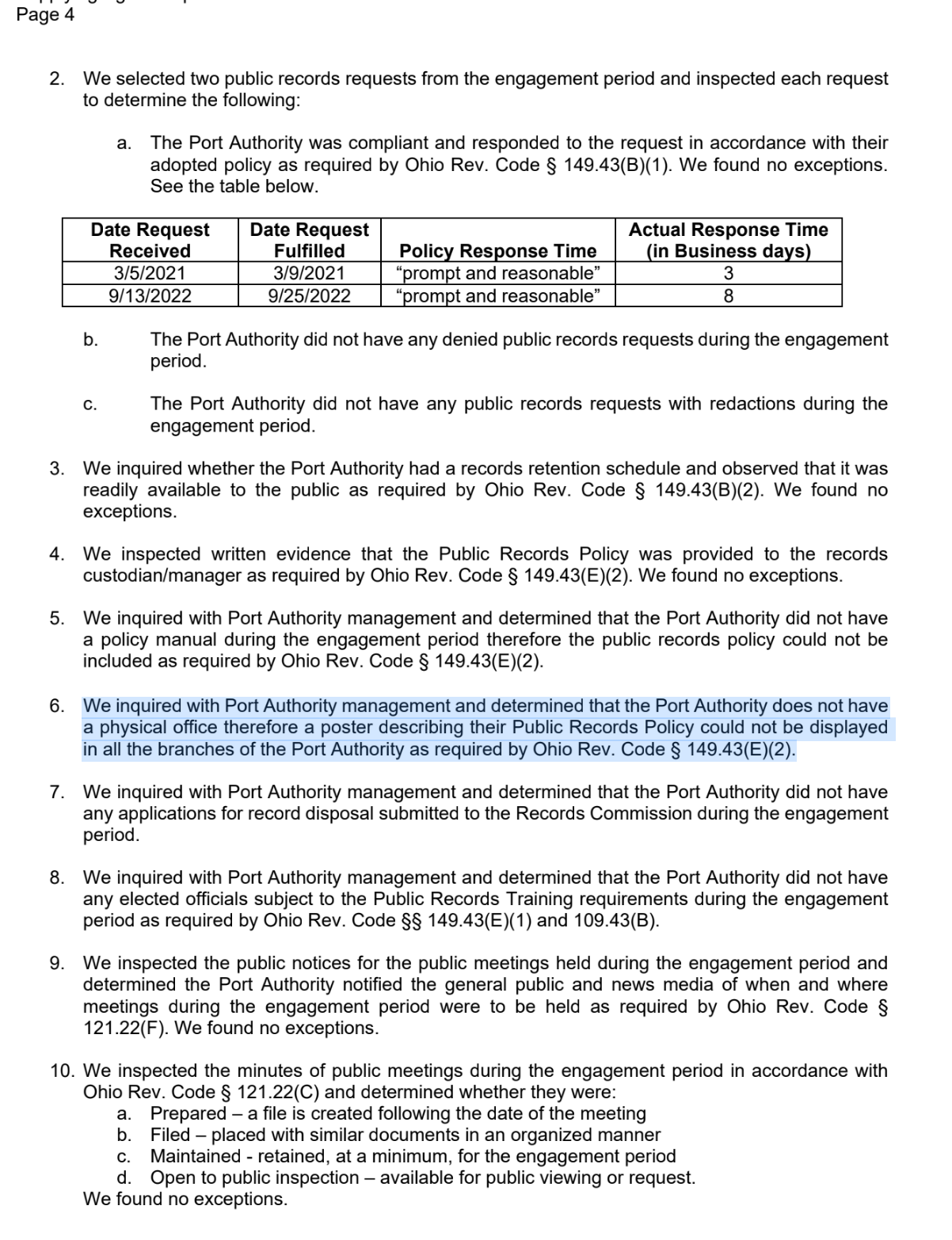
In its initial operational period, the state handled the entity via a basic procedural check. As recorded in Ohio Auditor of State audits, the Ohio Auditor of State’s office conducted a basic audit for the years ended December 31, 2019, and December 31, 2020. At that time, state auditors found no significant compliance or accounting issues to report under their highly limited testing scope.
The Transition to Debt (2021–2022)
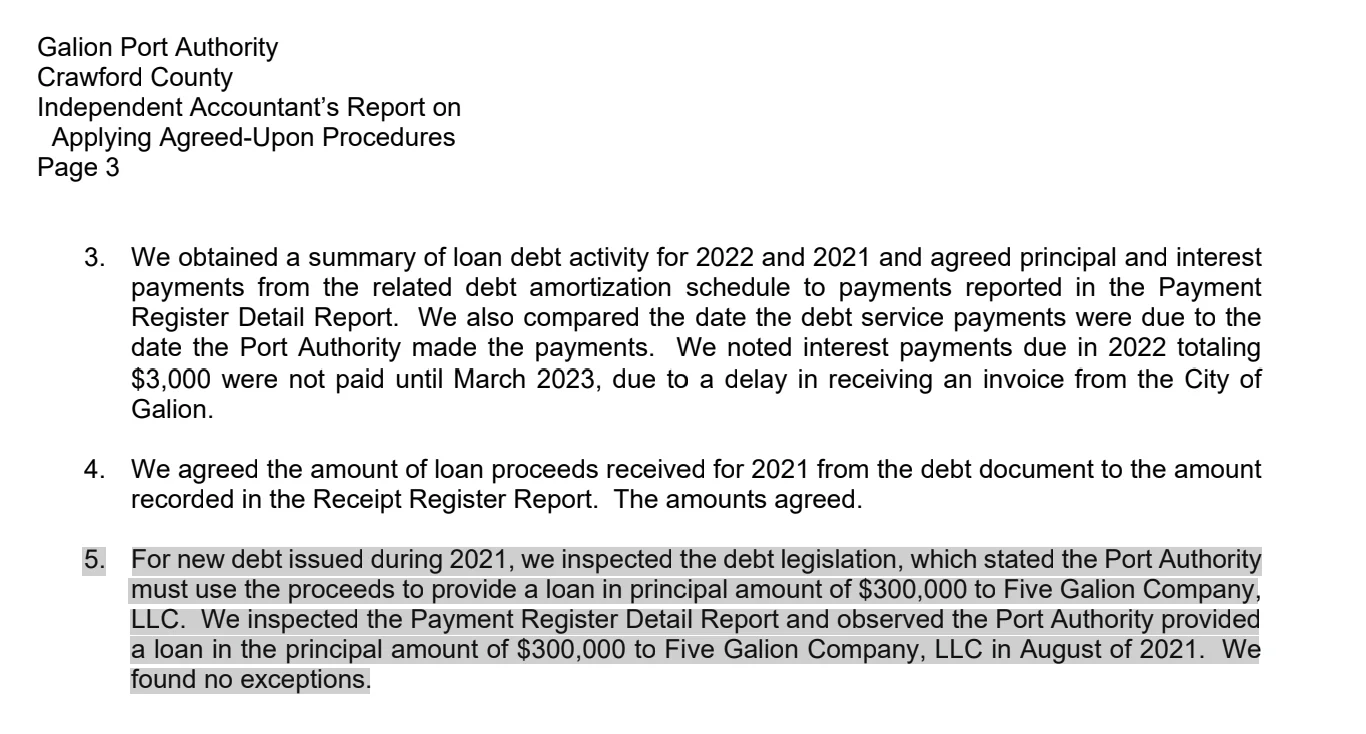
As the Port Authority expanded into development, its financial mechanics grew more complicated. According to the independent accountant’s report found in Ohio Auditor of State audits, an Agreed-Upon Procedures review for 2021 and 2022 noted that the prior 2020 basic audit showed zero outstanding debt.
However, by August 2021, the Port Authority began acting as an administrative conduit for larger private financing, issuing a $300,000 loan to local developers. Notably, structural and procedural delays were already creeping in; interest payments due to the City of Galion totaling $3,000 in 2022 were delayed and not paid until March 2023 due to explicit internal invoicing gaps.
Click to Enlarge Images
The Current Debt Load (2023–2024)
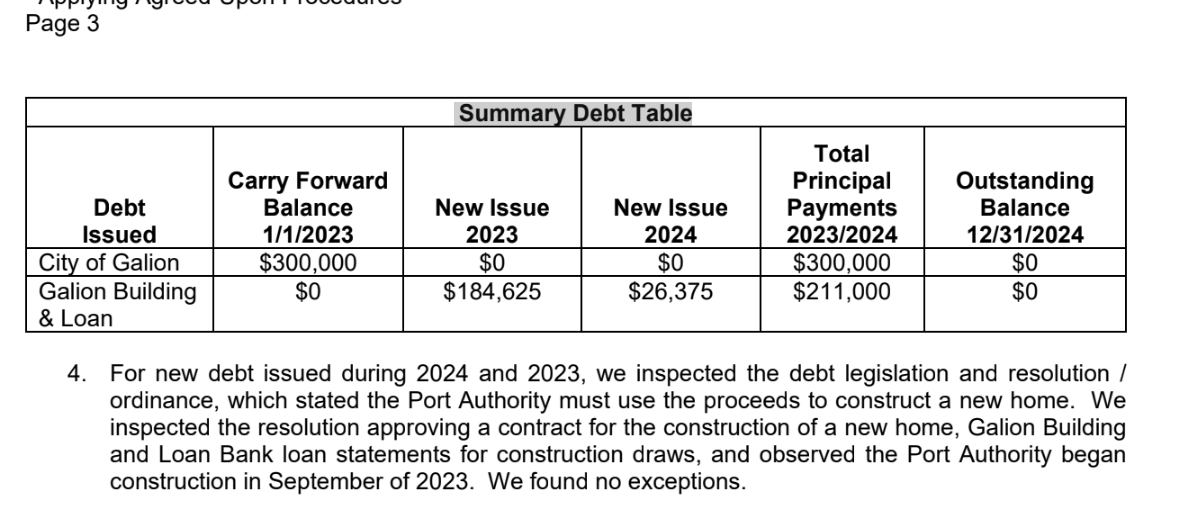
The escalating financial exposure of the entity is clearly mapped out in the official state documentation. The Summary Debt Table reveals how quickly the Port Authority has cycled through public and private money.
The Port Authority’s financial cycles show a consistent pattern of replacing old obligations with new borrowing.
While the $300,000 debt carried forward from the City of Galion was eventually settled, the entity immediately replaced it by securing fresh financing to fund residential construction: $184,625 in 2023, followed by an additional $26,375 in 2024 through Galion Building & Loan.
Although these specific bank loans show a zero balance by the end of 2024 due to structural construction draws and principal turnarounds, this rapid shuffling of funds underscores a thin operational margin.
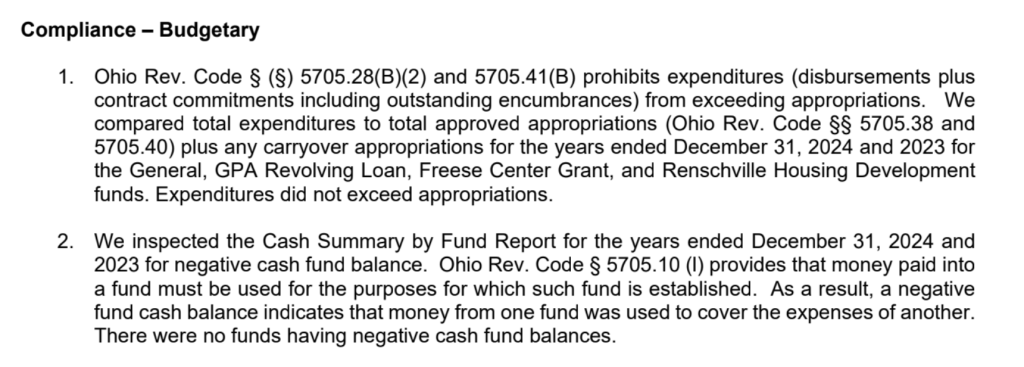
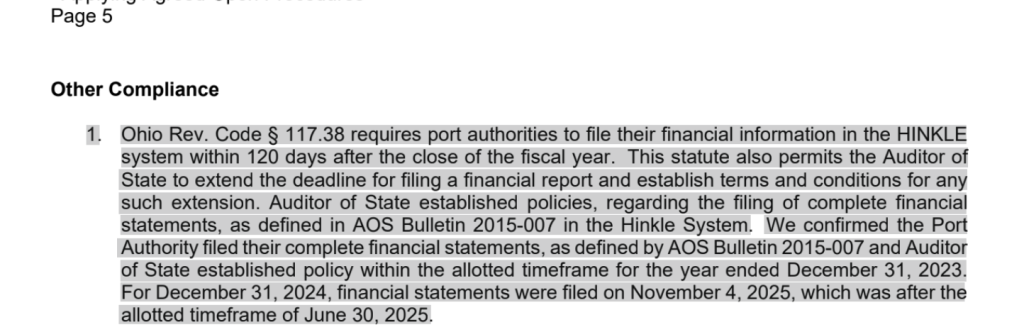
According to Galion sources, the Port Authorty never disclosed the financial reports regarding these sales to confirm an exact dollar amount.
Click to Enlarge Images
The Smoke Testing Battleground: Citizen Blame vs. Public System Failures
The continuous demand for city bailouts and cash injections by the Port Authority comes at the worst possible time for Galion’s broader municipal ledger. City Council discussions heavily underscored that the general fund and utility enterprise funds are already facing severe operational strain from overdue water, wastewater, and storm sewer infrastructure projects.
The ongoing infrastructure narrative takes a critical turn on Galion’s west side, where contracted engineering firm Wessler Engineering kicked off aggressive smoke testing of the wastewater collection system. Conducted under a strict, legally binding Ohio EPA mandate requiring a complete evaluation by June 14, 2027, the test’s primary function is to delineate between private and public defects causing devastating Inflow and Infiltration (I&I).
A central point of contention has erupted following early presentations to City Council by Wessler representatives. Initial reporting and administrative talking points leaned toward minimal public-side failures, subtly deflecting systemic blame onto the private sector. However, internal findings and council floor discussions reveal a completely different reality: the testing results primarily expose severe, failing city-owned infrastructure as the true culprit, something Marion Watch hinted at weeks ago.
While code enforcement historically targets private-property issues—such as illegal sump pump connections, broken cleanout caps, or deteriorated service laterals—pressurized smoke reveals massive systemic failures occurring directly underneath city streets:
- Broken Main Lines: Structural fractures in the main collection lines are allowing millions of gallons of groundwater to flood the network during rain events, overloading the wastewater treatment plant far beyond its daily baseline.
- Deteriorated Municipal Manholes: Deep underground structural defects, open pick holes, and degraded manhole walls sitting in low-lying public zones are acting as direct storm sewers, capturing surface run-off and channeling it straight into the sanitary network.
- The Multimillion-Dollar Capital Trap: City financial officials have previously warned council of multi-million dollar spending gaps primarily driven by capital-heavy enterprise funds—specifically the storm water, electrical, and wastewater treatment plant funds—which have forced the city to actively spend down its internal fund balances.
The Transparency Gap and On-the-Ground Verification
Despite explicit statements that Wessler Engineering would compile and fully publish a comprehensive, localized data report and prioritized rehabilitation worksheet for the public, the administration has yet to release the raw, unedited findings.
Local officials continue to publicly message that city-owned infrastructure failures are minimal, but on-the-ground intelligence gathered directly from the Galion citizenry paints a vastly more severe picture. Residents consistently report seeing widespread public-side smoke plumes emerging from municipal easements, storm grates, and center-line street cracks rather than private yards.
Because the official statistics and the narrative being pushed from city hall fail to match the real-time observations of local property owners, Marion Watch will be deploying investigative assets directly to the field zones as testing is done.
Our teams plan to independently track, cross-examine, and visually verify these municipal defect claims to ensure that the ultimate financial accountability for repairing these multi-million dollar public mainline failures rests squarely on the city administration—not pushed onto the wallets of private homeowners.
The Mounting Case for Dissolution
Because the Port Authority continues to operate with razor-thin financial returns while simultaneously demanding taxpayer-funded cash injections—such as the $75,000 requested under Ordinance 2026-50—local watchdogs and council members are increasingly raising the alarm.
The primary fear is structural: if the Port Authority signs onto additional major redevelopment projects without securing an independent, sustainable source of revenue, any resulting financial defaults will ultimately crash down onto the City of Galion’s general ledger.
With the city already balancing on an infrastructure tightrope to fund mandatory water, wastewater, and storm sewer upgrades, a tipping point has been reached. Formal discussions have actively begun among decentralized citizen action networks to legally push for the Port Authority to be completely dissolved before these compounding external liabilities spiral entirely out of control.
What the Data and Local Engagement Reveal
Marion Watch is digging deeper into the financial operations of both the Galion Port Authority and the city’s broader municipal funds to continue publishing in-depth investigative reports on these matters of urgent public concern. Currently, the operational risks and overhead costs associated with the Port Authority match or exceed the severe fiscal strain seen in the city’s aging infrastructure.
The metrics driving this investigation go far beyond mere balance sheets. Online engagement, public records analysis, and direct discussions with local residents have generated a volume of concern that is massive when scaled against Galion’s actual population.
This disproportionate response from the community underscores the sheer seriousness of the situation, providing a clear roadmap of exactly where investigators need to look next to expose further transparency gaps.
Read more about the City of Galion: