

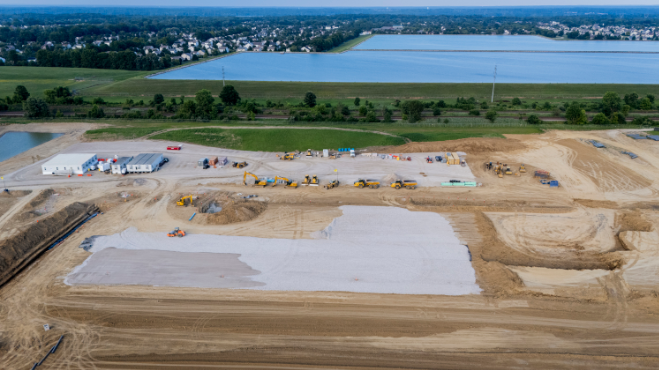
 Written by
The Marion Watch Perspective: THE DATA CENTER EXPANSION NO ONE IS FULLY EXPLAINING — AND WHY IT MATTERS FOR OHIO
The global shift toward an artificial intelligence-driven economy has triggered an extraordinary expansion in digital infrastructure — most visibly in the form of hyperscale data centers spreading rapidly across the American heartland. Marion Watch’s position on this development is clear and uncompromising: we are not anti-technology. We have information technology professionals directly on our team and within our broader contributor network. We understand how this industry works. We do not oppose data centers.
What we vehemently oppose is the rushed, mass construction of these enormous facilities without first requiring the technological innovations that would protect our communities and our environment.
The current model of data center deployment is fully extractive in nature.
It draws unsustainably from local water aquifers.
It strains aging power transmission grids to the point of failure.
And it captures massive tax abatements — all while offloading the real costs of that infrastructure directly onto the people who live there.
Before any more ground is broken in Marion, or anywhere else in Ohio, the industry must evolve.
Deploying these facilities at mass scale without the matching technological and regulatory safeguards is a public policy failure.
Citizens must come first. We must demand decentralized processing, waterless cooling, and ratepayer protections before any multi-billion-dollar corporation receives access to our local resources.
The data center industry wants the public to believe that massive water evaporation and total grid dependency are unavoidable features of the AI revolution.
That is a half truth, the most cowardly of all lies.
It is highly likely that developers and technology giants understand the innovations that will be released soon, and are aware of the products already on the market.
So why are they relying on outdated wasteful cooling and power methods?
It all comes down to profits over people. Let’s look closer at the AI data center half truths that are depleting our water supply, stressing our power grids, and forcing the citizenry to pay for the upgrades.

The Ohio Backdrop: A Rushed Expansion at the Public’s Expense
To grasp the urgency here, you have to look past the industry’s marketing and examine what is actually happening on the ground in Ohio communities.
Driven by affordable land and a historically permissive regulatory environment, Ohio has rapidly become the fifth-largest hub for data center concentration in the United States, with more than 200 active sites — and growing. That concentration has generated serious, organized resistance from rural residents and agricultural producers. Their concerns are fully justified.
While a standard home desktop computer draws about 100 watts of power, a single hyperscale data center demands hundreds of millions of watts — consuming as much electricity as 100,000 homes. By 2030, U.S. data centers as a whole are projected to account for up to 9% of all national electricity consumption. Some of Ohio’s largest data center developments can consume as much water in a single year as tens of thousands of residents, feeding legitimate fears about groundwater subsidence across Central Ohio.
The failure of state oversight reached a defining moment in 2026 when the true cost of Ohio’s data center tax exemption program was finally exposed. The Ohio Department of Taxation had projected the program would cost $136 million in fiscal year 2025.
The actual figure came in at roughly $1.5 billion — more than ten times the estimate — after already costing $554 million in 2024. Ohio currently holds active sales tax agreements with 18 data center companies. Some of the earliest contracts granted a 100% sales tax exemption lasting 40 years.
Bipartisan Outrage — Documented State Senate Democratic leader Nickie Antonio called it “alarming that the state’s forecasting so woefully underestimated the cost of this tax break and that we are just now finding out about it.” Republican State Senator Bill Blessing, who had already introduced legislation to eliminate the exemption entirely, was equally blunt: “Every member of the general assembly should be furious over this.” |
On May 28, 2026, Governor Mike DeWine ordered a suspension of all new tax exemption applications while a legislative committee investigates the program’s full impact on energy, the environment, and local communities. This suspension is significant — and welcome.
But citizens must understand: it is a pause, not a reform. Nothing has structurally changed.
Meanwhile, community resistance is intensifying. In September 2025, Jerome Township trustees voted to impose a nine-month moratorium on data center zoning certificates — one of the few legal tools available to local governments. Residents in other parts of Ohio are now pushing to place a referendum on the November 2026 midterm ballot that would permanently ban new hyperscale data centers statewide. At the regulatory level, Ohio EPA issued a draft General Permit (OHD000001) in October 2025 that would replace individualized environmental review for data center wastewater with a one-size-fits-all approval process — a move critics rightly describe as fast-tracking approvals rather than protecting communities.
“The unchecked mass implementation of data centers must cease until the technology industry deploys structural innovations that alter their resource consumption, and until civic leaders implement policies that protect the public.” — Marion Watch Position on Data Centers |
This moment — the tax pause, the township moratoriums, the ballot referendum effort — represents a definitive mandate from the people. It aligns exactly with Marion Watch’s position: stop the unchecked expansion now, and do not restart it until the industry proves it can operate without plundering local resources.

Currently Available Technologies: Profit vs. Progress
The single most important fact for citizens and local officials to understand is this: the sustainable technologies needed to protect our communities exist right now. They are commercially available. They are proven. They are in active deployment.
The data center industry wants the public to believe that massive water evaporation and total grid dependency are unavoidable features of the AI revolution.
That is false.
The evaporative cooling systems that consume millions of gallons of local water per day are not a technical necessity — they are the cheapest option for maximizing operator profit at the community’s expense. The industry has alternatives. It simply has no legal obligation to use them.
Advanced Thermal Management: Protecting Local Water Today
To understand the problem, you first need to understand the heat.
A standard business laptop generates about 65 watts of heat — easily managed by a small internal fan. A custom gaming PC might generate up to 1,000 watts, requiring larger fans or a small liquid cooling loop. Now consider a single server rack in a modern AI data center — one loaded with units like the NVIDIA DGX H100, which draws 10,200 watts per server. A fully populated AI rack can generate over 100 kilowatts of heat. That is the thermal equivalent of running 65 heavy-duty residential space heaters at full blast inside a space the size of a refrigerator. When a data center houses thousands of these racks, the aggregate heat output is enormous.
Historically, the industry has managed that heat through evaporative cooling: enormous quantities of potable municipal water are moved through cooling towers, where it evaporates to carry heat away. Hyperscale facilities can consume up to 5 million gallons of fresh water per single day of operation — a volume equivalent to the daily water consumption of a town of 10,000 to 50,000 people. In communities that depend on that same water for farming and for their families, allowing corporations to claim that water for silicon cooling is a catastrophic misallocation of a public resource.
But alternatives are fully commercialized and ready for deployment right now.
Direct-to-Chip Liquid Cooling (DLC) — pioneered by firms including ZutaCore — offers a fundamentally different approach. Instead of evaporating municipal water, these systems circulate a specialized, non-conductive dielectric fluid directly to engineered cold plates mounted on the chips themselves, in a sealed, closed loop. No water is evaporated. No municipal supply is drawn down. Water consumption for cooling is reduced to absolute zero.
These are not experimental systems. ZutaCore’s HyperCool platform is in active commercial deployment, cooling the hottest processors currently on the market — including NVIDIA’s latest GPU clusters — without a single drop of municipal water. The two-phase design, where the dielectric fluid absorbs heat, boils into a vapor, then condenses back to liquid in a closed circuit, is thermodynamically elegant and operationally proven.

“Given that viable, commercialized waterless cooling exists, local planning commissions should categorically refuse zoning approvals for any new data center that relies on evaporative cooling. Waterless thermal management must be an enforced baseline, not an optional upgrade.” — Marion Watch Position on Data Centers |
Marion Watch’s position is clear: since zero-water cooling technology exists and works today, no new data center should receive a zoning approval in Marion, or any Ohio community without demonstrating compliance with that standard. The question local officials must ask is simple — if the technology exists, why are we still permitting the alternative?

Powering the Future Today: Microgrids and Energy Alternatives
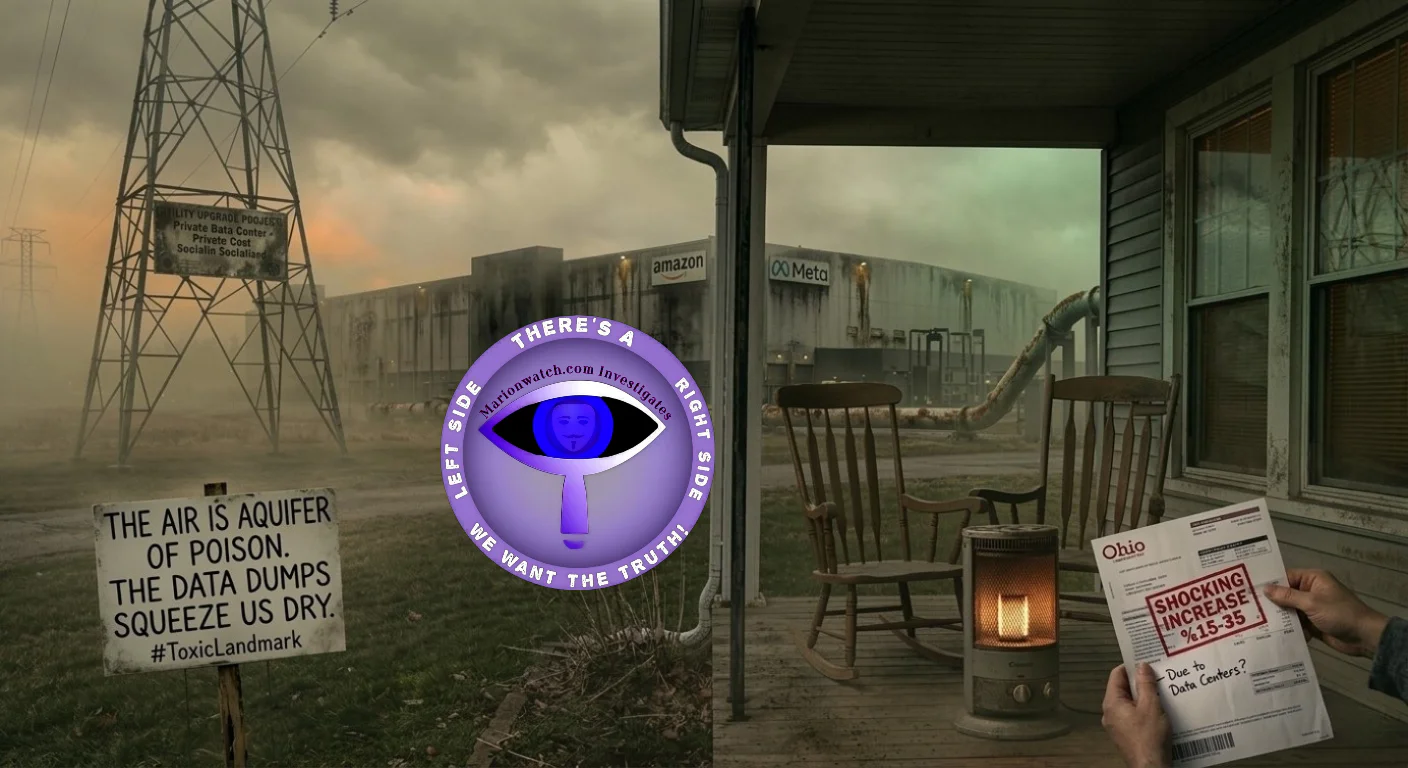
The water crisis runs in parallel with an electricity crisis. As data centers monopolize grid capacity across Ohio, host communities face a compounding fear: the billions in substation upgrades and high-voltage transmission lines required to supply that power will ultimately be paid for through rate increases and surcharges on residential and agricultural utility customers.
Ohio’s working families should not be the underwriters of the electricity infrastructure that makes multi-billion-dollar technology corporations profitable. If a utility must rebuild a substation, lay new transmission lines, or expand generation capacity to serve a hyperscale data center, that cost must fall entirely on the developer — not on the ratepayer who was never asked whether they wanted a data center in the first place.
Solutions exist here too, and they are already working at scale.
Behind-The-Meter (BTM) power generation allows a data center to generate its own electricity on-site and operate independently of the public utility grid. When paired with Long-Duration Energy Storage (LDES) — such as vanadium redox flow batteries, which can store and discharge large amounts of energy over many hours without performance degradation — a BTM microgrid-equipped facility can ride through regional utility disruptions without drawing a single watt from the public grid. Vanadium redox flow batteries are particularly well-suited to this application because they can be charged and discharged tens of thousands of times with minimal capacity loss over their operational life.
This is not theoretical. In March 2026, Pure Data Centers Group (Pure DC) officially commissioned Europe’s first large-scale data center microgrid at its Dublin, Ireland campus — a 110 MW on-site power system built with power solutions provider AVK. The system uses three interconnected energy centers, each capable of generating up to 30 MW, powered primarily by Wärtsilä dual-fuel engines and backed by a 20 MW battery energy storage system (BESS). The design includes future-ready fuel flexibility, with infrastructure in place to blend hydrogen as it becomes available and to integrate expanding renewables over time. The facility also incorporates waste heat recovery and future plans for rainwater harvesting to reduce reliance on mains water for engine operations.
Pure DC’s Executive Chairman and interim CEO Gary Wojtaszek put it plainly: “The biggest barrier to deploying AI infrastructure in Europe today isn’t technology — it’s power. This microgrid proves that even the most constrained markets can unlock new digital capacity.”
Marion Watch acknowledges that Pure DC’s current system relies on natural gas as its primary fuel source — this is not a clean-energy solution in the complete sense. But that reality reinforces our argument: if a data center can build an independent 110 MW power plant on-site using today’s fuel mix, there is no technical barrier to doing the same thing with renewable generation. The BTM microgrid model works.
Ohio lawmakers should require it.
Ohioans should demand that any such onsite generation roadmap prioritize a credible, binding transition to clean energy sources.
Furthermore, under an emerging “grid-safe” operating model, a data center with surplus generation capacity can export power back to the local distribution grid during extreme weather or peak demand events — actively preventing brownouts rather than causing them. A facility that refuses to generate its own power, insists on grid dependency, and then passes infrastructure upgrade costs to ratepayers has no standing to claim it is a community asset. It is a community burden.
The Near Future: Why Rush When Tech Is Decentralizing?
While communities must insist on the cooling and energy technologies that exist today, there is a second, equally important dimension to this conversation — one that directly challenges the premise behind the current data center construction frenzy.
The fundamental driver of that frenzy is the assumption that AI requires permanent, massive centralization — that every AI task must be processed in an enormous, power-hungry facility somewhere in Central Ohio. That assumption is already becoming obsolete.
The essential shift underway is the decentralization of AI inference workloads — the process of actually running an AI model to produce an answer — away from centralized cloud infrastructure and onto local devices. The industry term for this emerging model is “agentic AI”: personal computers and edge devices executing complex AI routines locally, securely, without constantly transmitting data to remote cloud servers for processing.
Two major semiconductor announcements in 2026 make this concrete.
AMD Ryzen AI Max PRO 400 Series
Announced on May 21, 2026 — with OEM availability beginning in Q3 2026 from partners including ASUS, HP, and Lenovo — the Ryzen AI Max PRO 400, codenamed “Gorgon Halo,” engineers server-grade computational capability into a mobile device. The flagship chip, the Ryzen AI MAX+ PRO 495, features 16 Zen 5 CPU cores clocked up to 5.2 GHz, an RDNA 3.5 integrated GPU with 40 compute units, and a 55 TOPS neural processing unit. Most critically, it supports up to 192 gigabytes of unified memory.
To put 192 GB into context: a standard business laptop used for office work typically runs on 8 to 16 GB of memory. A high-end gaming desktop might ship standard with 32 to 64 GB.
A standard enterprise server such as the Dell PowerEdge R760 can be configured with up to 2 terabytes (2,000 GB) of system memory.
The industry-standard NVIDIA DGX H100 AI server — the heavy-duty workhorse currently driving the cloud AI boom — features 640 GB of dedicated video memory across eight massive GPU cards. Packing 192 GB into a single mobile system-on-chip is genuinely transformative. It means this chip can run AI language models with more than 300 billion parameters locally — tasks that today require expensive cloud API subscriptions or access to dedicated data center hardware. AMD estimates that a professional switching from a cloud AI subscription like Claude Sonnet to a locally-run model on Ryzen AI Max hardware could save approximately $750 per month.

NVIDIA RTX Spark Superchip
Unveiled on June 1, 2026 at Computex in Taipei and developed in close collaboration with Microsoft, the RTX Spark is NVIDIA’s entry into the Windows PC processor market. The chip combines a Blackwell RTX GPU with 6,144 CUDA cores and a 20-core ARM-based Grace CPU co-designed with MediaTek, all manufactured on TSMC’s 3-nanometer process. It delivers 1 petaflop of FP4 AI computing performance — one quadrillion mathematical operations per second — while drawing between single-digit watts and up to 80 watts depending on workload. It supports up to 128 GB of unified memory, allowing a thin laptop or compact desktop to run 120-billion-parameter AI language models entirely on-device, without any cloud connection.
To compare that against existing data center hardware: a single NVIDIA DGX H100 AI server delivers up to 32 petaflops of AI-specific performance — but it draws 10,200 watts of system power. The RTX Spark delivers 1 petaflop at up to 80 watts. That is a power efficiency difference of more than 125-to-1 for comparable inference tasks.
Devices from ASUS, Dell, HP, Lenovo, MSI, and Microsoft Surface are scheduled to ship in fall 2026.
“If the industry is moving toward decentralized agentic computing in the coming months and years, why are local governments rushing to approve massive, centralized data centers that may become outdated, power-draining relics in just a few years?” — Marion Watch Position on Data Centers |
When local consumer and enterprise devices handle AI inference workloads, the structural demand for centralized cloud capacity diminishes. If the semiconductor industry — led by AMD, NVIDIA, and others — is already commercially delivering this shift in 2026, the question every Ohio township trustee, county commissioner, and state legislator should be asking is this: are we locking our communities into 40-year tax agreements and permanent infrastructure upgrades for data centers that the market itself may render obsolete within the decade?

The Big Ones: Utah’s Massive New Data Center
In Box Elder County, Utah, infrastructure firm O’Leary Digital — led by celebrity investor Kevin O’Leary and designed by global architecture studio Gensler — has received authorization to build the Stratos Hyperscale Data Center, a 7.5-gigawatt campus spanning an initial 10,000 acres of a 40,000-acre parcel designated by Utah’s Military Installation Development Authority. At full build-out, it would rank among the largest data center complexes on Earth, comprising 60 individual facilities across six clusters. The land currently sits on unincorporated agricultural territory, and the Ruby Pipeline — an interstate natural gas line — runs directly through the site, which is expected to provide the facility’s primary power source until its planned 3,000-acre solar array comes online. Locals pushed back before the county commission vote, and their concerns were well-founded: the Great Salt Lake, already critically stressed by decades of water diversion, sits nearby, and residents have every reason to be skeptical of the developer’s assurance that water use will be “a fraction of what’s been claimed.” On the cooling front, O’Leary Digital does claim the project will use closed-loop cooling — which, if true and independently verified, aligns with exactly the standard Marion Watch demands. But a claim is not a contract, and authorization is not accountability. Utah residents deserve the same thing Ohio residents deserve: binding legal commitments, independent audits, and enforceable limits — not architectural renderings and a CEO’s promise that everything will be fine.


The “Citizens First” Policy Framework: Institutionalizing Civic Accountability
Proven technologies in zero-water cooling, BTM microgrids, and agentic edge computing provide the technical mechanisms for responsible data center development. But technology alone does not protect communities. Corporations will default to the cheapest, fastest deployment method available unless they are legally required to do otherwise.
The gap between opaque corporate development practices and citizen disenfranchisement demands an immediate policy response. Marion Watch calls this the Citizens First framework.
Before any municipal government considers granting a zoning variance or tax incentive to a data center developer, it must require a comprehensive Data Center Impact Study (DCIS) — funded entirely by the corporate developer but conducted by a fully independent auditor. No internal consultants. No developer-selected reviewers. The DCIS must account for the facility’s real projected impact on local utility rates, water tables, aquifer levels, municipal services, and long-term infrastructure obligations.
Additionally, communities must utilize Community Benefits Agreements (CBAs) — legally binding contracts that turn corporate promises into enforceable obligations. A robust CBA must prohibit public utilities from passing any infrastructure upgrade costs onto ordinary ratepayers, establish hard daily caps on water consumption, and mandate the use of zero-water cooling technologies as a condition of operation.
Virginia has already demonstrated this model works: the state released a comprehensive Data Center Impact Study in 2024 that established the analytical baseline for exactly this kind of accountability. Ohio can and must follow suit — but go further, with binding contractual teeth rather than advisory reports.

Actionable Frameworks: The Marion Watch Demand Checklist
To protect local sovereignty, communities must adopt strict, non-negotiable auditing standards before authorizing any data center development. The following checklist represents the minimum threshold citizens should secure during the zoning and permitting phase.
These are not suggestions.
They are prerequisites.
1. Thermal Management Validation
Does the facility plan mandate currently available zero-water cooling architecture — specifically, direct-to-chip two-phase liquid cooling or equivalent? Evaporative cooling that consumes millions of gallons of local water per day is not acceptable when the alternative exists and works. Cost savings for the developer are not a valid justification for depleting a public water supply.
2. Ratepayer Protection Guarantees
Is there an absolute, legally binding contractual prohibition against shifting any grid infrastructure upgrade costs onto local residential and agricultural energy consumers? The developer must fund 100% of all grid interconnection, substation upgrades, and transmission infrastructure required by their facility. Every dollar. No exceptions.
3. Grid Independence
Does the development proposal integrate a Behind-The-Meter (BTM) microgrid equipped with Long-Duration Energy Storage capable of islanding — operating independently from the public grid — during utility peak load events? The facility must demonstrate this capability using currently available technology. If it cannot generate its own power, it should not receive a license to operate.
4. Independent Auditing
Has a comprehensive Data Center Impact Study been commissioned and completed by a fully independent auditor, with zero involvement from the developer’s internal consultants or affiliated firms? If the answer is no, zoning review should not proceed.
5. Silicon Efficiency and Future-Proofing
Has the developer provided documented evidence of workload optimization planning that accounts for the near-term industry shift toward decentralized edge computing? We must not build oversized, energy-intensive facilities anchored to a centralized AI model that the semiconductor industry is already moving away from. Communities need assurances that these facilities will not become stranded assets — consuming resources and occupying land — within a decade of opening.
Conclusion
Data centers are a fixture of the modern economy. Marion Watch understands their value and does not oppose their existence.
What is unacceptable is the premise that communities must absorb unlimited environmental and financial costs as the price of participation in the digital economy. Unrestricted access to local water, to local grid infrastructure, and to local tax revenues is a conditional privilege — not an inherent corporate right.
Ohio proved that point in 2026 when the true cost of its data center tax exemption program was finally tallied: $1.5 billion in a single year, against a projection of $136 million. The communities that hosted those facilities did not receive $1.5 billion in benefits. They received noise, water drawdowns, grid strain, and tax base erosion.
The technology required to do this differently already exists. Zero-water cooling is real and commercially deployed. Behind-the-meter microgrids are operational at industrial scale. Agentic AI chips that bring inference workloads to local devices are shipping this year. There is no technical excuse for the current model. There is only an economic incentive — on the operator’s side — to keep using the cheapest possible methods at the public’s expense.
Forcing developers to implement zero-water cooling, independent microgrids, and strict ratepayer protections is not a position against innovation. It is the prerequisite for ensuring that Marion, Galion, and every other Ohio community can survive and thrive in the era of artificial intelligence — rather than simply being consumed by it.
Works Cited (Click Here)
- RFD-TV. “Ohio Hits Pause on Data Center Tax Breaks After Farmer Pushback.” 2025.
- Environmental and Energy Study Institute (EESI). “Data Centers and Water Consumption.” 2025.
- ZutaCore. “AI Server Cooling System | Waterless Liquid Cooling.” blog.zutacore.com.
- ZutaCore. “HyperCool: The Data Center Cooling System for Today’s AI Factories.” blog.zutacore.com.
- MediaTek / NVIDIA. “RTX Spark | Next Era of Windows PCs.” mediatek.com. June 2026.
- Data Center Knowledge. “Why Data Centers Are Turning to Behind-the-Meter Power.” datacenterknowledge.com.
- Sumitomo Electric. “Data Center Power Shortage Solutions | BTM Long-Duration VRFB.” sumitomoelectric.com.
- Orrick. “Powering Data Centers | Megawatts to Megabytes.” November 2025.
- HotHardware / AMD. “AMD Ryzen AI Max 400: New APU Unlocks 192GB Unified Memory.” May 21, 2026.
- AMD. “AMD Powers Next-Generation Agent Computers with New Ryzen AI Halo Developer Platform and Ryzen AI Max PRO 400 Series Processors.” amd.com. May 2026.
- NAIOP. “Virginia Releases Data Center Impact Study.” 2024.
- Data Center Knowledge. “Inside Europe’s First Microgrid Data Center.” March 2026.
- Pure DC / AVK. “Pure DC and AVK Deploy Europe’s First Data Center Microgrid.” Press Release. March 2026.
- AP News. Levy, Marc. “Ohio Suspends Data Center Tax Break as Tech Firms Face Pressure to Pay the Cost to Power AI.” May 28, 2026.
- The Plain Dealer / AOL. “$136 Million Or $1.5 Billion? Ohio Freezes Data Center Tax Breaks After Math Goes Missing.” May 30, 2026.
- The Statehouse News Bureau. Donaldson, Sarah. “Study: Ohio Data Centers Have Contributed $5.2 Billion in Tax Revenue.” October 3, 2025.
- TechSpot. Shrout, Ryan. “Nvidia RTX Spark CPU is now official: ‘superchip’ will power Windows laptops and desktops.” June 1, 2026.
- Engadget. Hardawar, Devindra. “NVIDIA’s RTX Spark is an AI ‘superchip’ that will power Windows laptops and desktops.” June 1, 2026.
- NVIDIA Official Product Page. “NVIDIA RTX Spark — Slim Laptops & Small Desktops.” nvidia.com. June 2026.
- Ohio EPA. Draft General Permit OHD000001. Public Notice October 31, 2025. Comment Period Closed January 16, 2026.