


 Written by
 Ohio now hosts over 200 data centers. Columbus is the fastest-growing data center market in the United States.
Overview
MarionWatch’s most recent investigation, “America’s Vanishing Water,” documented the accelerating collapse of the nation’s principal aquifer systems — the Ogallala, the Central Valley, the Colorado River Basin, and the Atlantic Coastal Plain. That report established what the data make clear: groundwater beneath the United States is disappearing at rates that dwarf natural recharge, with consequences for drinking water, agriculture, and land stability that will unfold across generations.
This investigation examines the industrial layer compounding that crisis. The data center industry — supercharged by the artificial intelligence boom — has become one of the largest and fastest-growing industrial water consumers in the United States. It is concentrating the world’s most water-hungry facilities in precisely the states where aquifer systems are most severely compromised: Ohio, Virginia, Texas, California, Arizona, and New Mexico. The digital economy is being built on a physical foundation that is literally sinking.
This report maps those overlaps region by region and state by state, drawing on federal satellite data, state water agency projections, peer-reviewed hydrological research, and the most comprehensive audit of data center water use yet assembled. The question is not whether the crisis is real — the aquifer data settled that. The question this report asks is: who in the data center industry is accountable for what comes next?

|
WHAT THIS INVESTIGATION COVERS |
|---|
The Aquifer Story Has a Second Layer
MarionWatch has reported extensively on the depletion of America’s aquifer systems. Our most recent piece examined the Ogallala and Central Valley aquifers in granular detail — the USGS monitoring curves, the NASA GRACE satellite measurements, the irreversible subsidence physics, and the economic modeling of what agricultural failure at that scale looks like. Readers looking for that foundation should start there.
This report takes the next step. It examines the industry sitting directly above those failing aquifer systems — one that has received far less regulatory scrutiny than agriculture, despite consuming water at comparable or greater scale in the most stressed regions of the country. The data center industry operates without a federal water reporting standard, without a national permitting framework tied to aquifer health, and in most states without any requirement to disclose projected water use before breaking ground.
What follows is not a repetition of aquifer science. It is a map of where the digital economy is being built, whose water it is consuming, and what regulatory structures — or absence of them — govern that consumption.
|
· REGION BY REGION — THE DATA CENTER LAYER |
|---|
Every Stressed Aquifer Region Has a Data Center Problem
The regions covered in MarionWatch’s aquifer investigation — the Great Plains, the West, the Southwest, the Mid-Atlantic, and the Midwest — are also, without exception, significant and growing data center markets. The sections below examine each region through that lens: how many facilities are operating or planned, how much water they consume, and what accountability exists. We begin with Ohio, where the scale and pace of the buildout demands it.
|
THE GREAT LAKES FRINGE — OHIO |
|---|
The Silicon Heartland’s Hidden Cost
In 2015, Amazon Web Services announced its first central Ohio hyperscale data centers — sprawling campuses in Dublin, Hilliard, and New Albany. State and local officials celebrated the arrival as economic transformation: capital investment, construction jobs, a technology identity for a region that had long sought one. Civic leaders began calling the Columbus area the ‘Silicon Heartland.’ What nobody was tracking at the time was how much water those campuses would need — or who, exactly, would be responsible for accounting for it.
A decade later, the numbers are staggering. Ohio is now home to at least 200 data centers statewide, with 121 concentrated in the Columbus metropolitan region alone. Columbus has become the fastest-growing data center market in the United States and the tenth-largest in North America, according to a 2025 report by global real estate firm JLL. That firm projects the region’s data center capacity could grow six-fold based solely on projects already in the pipeline. New Albany — a suburb of Columbus and one of the earliest hosts — has already crossed 40 facilities within its city limits. American Electric Power, Ohio’s largest utility, has warned that electricity demand in greater Columbus will rival that of Manhattan by 2030, driven overwhelmingly by data center load.
The physical scale of individual facilities illustrates why these numbers matter for water. Vantage Data Centers’ OH1 campus in New Albany, when complete, will span 70 acres — roughly two-fifths of the average Ohio farm — and draw 192 megawatts of critical IT load, equivalent to the continuous electricity consumption of approximately 160,000 average American households. Intel has projected that its planned Ohio semiconductor and data infrastructure facilities will use up to 5 million gallons of water per day. A single medium-sized data center, by industry estimates, consumes approximately 110 million gallons of water annually. Multiply that by 200 facilities — and then by the six-fold growth projection — and the arithmetic becomes a water management problem that Ohio has not yet formally acknowledged.
|
❝ Intel projects up to 5 million gallons of water per day for its planned Ohio facilities. Columbus already hosts 121 data centers. The state’s water agency says it will investigate problems ‘if they arise.’ ❞ |
|---|
Google pledged an additional $2.3 billion in investment in its Columbus-area sites in June 2024 — one of the largest single data center commitments in the state’s history. The announcement was attended by Ohio Lt. Governor Jon Husted, who acknowledged the tension plainly: ‘From Microsoft and AWS and Meta, they all demand a lot of electricity, and they demand a lot of water for cooling on days like this, and so we have to have a balance.’ The balance he referenced has no formal mechanism. There is no state law, no permitting requirement, and no regulatory standard that connects data center water consumption to Ohio’s groundwater monitoring framework.
Ohio’s primary groundwater supply across central Ohio comes from glacial aquifers — thick deposits of sand and gravel left by retreating ice sheets at the end of the last glacial period. Unlike the fossil Ogallala, these systems can recharge — but recharge is local, seasonal, and limited by surface conditions. When a cluster of hyperscale data centers draws millions of gallons per day from the same aquifer system, it creates localized depletion cones — zones where the water table drops faster than surrounding areas can replenish it. These effects are real, measurable, and essentially unmonitored in Ohio’s current regulatory framework. The Ohio Department of Natural Resources, asked about the threat to residential water supplies from accelerating data center growth, issued a statement that read, in part: ‘There are areas in Central Ohio endowed with substantial groundwater resources that could support additional growth… The agency will investigate conflicts between groundwater users if they arise.’ That ‘if they arise’ framing — reactive, not precautionary — is the defining characteristic of Ohio’s current posture toward one of the fastest infrastructure buildouts in state history.
The electricity strain has become severe enough that AEP paused accepting new data center contracts more than a year ago. The Public Utilities Commission of Ohio (PUCO) approved a new tariff in Case No. 24-508-EL-ATA establishing a minimum billing threshold of 85% of contracted capacity — designed to cover the cost of new extra-high voltage transmission infrastructure the grid requires. The tariff’s power as a regulatory filter is striking: data center developers had initially submitted requests for an unprecedented 30,000 megawatts of electricity capacity in central Ohio. When forced to back those requests with binding 12-year contracts and financial collateral, speculative projects withdrew. Only 5,642 MW of binding contracts were ultimately signed under the tariff. Combined with the 12,219 MW of data center contracts signed before the tariff took effect, AEP Ohio now carries a total contracted data center load of 17,861 MW scheduled to come online through 2035 — a figure that dwarfs the historical peak demand of all other AEP Ohio customers combined, which ranges between 8,000 and 10,500 MW. AEP’s Ohio president Marc Reitter stated plainly: ‘We saw where this was headed, and we did not want to compromise the integrity of the grid.’ The Ohio Manufacturers’ Association has appealed the PUCO ruling to the Ohio Supreme Court. The grid is straining. The aquifer monitoring is absent. And the permitting keeps moving.
At least one Ohio community has drawn its own line. Jerome Township, in Union County northwest of Columbus, enacted a 9-month moratorium on new data center approvals on September 3, 2025, as it weighs the facilities’ cumulative effects on community character, road infrastructure, noise, and lighting. Local records make clear the moratorium’s trigger: residents had filed numerous complaints regarding a persistent industrial buzz from the cooling fans and generators of the two active Amazon Web Services data centers already operating in the area. Trustees sought to reclassify data centers from a permitted to a conditional land use under local zoning codes. The moratorium has proven legally constrained: Jerome Township was forced to approve certain data center permits even after it took effect because developers held pre-existing zoning certificates. AWS paid $1.1 million in property taxes in Union County in 2024 — a figure supporters cite as community benefit, though the permanent on-site employment of hyperscale data centers remains minimal. Around 18 municipalities across Ohio have considered or enacted similar temporary bans, with some, like Lordstown, locked in complex legal battles after blocking data center bids. The moratorium is limited in scope and does not address water. But it represents the clearest acknowledgment yet from any Ohio government that the buildout has moved faster than the frameworks designed to manage it. New Albany’s mayor, meanwhile, told a crowd at the opening of a new data center: ‘Water is for streams, not streaming’ — a line that drew applause from an audience assembled specifically to celebrate a new facility that would consume millions of gallons of it.
The regulatory dimension of this story is more nuanced than it first appears. Ohio’s data centers are concentrated in central Ohio, drawing from inland glacial aquifers. The Great Lakes–St. Lawrence River Basin Water Resources Compact — the binding agreement governing water diversions among eight states and two Canadian provinces — is frequently cited in connection with Ohio’s data center boom. But that Compact does not apply to Columbus or Franklin County. The St. Lawrence Continental Divide, which marks the Great Lakes Basin boundary in Ohio, runs well north of Columbus, through portions of Marion, Crawford, Richland, and other counties. Columbus sits entirely within the Ohio River Basin. Its glacial aquifers drain southward into the Scioto River, then into the Ohio River, and ultimately into the Mississippi River system. Diversions in the Columbus region are governed by Ohio River Basin rules, which require only a permit for withdrawals exceeding 100,000 gallons per day out of the basin — not the strict anti-diversion and consumptive use standards of the Great Lakes Compact. This means the region hosting the nation’s fastest-growing data center market operates under a significantly lighter water governance framework than is commonly assumed — one that places almost no meaningful ceiling on the scale of groundwater extraction.
|
❝ ‘Water is for streams, not streaming,’ New Albany’s mayor told a crowd at a data center opening. The facility behind him would consume millions of gallons of it. The crowd applauded. ❞ |
|---|
Ohio’s data transparency record mirrors the national pattern in its worst form. Water use figures for individual Ohio data center facilities are, in the words of one researcher, ‘largely undisclosed.’ There is no state reporting requirement. There is no centralized database. Investigative reporters and researchers have had to piece together consumption estimates from utility filings, water purchase agreements with municipal suppliers, and the occasional corporate sustainability report — documents that, when they exist at all, report water use only at the national portfolio level, not by facility. Ohio has invited one of the most water-intensive industries in the modern economy into one of its most important aquifer regions, and it has done so without a single binding requirement that those facilities disclose how much water they use.
|
THE GREAT PLAINS — OGALLALA / HIGH PLAINS AQUIFER |
|---|
Texas Has 413 Data Centers Above a Dying Aquifer
MarionWatch’s aquifer investigation documented the Ogallala’s long arc of depletion: the 15.8-foot average decline since pre-development, the concentrated losses in Texas and Kansas, the irreversible math of a fossil aquifer recharged in inches and pumped in feet. This report adds the industrial layer operating directly above that decline.
The Kansas Geological Survey’s January 2025 monitoring report found that the Southwest Kansas groundwater management area dropped 1.52 feet in 2024, up from 1.43 feet the year before. The Northwest Kansas area dropped 1.34 feet — nearly three times its 0.47-foot decline of the prior year. In West Texas, a 2024 field survey found that over 60% of wells had reached levels below pump intake. The aquifer is not declining on a steady curve. It is accelerating.
Texas ranks second in the United States for total data center count: 216 operational facilities and 413 planned or approved, each capable of consuming up to 5 million gallons of water per day. They are being built, permitted, and connected to the grid above an aquifer that some hydrological models project could be functionally depleted in critical zones within 20 years. Texas has no statewide groundwater pumping limits. The two facts exist in the same state, in the same legal framework, without any formal connection between them.
|
❝ Over 60% of West Texas wells surveyed in 2024 had already dropped below pump intake. Texas has 413 data centers planned above this aquifer — with no statewide pumping limits in place. ❞ |
|---|
|
THE WEST — CALIFORNIA CENTRAL VALLEY |
|---|
321 Data Centers Above a Collapsing Aquifer System
MarionWatch’s aquifer investigation documented the Central Valley’s collapse: the GRACE satellite data, the permanent storage loss from subsidence-induced clay compression, the visible sinking of the valley floor. This report adds the demand layer sitting on top of it. California now hosts 167 operational data centers, with 321 total planned or approved — the third-largest state footprint in the country. Silicon Valley’s digital infrastructure and the San Joaquin Valley’s agricultural infrastructure are drawing from the same failing reservoir.
A May 2025 California Department of Water Resources report confirmed that subsidence has already reduced State Water Project delivery capability by 3%. If uncontrolled, DWR projects that by 2043, SWP deliveries could fall by up to 87% — a system supplying 27 million Californians and 750,000 acres of farmland. A UC Riverside study from July 2025 found that subsidence has caused $1.87 billion in aggregate housing value losses across the Central Valley; homes in subsiding areas lose between $6,689 and $16,165 in sale value per home.
|
❝ By 2043, California’s State Water Project — supplying 27 million people — could see delivery capability fall by up to 87% if subsidence continues unchecked. California has 321 data centers planned above this system. ❞ |
|---|
|
THE SOUTHWEST — COLORADO RIVER BASIN |
|---|
A Full Lake Mead — Lost Underground
NASA GRACE satellite data covering 2002 through 2024 shows the Colorado River Basin has lost approximately 27.8 million acre-feet of groundwater — roughly the entire storage capacity of Lake Mead. Forty million people rely on this system across seven states. Approximately 68% of those losses are concentrated in the lower basin, primarily Arizona. The rate of groundwater loss in western and southeastern Arizona more than doubled between 2002–2014 and 2015–2024.
The Arizona Department of Water Resources’ own 2023 Phoenix model found the Phoenix Active Management Area faces 4.86 million acre-feet of unmet groundwater demand over the next 100 years. Arizona State University researcher Jay Famiglietti: ‘If left unmanaged for another decade, groundwater levels will continue to drop, putting Arizona’s water security and food production at far greater risk than is being acknowledged.’ Arizona ranks sixth nationally for data centers: 82 operational, 164 total — clustered in Phoenix, one of the most water-stressed metros on Earth. Arizona has formally acknowledged it cannot issue new Assured Water Supply certifications based on groundwater. It continues to approve data center permits regardless.
|
❝ Arizona has officially declared it can no longer certify new groundwater-based water supplies. Data center permits continue to be issued. There are 164 planned above a basin that has already lost the equivalent of Lake Mead underground. ❞ |
|---|
|
THE MID-ATLANTIC — POTOMAC RIVER BASIN |
|---|
The World’s Data Center Capital Is Drinking Washington’s Water
Virginia’s Potomac River basin provides 75% of the water supply for 5 million people in the Washington metro area and is the sole drinking water source for Washington, D.C. and Arlington County. Data center water use in Northern Virginia increased approximately 86% between 2019 and 2023. ICPRB’s 2026 analysis finds data center consumptive water use in the Washington metro averaging approximately 4 million gallons per day, with peak-day use reaching approximately 15 MGD, with rapid further growth projected.
Virginia is the world’s single largest data center hub: 322 operational facilities, 665 total planned or approved. The infrastructure serving the global internet is being cooled, in significant part, with water from the same watershed that supplies the nation’s capital. No binding state or federal framework connects those two facts.
|
❝ Northern Virginia’s data center water use grew 86% in four years. Peak-day demand already reaches 15 million gallons — drawn from the basin that is Washington D.C.’s sole drinking water source. ❞ |
|---|
|
THE MIDWEST — MISSISSIPPI EMBAYMENT AND GREAT LAKES FRINGE |
|---|
The Surplus States Are Running a Deficit
Illinois and Iowa have long been regarded as water-abundant states. That reputation is being tested. Illinois hosts 244 total data centers — including a dense Chicago metro concentration — drawing in part from a deep Cambrian-Ordovician aquifer not meaningfully replenished under current hydrological conditions. Recharge timescales for these deep confined systems are measured in centuries. Iowa hosts 105 operational data centers in a heavily agricultural state where groundwater reliance for irrigation is foundational to the state’s $40 billion farm economy. The Midwest’s reputation as the nation’s water surplus region has begun to obscure a growing withdrawal problem that state monitoring systems are not yet built to track.
|
· THE INDUSTRY BEHIND THE DRAWDOWN |
|---|
449 Million Gallons a Day — and Climbing
|
[ WESTERN U.S. RESERVOIR — DROUGHT CONDITIONS | 2024–2026 ] |
|---|
The bleached “bathtub ring” marks the historic waterline of a Western reservoir at critically low levels, with exposed cracked lakebed stretching below. Scenes like this are now commonplace across the Colorado River system as aquifer depletion and drought compound.
A single large data center can consume up to 5 million gallons of water per day — enough for a city of 10,000 to 50,000 people. The United States now has over 5,400 data centers collectively consuming an estimated 449 million gallons of water per day. The AI boom is driving unprecedented construction: a Business Insider investigation found 1,240 data centers built or approved by the end of 2024 alone.
Each 100-word AI prompt is estimated to consume approximately 519 milliliters — roughly one standard water bottle. U.S. data centers collectively consumed approximately 163.7 billion gallons of water annually as of 2021. That baseline is now growing rapidly. The Ceres “Drained by Data” report (September 2025) projects cooling water use could increase 870% as more AI-focused facilities come online. Water use associated with data center electricity generation is expected to increase 400%, from 2.9 billion to 14.5 billion gallons annually.
Fewer than one-third of data center operators tracked water consumption as of the most recent major industry survey. Business Insider found that 40% of planned and existing U.S. data centers sit in areas the World Resources Institute characterizes as ‘extremely high’ or ‘high’ water scarcity. For the largest facilities (40+ MWh/hour), that figure rises to 43%. Amazon operates 81 data centers in high or extremely high water-stressed areas. Microsoft operates 23 — but ranks first as a share of its portfolio, with 52% of facilities in arid or stressed zones.
The indirect water problem is larger than the direct one. The electricity powering data centers requires water from thermoelectric power plants — a footprint nearly invisible in public reporting, regulatory filings, or corporate sustainability disclosures. There is no federal standard requiring data centers to report either figure.
|
❝ Each 100-word AI prompt consumes roughly one water bottle’s worth. Multiply that by billions of daily queries — across a fleet of facilities projected to increase cooling water demand by 870%. ❞ |
|---|
|
· STATE-BY-STATE — THE DIGITAL WATER MAP |
|---|
Where the Servers Are — and What’s Beneath Them
The table below cross-references data center concentration with aquifer stress, drawing on Aterio/Datacentermap.com facility counts (2025), USGS aquifer monitoring, and state water agency projections.
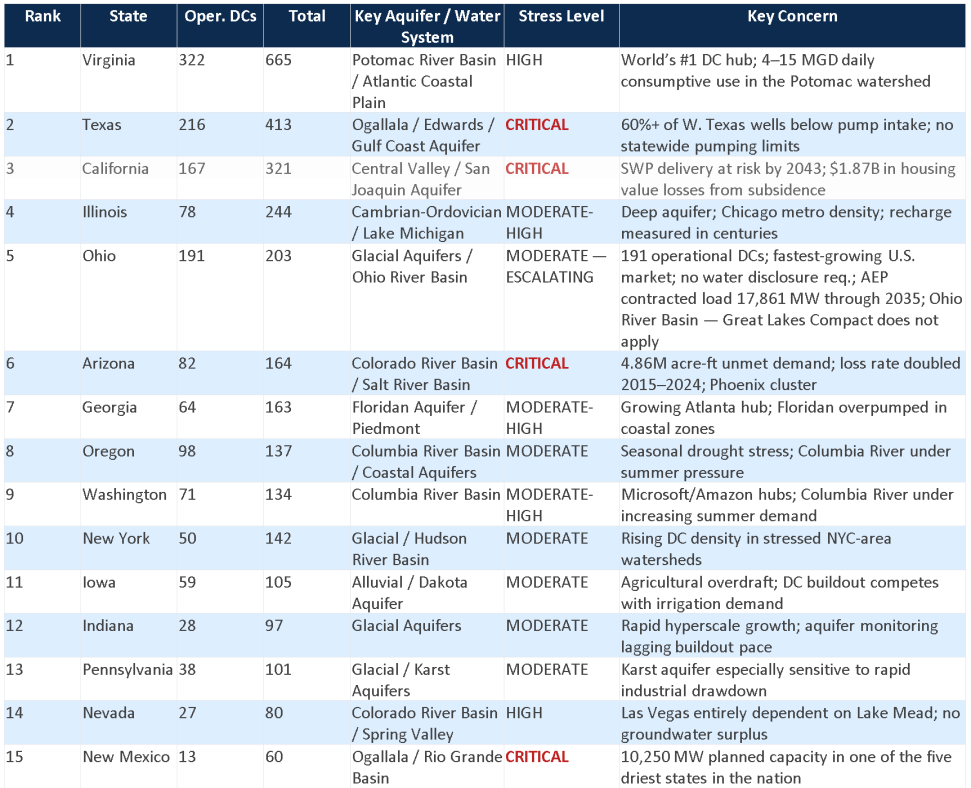
The most alarming pattern in this data is not simply the presence of data centers in water-stressed states — it is the concentration of the largest, most power-hungry facilities in precisely the zones already facing aquifer exhaustion. Virginia leads the world in data center density while sitting astride the Potomac Basin’s most critical withdrawal zone. Texas permits unlimited groundwater pumping while hosting 216 operational data centers directly above the Ogallala. Arizona has formally acknowledged it cannot issue new Assured Water Supply certifications based on groundwater — and continues to approve data center permits by the hundreds. Ohio, ranked fifth nationally, has no water disclosure requirement whatsoever and is adding capacity at a pace that has already overwhelmed its electric grid.
New Mexico represents perhaps the starkest case. The state has just 13 operational data centers today — but 10,250 megawatts of planned capacity in the pipeline. New Mexico ranks among the five driest states in the nation. Its aquifer systems are already overdrawn. There is currently no mechanism to connect those two facts in a permitting process.
|
· THE CONVERGENCE |
|---|
The Double Burden
The central finding of this investigation is that states with the most severe aquifer stress are simultaneously the fastest-growing data center markets. The same geographic and economic conditions that create water scarcity — heat, flat land, available power infrastructure, permissive regulation — also attract data center investment. The overlap is not incidental. It is structural.
The Ceres September 2025 report found that data center growth could increase water stress in already-strained basins by up to 17% annually, with higher spikes during peak summer cooling season. The indirect water footprint — water consumed by the power plants generating electricity that data centers use — is larger than direct cooling water use and is almost entirely absent from public reporting, regulatory filings, or corporate sustainability disclosures.
The transparency gap defines the regulatory failure. Fewer than one in three data center operators tracked water consumption in the most recent major industry survey. No federal reporting standard exists. No national permitting framework ties data center approvals to aquifer stress assessments. In Ohio — the fastest-growing data center market in the United States — AEP Ohio now carries 17,861 MW of contracted data center load through 2035, a figure that dwarfs every other customer class on the grid. The state’s water agency has pledged to investigate conflicts between groundwater users ‘if they arise.’ Not before. Not proactively. If. Meanwhile, in Virginia, peak-day data center water demand already reaches 15 million gallons from the same watershed that supplies Washington, D.C.’s drinking water. In Arizona, the state has formally declared it cannot certify new groundwater-based water supplies — and continues to approve data center permits. In Texas, over 60% of monitored West Texas wells have already dropped below pump intake, above an aquifer with no statewide pumping limits and 413 data centers in the pipeline. The pattern is not regional. It is national. The digital economy is being built on water it does not have, above aquifer systems it is not required to measure, with no binding legal connection between the two.
|
❝ There is no federal standard requiring data centers to disclose how much water they use. The public cannot measure what it cannot see — and regulators are not looking. ❞ |
|---|
|
· THE POLICY LANDSCAPE |
|---|
Frameworks Without Force
The 2024 Ogallala Aquifer Summit convened more than 230 stakeholders. Kansas Governor Laura Kelly called it a ‘crossroads moment — act now or watch western Kansas dry up within a generation.’ The summit produced no binding commitments.
California’s Sustainable Groundwater Management Act exists but implementation lags critically behind the pace of subsidence damage documented in the May 2025 DWR report. Arizona’s own 2024 model update does not support issuance of new Assured Water Supply determinations based on groundwater — a formal admission that the aquifer cannot support new demand. Data center permitting continues regardless.
Colorado River Compact renegotiation is ongoing. Lower basin states — Arizona, California, and Nevada — have proposed 3.2 million acre-feet in voluntary cuts through 2028. No post-2028 framework has been agreed upon. Fairfax County, Virginia’s Environmental Quality Advisory Council issued 2024 recommendations requiring recycled wastewater for data center cooling and drought-triggered mandatory cutoffs. The recommendations have not been adopted.
What is missing: no federal data center water disclosure mandate; no national groundwater emergency declaration; no binding legal connection between data center permitting and aquifer stress assessments in any state; no requirement that corporate sustainability reports include facility-level water withdrawal data.
|
❝ Arizona has formally declared it can no longer certify new groundwater-based water supplies. It continues to issue data center permits. No state has enacted a binding connection between the two. ❞ |
|---|
|
· THE RECKONING |
|---|
A Digital Economy Built on Water It Doesn’t Have
The Ogallala aquifer could be functionally exhausted in critical zones within 20 years under current extraction rates. Arizona faces 4.86 million acre-feet of unmet groundwater demand over the next century. California’s State Water Project faces up to 87% delivery reduction by 2043 if subsidence is not controlled. The Colorado River Basin has already lost the equivalent of Lake Mead in groundwater since 2002. Ohio is approving data center campuses above glacial aquifers with no water use disclosure requirements and a grid operator that has already paused new connections.
Against this backdrop, the data center industry — now consuming 449 million gallons per day nationally — is projected to increase its cooling water demand by 870% as AI infrastructure scales. The United States is making trillion-dollar commitments to AI infrastructure without any corresponding commitment to the water that infrastructure requires.
MarionWatch will continue to track this investigation. The data centers are being built. The aquifers are being drawn down. The frameworks that should connect those two facts do not yet exist — and the communities living above these aquifers have a right to know.
Works Cited (Click Here)
Data sourced from: USGS National Water Information System; NASA GRACE/GRACE-FO satellite mission; U.S. Drought Monitor; Aterio / Datacentermap.com (2025 facility counts); Business Insider data center investigation (2024–2025); Ceres “Drained by Data” report (September 2025); California Department of Water Resources (May 2025); ICPRB Potomac Basin Analysis (March 2026); University of Illinois Center for Secure and Sustainable Infrastructure (January 2026); UC Riverside (July 2025); Arizona Department of Water Resources (2023–2024); Kansas Geological Survey (January 2025); 2024 Ogallala Aquifer Summit Summary Report.