

 Written by
 For months, the citizens of Marion have dealt with green-tinted tap water, lingering chemical odors, and a bitter, earthy taste. In response, Aqua Ohio, backed by state environmental regulators, has largely attributed these issues to seasonal algae cycles and naturally occurring compounds like geosmin.
But as watchmen on the wall for this community, it is our duty to demand the receipts. A neutral, objective platform relies on verifiable evidence, not press releases. When residents and several City Council members express deep suspicion regarding the official narrative, it is time to compare the utility’s official data against comprehensive, independent testing.
The results expose a glaring discrepancy. While the utility company offers a narrow, single-element snapshot designed to generate a passing grade, independent lab results by professional water filtration companies reveal a municipal distribution system under significant stress—including elevated pH, failing sulfate levels, and the presence of lead.
The “Special Sample” Sleight of Hand
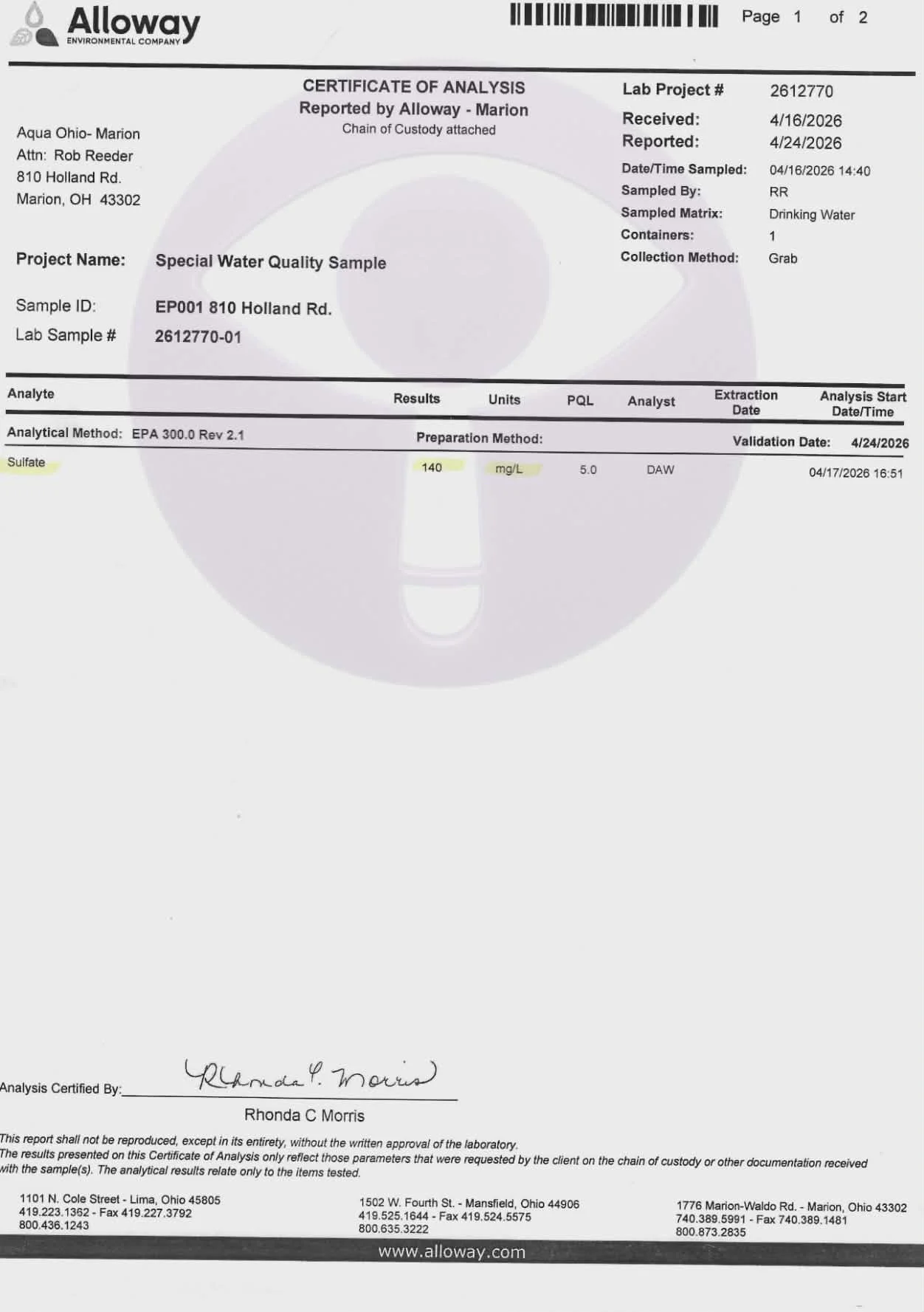
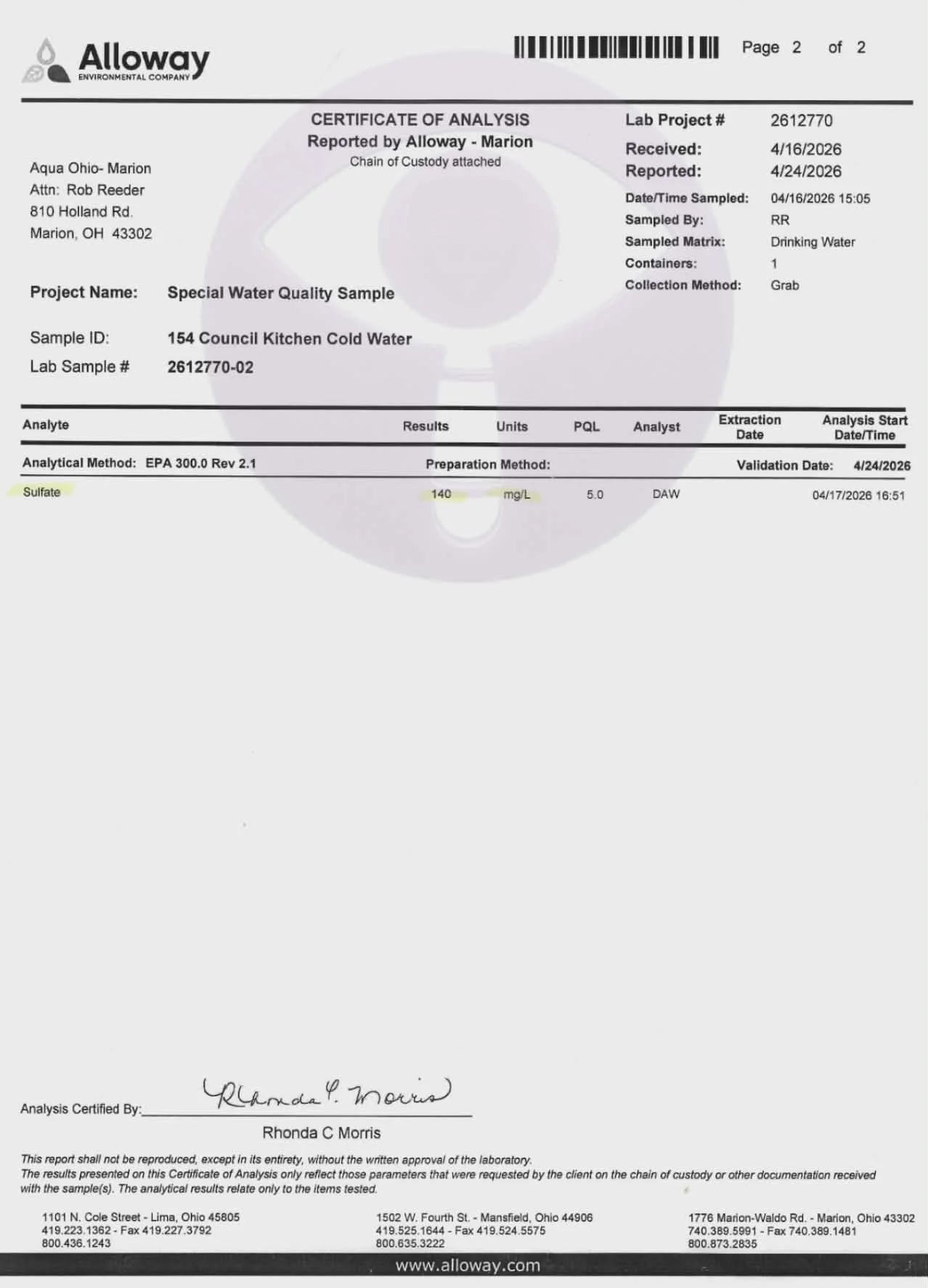
When a community reports a complex array of water quality issues—ranging from discoloration to chemical odors—a genuine audit demands a full-spectrum analysis. Instead, Aqua Ohio recently produced two “Special Water Quality Sample” lab reports from Alloway.
These samples were collected on April 16, 2026. One was drawn from an address on Holland Road, and the other from “154 Council Kitchen,” connected to Councilwoman Pam Larkin. The utility company ordered an EPA 300.0 Rev 2.1 analysis for exactly one element: Sulfate.
The lab results for both locations showed a sulfate level of 140 mg/L, which comfortably passes the EPA’s Secondary Maximum Contaminant Level (SMCL) of 250 mg/L.
Providing a single-analyte test in the face of widespread, multi-symptom water quality complaints is a procedural diversion. Testing solely for sulfate bypasses the volatile organic compounds (VOCs), heavy metals, total dissolved solids (TDS), and disinfection byproducts that are the actual root causes of the community’s complaints. By controlling the chain of custody and isolating a single, benign parameter, the utility ensures a clean official document while effectively ignoring the lived reality of Marion households.
A Historical Warning: The Danger of Parameter Isolation
The pattern of a municipal utility releasing narrow, “compliant” test results that contradict comprehensive independent audits is not just a theory—it is a well-documented phenomenon that has preceded some of the most severe public health crises in recent American history.
When official agencies rely on procedural loopholes or highly selective testing to generate a “passing grade,” it often masks systemic infrastructure failures. Independent testing is frequently the only mechanism that forces these issues into the light.
Here are three major instances in the past 20 years where “suspicious” official testing clashed with independent audits, ultimately exposing massive public health threats:
- Flint, Michigan (2014–2015): After switching the city’s water source to the Flint River, residents immediately complained of brown, foul-smelling, and bitter-tasting water. The Michigan Department of Environmental Quality (MDEQ) and city officials repeatedly assured the public the water was safe, releasing official lab results that showed lead levels were technically within EPA compliance. It was later revealed that the official tests were highly manipulated. The city instructed residents to “pre-flush” their taps before collecting samples—a tactic that washes away the highest concentrations of lead before the water goes into the sample bottle. They also strategically discarded samples from the highest-risk homes to keep the city’s overall average below the EPA action limit. Citizens partnered with independent researchers from Virginia Tech. The independent, full-spectrum audits revealed massive lead spikes—some high enough to be classified as toxic waste. It took these independent tests, alongside independent blood-lead level tests from a local pediatrician, to prove the water was poisoning the community.
- Newark, New Jersey (2017–2019): As residents complained about water quality, Newark officials mailed out brochures explicitly stating, “Your water is safe to drink and meets all federal standards.” The city relied on localized compliance data to claim that any lead issues were isolated to a few individual homes with old plumbing, rather than a systemic failure of the water treatment plant. The city was using a localized testing strategy that failed to account for a massive shift in the water’s chemistry. The corrosion control chemicals added at the treatment plant had stopped working, meaning lead was leaching from pipes across the entire city. Official tests were too narrow in scope to catch the widespread chemical failure. The Natural Resources Defense Council (NRDC) and a local education group conducted independent testing and sued the city. The independent data proved the corrosion control had failed system-wide. The EPA ultimately had to intervene, forcing the city to hand out bottled water and replace tens of thousands of lead service lines.
- Benton Harbor, Michigan (2018–2021): For years, residents in Benton Harbor complained about water quality. Local and state regulators pointed to periodic, localized compliance tests to suggest that while the water system had challenges, there was no imminent health emergency. Regulators were testing just enough to show that the water leaving the treatment plant was generally fine, but they were ignoring what happened to the water as it traveled through the city’s aging, deteriorating distribution system. A coalition of local citizen groups and independent environmental organizations conducted their own rigorous sampling. Their tests consistently showed lead levels that dwarfed the state’s official averages. The independent data proved that the city’s official testing was failing to capture the reality at the tap, ultimately prompting a massive state intervention and a total overhaul of the city’s pipe infrastructure.
The Playbook: How Utilities Engineer “Clean” Results
Looking at these historical cases, a distinct pattern emerges regarding how utilities can produce “suspiciously” clean lab results when independent tests show the opposite. The tactics often mirror the exact discrepancies seen in current local water disputes:
- Parameter Isolation (The “Blind Spot” Method): Just as Aqua Ohio produced a test strictly for sulfate while residents complained of chemical smells and discoloration, utilities will test for a single, benign element to generate a passing lab report, deliberately not testing for the volatile organics, TDS, or heavy metals (like lead) causing the actual problem.
- The “Averaging” Loophole: The EPA requires action when the 90th percentile of homes tested exceeds the lead limit. Utilities have historically flooded their data pool with tests from low-risk, newly built homes to dilute the bad tests from older neighborhoods, ensuring the “official average” looks safe.
- Controlling the Chain of Custody: When the utility collects the sample, they dictate the time, location, and flow rate. Independent tests—like those from Culligan or Pure H2O—capture the water exactly as a resident experiences it in real-time, which is why the independent data often looks drastically worse than the official reports.
History shows that when a utility answers widespread, multi-symptom water complaints with a highly narrow, single-element lab test, the community’s suspicions are usually justified. Independent audits are not just “second opinions”—they are historically the primary catalyst for uncovering systemic infrastructure failures.
The Receipts: What Independent Testing Actually Shows
Marion Watch Investigates has reviewed full-spectrum water analyses conducted by two independent filtration companies: Pure H2O and Culligan. Because these tests capture the water exactly as it flows from the residential tap, they bypass the utility’s highly controlled sampling parameters. The findings directly contradict the narrative that Marion’s water is perfectly balanced.
1. The Pure H2O Report (January 2026)
An independent test conducted by Pure H2O on January 12, 2026 , at a Sargent Street residence revealed severe system stressors that a simple sulfate test would never catch:
- Lead Detection: The test detected lead at 0.0006 mg/L. While this falls below the EPA action limit , the report explicitly notes that there is no safe level of lead, especially for children. The detection alone warrants immediate attention, as it is a prime indicator that the water’s chemistry is reacting poorly with older household plumbing.
- Highly Elevated pH: The water tested at a pH of 8.72. This explicitly exceeds the EPA’s secondary recommended limit of 6.5 to 8.5. High pH is a critical system stressor; it reduces the effectiveness of chlorine disinfection and actively accelerates the leaching of heavy metals—such as lead and copper—from municipal and residential pipes.
- Total Dissolved Solids (TDS): TDS was measured at 374 mg/L. While technically under the 500 mg/L limit, the report clarifies that levels above 300 routinely cause the exact dryness, scaling, and poor taste issues residents are experiencing.
2. The Culligan Report (February 2026)
A problem water analysis conducted by Culligan on February 19, 2026 , sampled water directly from Councilwoman Pam Larkin’s residence at 154 Cornil. This comprehensive test provides a stark contrast to the targeted sulfate test Aqua Ohio pulled from the same location two months later:
- Failing Sulfate Levels: While Aqua Ohio’s April test showed a compliant 140 mg/L, Culligan’s independent test of the exact same residential supply measured sulfate at an excessive 268.62 mg/L. This definitively exceeds the EPA Secondary limit of 250.00 mg/L. Elevated sulfate is widely known to cause a bitter taste and act as a laxative.
- Chlorine Byproducts: The total chlorine measured at 1.97 mg/L , with chloramine levels at 1.74 mg/L. When utility companies pump high levels of chlorine into a system to combat elevated pH or organic matter, it creates disinfection byproducts. This chemical reaction is frequently the exact cause of the “bleach-like” odors residents are actively reporting.
- High TDS and pH: The Culligan test corroborated the Pure H2O findings, showing a high pH of 8.5 and an estimated TDS of 439.12 mg/L , hovering dangerously close to the maximum EPA secondary limit of 500.00 mg/L.
The “Pre-Flushing” Tactic: A Highly Suspicious Coincidence
Adding to the community’s skepticism is a startling revelation regarding the specific conditions under which the Aqua test was conducted at Councilwoman Pam Larkin’s residence.
According to direct communications with the Councilwoman, Aqua Ohio flushed the fire hydrant located directly in front of her house the very day before the Aqua water test was scheduled to be drawn.
In the context of environmental auditing, this timing is highly suspicious. Hydrant flushing is designed to aggressively clear out sediment, biofilm, stagnant water, and concentrated contaminants from the immediate municipal lines. Conducting a targeted flush directly in front of a testing site merely hours before a sample is collected is a textbook example of “pre-flushing.”
As noted in historical water crises like Flint, Michigan, pre-flushing is a well-documented tactic used by utilities to artificially manipulate test results. It washes away the highest concentrations of contaminants, temporarily masking system failures and ensuring the sample bottle captures “fresh” water rather than the actual, day-to-day conditions the resident has been enduring.
What makes this revelation truly alarming is the data itself.
When the preceding tests were conducted there was also ongoing flushing taking place. If the water supply failed these critical metrics less than 24 hours after a targeted flush, it raises a severe and urgent question: just how toxic were those levels before the utility cleared the line?
The Demand for True Accountability
The community is no longer accepting excuses. Several Marion City Council members have publicly thrown their weight behind the citizens, demanding executive accountability and citing the utility’s actions as highly suspicious.
The independent data proves that the municipal distribution system is under significant stress. We are seeing elevated pH levels that strip municipal pipes, failing sulfate metrics, and the unacceptable detection of lead at the tap.
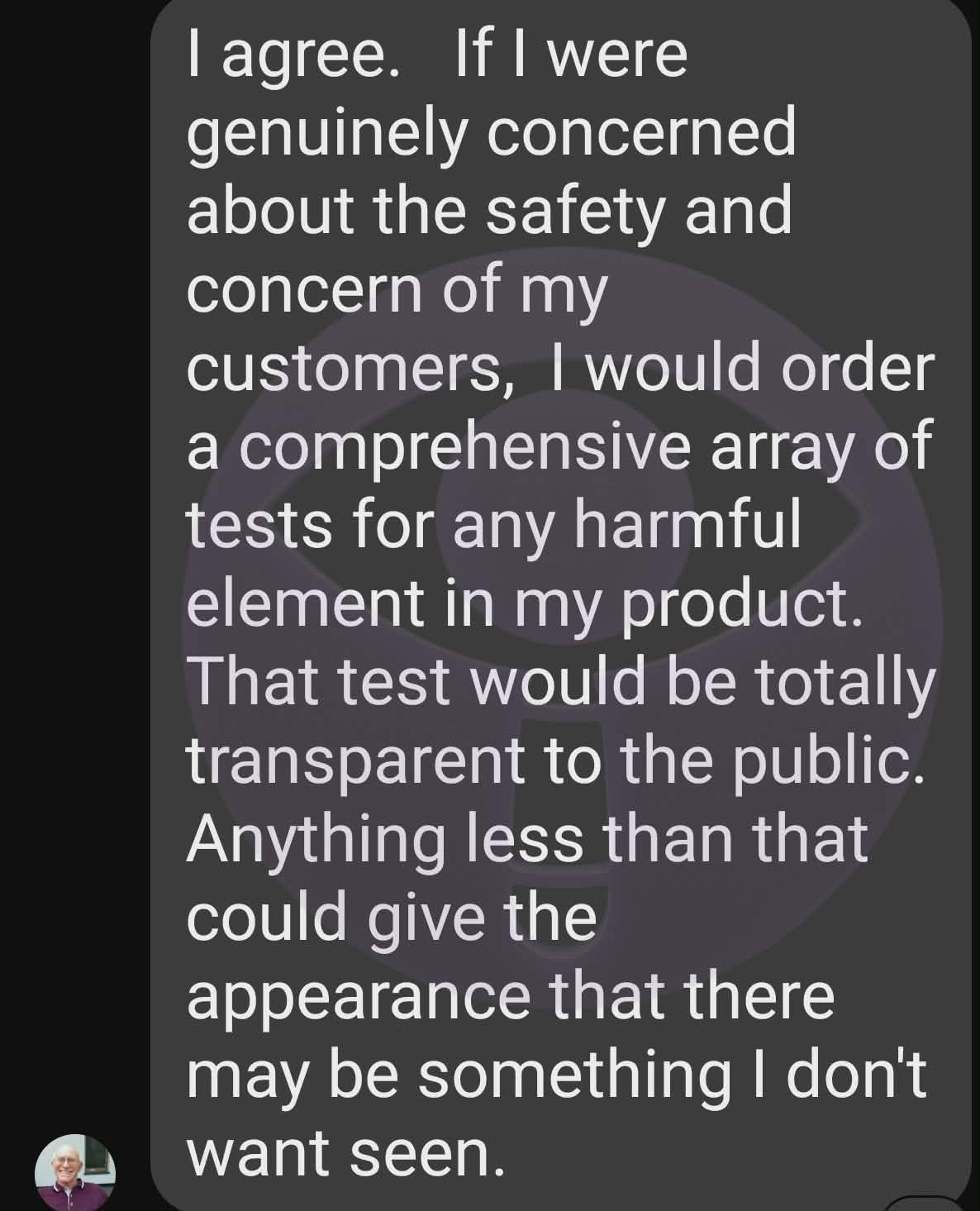
If local utilities and state agencies intend to assure the public that this infrastructure is sound, a transparent audit requires an unvarnished, full-spectrum analysis—not a narrowly tailored, single-element test engineered to guarantee a passing result. Transparency is not optional. As long as the official narrative conflicts with the verifiable data flowing from residents’ taps, we will continue to demand the receipts.