

 Written by
 The Kinetic Strike and the Intelligence Victory
In a defining moment for international counter-terrorism, a highly complex and meticulously planned joint military operation between United States forces and the Armed Forces of Nigeria has successfully eliminated Abu-Bilal al-Minuki last night, the global second-in-command of the Islamic State (ISIS). Executed flawlessly at the direct order of U.S. President Donald J. Trump, the mission permanently removed a figure identified by the administration as the most active terrorist operating on the global battlefield.
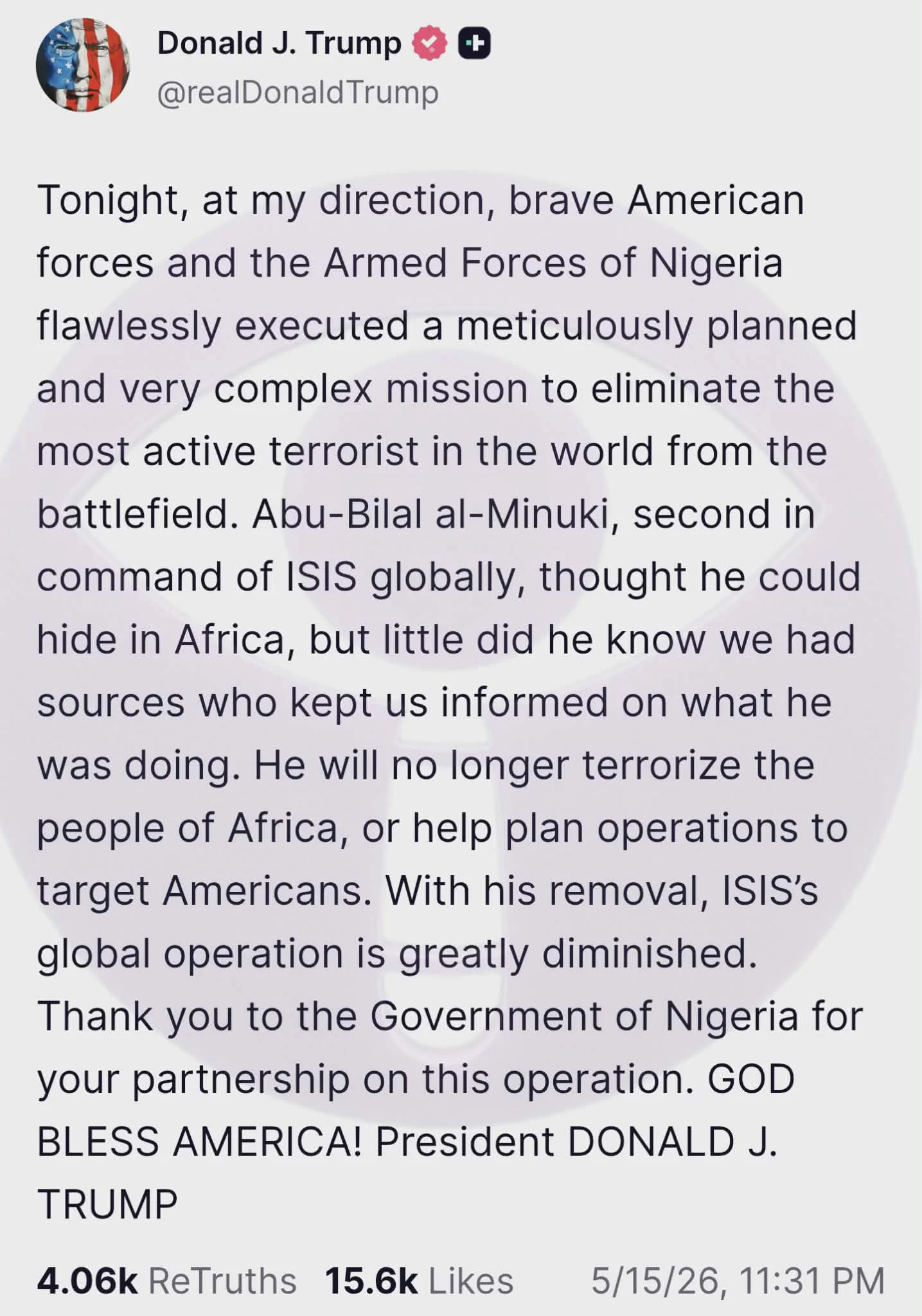
The successful interdiction of al-Minuki was the culmination of an extensive, clandestine intelligence-gathering apparatus. While the ISIS commander believed the remote and often ungoverned expanses of the African continent would provide an impenetrable safe haven, his movements were systematically tracked. The operation was facilitated by deeply embedded sources who continuously informed U.S. and allied intelligence networks of his activities, ultimately allowing strike teams to pinpoint his location and neutralize the threat.
The immediate tactical result of this operation is a severe degradation of ISIS’s global command structure. By terminating al-Minuki, the United States and its Nigerian partners have dismantled a critical node in the terror group’s operational hierarchy, effectively diminishing its capacity to terrorize African populations and critically disrupting advanced plots intended to target American citizens globally.
The Target: Who Was Abu-Bilal al-Minuki and Why Was He So Dangerous?
To understand the magnitude of this operation, it is necessary to examine the specific threat profile of Abu-Bilal al-Minuki and the strategic logic behind his presence in Africa. As the second-in-command of ISIS globally, al-Minuki was not merely a localized insurgent; he was a transnational operational architect. His danger stemmed from his dual capability to synthesize global jihadist ideology with the localized exploitation of vulnerable states.
Al-Minuki recognized that the geopolitical center of gravity for global terrorism was shifting away from the Middle East and toward the African continent. Africa is a “nexus theater” where global interests, massive demographic expansion, and severe security challenges converge. By 2050, the continent will account for 25% of the world’s population, boasting the largest youth demographic globally. Al-Minuki sought to exploit this rapidly urbanizing, resource-rich environment by weaponizing environmental stressors and the widespread economic disenfranchisement prevalent in the region.
His specific danger lay in his strategic intent to expand the ISIS caliphate out of the landlocked, arid regions of the Sahel and into the more prosperous coastal states of West Africa. Intelligence assessments and military leadership explicitly identified a deliberate push by ISIS factions to migrate toward littoral nations such as Benin and Côte d’Ivoire. Al-Minuki was the ideological and logistical engine driving this coastal migration. If successful, this strategy would have linked inland insurgencies with vital maritime logistical networks, providing ISIS with unparalleled access to illicit funding streams and fundamentally destabilizing some of the world’s fastest-growing economies. Furthermore, documentation of his activities confirms he was actively leveraging these African operational bases to finance, plan, and direct attacks specifically targeting Americans.
The Strategic Vacuum: The Collapse of Sahelian Security
Al-Minuki’s ability to operate and thrive in Africa prior to his elimination was directly facilitated by the catastrophic collapse of established regional security architectures. Between 2022 and 2025, the overarching framework designed to contain extremism in the Sahel effectively disintegrated, creating a massive territorial blind spot that high-value targets immediately exploited.
Historically, the containment of groups like ISIS and al-Qaeda relied on transnational military coalitions, primarily the G5 Sahel initiative and the Multinational Joint Task Force (MNJTF). These frameworks provided the contiguous border surveillance necessary to track militant convoys. However, the internal political dynamics of the region fractured under the pressure of successive military coups. General Michael E. Langley, the Commander of U.S. Africa Command (USAFRICOM) from 2022 to 2025, confirmed in a 2024 intelligence assessment that the large security construct stretching from Chad westward through Mauritania had wholly regressed, becoming completely “non-existent”.
This regression was cemented when three military-led West African nations—Niger, Mali, and Burkina Faso—severed their diplomatic and security ties with the Economic Community of West African States (ECOWAS). In an unprecedented geopolitical rupture, these nations formed their own independent bloc known as the Alliance of Sahel States (AES). The departure of Niger, in particular, crippled regional intelligence sharing, as the country had previously served as a keystone for Western counter-terrorism operations.
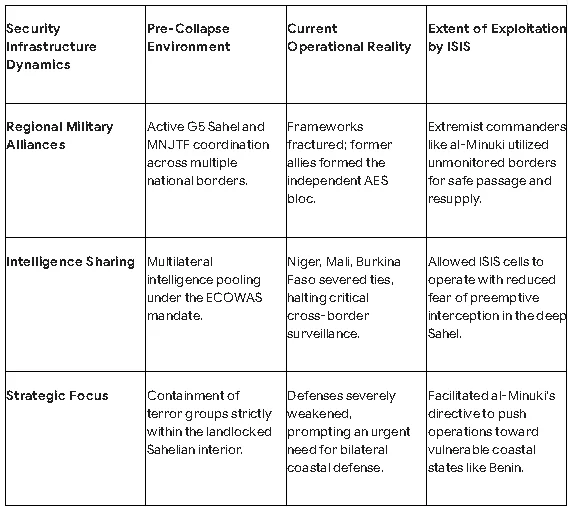
This institutional collapse provided Abu-Bilal al-Minuki with the exact environment he needed: weak governance, disrupted intelligence-sharing networks, and massive tracts of unpoliced territory. It became the operational baseline from which he planned attacks against American and African targets.
The Center of Gravity: The Vital U.S.-Nigeria Partnership
Given the disintegration of the Sahelian security apparatus, the United States was forced to recalibrate its regional strategy, placing immense reliance on the Republic of Nigeria. The successful operation against al-Minuki was the direct result of this intensified bilateral partnership. As highlighted by President Trump following the strike, the partnership with the Government of Nigeria was the indispensable factor in removing ISIS’s second-in-command from the battlefield.
Nigeria’s status as the linchpin of West African security is unquestionable. It holds the largest population, the most robust economy, and the largest democracy on the continent. USAFRICOM leadership fundamentally views the nation as the ultimate bulwark against total regional collapse. As General Langley starkly noted, “If they win, West Africa wins. The Sahel wins.”
To operationalize this alliance ahead of such high-stakes missions, extensive diplomatic and military groundwork was laid. On January 10-11, 2024, General Langley, accompanied by U.S. Marine Corps Sergeant Major Michael Woods, conducted a critical strategic visit to Nigeria. During this summit, U.S. command engaged deeply with Major General E.V. Onumajuru, Nigeria’s Chief of Defense Training and Operations. The primary objective of these talks was to synchronize efforts to counter the virulent spread of extremism and to reinforce Nigeria’s central leadership role in stabilizing the region.
This relationship operates strictly under the USAFRICOM doctrine of being “African Partner-led, U.S.- and Ally-enabled.” The strategy recognizes that while the U.S. can provide critical intelligence and advanced capabilities, long-term security requires operational independence from African partners. General Langley reiterated that cooperation and joint training are vital to navigating the evolving security landscape. By combining Nigeria’s tactical ground presence with U.S. intelligence networks—the “sources” referenced in the operation’s aftermath—the joint force achieved the lethal precision required to penetrate al-Minuki’s network.
Multi-Domain Engagement: Beyond Kinetic Strikes
The partnership that enabled the al-Minuki strike extends beyond purely military applications. It incorporates a sophisticated understanding of how to permanently dismantle the appeal of groups like ISIS. David Greene, the U.S. Mission Nigeria Chargé d’Affaires, explicitly stated that addressing regional instability requires comprehensive collaboration, encompassing intelligence sharing, capacity building, humanitarian assistance, and the creation of a secure environment conducive to economic growth.
Demonstrating this multi-domain approach, General Langley’s 2024 engagements in Nigeria included deep interactions with civil society. He met with Nigerian alumni of the embassy’s Young African Leaders Initiative (YALI), sharing perspectives on leadership and emphasizing the role of youth in forging a stable democratic future. By simultaneously neutralizing high-level kinetic threats like al-Minuki and investing in the region’s massive youth demographic, the U.S.-Nigeria partnership seeks to erode both the leadership and the recruitment base of transnational terror networks.
The Technological Architecture of the Strike
Locating a target as heavily protected and elusive as the global second-in-command of ISIS requires an overwhelming technological advantage. While the human intelligence sources provided the foundational tracking, the operational execution was undoubtedly underwritten by USAFRICOM’s advanced technological posture.
To offset the massive territorial expanses and the lack of contiguous regional alliances, the U.S. military relies heavily on Airborne-Intelligence, Surveillance, and Reconnaissance (A-ISR) capabilities. A-ISR platforms are critical to establishing the persistent, unblinking overwatch required to verify the movements of high-value individuals like al-Minuki without alerting them to an impending strike.
Furthermore, the operating environment has become highly contested due to the democratization of drone technology among extremist groups. To protect allied forces and ensure the unhindered execution of complex missions, USAFRICOM has heavily integrated Counter-Unmanned Aerial Systems (C-UAS) into its tactical framework. These systems neutralize the asymmetrical aerial threats posed by ISIS, ensuring that U.S. and Nigerian strike teams maintain total battlefield dominance during targeted eliminations. The seamless integration of partner ground forces with cutting-edge A-ISR and C-UAS technology epitomizes the modern methodology required to keep the risk to U.S. national security interests critically low while degrading terror networks.
Conclusion: A Diminished ISIS and the Road Ahead
The meticulously executed joint operation that resulted in the death of Abu-Bilal al-Minuki stands as a paradigm-shifting victory in the global war on terror. By eliminating ISIS’s global second-in-command, the United States and the Armed Forces of Nigeria have fundamentally fractured the organization’s ability to project power from the African continent. The intelligence failure experienced by ISIS—believing their senior leadership was secure in the ungoverned spaces of Africa—demonstrates the lethal efficacy of the “Partner-led, U.S.-enabled” operational doctrine.
However, the geopolitical conditions that allowed a figure of al-Minuki’s caliber to embed himself in the region persist. The collapse of the G5 Sahel, the fragmentation of ECOWAS, and the systemic vulnerabilities stemming from weak governance continue to offer fertile ground for radicalization. ISIS’s strategic intent to migrate from the arid interior toward the prosperous coastal economies of West Africa remains a pressing threat that demands constant vigilance.
The success of this operation vindicates the strategic necessity of maintaining flexible, enduring military-to-military relationships in the region. As Africa continues to grow into an undeniable global nexus theater, the security of the United States homeland and the stability of the international economy will increasingly depend on the strength of bilateral partnerships, epitomized by the U.S.-Nigeria alliance, to systematically hunt and dismantle the remnants of extremist leadership.
Works Cited (Click Here)
- Trump, Donald J. (@realDonaldTrump). Social media statement detailing the joint U.S.-Nigeria military operation to eliminate Abu-Bilal al-Minuki, ISIS second-in-command.
- Langley, Michael E. Interview on the collapse of the G5 Sahel construct, USAFRICOM strategy, and the movement of ISIS factions to coastal West Africa. Premium Times.
- United States Africa Command (USAFRICOM). 2025 Posture Statement to the House Armed Services Committee.
- United States Africa Command (USAFRICOM). “U.S. Africa Command Head Advances U.S.-Nigeria Cooperation.” Press Release, January 2024.
- United States Embassy in Nigeria. “U.S. Africa Command Head Advances U.S.-Nigeria Cooperation.” Press Release, January 2024.
- United States Department of Defense. Biography of General Michael E. Langley, U.S. Marine Corps.