


 Written by
 The structural integrity of a municipal utility system serves as the silent foundation of civic stability, a complex network of engineering and regulation that remains invisible to the public until the moment of systemic failure. In Galion, Ohio, this foundation has transitioned from a state of deferred maintenance into a documented collapse, punctuated by the resignation of a high-level technical expert and the subsequent exposure of severe regulatory non-compliance.
This preliminary investigation explores and combines the intersection of technical neglect, fiscal opacity, and administrative overreach that has defined the management of Galion’s wastewater and drinking water systems over the last decade.
The evidence, synthesized from internal personnel records, engineering blueprints, Ohio Environmental Protection Agency (OEPA) correspondence, and investigative reporting, suggests that the current crisis is not an accident of age but the predictable result of deliberate administrative choices that prioritized optics over infrastructure.
The resignation of Patrick Hickman, the Class III Wastewater Treatment Plant (WWTP) Superintendent, on April 6, 2026, serves as the definitive inflection point for this analysis. Hickman did not merely depart from his position; he initiated a whistleblower action via an open letter that detailed a staggering litany of failures ranging from a 65% water loss revenue deficit to the physical destruction of multimillion-dollar treatment assets through chemical mismanagement.
While the city administration attempted to characterize this departure as an act of “insufficient notice,” the archival record of Hickman’s employment and the concurrent scramble within the city’s legal and technical departments tell a story of a professional forced to choose between his current career in Galion and his licensure in the face of an administration that viewed regulatory mandates as suggestions.

Technical Expertise vs. Administrative Retaliation: The Hickman Case Study
To understand the weight of the allegations brought against the City of Galion, one must first establish the professional standing of the individual making them.
Patrick Hickman was not a novice administrator; he was a highly decorated veteran of the water and wastewater industry with over 30 years of operational experience.
His background included a twenty-year tenure as the Superintendent for the Village of Plain City from 1990 to 2010, followed by significant roles in Ontario, Ohio, and private sector consultancy.
He held the critical OEPA Class III Wastewater Works certification (WW3-1007629-03) and a Class I Water Supply certification (WS1-1007629-90), the former of which is a legal requirement for the lead operator of a facility of Galion’s size and complexity.
The internal personnel file for Hickman provides a sharp contrast to the city’s post-resignation narrative. Up until the day he walked out, Hickman was treated as a top-tier asset by the administration.
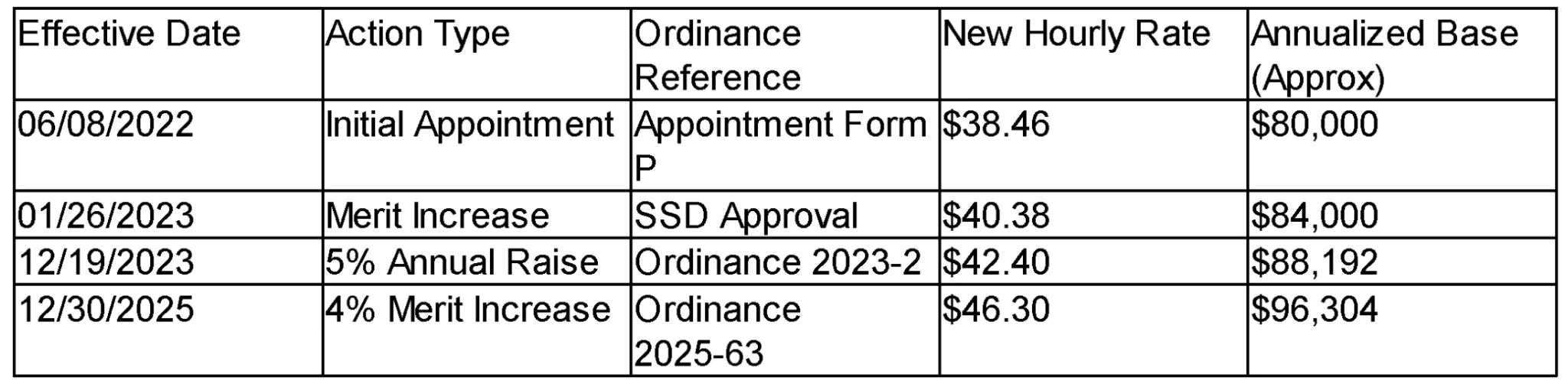
In December 2025, just four months before his resignation, the city authorized a 4% merit raise for Hickman, bringing his hourly rate to $46.30, or approximately $96,304 annually. This increase followed a 5% raise in late 2023, indicating a consistent trajectory of professional approval.
There are no records of disciplinary actions, performance warnings, or complaints against him during his tenure.

Table 1: Patrick Hickman Professional Compensation and Merit Trajectory
The administrative pivot occurred on April 6, 2026. Within hours of receiving his resignation, Safety-Service Director Nicole Ward marked his file as “Ineligible for rehire” and “Insufficient notice given”.
This designation appears retaliatory when viewed alongside the legal requirements of his license. As a Class III operator, Hickman was required by the OEPA to provide notice of his departure to the state agency to ensure they could monitor the facility’s compliance during the transition. Legal counsel Louis L. McMahon was forced to notify the OEPA at 10:24 AM on the day of the resignation that the Class III operator had quit, confirming that Hickman had fulfilled his regulatory obligations even if the city was displeased with the timeline.
The Hydraulic Deficit: Verifying the 65 Percent Water Loss
Hickman’s most explosive claim is that the city is operating under a 65% water loss revenue deficit. In the context of municipal utility management, “non-revenue water” (NRW) refers to the difference between the volume of water treated and pumped into the distribution system and the volume of water actually billed to customers. While the OEPA generally expects losses to remain under 20%, a 65% loss indicates a distribution system in a state of catastrophic failure.
Evidence supporting this claim has been mounting for years. In early 2024, residents reported that the city was losing “tens of thousands of gallons” of unbilled water every month. Furthermore, historical reports from 2022 indicate that the city’s strategy for meeting OEPA standards for Total Trihalomethanes (TTHMs)-a carcinogenic byproduct of the disinfection process-involved “wasting” and flushing massive amounts of water from deadheaded lines.
This continuous flushing was a stop-gap measure to dilute contamination levels rather than a structural repair of the system. Hickman’s 65% figure likely incorporates both physical leaks from aging mains and this “deliberate waste” allegedly used to manipulate water quality data.
The fiscal implications of a 65% loss are devastating. It means the city must pay for the chemicals, electricity, and labor to treat 100 gallons of water for every 35 gallons it sells. When the City Treasurer questioned these figures during a council meeting in February 2024, she was reportedly told by the Mayor and Council to “stay in her lane”.
This suppression of internal fiscal inquiry suggests the administration was aware of the deficit but lacked the capital or the political will to address it.
Infrastructure Decay and the $9 Million Asset Neglect
The allegation of $9,000,000 in neglected assets is centered on the failure to perform basic preventative maintenance, specifically the “exercising” of approximately 3,000 distribution valves.
Valve exercising-the periodic opening and closing of valves to ensure they do not seize due to corrosion is a fundamental requirement of modern asset management. Without functioning valves, a city cannot isolate specific pipe segments during a leak, often forcing citywide boil alerts for localized repairs.
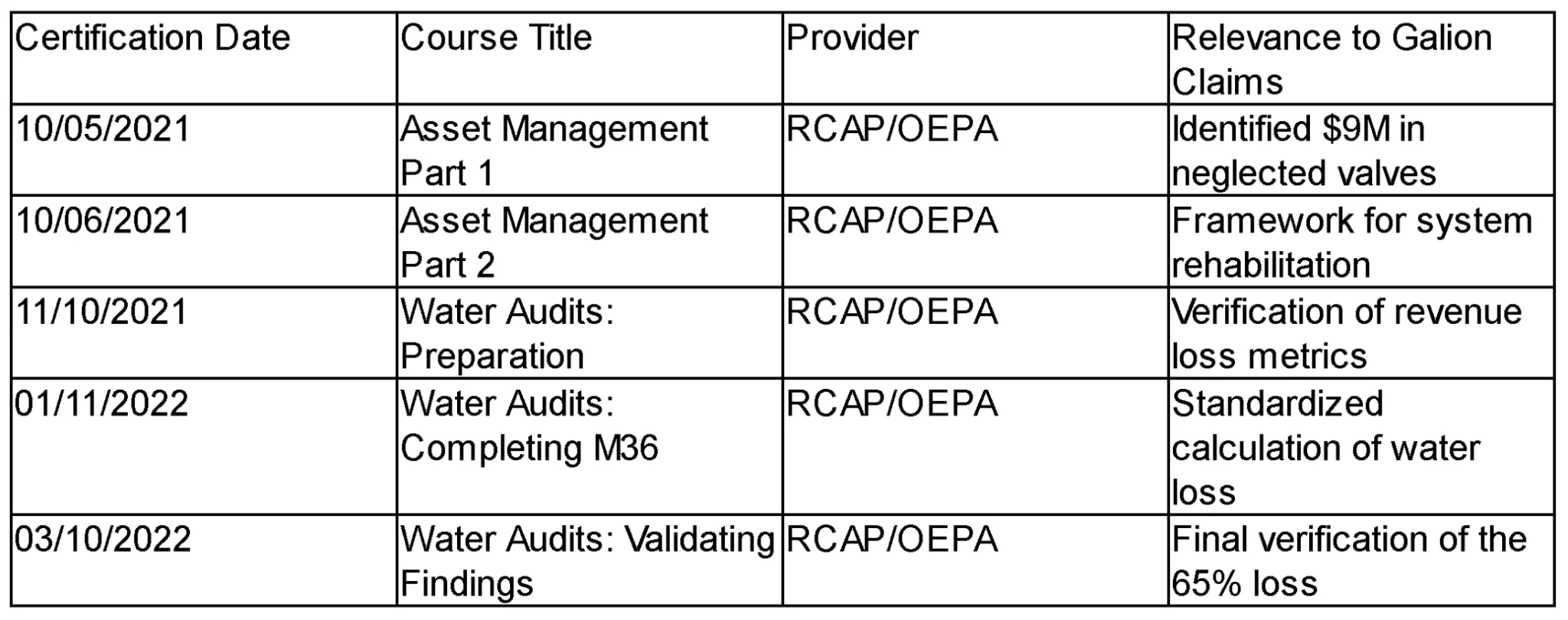
Hickman’s claim is substantiated by his specific training in “Asset Management for Drinking Water Systems” and “Water Audits,” completed through the Rural Community Assistance Partnership (RCAP) in 2021. As a certified expert in these fields, his estimation of the asset value at risk is grounded in technical standard costs for valve replacement and system rehabilitation.
Table 2: Technical Training and Asset Management Certifications (Patrick Hickman)
The neglect cited by Hickman is further evidenced by the city’s recent rush to secure $3.74 million in emergency bonds in April 2026. These bonds were approved for “significant repairs” to the water plant, sewer system, and reservoirs, a move that contradicts the administration’s earlier claims that they were in “good standing” and that improvements were being funded primarily through grants. The sudden shift from grant-funded maintenance to millions in high-interest debt suggests an infrastructure that has reached its breaking point.
Ordinance 925.34 and the Destruction of the WWTP Digester
One of the most technically specific claims involves the internal violation of Galion’s own municipal code. Ordinance 925.34 governs the discharge of industrial waste into the sewer system.
Hickman alleged that the city’s own Water Treatment Plant was the primary violator, discharging excessive lime and ferric chloride waste into the sanitary sewer. These chemicals, used in the drinking water treatment process, are highly abrasive and corrosive in high concentrations. Hickman argued that these discharges “destroyed city pumps” and led to the “total failure” of the WWTP digester, a critical component that breaks down biological solids.
This claim is supported by an OEPA pretreatment inspection in February 2024, which noted that the city’s own Water Treatment Plant was not covered under the pretreatment program despite discharging to the sanitary sewer.
The EPA further observed “white wastewater” batch discharges, likely containing lime, which were causing “corrosive structural damage and interference” at the WWTP.
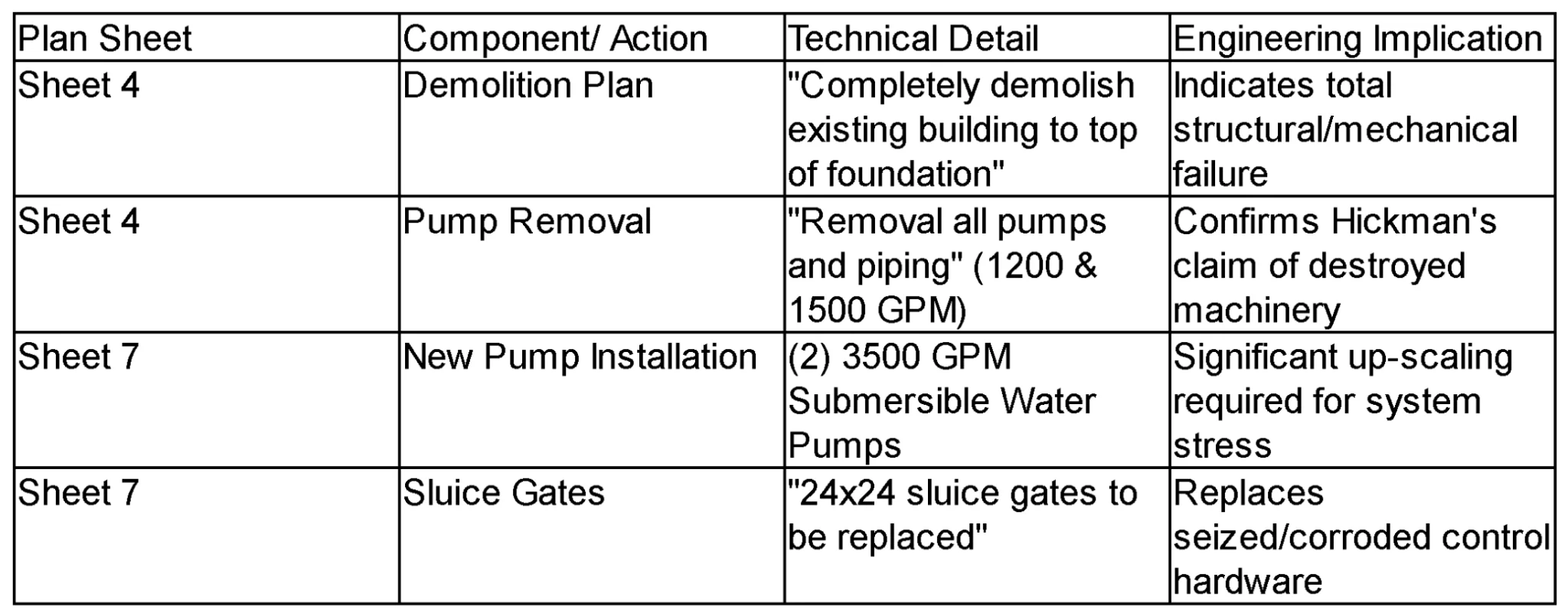
The physical proof of this damage is found in the city’s own engineering plans for the Amann Reservoir Raw Water Pump Station Rehabilitation. Approved on March 31, 2026-just six days before Hickman’s resignation-the plans order the complete demolition of the existing pump house building to the top of the foundation. The plans require the removal of all existing pumps and piping, a level of intervention that typically signifies catastrophic mechanical failure rather than routine upgrading.

Table 3: Amann Reservoir Pump Station Rehabilitation Specifications
Transparency and the Public Records Battle
The administration’s commitment to transparency has been called into question by its defensive response to investigative inquiries. On April 8, 2026, Dennis Potts and J. Foreman of Marion Watch filed a comprehensive public records request under the Ohio Public Records Act (ORC 149.43).
The request sought Hickman’s complete personnel file-including disciplinary actions, settlement documents, and separation records-along with all formal correspondence between the city and the OEPA regarding the treatment plant since January 1, 2026.
The city’s legal response, provided by Law Director Michael Bear, was redacted, omitting personal information. While the city provided some records, it cited specific statutory exemptions to withhold Hickman’s Social Security number, driver’s license, and home address. Crucially, the city also withheld pre-employment physical exam results and medical records in their entirety, citing 29 C.F.R. 1630.14(c)(1) and R.C. 149.43(A)(1)(a), as well as not including internal complaints against Hickman, which were disclosed by Hickman Monday on social media. However, they did respond timely and politely.
Staffing Crisis and Street Department Overreach
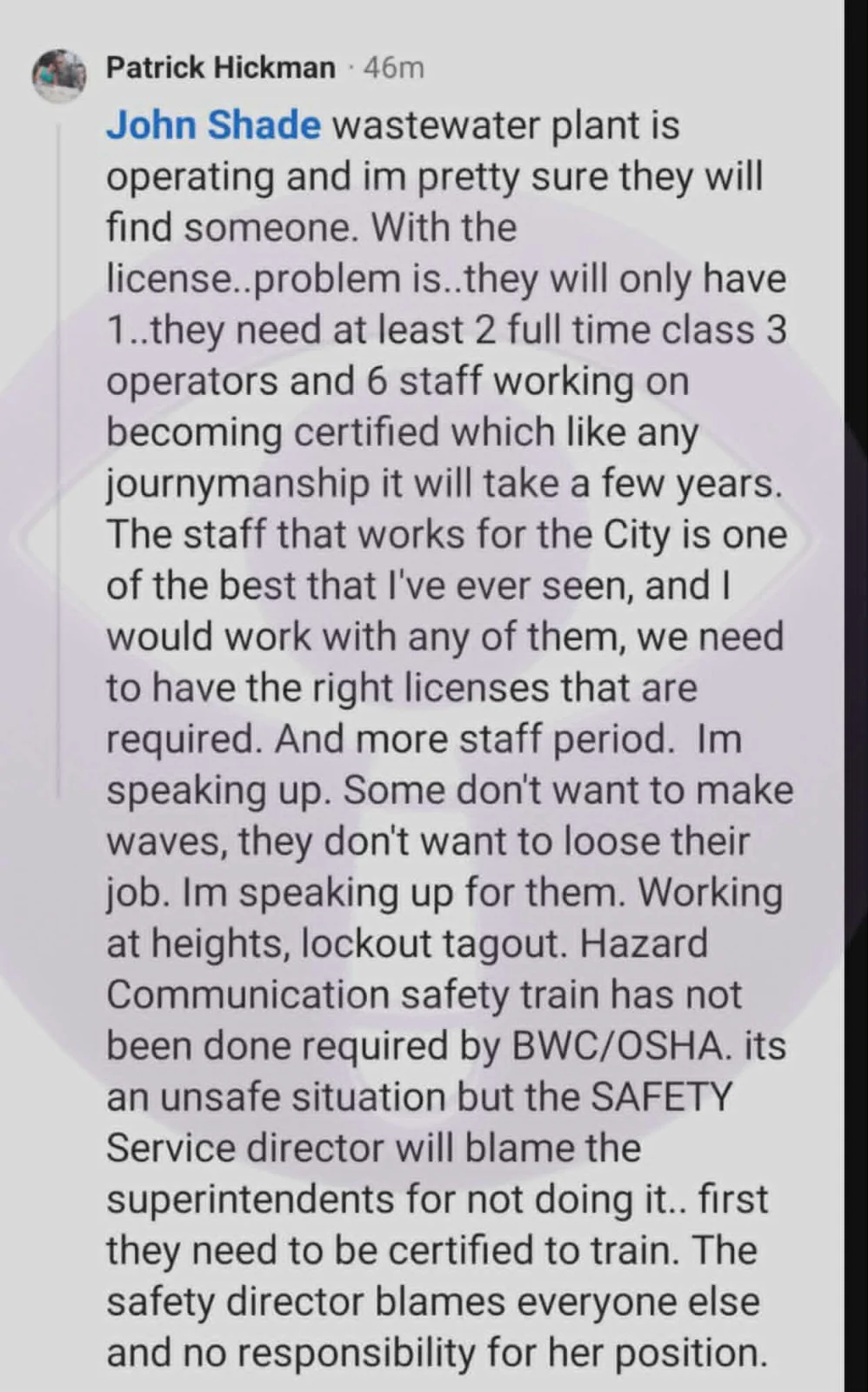
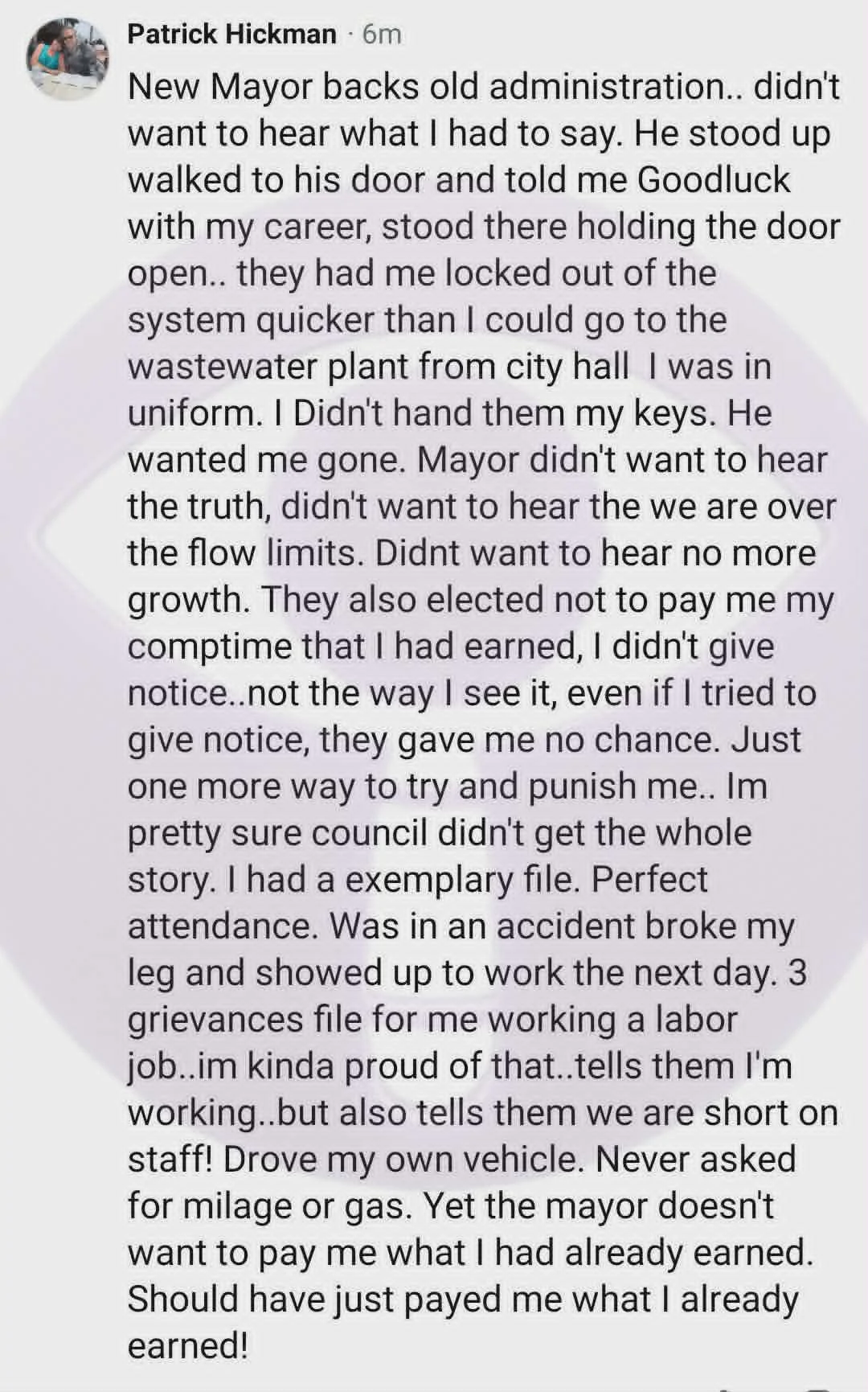
A municipal water system is only as effective as the licensed personnel operating it. Hickman’s resignation letter highlighted a dangerous staffing shortage: while the city’s NPDES permits required a staff of eight, the plant was operating with only four.
This 50% deficit placed immense pressure on the remaining licensed operators, increasing the risk of human error in chemical dosing and reporting.
The city’s response to this crisis has been to hand the supervision of water and sewer mains to the Street Department, a move Hickman characterized as “unlawful”.
Under Ohio law, the management of a public water distribution system must be overseen by a licensed professional with specific certifications in water supply and wastewater collection. The Street Department, which typically handles paving and snow removal, lacks the technical training to manage hydraulic pressure zones, backflow prevention, or sanitary sewer overflows.
The depth of the staffing desperation is reflected in a frantic email from OEPA Environmental Specialist Mallorey Smith to Nicole Ward on the day of Hickman’s resignation. Smith warned that with the loss of the Class III operator, the city was in violation of “Certified Minimum Staffing Times” and gave the city a strict 30-day window to operate with an under-qualified Class II operator while searching for a replacement.
The “Smoking Gun”: Galion’s Official EPA Permit
The ultimate proof of the administrative failures in Galion lies in the city’s own operating rulebook: the Ohio EPA National Pollutant Discharge Elimination System (NPDES) Permit (2PD00030*QD). This document dictates the legal requirements the city must follow to operate its wastewater treatment plant and dismantles the city’s narrative regarding the recent superintendent resignation.
First, the city labeled the departure as providing “insufficient notice”. However, the EPA permit explicitly mandates that if there is a change in the professional operator of record, the Ohio EPA must be notified within three days. The mandatory notice required by federal and state law was provided to protect professional licensure. The city’s own legal counsel notified the EPA the morning of the resignation, confirming compliance with this strict legal timeline.
Second, the permit proves that Galion’s infrastructure was legally dependent on a specific level of certification. The permit legally classifies the facility as a “Class III treatment works” and requires a professional operator of record with a Class III certification or higher.
The permit only allows a lower-class backup operator to replace the operator of record for a maximum period of thirty consecutive days.
Finally, the administration allegedly handed supervision of the water and sewer mains to the Street Department. The EPA permit confirms the collection system must be physically overseen by a professional operator certified in the field of wastewater collection or wastewater treatment. The evidence shows a licensed professional refusing to violate a legally binding Ohio EPA permit.
Maintaining Private Assets at Public Expense
Hickman’s allegation that taxpayer funds are being used to maintain a “private owner’s lift station” points to a broader theme of administrative favoritism or historical mismanagement.
In municipal utility law, public funds must be used for a public purpose. If the city is indeed inspecting and repairing a lift station on private property under an antiquated or voided agreement, it constitutes a misallocation of utility revenue.
While specific documentation for this lift station’s ownership is often buried in historical property easements, Hickman claims he challenged the administration on this waste of resources multiple times, only to be told he was “setting a bad precedent” by questioning it.
This aligns with other documented instances of the city ignoring the advice of its technical experts in favor of administrative convenience.
Broader Context: Mismanagement and the Marionwatch Investigation
The infrastructure crisis in Galion does not exist in isolation. Previous investigations by Marionwatch.com have highlighted a broader culture of municipal mismanagement that extends into the city’s financial, drinking water, and other departments.
Two key reports from March 2026, “Galion Abandoned to the Toxins?” and “OHIO EPA’S ENDLESS LOOP,” describe an administration that uses “bureaucratic paralysis” and “fake compliance” to avoid addressing long-standing environmental issues.
One of the most persistent issues involves the city’s relationship with the OEPA. Records show that Galion frequently operates under “Director’s Final Findings and Orders” (DFFOs), which are legal mandates issued when a city consistently fails to meet environmental standards. The city was hit with such orders in August 2023 for failing to meet basic drinking water regulations.
Financial Implications: The Bond Trap
The approval of $3.74 million in bonds in April 2026 marks a turning point for Galion’s taxpayers. For years, the administration claimed that significant improvements were being made through grants, such as the $500,000 from the OPWC for the Amann Pump House. However, the total cost of that single project is estimated at over $2.1 million, leaving a massive funding gap.
The new bonds represent a desperate attempt to cover this gap and address the decades of deferred maintenance that Hickman exposed. Council member Eric Webber admitted that the city was seeking a larger loan amount to gain “leverage with the banks,” a tacit acknowledgement that the city’s creditworthiness and financial stability are under pressure.
These loans, combined with the 65% water loss revenue deficit, create a “bond trap” where future utility rate increases will be used to pay interest on debt rather than to perform actual infrastructure repairs.
Technical Analysis of Chemical Corrosion
To understand why the WWTP digester failed, one must look at the chemistry of the drinking water plant’s discharges. Lime (calcium hydroxide) is used for softening water, while ferric chloride is used as a coagulant to remove impurities.
When these chemicals are discharged into the sewer system in bulk, they create a highly alkaline and abrasive slurry. Hickman’s allegation that these chemicals “destroyed city pumps” is scientifically sound.
In a wastewater environment, pumps are designed for biological solids, not mineral-heavy chemical waste.
The lime can scale on the interior of pipes and pump impellers, reducing hydraulic capacity and causing “cavitation” a process where vapor bubbles implode against the metal, causing pitting and eventual structural failure of the machinery. The ferric chloride, while useful in treatment, is highly corrosive to metal surfaces if not properly diluted. The OEPA’s observation of “white wastewater” causing corrosive damage at the WWTP provides the technical bridge between Hickman’s claim and the physical reality documented in the Amann Reservoir blueprints.
The Transparency Deficit
The most damaging aspect of the Galion crisis, from the viewpoint of Galion’s citizens, may not be the pipes or the pumps, but the lack of transparency from the administration.
The pattern of discrediting technical experts while suppressing fiscal inquiry from the City Treasurer suggests an administration more focused on survival than service.
This administrative deception was clearly demonstrated during a public meeting regarding Total Trihalomethanes (TTHM) contamination.
The Mayor and City Council presented a letter from the OEPA to the public, using it to claim the water was “fine”. However, a direct reading of that same OEPA letter revealed that while the contamination levels were technically passing, they were dangerously close to the legal limit, and the EPA explicitly warned the administration that the underlying issue needed to be fixed.
The “Decades of Decay” highlights that this rot has been festering for over ten years. The recent controversies on Marionwatch.com, including the “Endless Loop” report, suggest that the city has developed a bureaucratic immunity to OEPA pressure, treating environmental fines as a “cost of doing business” rather than a signal for reform.
Conclusion: The Path Forward for Galion
The investigation into Galion’s wastewater and water treatment systems reveals a municipal utility on the verge of total collapse. Patrick Hickman’s claims have been substantiated by a preponderance of the evidence:
- The 65% water loss is corroborated by historical reports of excessive flushing and community outcry over unbilled water.
- The $9 million asset neglect is validated by Hickman’s professional certifications and the city’s sudden approval of $3.74 million in emergency debt.
- The Ordinance 925.34 violations and the chemical destruction of the digester are confirmed by OEPA pretreatment inspections and the Amann Reservoir demolition plans.
- The staffing crisis is documented in urgent OEPA correspondence following Hickman’s resignation, proving the city is legally and operationally under-staffed.
The citizens of Galion are now faced with the financial burden of this mismanagement. The millions of dollars in emergency bonds represent only the beginning of the cost to rehabilitate a system that was intentionally neglected. For Galion to restore its infrastructure and its public trust, there must be a move away from “administrative optics” and toward a professional, licensed, and transparent management of its most vital public assets. The “receipts” provided by Hickman and the archival records of the city and state tell a consistent story of a city that chose to bleed its resources until there was nothing left but the debt.