

 Written by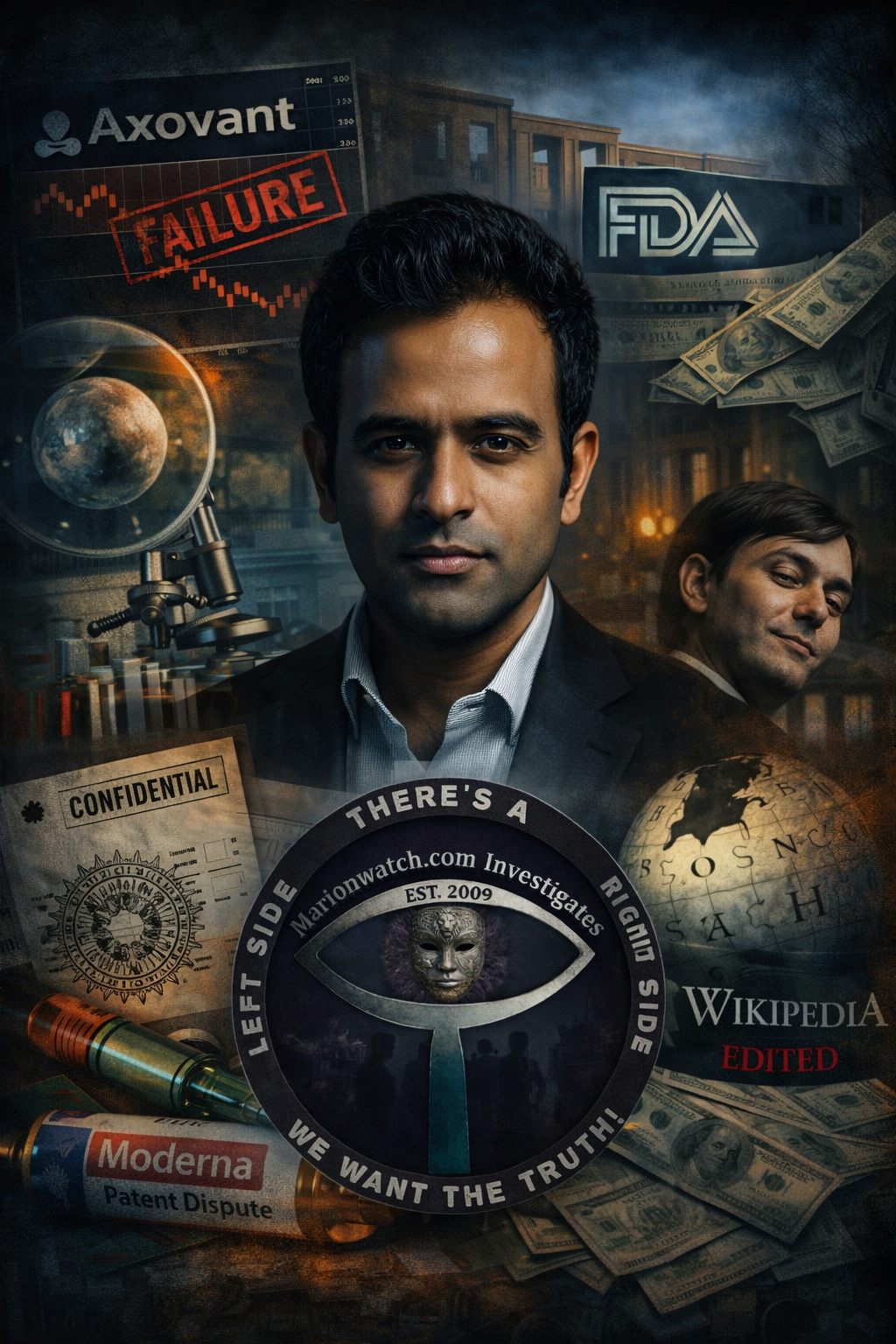
The public trajectory of Vivek Ramaswamy has been nothing short of meteoric. From a high-flying hedge fund manager to a “wunderkind” of the biotech world, and finally to a presidential candidate turned leader of the Department of Government Efficiency (DOGE), he has positioned himself as a disruptive force against the “managerial class”.
However, beneath the polished debate performances and the populist rhetoric lies a complex biomedical empire built on a foundation of aggressive financial engineering, “forgotten” drug assets, and high-stakes patent litigation that has seen his firms extract billions of dollars from the very companies that produced the COVID-19 vaccines.
This investigation reveals a pattern of behavior that sits at the intersection of medical innovation and opportunistic capitalism. While Ramaswamy brands himself as a savior of shelved medicines, the paper trail of his corporate “Vants” tells a story of spectacular clinical failures, accusations of “pump and dump” stock schemes, and a quiet but persistent effort to rewrite his own history on platforms like Wikipedia to better suit a burgeoning political career.
Central to this narrative is his involvement in controversial biomedical ventures, including stem cell therapies and regenerative medicine, which often escaped public scrutiny until his rise to national prominence.
The Roivant Hub: A New Kind of Pharmaceutical Alchemy
To understand Vivek Ramaswamy, one must first understand the “Vant” model. In 2014, after a successful career at the hedge fund QVT Financial, Ramaswamy founded Roivant Sciences. His mission was to solve what he described as the pharmaceutical industry’s massive inefficiency: the abandonment of potentially life-saving drugs due to bureaucratic shifts or budgetary constraints rather than scientific failure. Roivant would serve as the “hub” of a wheel, with “spokes” called Vants—independent, nimble subsidiaries focused on specific disease areas.
The model was designed to leverage “incentive alignment”.
By giving each Vant its own management team and equity, Ramaswamy argued he could attract top talent and drive faster results than “Big Pharma” giants like Pfizer or Merck. However, this structure also allowed for a unique kind of financial layering.
Roivant could raise capital for the parent company while simultaneously taking individual Vants public, a process that created multiple “liquidity events” for Ramaswamy and his early investors, even when the underlying drugs had not yet been proven to work.
The Proliferation of the Vant Ecosystem
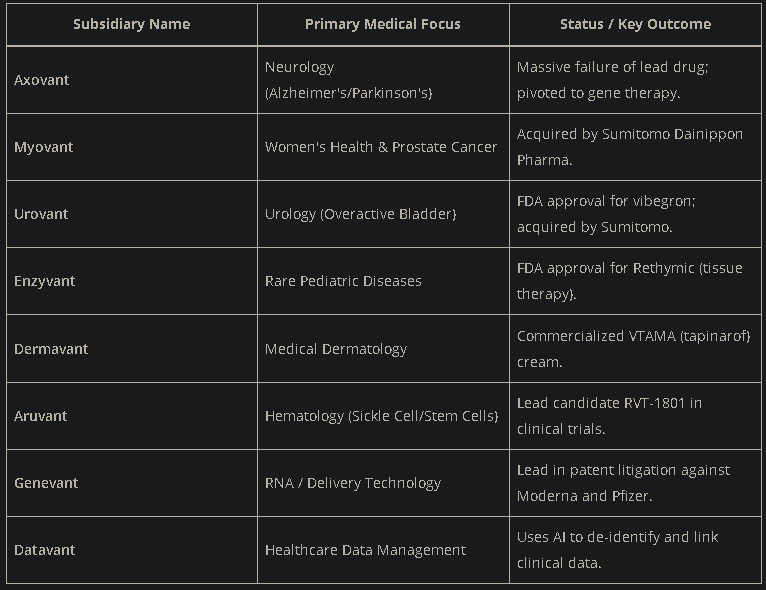
The efficiency of this model is a point of intense debate.
While Roivant has successfully brought one drug, the psoriasis cream VTAMA, to market entirely on its own, many of its other “successes” were actually drugs that had already reached late-stage testing under other companies before being acquired. For critics, the “Vant” model looks less like medical discovery and more like “patent trolling” and financial recycling.
The Axovant Affair: The $3 Billion Hype Machine
The definitive case study in the Ramaswamy method is Axovant Sciences. In 2014, Axovant purchased an Alzheimer’s drug candidate called intepirdine from GlaxoSmithKline (GSK) for just $5 million upfront. GSK had already put the drug through four clinical trials, all of which failed to show significant improvement in patients. Despite this, Ramaswamy and his team launched a massive marketing campaign, portraying the drug as a potential breakthrough that had merely been “misunderstood” by the legacy pharma giant.
The hype worked. In 2015, Axovant went public in what was then the largest biotech IPO in history, raising $360 million. The company’s valuation soared to nearly $3 billion. Ramaswamy was hailed as the “wunderkind” of the industry, appearing on the cover of Forbes as the “The 30-Year-Old CEO Conjuring Drug Companies from Thin Air”.
However, the internal math told a different story. Experts noted that Ramaswamy was likely aware that 99.7% of all Alzheimer’s drug candidates fail to reach the market. While Axovant’s stock was being sold to “mom-and-pop” investors on the promise of a cure, Ramaswamy and Roivant were already securing their profits. In September 2017, the results of the Phase 3 clinical trial finally came in: intepirdine was no more effective than a sugar pill.
Axovant’s stock crashed by 75% in a single day and eventually fell from $200 per share to just 40 cents.
While thousands of retail investors were “fleeced,” as some critics described it, Ramaswamy had already cashed out a “tiny portion” of his shares, which amounted to over $40 million in personal windfalls. This pattern—hyping an asset, cashing out, and then presiding over a clinical failure—has led to comparisons with “pump and dump” schemes common in the darker corners of Wall Street.
The Stem Cell Frontier: Aruvant and the Fetal Hemoglobin Gamble
While the world was focused on the Alzheimer’s failure, Ramaswamy was moving Roivant into the cutting-edge and often controversial field of stem cell research and gene therapy.
In 2018, Roivant partnered with Cincinnati Children’s Hospital to launch Aruvant Sciences. This venture focused on a potential cure for sickle cell disease and beta-thalassemia, conditions that primarily affect the blood’s ability to carry oxygen.
The lead candidate, RVT-1801, utilized “autologous stem cells”—cells taken directly from the patient. Scientists used a “lentiviral vector” to insert a modified gene for fetal hemoglobin into these stem cells. The goal was to “reprogram” the patient’s own body to produce the type of hemoglobin babies have in the womb, which doesn’t have the defects that cause sickle cell disease.
The Mechanics of the RVT-1801 Stem Cell Therapy
The process is a highly technical multi-step procedure that requires significant medical intervention:
- Harvesting: Hematopoietic stem cells are extracted from the patient’s bone marrow.
- Modification: In a laboratory, a viral delivery system inserts the gene for “anti-sickling” fetal hemoglobin.
- Conditioning: The patient undergoes a Reduced-Intensity Conditioning (RIC) regimen—essentially a form of chemotherapy—to make room for the modified cells.
- Re-implantation: The modified stem cells are infused back into the patient, where they hopefully take root and begin producing healthy red blood cells.
While the science is promising, it is also fraught with risk. Similar gene therapies using viral vectors have occasionally led to “insertional mutagenesis,” where the new gene causes the patient to develop leukemia or other cancers. Furthermore, the “conditioning” process is grueling for patients. Despite these complexities, Ramaswamy’s team pushed the narrative of a “transformative” cure, even as competitors like Bluebird Bio and Vertex Pharmaceuticals were further ahead in the race with more robust clinical data.
The Moderna Settlement: Profiting from the Pandemic
Perhaps the most controversial aspect of Ramaswamy’s biomedical career is the recent $2.25 billion windfall his firms secured from Moderna, the developer of one of the primary COVID-19 vaccines. This settlement stems from a massive patent lawsuit involving Arbutus Biopharma and Genevant Sciences, companies in which Roivant holds significant stakes.
The dispute was not over the mRNA itself, but over the “lipid nanoparticles” (LNPs)—the “molecular caravans” or tiny fat bubbles that protect the mRNA and deliver it safely into human cells. Arbutus had pioneered this delivery technology years before the pandemic. When Moderna and Pfizer developed their vaccines, they used a delivery system that Arbutus and Roivant claimed was their intellectual property.
The mRNA Patent Windfall Breakdown
The Soros Connection: References to the “Paul & Daisy Soros Fellowship for New Americans,” which Ramaswamy received in 2011 to fund his law degree at Yale.
The fellowship is named after the brother of George Soros, the progressive megadonor who is a frequent target of conservative conspiracy theories.
COVID-19 Response Involvement: His role on the Ohio COVID-19 Response Team, which supported early pandemic mitigation strategies.
The irony of this settlement has not been lost on political observers. While Ramaswamy was on the campaign trail criticizing the “rushed” nature of the COVID-19 vaccines and attacking the FDA’s mandates, his companies were aggressively suing to ensure they got a “fair royalty” from every dose sold.
Some industry veterans, including the former CEO of Alnylam, have called this “patent trolling,” arguing that Roivant did nothing to help solve the pandemic and is merely “extracting money” from those who did.
The COVID Registry and the “Segregation” Controversy
Accompanying the financial success of the Moderna settlement is a darker political controversy regarding Ramaswamy’s stance on pandemic-era monitoring. Investigative reports and viral social media posts have highlighted Ramaswamy’s past support for a “national COVID registry”. This proposal, which surfaced during the early days of the pandemic when Ramaswamy was part of the Ohio COVID-19 Response Team, suggested using a database to track the immunity status of Americans.
Critics argue that such a registry would have effectively “segregated” Americans into different tiers of citizenship based on their medical status—allowing those with antibodies or vaccines to participate in society while restricting those without.
This stance seems at odds with his current “freedom-first” political persona. The image of Ramaswamy backed by a $2.25 billion payout from vaccine makers while having once supported a tracking system for the vaccinated has become a central point of attack for those who view him as a political chameleon.
Wikipedia and the “Scrubbing” of the Past
As Ramaswamy’s political ambitions grew, his public record began to change—literally. In 2023, it was revealed that Ramaswamy had paid a professional Wikipedia editor to alter his biography to remove information that might be unpalatable to Republican primary voters.
According to reporting in The Wikipedia Signpost, an editor using the handle “Jhofferman” was paid to make nearly 100 edits to Ramaswamy’s page. The most significant deletions included:
- The Soros Connection: References to the “Paul & Daisy Soros Fellowship for New Americans,” which Ramaswamy received in 2011 to fund his law degree at Yale. The fellowship is named after the brother of George Soros, the progressive megadonor who is a frequent target of conservative conspiracy theories.
- COVID-19 Response Involvement: His role on the Ohio COVID-19 Response Team, which supported early pandemic mitigation strategies.
The campaign initially denied that these edits were politically motivated, claiming they were merely “correcting factual distortions”. However, the timing of the edits—just before his presidential announcement—suggests a calculated effort to “scrub” his history and avoid the “woke” associations he now publicly derides.
Enzyvant and the “Regenerative” Business Model
While stem cells and vaccines dominate the headlines, another Vant, Enzyvant Therapeutics, provides a window into Ramaswamy’s move into “regenerative medicine.” Enzyvant focused on a rare, fatal condition where babies are born without a thymus, an organ essential for the immune system.
The treatment, called Rethymic, is not a drug in the traditional sense. It is “allogeneic processed thymus tissue”—essentially laboratory-grown human tissue that is surgically implanted into the patient to “regenerate” their immune system. This type of therapy is incredibly complex to manufacture and regulate. To tackle this, Enzyvant began building a 26,000-square-foot specialized manufacturing facility in North Carolina.
This venture Highlights a central tension in Ramaswamy’s worldview. He frequently attacks the FDA as the “Failed Drug Administration” for having too many “unnecessary barriers to innovation”. Yet, his own companies, like Enzyvant and Aruvant, are operating in fields like tissue engineering and gene therapy where the safety risks are highest and the need for rigorous oversight is most acute.
The $200 Million Sumitomo Payout
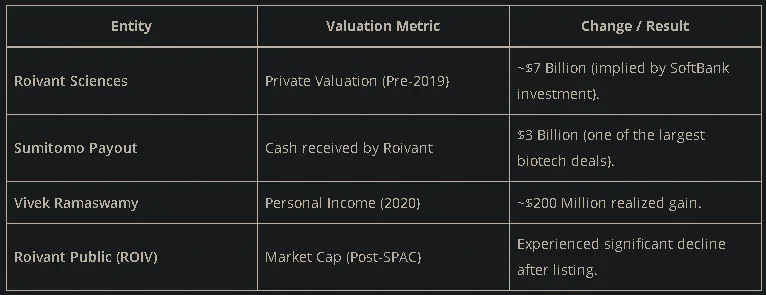
One of the most revealing moments in Ramaswamy’s career occurred in 2019, through a “Strategic Alliance” with the Japanese firm Sumitomo Dainippon Pharma. In a single deal, Sumitomo paid $3 billion for five of Roivant’s Vants (Myovant, Urovant, Enzyvant, Altavant, and Spirovant) and a 10% stake in Roivant itself.
For the Japanese firm, the deal was a desperate attempt to find new “blockbuster” drugs as their current patents expired. For Ramaswamy, it was a massive liquidity event. Tax records released during his campaign show that he personally realized nearly $200 million from this deal.
What makes the deal controversial is what happened next. Many of the Vants sold to Sumitomo were combined into a new entity called “Sumitovant”.
While some products like vibegron eventually reached the market, the overall value of the portfolio has been questioned by analysts. Meanwhile, Ramaswamy used his payout to launch Strive Asset Management, a firm dedicated to “anti-woke” investing, effectively using the proceeds from his biomedical engineering to fund his entry into the culture wars.
Comparative Financial Analysis: Pre- and Post-Sumitomo Deal
DOGE and the Ultimate Conflict of Interest
Today, Vivek Ramaswamy is in a position to reshape the very agency he spent a decade “gaming”.
As a co-lead of the Department of Government Efficiency (DOGE), he has proposed massive cuts to the FDA’s budget and staff, arguing that the agency should “err on the side of approving promising therapies faster”.
The ethical implications are staggering. Ramaswamy still holds a 7% stake in Roivant Sciences, worth approximately $670 million. His company currently has multiple drugs in the pipeline for autoimmune and inflammatory diseases that are entering the very Phase 2 and Phase 3 trials he wants to streamline. If Ramaswamy succeeds in reducing the requirement for clinical trials from two to one, he could shave years and hundreds of millions of dollars off the development costs for his own companies.
FDA Commissioner Robert Califf has noted that such a position is unprecedented. “At FDA, you’re not allowed to make decisions about industries in which you have a vested interest,” Califf said, adding that “the amount of money he has invested and what’s at stake speaks for itself”. Ramaswamy’s response has been to “welcome the scrutiny,” while simultaneously using his platform to “gut” the regulators.
The Shkreli Connection and the “Pharma Bro” Legacy
Investigative reports, including those on Marionwatch.com, have also pointed to Ramaswamy’s professional and personal ties to Martin Shkreli, the infamous “Pharma Bro”. Shkreli, who was banned from the pharmaceutical industry for life and served time in federal prison for securities fraud, has publicly called Ramaswamy “a friend” and one of his “biggest fans”.
While Ramaswamy has never been accused of the same kind of illegal activity as Shkreli, critics argue they share a common philosophy: viewing life-saving medicines primarily as financial “assets” to be leveraged for maximum profit. Both mastered the art of acquiring “shelved” drugs, hiking their perceived value through media hype and complex accounting, and then cashing out before the clinical or regulatory reality set in.
Conclusion: The Architect of the New Gilded Age
The story of Vivek Ramaswamy is the story of modern American capitalism at its most extreme.
He is a man who can simultaneously sue the government for a piece of the vaccine pie while calling the government “corrupt” for mandating those same vaccines.
He is a man who can champion “innovation” in stem cells and gene therapy while attacking the very regulations designed to ensure those therapies don’t cause leukemia or blindness.
As he moves into the halls of power, the biomedical empire he built serves as a blueprint for his political vision. It is a vision of a world where the “Vants” rule—where independent, minimally regulated entities can move at the “speed of capitalism,” unfettered by the safety standards or transparency requirements of the past.
Whether this leads to a new era of medical miracles or a new generation of “fleeced” citizens remains the central question of the Ramaswamy era.
For now, the paper trail of the $2.25 billion Moderna settlement and the $200 million Sumitomo payout suggests that for Vivek Ramaswamy, the most successful drug he ever developed was himself.
Works Cited (Click Here)
1. Vivek Ramaswamy – Milken Institute, https://milkeninstitute.org/events/global-conference-2019/speakers/vivek-ramaswamy
2. Why Vivek Ramaswamy’s ‘Excellence Capitalism’ Bet May Come In Handy For Trump & Musk’s ‘DOGE’ Goal – YouTube, https://www.youtube.com/watch?v=hHi7LXHY9os
3. Inside Health Policy — Trump’s Planned Ramaswamy-Musk Commission Stokes Fears Of Major FDA Cuts – Friends of Cancer Research, https://friendsofcancerresearch.org/news/inside-health-policy-trumps-planned-ramaswamy-musk-commission-stokes-fears-of-major-fda-cuts/
4. POPULAR STAT+ – University of Illinois, https://law.illinois.edu/wp-content/uploads/2026/03/SherkowModernSTAT.pdf
5. The Morning Brief: Viking Makes Private Investment in Roivant | Institutional Investor, https://www.institutionalinvestor.com/article/2bsy8ykgtvgpxvqtguvpc/portfolio/the-morning-brief-viking-makes-private-investment-in-roivant
6. What I Learned Debating Vivek Ramaswamy | Yale Insights, https://insights.som.yale.edu/insights/what-i-learned-debating-vivek-ramaswamy
7. Vivek Ramaswamy – Wikipedia, https://en.wikipedia.org/wiki/Vivek-ramaswamy
8. Roivant Launches Aruvant Sciences and Roivant Foundation in Partnership with Cincinnati Children’s Hospital Medical Center – PR Newswire, https://www.prnewswire.com/news-releases/roivant-launches-aruvant-sciences-and-roivant-foundation-in-partnership-with-cincinnati-childrens-hospital-medical-center-300755244.html
9. Inside The Altavant/Enzyvant Self-Made Merger – Bioprocess Online, https://www.bioprocessonline.com/doc/inside-the-altavant-enzyvant-self-made-merger-0001
10. I’m Vivek Ramaswamy. I’m the founder and executive chairman of Roivant. Prior to founding Roivant, I was an investor in the biotech industry for seven years, where I focused on pre-commercial companies. Prior to that, my background was in molecular biology as an undergrad. I also have a background in law along the way, and I left my career as an investor in 2014 to found a company that was designed to address a lot of the inefficiencies that I had noted through my time and career as an investor. I’ve been running the company together with Matt for the last several years, our CEO. He’s been with Roivant for the last 5½ to 6 years. I’ll hand it over to him. – SEC.gov, https://www.sec.gov/Archives/edgar/data/1819263/000110465921059579/tm2114865d1_ex99-3.htm
11. Reimagining Biopharma: Fireside Chat with Vivek Ramaswamy, CEO, Roivant Sciences, https://files-profile.medicine.yale.edu/documents/7cc77f9c-7c36-48f9-85c9-af8fe98d6741
12. Emerging Pharma: Roivant Sciences on the Rise – DCAT Value Chain Insights, https://www.dcatvci.org/features/emerging-pharma-roivant-sciences-on-the-rise/
13. Sumitomo Dainippon Pharma and Roivant Sciences Sign a Definitive Agreement for a Strategic Alliance, https://www.sumitomo-pharma.com/news/assets/pdf/ene20191031.2.pdf
14. Vivek Ramaswamy’s Latest “Vant”: Aruvant to Focus on Sickle Cell and Beta-Thalassemia, https://www.biospace.com/roivant-launches-aruvant-sciences-and-roivant-foundation
15. Vivek Ramaswamy’s crusade to change FDA could boost biotech, and himself, https://www.center4research.org/washington-post-ramaswamy-conflicts-of-interest-doge/
16. Biotech’s brash entrepreneur finally finds drug-development success with overactive bladders, https://cabiotech.org/news/in-the-news/biotechs-brash-entrpreneur-finally-finds-drug-development-success-with-overactive-bladders/
17. Respivant Sciences, Inc. – Drug pipelines, Patents, Clinical trials – Patsnap Synapse, https://synapse.patsnap.com/organization/ac4f28250b4bacbd5f7b7e713545d638
18. Ramaswamy’s latest ‘vant’ to focus on gene therapies for blood disorders | Fierce Biotech, https://www.fiercebiotech.com/biotech/aruvant-ramaswamy-s-latest-vant-to-focus-gene-therapies-for-blood-disorders
19. Certain identified information has been omitted from this exhibit because it is both (i) not material and (ii) would likely cause competitive harm to the Registrant if publicly disclosed. Such omitted information is indicated by brackets (“[…***…]”) in this exhibit. – SEC.gov, https://www.sec.gov/Archives/edgar/data/1788028/000121390021040851/fs42021a2ex10-31_amplitude.htm
20. The State of Gene and Cell Therapy for Sickle Cell Disease – HCPLive, https://www.hcplive.com/view/state-gene-cell-therapy-sickle-cell-disease
21. Genetic renaissance: a cross-regional analysis of the approval landscape of authorised gene therapeutics in paediatrics, challenges and future prospects – PMC, https://pmc.ncbi.nlm.nih.gov/articles/PMC12401787/
22. Covid vaccine patent landscape heats up as Pfizers partner sues Arbutus and Genevant, https://www.echemi.com/community/covid-vaccine-patent-landscape-heats-up-as-pfizers-partner-sues-arbutus-and-genevant_mjart2206171993_572.html
23. Wikipedia:Wikipedia Signpost/Single/2023-05-08, https://en.wikipedia.org/wiki/Wikipedia:Wikipedia_Signpost/Single/2023-05-08
24. Wikipedia:Wikipedia Signpost/2023-05-08/In the media, https://en.wikipedia.org/wiki/Wikipedia:Wikipedia_Signpost/2023-05-08/In_the_media
25. Page 440 – Philadelphia Jewish Exponent, https://www.jewishexponent.com/page/440/?taxonomy=mazel_tov_categ
26. Commercialization of regenerative-medicine therapies – CDN, https://bpb-us-e2.wpmucdn.com/sites.uci.edu/dist/3/3105/files/2023/09/Takahashia-Commercialization-of-regenerative-medicine-therapies.pdf
27. Position paper on Unproven Cell-Based Therapies: Current Global Status and Recommendations to the World Health Organization An i – WBMT, https://www.wbmt.org/wp-content/uploads/2020/06/WBMT-Unproven-Therapies-2020.pdf
28. Innovation today, healthier tomorrows – Sumitomo Pharma, https://www.sumitomo-pharma.com/ir/library/annual/pdf/2020/integrated_report2020_eng.pdf