

 Written by
 The American road was once the final sanctuary of the individual—a space where the turn of a key and the open highway offered the last remaining pulse of true, unmonitored freedom. That sanctuary has been breached. In Marion, Ohio, and in silent pockets across the nation, the quiet click of a shutter has signaled the end of the private journey. Under the sanitized banner of “public safety,” the Marion Police Department (MPD) has transformed the 43302 zip code into a high-stakes laboratory for vehicular mass-monitoring.
What was presented to the City Council on March 16, 2026, as a “digital fence” for stolen vehicles and missing persons is, in technical reality, a permanent, warrantlessly searchable ledger of the private life of every resident. Every trip to a doctor, every late-night drive to a friend’s home, and every visit to a place of worship has been stripped of its privacy and rebranded as a data point in a national dragnet. This report reveals that the quiet installation of Flock Safety cameras, rushed into implementation without proper oversight by the Schertzer Administration, is not a shield for the innocent, but a systematic dismantling of the right to move through the world without a government shadow. We are no longer citizens on a public road; we are subjects in a searchable database.
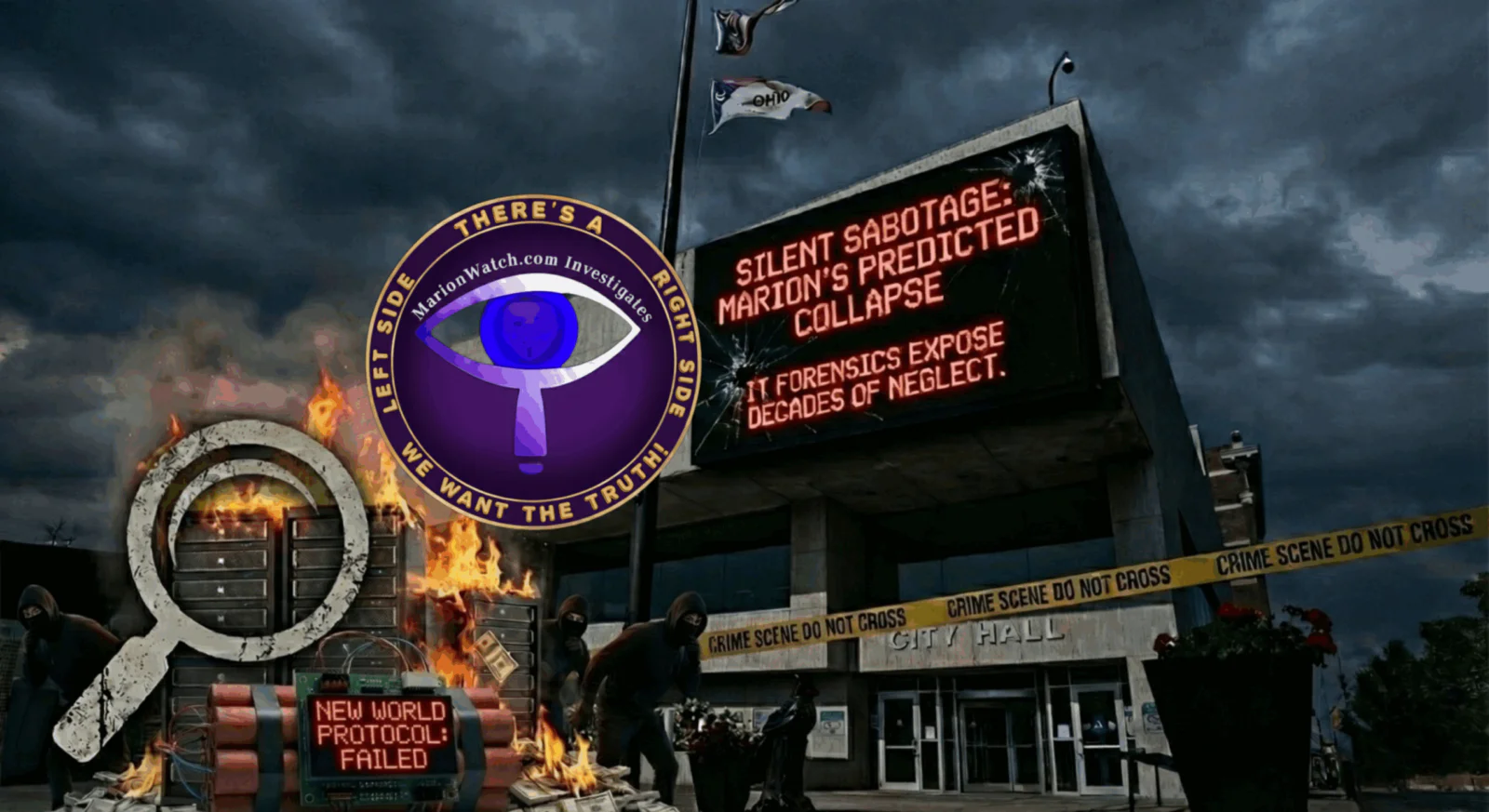
Worse, Marion City—currently under “fiscal caution” by the Ohio Auditor of State largely due to another rushed implementation and obviously intentional misconfiguration of the New World software system—is now faced with the prospect of footing the bill for a surveillance network that was originally promised to be covered by grant monies.
This pattern of administrative haste and fiscal instability suggests that the city is once again prioritizing rushed and largely unvetted digital “solutions” over the constitutional rights and financial health of its taxpayers.
The 30-Day Deletion Myth: Data Persistence and the Infinite Archive
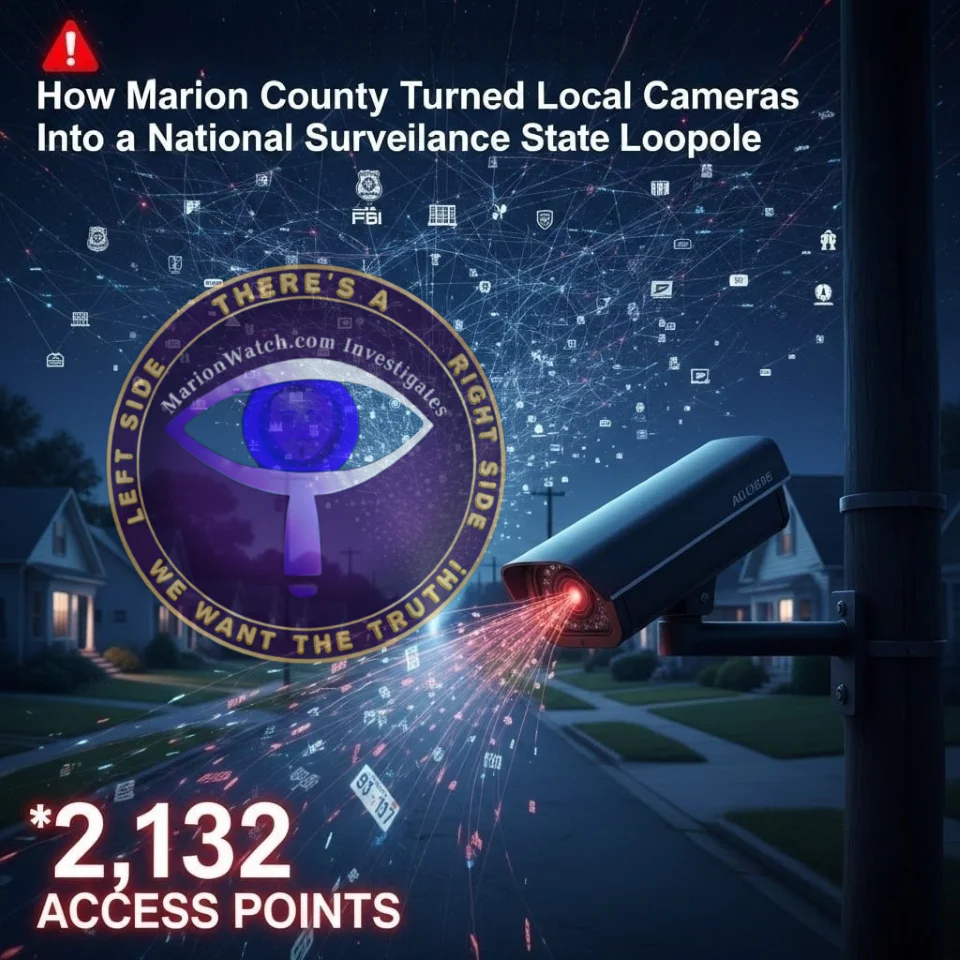
A central pillar of the MPD’s justification is the claim of a 30-day data retention policy. In the world of modern IT, “deletion” is a comforting bedtime story. Unless rigorous, forensic-level “zeroing” procedures are utilized, data within a cloud-integrated network (hosted on infrastructure like AWS or Azure) persists far beyond the 30-day window.
- The Persistence of Backups: Standard cloud redundancy involves “snapshots.” A record of your movement backed up on day 29 lives on in a secondary archive long after it vanishes from the police dashboard.
- The “Indefinite” Federal Loophole: Once data is shared via the TALON Network, Marion’s 30-day clock becomes irrelevant. If any of the 2,000+ outside agencies—including the ATF, DEA, or FBI—flag a record for a federal “investigation,” that data is moved to their internal servers and can be retained indefinitely. Any actor with access can “scrape” Marion’s data daily, building a permanent, private database that the City of Marion has no power to purge.
The Engineering of Deception: Performance vs. Integrity
A critical deception in the public discourse surrounding this technology is the conflation of stress testing with security audits. In testimony to the Council, Flock representatives used these terms interchangeably to create a false sense of safety.
- Stress Testing (Performance): Measures if the hardware can maintain a cellular link during a blizzard. It is a measure of reliability, not security.
- Security Audits (Integrity): Measures if the data is encrypted or if a hacker can bypass the login screen.
A camera that remains online during a storm (stress-tested) but leaks its live feed to the open internet (security failure) is a public liability. By grouping these, Flock creates the illusion that a “reliable” system is an “impenetrable” one.
Exposed: Examples of Known IT and Physical Security Vulnerabilities
Investigations into 2026 have exposed deep-seated flaws in the Flock architecture that make Marion’s data a target for bad actors:
- The Condor Live-Stream Exposure (January 2026): Researchers discovered Flock’s advanced Condor cameras broadcasting live and archived footage to the open internet without password protection, allowing anyone with a browser to watch Marion’s private feeds.
- The “Raven” Physical Exploit: An actor with 30 seconds of physical access to a pole-mounted device can force it into a “debug mode,” generating a local Wi-Fi hotspot that grants direct access to internal software.
- Hardcoded Passwords (CVE-2025-59407): In late 2025, it was revealed that Flock’s applications contained a hardcoded password (
flockhibiki17) for its internal Java Keystore, allowing attackers to extract private keys and access data.
“Snooping” and the 2,000-Agency “Side-Door”
The MPD claims data sharing is a “local decision,” but the TALON Network is a side-door for mass federal overreach. Agencies ranging from the U.S. Air Force to the National Park Service have been documented accessing local camera data millions of times nationwide.
This system facilitates “Vehicle Fingerprinting,” which identifies unique profiles based on bumper stickers, roof racks, and damage. This allows law enforcement to “snoop” on political or religious views. Investigative logs show over 50 agencies have searched for vehicles at protests—including “No Kings” and “Hands Off” movements—using only the word “protest” as justification.
Constitutional Erosion and Documented Abuse
Legal experts argue this violates the “Mosaic Theory” of the Fourth Amendment. In a 2025 Warrensburg, MO case, a driver was tracked 526 times in four months. The human cost of this infrastructure is already visible:
- Stalking: Police chiefs in Kansas and Wisconsin have been criminally charged for using Flock to track ex-girlfriends; one tracked a woman 228 times in four months.
- Abortion Tracking: In 2025, Texas deputies used a nationwide search across 83,000 cameras to track a woman for a self-managed abortion, bypassing privacy rules by falsely labeling the search as a “missing person” query.
The Verdict: A Legacy of Digital Shadows
Marion is witnessing the birth of a “Mosaic” society—a world where the government no longer needs a warrant to map your politics, your health, or the intimate rhythms of your life. By aggregating the digital shadows left behind on the asphalt, this architecture ceases to be a shield for the innocent and becomes a data-driven cage, turning every citizen into a permanent person of interest. If this infrastructure remains unchecked, we are not merely losing our privacy; we are losing the very essence of what it means to be a free people in an open society. The asphalt now has eyes, and the government has the memory of an elephant.
To mitigate this overreach, Marion Watch formally suggests that if the city persists with its Flock Safety contracts, the administration must immediately shift oversight of the system. Control and auditing authority should be stripped from the agencies currently managing the data and placed under the IT Oversight Committee, chaired by Ralph Smith. Only through rigorous, independent technical vetting and transparent civilian governance can we hope to prevent this “digital fence” from becoming a permanent instrument of administrative and constitutional abuse.

Works Cited (Click Here)
- Marion City Council. Official Committee Meeting: Testimony of Flock Safety and MPD Chief. March 16, 2026. https://www.youtube.com/live/a3DJ21zS7jw.
- NIST/MITRE. CVE-2025-59407: Hardcoded Password in Flock Safety Application. Oct 2, 2025.
- Cyber Security Intelligence. Flock Safety Data Exposure Reveals Surveillance Targets. Jan 15, 2026.
- Palo Alto Daily Post. Federal agencies (ATF, GSA, Air Force) improperly accessed city’s Flock camera data. Jan 31, 2026.
- Electronic Frontier Foundation (EFF). The Problem with “Delete”: Why Surveillance Data Often Persists. Feb 12, 2026.
- University of Washington Center for Human Rights. Leaving the Door Wide Open: Flock Surveillance Systems and Immigration Enforcement. Oct 21, 2025.
- Warrensburg, MO Case Records. Police cameras tracked one driver 526 times, lawsuit says. 2025.
- The Marshall Project. Police Misuse of Flock Surveillance. March 7, 2026.
- Avitar Legal. Flock Safety and ALPR: Mass Surveillance, Discrimination, and Privacy. 2025.
- Marion Watch Silent Sabotage Series on New World and Finance: https://www.facebook.com/share/p/17DmbHGXDt/