


 Written by
On a brisk Tuesday night, the atmosphere inside the Marysville town hall felt less like a routine civic assembly and more like the war room of a besieged community. Citizens from across Union and Marion counties gathered to confront a rapidly metastasizing industrial reality: the explosion of hyperscale data centers. While attempts to broadcast the proceedings live to the wider public faced hurdles, the message inside the room was unmistakable. Rural and suburban communities are finding themselves on the front lines of a national crisis, pitted against trillion-dollar tech conglomerates in a battle for local autonomy, water security, and public health.
The proliferation of these digital warehouses—driven by the insatiable demands of artificial intelligence and cloud computing—has transformed the American landscape. But behind the promises of the “Silicon Heartland” lies a darker narrative of deceptive corporate practices, alarming pathophysiological health impacts, and a regulatory framework that is willing to sacrifice decades-old environmental protections for the sake of Big Tech.
This extensive investigation explores the hidden costs of the data center boom, revealing the corporate “shell game” used to secure land, the strategic clustering that strains local grids, and the severe biological toll exacted upon the residents left living in the shadow of the cloud.
The Strategy of the Cluster: Creating Industrial Sacrifice Zones
To understand the scale of the threat, one must understand the developers’ primary geographic strategy: Clustering.
Tech giants like Amazon, Google, Meta, and Microsoft do not build data centers in isolation; they concentrate them in specific, dense geographic “alleys.” While regions like Loudoun County, Virginia, have historically borne the brunt of this—housing an infrastructure density that now consumes nearly a quarter of the state’s total electricity—this clustering model is rapidly migrating to the Midwest.
Developers prefer these clusters for several strategic reasons that almost universally conflict with residential well-being:
- Infrastructure Synergy: By targeting areas with existing high-capacity electrical grids, high-pressure natural gas lines, and robust fiber-optic backbones, developers avoid the multi-billion-dollar capital costs of laying new infrastructure. They effectively “piggyback” on resources originally intended for residential and agricultural growth.
- Latency Demands: As artificial intelligence transitions from background training to real-time “inference”—powering everything from instant algorithmic trading to autonomous driving—physical proximity to major population centers is a technical necessity to reduce the milliseconds it takes for data to travel.
- Regulatory Momentum and “Industrial Creep”: Once a local government approves the first facility, a legal and political precedent is set. This makes it exponentially easier for developers to fast-track subsequent facilities. The result is an industrial creep that steadily devours prime farmland, surrounding quiet neighborhoods with windowless, 75-foot-tall concrete monoliths.
The fallout of this clustering is cumulative and devastating. In Virginia, the sheer density of data centers is forcing utility providers to double their electricity generation, potentially increasing residential power bills by up to 50% to cover the multi-billion-dollar costs of high-voltage transmission line upgrades. In Omaha, Nebraska, the massive energy demands of a single Meta campus forced local utilities to postpone the retirement of two coal-fired power plants, keeping major localized sources of carbon and particulate emissions active.
The Veil of Secrecy: Deceptive Practices and the Corporate “Shell Game”
Perhaps the most glaring issue raised at the Marysville town hall was the pervasive lack of transparency. The expansion of these hyperscale clusters relies heavily on a nationwide pattern of corporate masking designed to bypass public scrutiny, stifle opposition, and secure land at sub-market rates.
The NDA Barrier The primary weapon in this arsenal of secrecy is the Non-Disclosure Agreement (NDA). Local elected officials, from county commissioners to city planning boards, are frequently pressured into signing strict NDAs as a mandatory prerequisite for early negotiations. These agreements effectively “blindfold” the public, creating an information vacuum where vast amounts of public resources, zoning changes, and infrastructure commitments are negotiated in the dark.
Jerome Township Trustee Wezlynn Davis—who notably stands as the only current candidate for Ohio’s 86th House District who actually owns her own property and accepts no money from big tech and other big money—has been a fierce vocal opponent of this practice. As highlighted by Davis and other local leaders during the town hall, when public servants’ hands are legally tied by corporate secrecy, genuine community engagement becomes impossible. Residents are routinely blindsided, learning of massive industrial developments only when annexation letters arrive in the mail or bulldozers appear on neighboring farmland.
Shell Corporations and Deceptive Acquisitions
Compounding the secrecy of NDAs is the widespread use of Limited Liability Companies (LLCs) with nondescript names to hide the involvement of Big Tech. When a company with limitless capital negotiates openly, landowners demand fair market value, and environmental watchdogs can scrutinize the corporation’s track record. To circumvent this, tech giants use proxies.
In New Albany, Ohio, a virtually unknown entity called “Sidecat LLC” requested and received a 100% property tax abatement for 15 years. Only after the deal was sealed was it revealed that Sidecat was a front for Meta. Similarly, in the Columbus area, “Mellan Enterprises LLC”—which filed heavily redacted air quality permits for massive backup generators—was eventually unmasked as Google. This shell game prevents communities from accurately assessing the environmental footprint of the incoming developer until it is far too late to object.
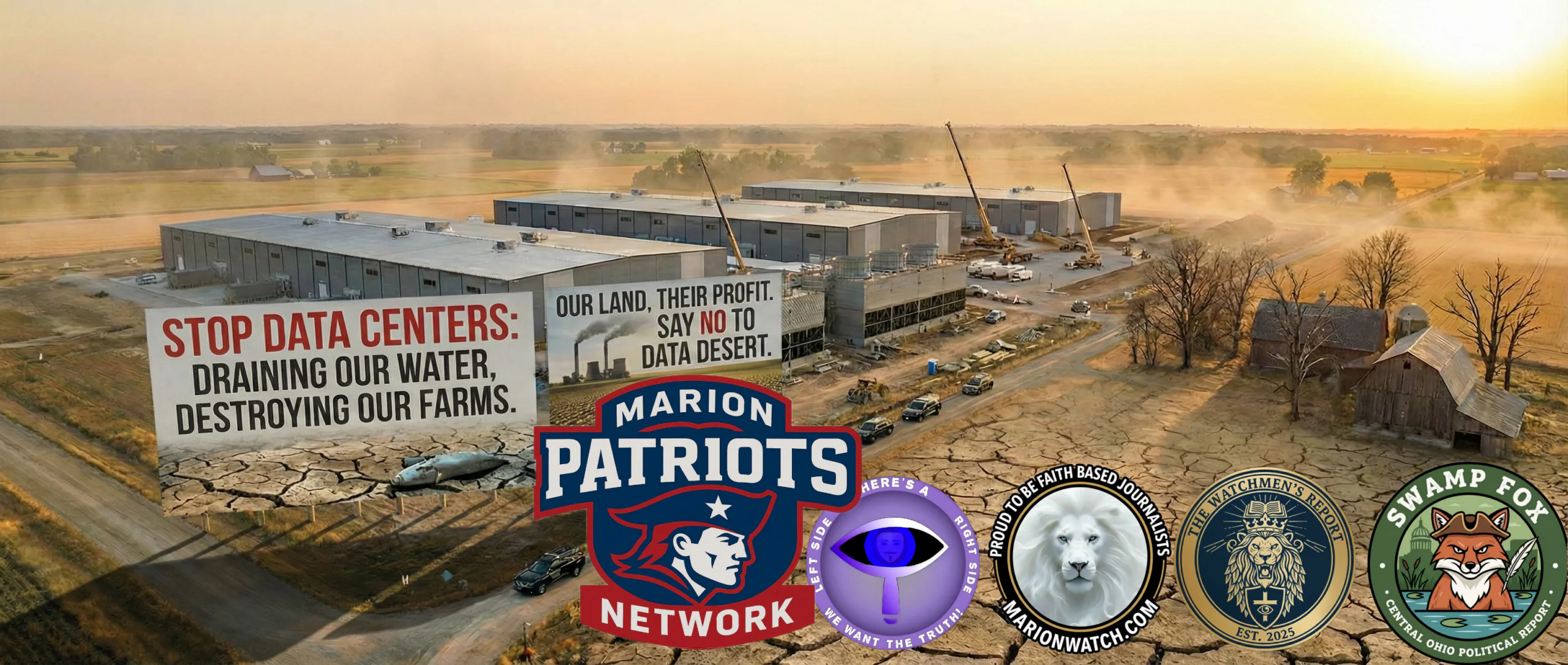
The Economic Mirage
Developers routinely market these facilities as massive economic drivers that will bring hundreds of high-paying tech jobs. The reality is remarkably different. An analysis of the industry reveals that a hyperscale data center, despite costing billions to construct and receiving millions in local tax abatements, typically employs fewer than 50 permanent workers. The vast majority of these roles are low-wage security and facilities maintenance positions, while the lucrative engineering jobs remain centralized at corporate headquarters out of state.
The “Preferred” Cooling Paradigm: Prioritizing Profit Over Preservation
A critical distinction discussed at the town hall involved the methods used to keep millions of computer servers from overheating. Industry representatives frequently boast about their use of “preferred cooling” methods, primarily Direct Evaporative Cooling (DEC). They market this as an environmentally conscious choice because it utilizes less electricity than traditional mechanical air conditioning. However, the true reason it is “preferred” is far more cynical: it is significantly cheaper to build.
Evaporative cooling—often referred to as “swamp cooling”—operates by drawing warm air through water-saturated pads. The water absorbs the heat and evaporates, cooling the air. While this method reduces the facility’s electrical load, it requires an astronomical volume of water. A single hyperscale facility can evaporate anywhere from 1 million to 5 million gallons of freshwater every single day.
This is water that is lost to the atmosphere as steam; it is not treated, it is not recirculated, and it is not returned to the local municipal supply. By opting for the “cheaper” capital expenditure of evaporative systems, developers are effectively shifting the burden of resource scarcity from their corporate balance sheets directly onto the community’s water supply.

Greener Alternatives Exist
More environmentally responsible technologies are readily available, though developers resist them due to higher upfront costs.
- Closed-Loop Liquid Cooling: Circulates a fixed amount of coolant through sealed pipes, chilling and reusing it indefinitely rather than evaporating it. This method virtually eliminates the daily consumption of municipal water.
- Direct-to-Chip Liquid Cooling: Places small cold plates directly on the hottest server components, allowing systems to rely on simple outdoor radiators (dry cooling).
- Two-Phase Immersion Cooling: Submerges entire server racks in a non-conductive dielectric fluid that boils, rises, and condenses in a continuous, highly efficient cycle that wastes neither water nor massive amounts of electricity.
Water Security: Toxic Runoff and the Regulatory Race to the Bottom
The reliance on massive water withdrawals poses an existential threat to the agricultural heritage and residential water security of regions like Union and Marion counties. The consequences extend far beyond simple scarcity; they present severe, documented public health risks.
Aquifer Depletion and Heavy Metal Concentration
When data centers pull millions of gallons of water from the ground, they create a massive cone of depression in the aquifer. This rapid drop in the water table alters the subterranean hydrology. As the volume of water decreases, naturally occurring heavy metals in the sediment—most notably Arsenic and Fluoride—become highly concentrated in the remaining water supply. Arsenic is a proven human carcinogen that disrupts DNA repair mechanisms, and chronic exposure through well water is directly linked to an increased risk of skin, lung, and bladder cancers.
The Ohio EPA’s Dangerous Concession
Perhaps the most alarming revelation regarding water security is the ongoing regulatory capitulation at the state level. As highlighted by environmental advocates, the Ohio Environmental Protection Agency (EPA) is currently advancing a general wastewater permit specifically tailored for data centers. The language of this permit explicitly states that it has been determined that a “lowering of water quality” in various state waters is “necessary to accommodate important social and economic development.”
This is a staggering admission. The state is legally paving the way for data centers to dump thousands of gallons of industrial wastewater—often laden with anti-scaling chemicals, corrosion inhibitors (like copper and zinc), and biocides used to prevent algae growth in cooling towers—directly into local rivers and streams.
This policy regression is occurring against a backdrop of water quality standards that have not seen a comprehensive update since the 1970s. The Clean Water Act framework currently in use is nearly 50 years out of date, failing to account for modern health science regarding the bioaccumulation of modern industrial chemicals and trace pollutants. Lessening these already archaic protections to accommodate Big Tech represents a severe abdication of public health responsibility. As noted by farmers at the town hall, local watersheds like the Darby Creek—home to sensitive freshwater mussels that act as the “canary in the coal mine” for pollution—are in immediate jeopardy of ecological collapse.
The Invisible Threat: Acoustic Hazards and Vibroacoustic Disease
While the visual blight and water consumption of these facilities are glaring, the most insidious health threat discussed at the town hall is entirely invisible.
Data centers are not quiet neighbors. To prevent catastrophic server failure, massive arrays of industrial cooling fans operate at maximum capacity 24 hours a day, 7 days a week, 365 days a year. This creates a relentless, droning “industrial buzz.” But the true danger lies beneath the audible spectrum.
The Pathology of Infrasound
These facilities emit incredibly high levels of Low-Frequency Noise (LFN) and Infrasound—acoustic pressure waves that fall below 20 Hertz. While human ears cannot register these frequencies as “sound,” the human body absolutely feels them as pressure. Unlike high-frequency noise, which is easily blocked by insulation or walls, infrasound wavelengths are massive. They pass effortlessly through solid concrete, residential siding, and human bone.
Neighbors of data center clusters in Virginia and Arizona report feeling a constant “vibration” in their chests, likening the sensation to an idling locomotive or a spaceship hovering just outside their homes.
Vibroacoustic Disease (VAD)
Prolonged exposure to these low-frequency pressure waves triggers a specific, clinically recognized physiological response known as Vibroacoustic Disease (VAD). VAD is a systemic, whole-body pathology characterized by the abnormal proliferation of extra-cellular matrices—specifically collagen and elastin.
Peer-reviewed medical literature confirms that chronic exposure to LFN causes pericardial thickening (the abnormal thickening of the sac surrounding the heart) and the stiffening of blood vessel walls. Crucially, this cardiovascular damage occurs without the presence of an inflammatory response, making it a unique mechanotransduction injury caused directly by acoustic resonance.
Neurological Disruption and Chronic Stress
The effects of infrasound on the central nervous system are equally severe. The constant bombardment of pressure waves disrupts the body’s HPA axis—the primary system responsible for managing stress. This results in chronic neuroinflammation, vestibular disturbances (vertigo and nausea), cognitive impairment, and severe sleep fragmentation. Residents report that “acoustic anxiety” takes over their lives, and because the vibrations are felt internally, earplugs and noise-canceling headphones offer zero relief.
Furthermore, the thousands of diesel backup generators required to ensure these clusters never lose power pose a secondary, massive respiratory threat. Routine testing of these generators releases massive plumes of fine particulate matter (PM2.5) and nitrogen oxides. Nationwide studies have attributed thousands of annual asthma cases and severe respiratory distress events directly to the diesel emissions emanating from data center campuses.
Conclusion: Reclaiming Local Autonomy
The Marysville town hall pulled back the curtain on an industry that thrives in the shadows. The expansion of the “Silicon Heartland” is currently being built upon a foundation of corporate deception, the depletion of irreplaceable water resources, and the willing degradation of public health and regulatory standards.
By prioritizing cheap evaporative cooling over sustainable closed-loop systems, developers are ensuring that local taxpayers and farmers subsidize the cost of the AI boom with their aquifers. By pushing state agencies to lower water quality standards that are already half a century out of date, the regulatory framework is signaling that corporate data storage is more vital than clean drinking water. And by ignoring the severe, proven pathophysiological impacts of infrasound and vibroacoustic disease, communities are being subjected to a slow-motion public health crisis.
The fight against unchecked data center expansion is no longer just about zoning or property values; it is a fundamental battle for transparency, environmental preservation, and the basic right to live in a community free from industrial harm. As civic organizations and investigative watchdogs continue to expose the dark side of the cloud, the mandate for state and local governments is clear: the era of NDAs, shell companies, and environmental concessions must end.
Works Cited (Click Here)
1. Wezlynn Davis Data Center Awareness Town Hall
- Date: February 19, 2026
- Relevance: This primary source provides the foundational eyewitness accounts, community organizing strategies, and local testimony regarding the Marysville and Union County data center crisis. It details the use of NDAs by local officials, community concerns over noise, and the “Avengers” strategy of grassroots advocacy against hyperscale developers.
- Full URL: https://www.youtube.com/watch?v=zNSHep20NQg
2. Exposing The Dark Side of America’s AI Data Center Explosion | View From Above
- Date: September 12, 2025
- Relevance: This investigative report by Business Insider maps the nationwide explosion of data centers and the deceptive practices of “shell” LLCs. It provides critical data on the severe water stress caused by evaporative cooling in regions like Arizona, the electricity strain in Virginia, and the immense carbon footprint of backup diesel generators.
- Full URL: https://www.youtube.com/watch?v=t-8TDOFqkQA
3. Data Center Infrasound: The Hidden Health Threat
- Date: 2025 (Referenced throughout town hall discussions)
- Relevance: This video details the specific physical threat posed by data center cooling fans, establishing the difference between audible noise and the dangerous, low-frequency infrasound that causes structural vibrations in nearby homes and triggers biological stress responses.
- Full URL: https://www.youtube.com/watch?v=_bP80DEAbuo
4. Ohio EPA: Draft General NPDES Permit for Discharges from Data Center Facilities (Permit No. OHD000001)
- Date: October 31, 2025 (Public Comment Period through January 2026)
- Relevance: This official regulatory document corroborates the state’s move to fast-track wastewater permits for data centers. Crucially, it documents the Ohio EPA’s controversial stance that “lowering of water quality” is necessary to accommodate economic development, allowing facilities to bypass standard, site-specific environmental reviews.
- Full URL: https://epa.ohio.gov/divisions-and-offices/surface-water/permitting/wastewater-discharges-from-data-centers–general-permit
5. Liquid versus Air: Life Cycle Carbon of Cooling Down AI Data Centers
- Date: June 11, 2025
- Relevance: Published via Harvard University’s DASH repository, this academic study provides the comparative data between “preferred” evaporative air cooling and closed-loop liquid cooling. It proves that transitioning to liquid systems could reduce operational carbon emissions by up to 50% and achieve near-zero water usage, highlighting developers’ prioritization of cheap CapEx over environmental sustainability.
- Full URL: https://dash.harvard.edu/entities/publication/17f98966-8598-4453-a51f-1349bcb5056f
6. Vibroacoustic Disease: Biological Effects of Infrasound and Low-Frequency Noise Explained by Mechanotransduction Cellular Signalling
- Date: January 2007 (Cited extensively in 2025/2026 public health reviews)
- Relevance: Published in Progress in Biophysics and Molecular Biology, this foundational, peer-reviewed medical study outlines the pathophysiology of Vibroacoustic Disease (VAD). It provides the medical evidence that chronic exposure to infrasound (0-20 Hz) causes mechanotransduction injuries, including the abnormal thickening of the pericardial sac and blood vessels without inflammation.
- Full URL: https://pubmed.ncbi.nlm.nih.gov/17014895/